Villard Dolmen: A Prehistoric Burial Chamber in France
Site at a Glance
- Popularity
- Very Low
- Country
- France
- Primary era
- Stone Age
- Eras represented
- Stone Age, Bronze Age
- Civilizations
- Unclassified
- Site type
- Burial
- Remains
- Tomb
On this page11 sections
History
Prehistoric Use
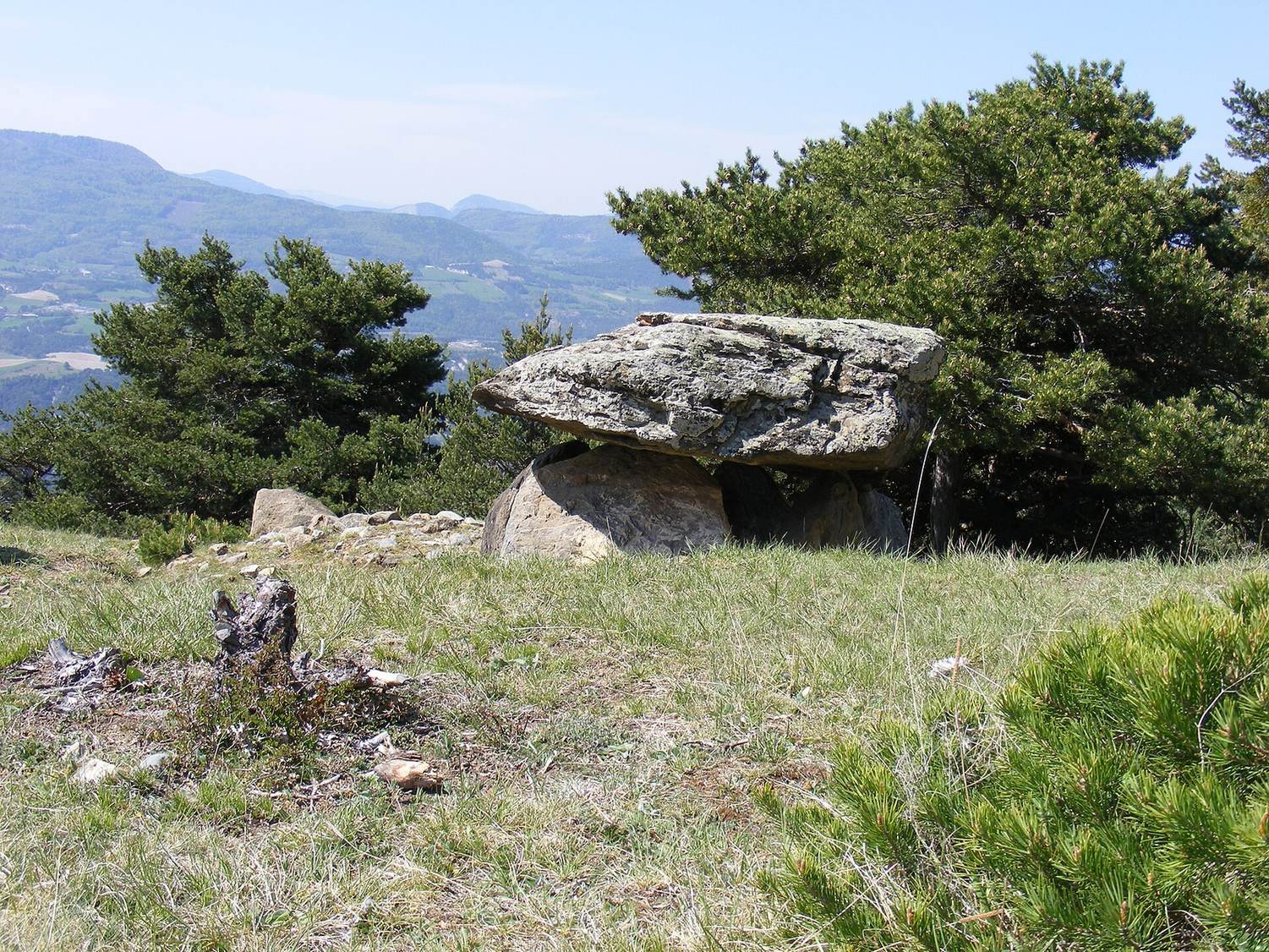
Villard dolmen is a prehistoric megalithic burial chamber, formed from upright stones supporting a large covering slab, in Le Lauzet-Ubaye, France. It was used during the Late Chalcolithic, or Copper Age, and reused in the Middle Bronze Age, a later subdivision of the Bronze Age. Burials were placed successively as whole bodies directly on the chamber floor. The dolmen is the only preserved example in this part of the Alps; others in the area were destroyed during the nineteenth century.
Discovery and Archaeological Study
David Martin, a teacher in Gap, discovered the monument, and the prehistorian Gabriel de Mortillet first reported it in 1894. It received France’s historic-monument designation in 1900 and is owned by the commune. In 1950, E. Derbez, then the landowner and mayor, carried out a superficial excavation that recovered a few human bones. Gérard Sauzade directed four archaeological campaigns between 1980 and 1983.
Remains
The dolmen stands about 1,240 m above the village of Ubaye, on the southern slope of Pic de Morgon, which reaches 2,324 m. Its north-south alignment resembles that of Alpine dolmens, while its west-facing entrance and overall design associate it with the Provençal group. These are regional groupings distinguished by aspects of dolmen design and construction.
Burial Chamber
The rectangular chamber is bounded by six upright stones, each 0.80 to 1 m long, about 1.50 m high, and 0.20 to 0.30 m thick. Two slabs of similar dimensions form its end wall. A triangular capstone, 2 m long and 1.50 m wide, with a thickness of 0.30 to 0.60 m, rests on just three slabs. The floor combines a large, thin schist slab in the southeast, a smaller schist slab to the west, and gray marl brought in for the northern part. Stones fill the gaps between the floor and the upright slabs. The two end-wall slabs have collapsed, helping to preserve the archaeological layer inside.
Entrance and Passage
The entrance is only about 0.30 to 0.35 m high. Two triangular pillars stand at its northwest and southwest sides, each resting on its broadest base. A trapezoidal closure slab, 0.60 m high and wide and 0.10 m thick, was designed to sit on a green-schist threshold measuring 0.80 by 0.35 m; another slab partly obstructs access. The passage faces west at 270 degrees, extends 1.50 m, and is up to 1.10 m wide. Six upright stones form two parallel rows of three, decreasing in height from 0.90 m at the entrance pillars to 0.35 m. The passage stops short of the mound’s edge and was filled with stone blocks. About sixty human and animal bones, along with a pottery sherd, were found in spaces between the blocks.
Mound
Only the western part of the mound remains visible, made up of large blocks piled irregularly. Its southern and eastern sections were taken apart because they obstructed farming, and their removal caused the dolmen to subside partly.
Excavated Evidence
Evidence of Burning
The dolmen was built over an earlier burned area about 9 to 10 m across. Gérard Sauzade proposed that the fire may have prepared the place through purification or consecration before the tomb was installed, or may instead have resulted from clearing the land. Charcoal inside the chamber and burn marks on some bones suggest that a fire was also lit within the dolmen.
Burial and Animal Remains
The chamber may have held the remains of about twenty people, including several young individuals. Excavations recovered four skulls and more than fifteen groups of bones still joined together. Animal remains include teeth from cattle, dogs, sheep or goats, pigs, bears, and rabbits; forearm bones from dogs and foxes; and long bones from dogs and sheep or goats. The remains do not all represent deliberate deposits. Two cattle vertebrae found joined together on the stone mound appear to have been placed there as an offering.
Objects
The excavations yielded twenty-three pottery fragments, five bearing chevrons and triangles made by comb impressions. Other finds include an archer’s armguard, a copper dagger, circular segments, and a boar’s tusk made into a pendant. Beads of bone and limestone include olive-shaped, disk-shaped, and cylindrical forms. Flint tools comprise seven flakes and two small blades. Bronze objects include a spiral ring and a pin with a hooked head.