St Lythans Chambered Tomb: A Neolithic Burial Monument in Wales
Site at a Glance
- Popularity
- Medium
- Country
- United Kingdom
- Primary era
- Stone Age
- Eras represented
- Stone Age
- Civilizations
- Unclassified
- Site type
- Burial
- Remains
- Tomb
On this page4 sections
History
Neolithic construction and use
St Lythans Chambered Tomb is a prehistoric chamber tomb in Wenvoe, Cardiff, United Kingdom, built around 4000 BC during the Middle Neolithic, a prehistoric period associated with settled farming. It formed part of a chambered long barrow, an elongated burial mound. The tomb is classified as a Severn-Cotswold type, a regional category of chambered tomb.
Its purpose may have included both burial and communal or ceremonial gatherings. One possible funerary practice was to leave the dead exposed until decomposition, then transfer their bones into the chamber.
Later use, names, and preservation
The tomb served as an animal shelter in the early nineteenth century. A Welsh name associated with it, Gwâl y Filiast, translates as “The Greyhound Bitch’s Kennel.” Local legend holds that on Midsummer’s Eve the capstone turns three times and the stones travel to a nearby river to bathe.
The field is called Maes y Felin, or “The Mill Field,” and is also known as the Accursed Field, supposedly because it was infertile. Musician and writer Julian Cope suggested that the field’s name might derive from “Field O’Koeur”; another interpretation links it to the title of Culhwch and Olwen, a medieval Welsh Arthurian tale.
William Collings Lukis, a British antiquarian and archaeologist, carried out a minor excavation in 1875. Conservation work in 1992–93 covered eroded areas of the barrow with soil and turf, and Cadw, the Welsh Government’s historic-environment service, maintains the site. St Lythans is a scheduled monument, a legally protected archaeological site in Great Britain.
Remains
The tomb stands in the field of Maesyfelin, south of St Lythans Road, on ground that slopes gently northwest. It occupies the eastern end of a flat-topped earthen mound about 27 metres long and 11 metres wide. The chamber is classified as a Severn-Cotswold type of chambered tomb.
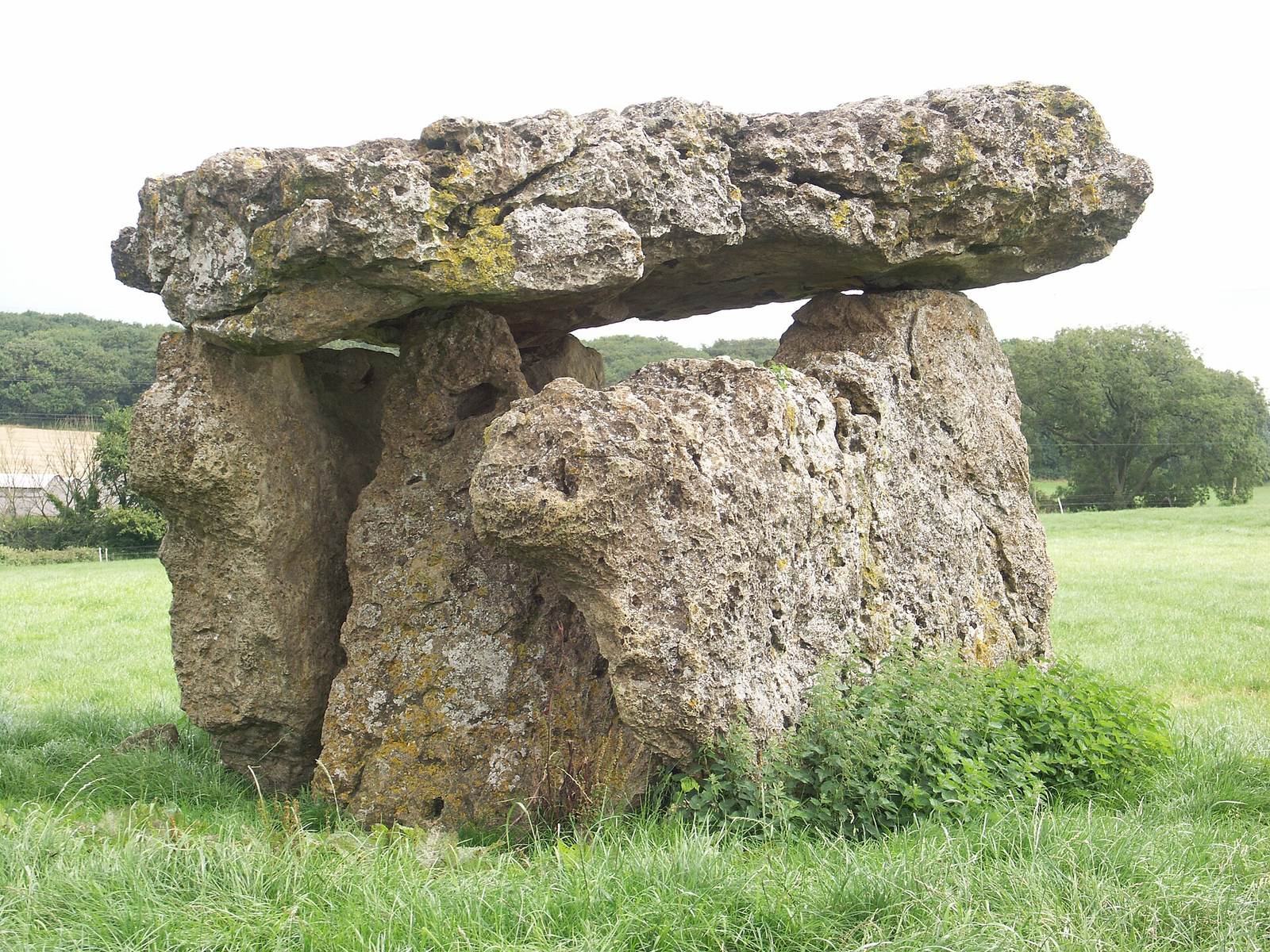
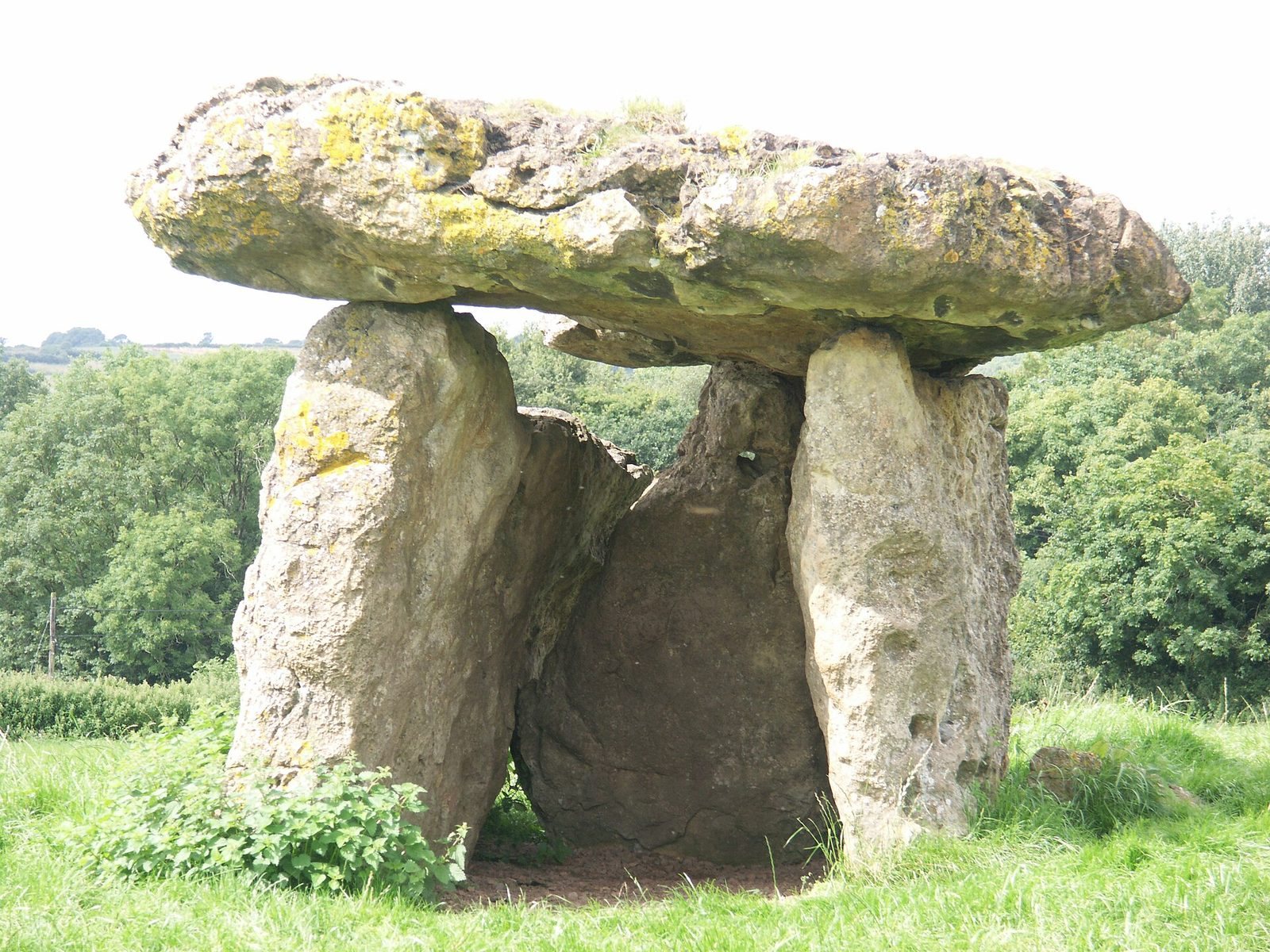
Three upright mudstone slabs support a broad, flat capstone. The two rectangular side stones have smooth inner faces, while the triangular rear slab has a hole near its top. The chamber runs east to west, with its entrance facing east, and reaches at least 1.8 metres in internal height. The capstone slopes from southeast to northwest and measures about 4 metres long, 3 metres wide, and 0.7 metres thick. The stones were probably available locally.
A forecourt probably stood just outside the entrance, and earth and smaller stones may once have covered the chamber. Erosion or removal of this material left the mound much lower than its earlier form. Because the chamber is unusually tall, its capstone may never have been completely covered. Human remains and coarse pottery were found in 1875 among debris from the chamber, which partly filled the hollow at the mound’s eastern end. Associated surface finds include a leaf-shaped flint arrowhead and part of a polished stone axe; both are held at St Fagans National History Museum in Cardiff.