Dolmen de la Devèze: A Prehistoric Burial Tomb in France
Site at a Glance
- Popularity
- Very Low
- Country
- France
- Primary era
- Stone Age
- Eras represented
- Stone Age, Bronze Age, Iron Age
- Civilizations
- Celtic
- Site type
- Burial
- Remains
- Tomb
On this page15 sections
History
The Dolmen de la Devèze is a prehistoric tomb southwest of Marcilhac-sur-Célé in the Lot department of France. Prehistorian Jean Clottes attributed its construction and use to either the Chalcolithic, or Copper Age, between the Neolithic and Bronze Age, or the Early Bronze Age.
Construction and burial
The mound’s sequence began with clearing and preparing the ground, followed by construction of the chamber and completion of the mound. After the burial chamber was used, its entrance was closed. The dolmen held multiple burials before it was violated and partly emptied at an unknown date. Bones and grave goods were discarded outside, while the deeper deposits were spared during this episode.
Reuse and investigation
The burial place was disturbed again during later reuse. In the Second Iron Age, the later phase of the Iron Age in French archaeological terminology, three graves were built into the mound. A subsequent violation may have damaged the dolmen’s capstone.
Jean Clottes and archaeologist Jean-Pierre Lagasquie excavated the monument in 1963 and 1964. Lagasquie returned for campaigns in 1992, 1993, and 1994 to examine the mound’s construction. Since 1997, the dolmen has been listed as a French historic monument under the name Dolmen de la Devèze-sud.
Remains
Chamber and mound
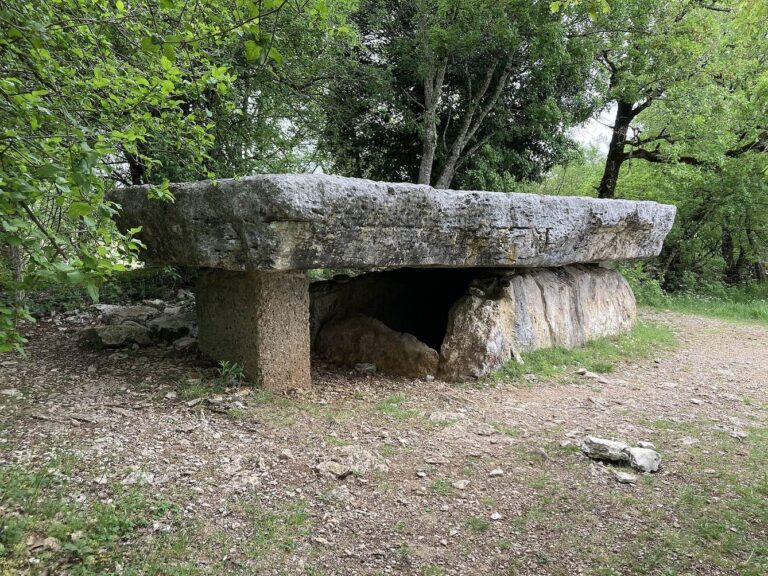
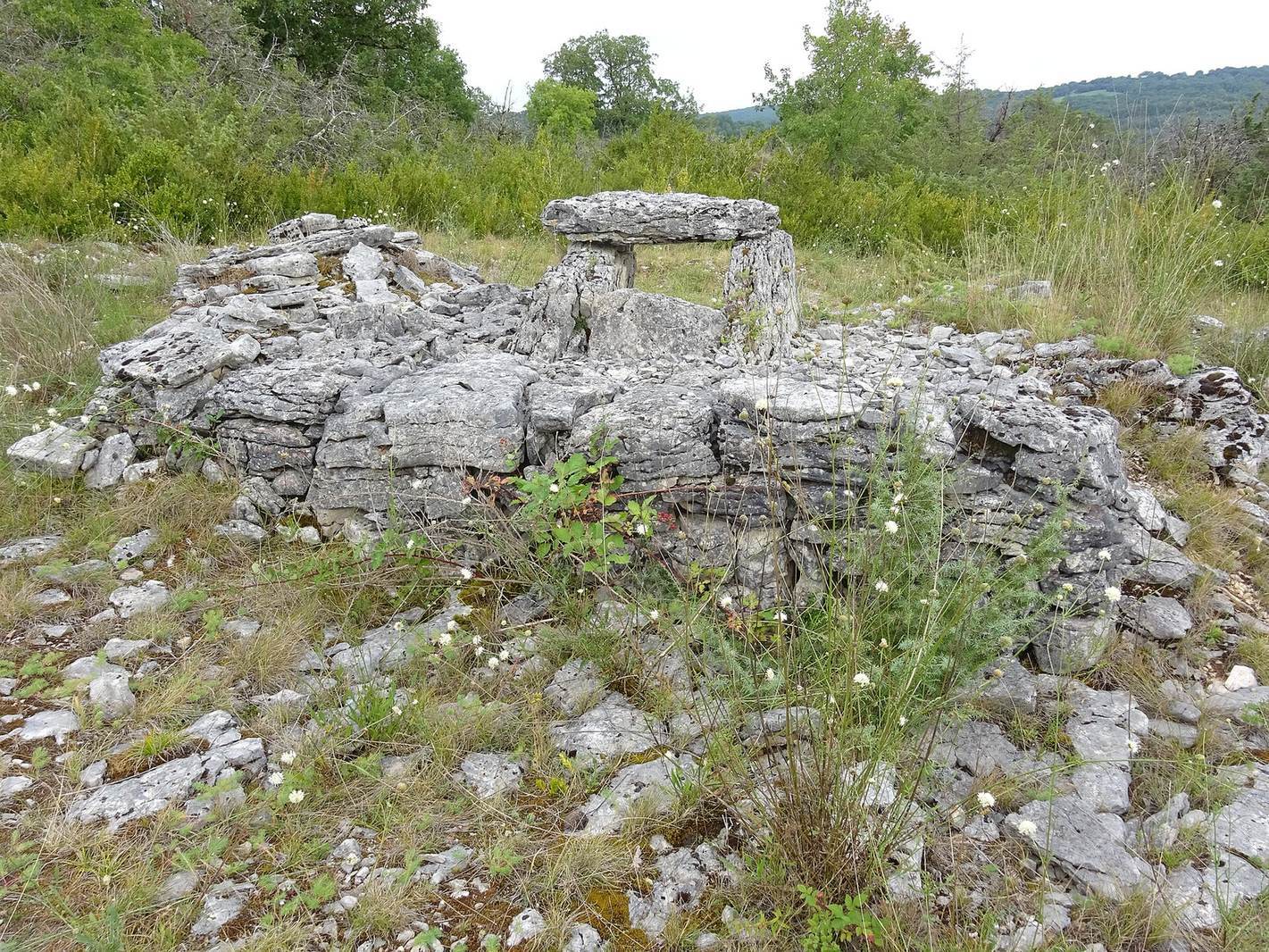
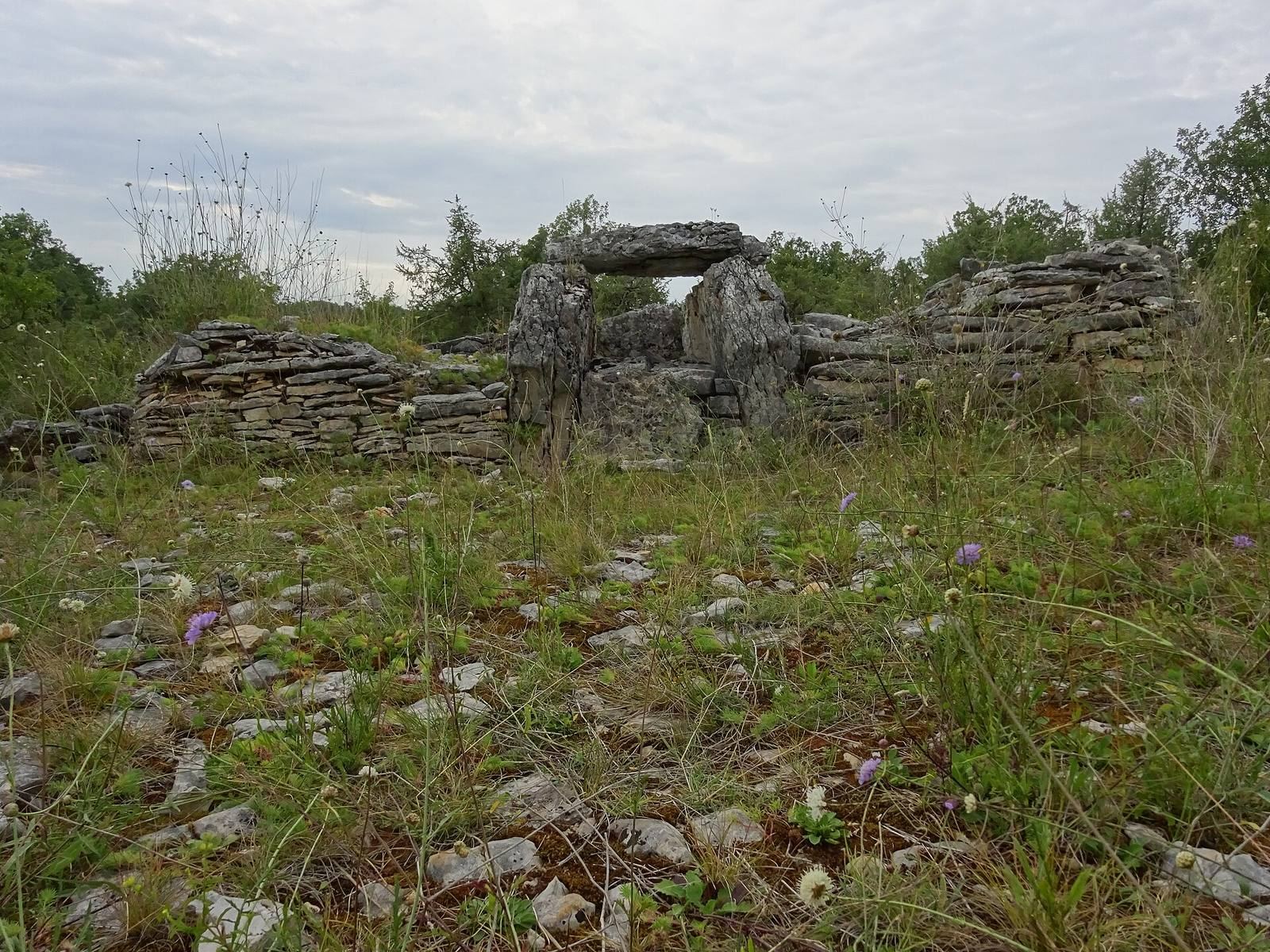
The small, simply built dolmen has a chamber formed by upright slabs and originally covered by a large capstone. It stands near a cliff above the Célé valley, close to a crossing. Its southeast-facing opening lies on an alignment of 140 degrees, in line with sunrise at the winter solstice. The floor is the natural limestone bedrock.
Burial chamber
The chamber slabs are relatively thin, reaching 2.25 metres in length and 1.35 metres in width. The two side stones rest at different levels: the left one was set deep in a natural hollow filled with clay, while the right one stands directly on bedrock. The entrance’s closure slab remains in place. Two large blocks nearby are thought to be fragments of the capstone.
Stone mound
The stone mound measures about 16 metres across and averages 1.4 metres in height, rising to 2.3 metres above its base. Flat slabs make up the fill near the chamber, within a roughly rectangular stone enclosure averaging 0.75 metres high. Within the enclosure, blocks of varied sizes were placed without an apparent pattern, with packing stones at the bases of the end slab and upright stones. On the mound’s sides, slabs were stacked regularly in overlapping, scale-like courses; earth and small stones accumulated in gaps.
Slabs used for the northeast side of the enclosure came from a lower limestone bed in the valley below the cliff. Other stones were collected on or very close to the site. Before building began, surface stones were cleared and kept for later use, and the ground was levelled slightly. About 10 centimetres of soil remained after this preparation.
Burial deposits and finds
Human remains
The disturbed deposits in the chamber reached 1 to 1.1 metres deep. Human remains were fragmented and dispersed. They included a complete hand, five vertebrae, and 420 teeth, representing an estimated 16 or 17 people.
Objects from the chamber
Finds include a small bronze ring fragment, a finely made notched javelin point of pink flint, white and pink flint flakes, and quartzite. Ornaments comprise 51 prism-shaped bone buttons drilled with V-shaped holes, 11 double-cone bone beads, 18 shell beads, nine calcite beads, four limestone beads, and three shell fragments. By count, the buttons form the third-largest such group recorded in France. Pottery fragments include black ware with a brown surface coating, reddish-brown ware, and grey ware with a red coating.
Finds from the mound
Objects recovered from the mound include a barbed arrowhead with a projecting base and assorted beads.
Later Iron Age graves
Grave in front of the chamber
The first grave lay in front of the chamber, at right angles to its central axis, about 0.3 metres below the mound surface. It was made as a stone-slab-lined grave. Collapsed blocks and human bone fragments surrounded it. The skeleton lay on its back with its hands crossed over the pubic area, and its main anatomical connections were intact. A fragment of a bronze brooch was found at chest level.
Grave at the southwest corner
The second grave lay at the chamber’s southwest corner, across the end of its left upright stone, with its stone lining close to the mound surface. The poorly preserved skeleton was on its back, hands crossed over the pubic area; its fractured and disordered bones included a tailbone inside the skull. Finds beneath the pelvis comprised a badly damaged bronze brooch and three feline canine teeth.
Grave beside the chamber
The third grave ran parallel to the chamber and used the dolmen’s right upright stone as one side of its stone lining. Its skeleton lay on its back with hands crossed over the pubic area. A piece of a bronze brooch was found near the mound’s surface.