Castro del Raso: A Vetton Fortified Settlement in Ávila, Spain
Site at a Glance
- Popularity
- Medium
- Country
- Spain
- Primary era
- Classical
- Eras represented
- Classical
- Civilizations
- Unclassified
- Site type
- Military
- Remains
- Fortified Town
On this page19 sections
History
Castro del Raso is a fortified hilltop settlement of the Vettones, an ancient people of the Iberian Peninsula, near El Raso in Ávila, Spain. Its main occupation lasted from the late 3rd century to the middle of the 1st century BC.
Before the hilltop settlement
People lived in the wider area as early as the late Bronze Age, though the location and chronology of the earliest settlement are uncertain. An unfortified community occupied lower ground at El Castañar before the hilltop settlement was established. El Castañar appears to have been destroyed by fire. A possible explanation is an attack by Carthaginian forces during Hannibal Barca’s campaign into the Iberian Plateau around 220 BC.
Following the destruction, people moved to the more defensible hill at Cabeza de la Laguna and established the Vetton settlement. The ancient name Ebora has been proposed for it, but that identification remains uncertain.
Vetton occupation and regional exchange
The settlement may have housed around 2,500 to 3,000 people. It had commercial connections with southern and eastern Iberia and wider Mediterranean regions. A historic route through western Iberia, the Vía de la Plata, may have passed nearby and connected the settlement with places including Cáceres, Villanueva de la Vera, Los Pajares, and Talavera la Vieja. Its course is uncertain; another proposed route ran by Medellín and the Guadiana. The settlement may also have helped distribute Phoenician weights toward the Iberian Plateau and Celtiberia.
Finds point to contacts with Castulo, Phoenician regions, pre-Roman Italy, and Greek communities in Attica. Iberian objects in some graves have been interpreted in different ways, including as evidence of military alliances, gift exchange, or the return of Iberian mercenaries. The earliest Roman objects found at the settlement date to the early 2nd century BC.
Roman conquest and later worship
Roman conquest and the pacification of the Iberian Plateau led to the forced abandonment of the hilltop settlement. The evacuation may have followed instructions from Julius Caesar, a Roman military and political leader. It appears to have been orderly and peaceful, with residents taking essential belongings. Roman forces then destroyed much of the settlement and disabled its walls. People moved down into the valley as the hilltop site was gradually abandoned, and a new settlement arose at the former El Castañar site.
A sanctuary dedicated to Vaelico, a deity associated with wolves, stood outside the settlement. After the conquest it was Romanized, adopting Roman customs and institutions, while worship continued there.
Excavation and protection
Fulgencio Serrano, a local resident, carried out early excavations in the first quarter of the 20th century. Juan Cabré Aguiló’s attempt to begin work in 1935 did not succeed, and Antonio Molinero resumed excavation in 1957, finding an Etruscan bronze figure. Fernando Fernández Gómez led systematic excavations from 1970 into the late 1980s. Work in the 1980s uncovered sectors A, B, and C; sector D was identified in the early 2010s. Two houses were restored for use as an interpretation centre. The site was declared an archaeological zone on 29 April 1994.
Remains
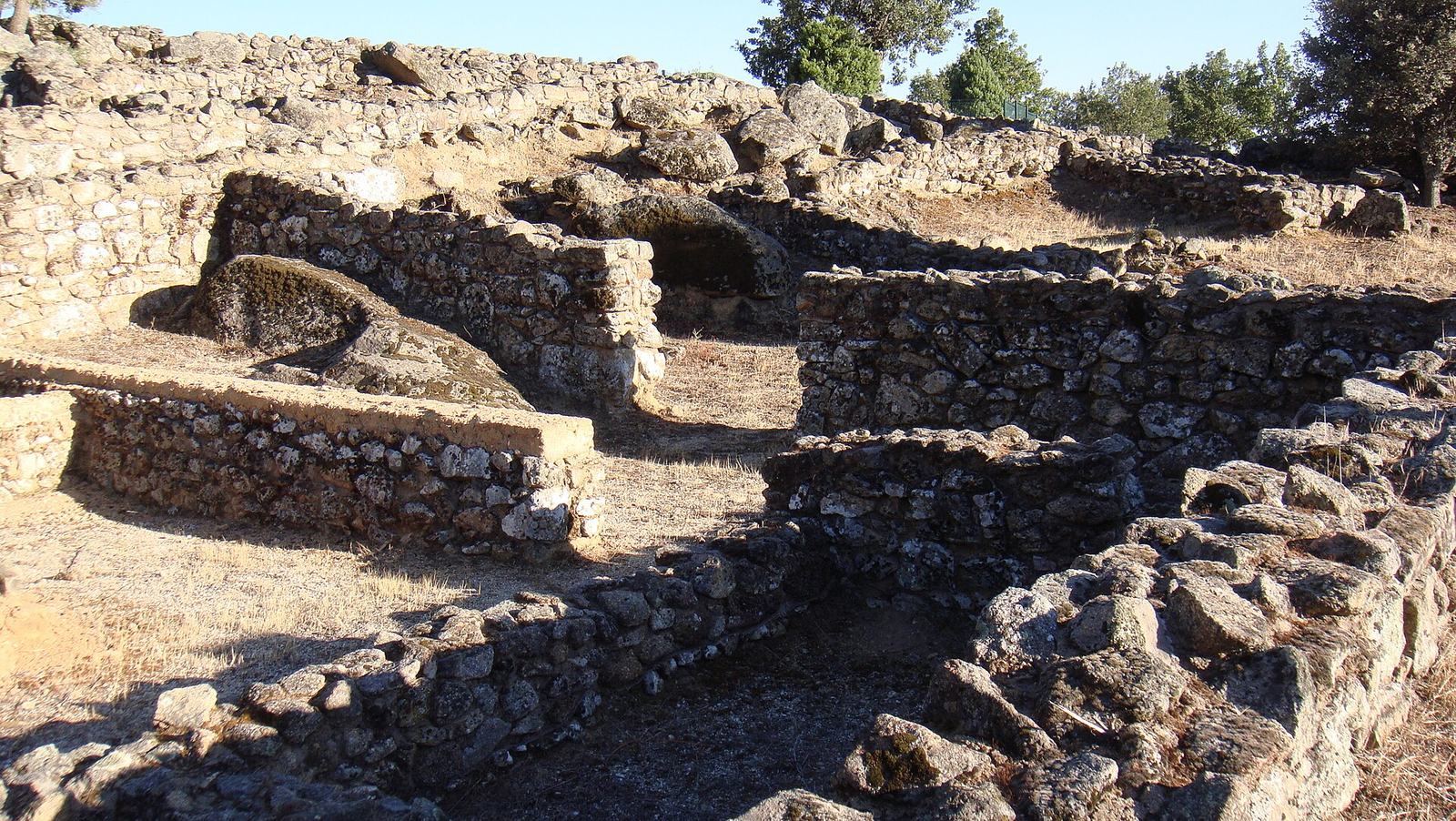
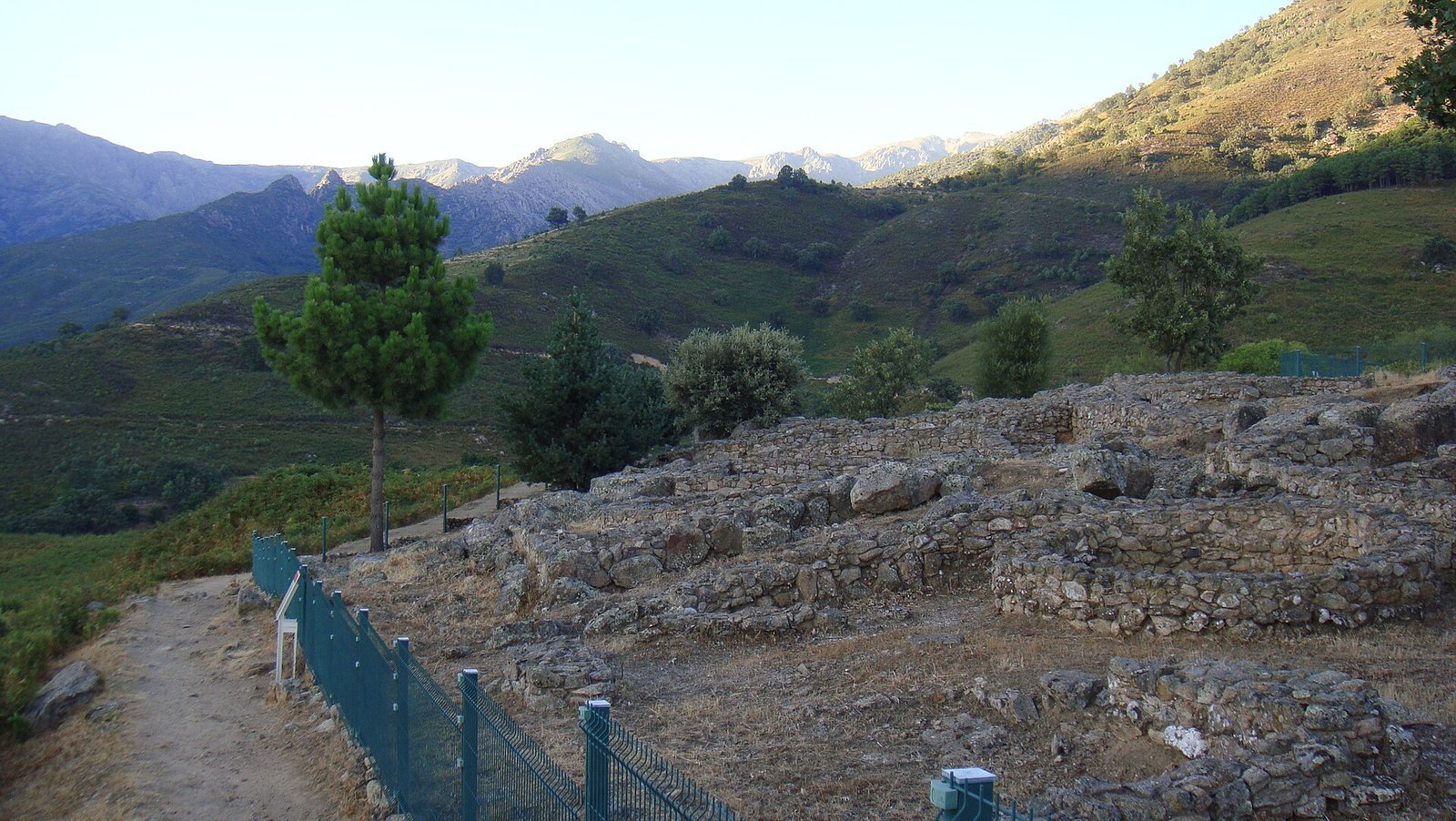
The site occupies a hill at El Freíllo, near El Raso, on the southern slope of the Sierra de Gredos, at about 790 m above sea level. It overlooks the Alardos gorge and the Tiétar valley. The gorge provided a natural defensive barrier, while the hill’s position gave access to lower ground and the mountain pastures. The humid mountain environment supports ferns and oaks. Covering about 20 hectares, the settlement comprises several walled areas, with at least three adjoining enclosures. Dense occupation followed irregular streets rather than a regular town plan.
Enclosures and defenses
The enclosing wall extends for about 2 km and is generally 2–3 m thick. It had one entrance, reinforcing towers, and bastions, projecting defensive platforms. A broad ditch lay outside the wall, and a barrier of upright stones may have stood in front of the settlement. A fort defended the summit, with two smaller forts at the highest point.
Houses and domestic activity
House plans and construction
Most houses measured about 50–100 m² and were quadrangular or rectangular. Their foundations were made of rubble stone, while the walls were built from adobe. The houses had no windows, and their pitched roofs used long, bound branches covered with straw, turf, or both. Brick floors are also recorded. In quadrangular houses, a central room held the hearth and kitchen, with other rooms around it, an entrance at the front, and a pantry at the rear. Rectangular houses had a central kitchen, courtyard, front porch, and rooms arranged one behind another. Some plans show a central hearth and bench with other rooms grouped around them.
Household and craft areas
Some houses had an outdoor enclosure for livestock and an entrance porch with benches. Interior doorways were offset, a layout intended to limit wind exposure and provide privacy. People ground grain and wove in entrance areas, while metalworking took place inside houses. Some buildings may have been shared spaces for baking bread or storing food. Rectangular House D3 had a bronze weight in its pantry, which may have been used to weigh goods kept there for trade. Houses D19, D22, and D24 contained metalworking areas, and iron ingots were found in D21.
Finds from House A2
House A2 yielded a bracelet, a neck ring, fragments of a bronze incense burner, a bronze ritual vessel, and silver objects made in the 1st century BC. It also contained a fibula, an ancient clothing fastener, from La Tène II, a phase of an Iron Age European culture.
Cemeteries and burials
Las Guijas and El Arenal
Excavations in the Las Guijas and El Arenal sectors revealed 123 graves dated from the 4th to the early 3rd century BC. These were cremation burials, with ashes and grave goods such as weapons and ornaments placed in urns. Most graves were individual, and few children were identified. Las Guijas was looted.
Grave goods
Finds include three handleless Attic black-figure cups, Greek pottery decorated with dark figures, dated 370–350 BC and recovered from tombs 5 and 29. Tomb 32 contained a polychrome glass-paste ointment jar and a spindle whorl, a weighted tool for spinning thread. Swords came from tombs 13 and 66, a dagger from tomb 30, and a falcata, a curved Iberian sword, and an Iberian shield from tomb 64. Tomb 78, dated to the early 4th century BC, held a burial after cremation and may have been constructed using material from tombs 86 and 87. Its grave goods included two parts of a gold diadem. A brooch came from tomb 113.
Several ingots were recovered at Las Guijas. Silver ingot 6, dated between the 5th and 3rd centuries BC, weighed 173.6 g; ingot 2 weighed 24.95 g.
El Castañar cemetery
A separate, looted cemetery at El Castañar dates from the 5th to the 3rd century BC. One proposed explanation for a later shift from cremation to exposure of bodies in the open is that insecurity encouraged people to reuse weapons and grave goods. An estimate based on a population of about 3,000 over roughly two centuries suggests that about 18,000 burials might otherwise be expected.
Objects and religious evidence
Pottery, tools, and trade-related finds
Excavated material includes plain, wheel-made pottery for storage, cooking, and dining; spindle whorls for spinning thread; and iron tools for fieldwork, along with daggers and spearheads. A group of silver objects and coins known as the El Raso hoard is held at the Museum of Ávila. Finds associated with links to Castulo include a fragment of a sheet-metal bracelet shaped like a serpent’s head, a Roman bronze coin called an as, and six iron knives dated to the 1st century BC. Other objects include sickle-shaped knives of eastern origin that were used for non-military purposes.
Bronze figures and incense burners
A bronze figure of a reclining woman, dated to the 6th century BC, is Etruscan, from the ancient people of Etruria in central Italy. It was discovered in 1935. An incense burner depicting Astarte, a Phoenician goddess, has two arms set at right angles to support its dish. A separate bronze votive figure of a man wearing a conical headdress was deliberately cast into the Alardos gorge and later recovered there. A votive offering is an object dedicated to a deity, often in worship or in thanks.
Postoloboso sanctuary
The Postoloboso sanctuary stood outside the settlement, near the confluence of the Alardos gorge and the Tiétar River. Stone votive offerings from the 1st and 2nd centuries AD were made in thanks for requests believed to have been granted.