Zuda Tower: The Surviving Keep of Zaragoza’s Former Muslim Palace
Site at a Glance
- Popularity
- Medium
- Country
- Spain
- Primary era
- Early Modern
- Eras represented
- Classical, Medieval, Early Modern
- Civilizations
- Crown of Aragon, Roman, Spanish, Umayyad
- Site type
- Military
- Remains
- Castle
On this page9 sections
History
Muslim Saraqusta and the palace
The Zuda Tower in Zaragoza, Spain, is the surviving keep of the Muslim Palace of the Zuda, built in 918 beside the city wall as a seat of government. From 714 to 1118, Zaragoza was a Muslim city known as Saraqusta. A well-defended frontier city, it later became the center of its own taifa, a Muslim kingdom formed when al-Andalus divided into competing states.
The palace housed Zaragoza’s governor, while its tower served as the keep, the palace’s principal defensive tower. The palace was built over one of the Roman wall’s towers. Taifa rulers later used it as a winter residence.
Royal palace and Hospitaller use
In 1118, Alfonso I of Aragon, known as the Battler, captured the tower during the Christian conquest of Zaragoza. The palace then became a royal residence and the seat of the kings of Aragon. They continued to use it in this role until they began residing at the Aljafería, a fortified palace in Zaragoza, in the 13th century.
In 1180, Alfonso II of Aragon granted the palace to the Hospitaller Order of St John of Jerusalem, a medieval Catholic religious and military order. He retained its southern section beside the former Toledo Gate. The Hospitallers converted the building into a hospital, where the order’s knights cared for poor and sick people, and built a church dedicated to St John the Baptist.
The building also served at times as a refuge for Aragonese rulers. In 1224, James I of Aragon and his wife, Leonor, were imprisoned there after Aragonese nobles rose against the king. From the 14th century, the palace was the seat of the Castellan of Amposta, a senior office in the Hospitallers’ administration in Aragon.
Later use and demolition
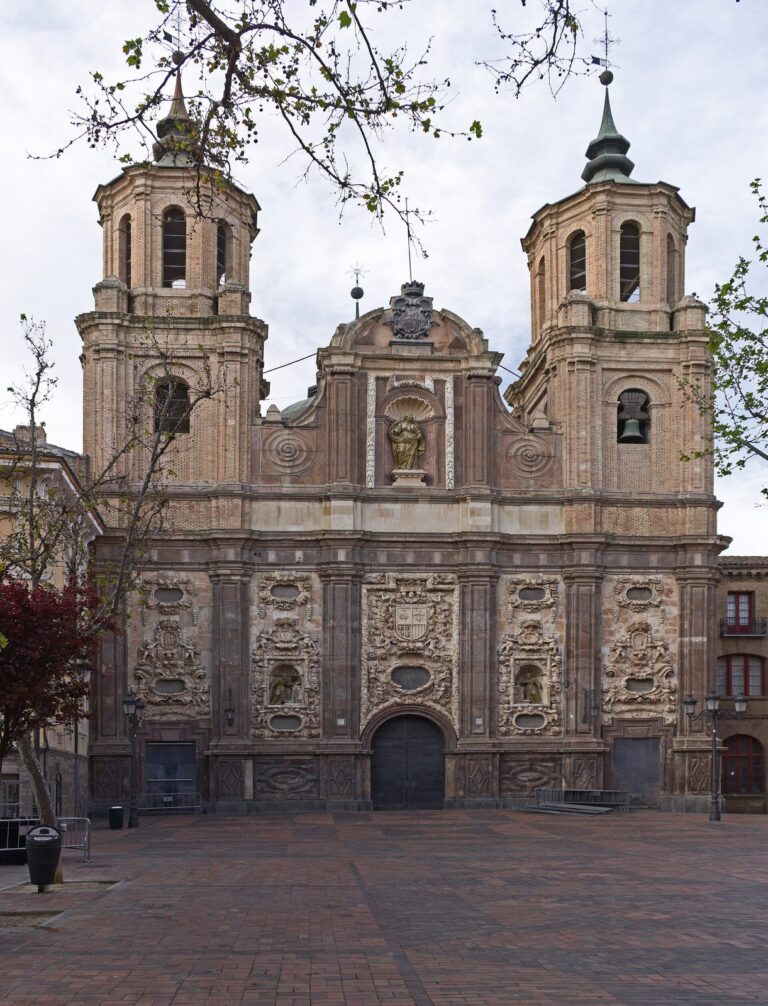
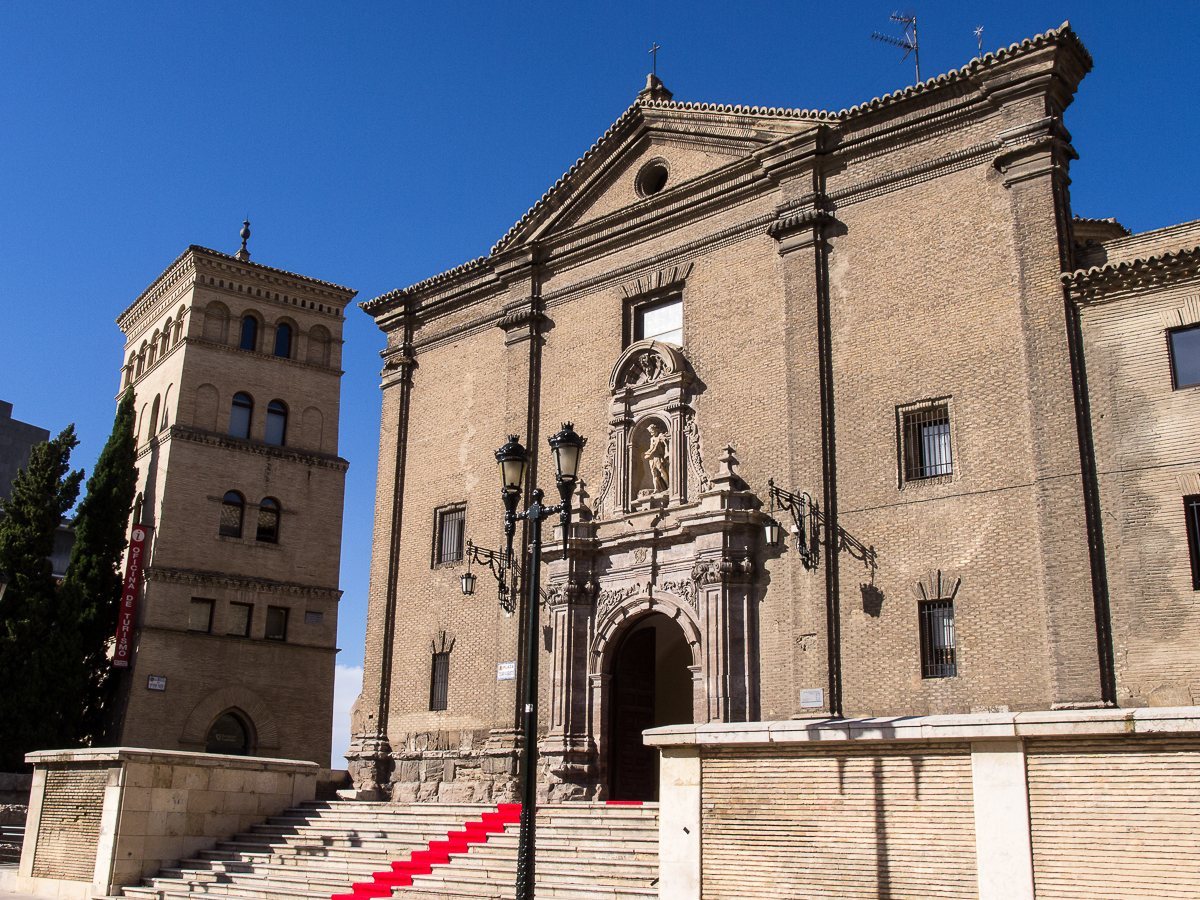
The medieval church was replaced by the present Church of San Juan de los Panetes. Grand Castellan Vicente de Oña ordered its construction, which was completed in 1725. The palace underwent further changes over subsequent centuries. By 1835, it had probably become a crowded mixture of architectural styles and additions, integrated with neighboring buildings.
The palace was abandoned in 1835 after the state confiscated ecclesiastical property. In 1857, Prince Francisco de Paula, then Castellan of Amposta, authorized its use by the Adoratrices, a congregation founded in 1856 by Mother Sacramento, María Micaela Desmaisières López de Dicastillo, Viscountess of Jorbalán. The congregation worked to protect women, particularly those affected by prostitution, and remained there until 1910. The tower was renovated during this period. The building was abandoned from 1914.
Demolition began in 1931 to allow Avenida de Nuestra Señora del Pilar to be widened, and was completed in 1937. On 27 November 1933, the Roman wall, tower, and Church of San Juan de los Panetes were declared national monuments. The tower is also protected as an Asset of Cultural Interest in Spain’s monument category. Archaeological excavation and restoration were completed in 2001.
Remains
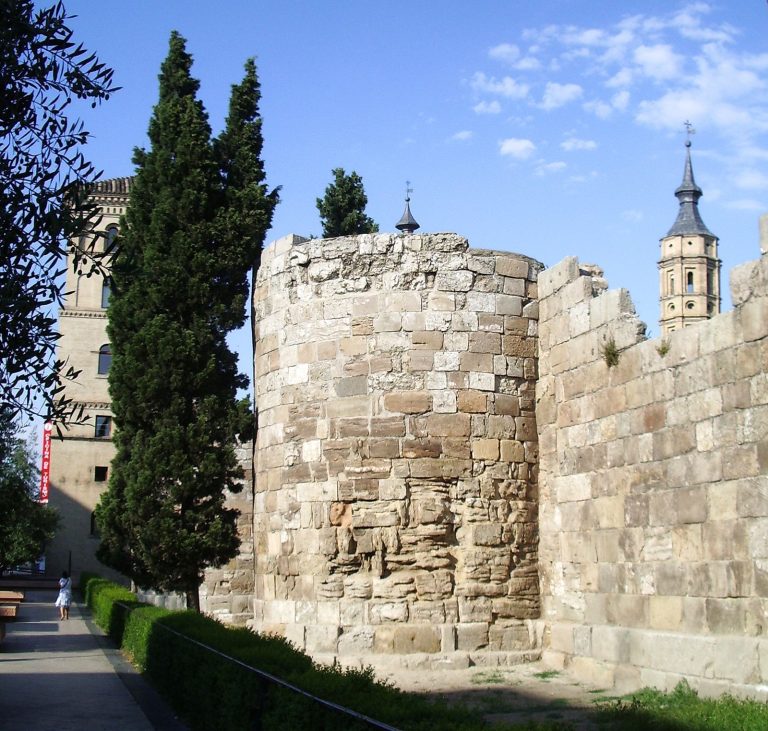
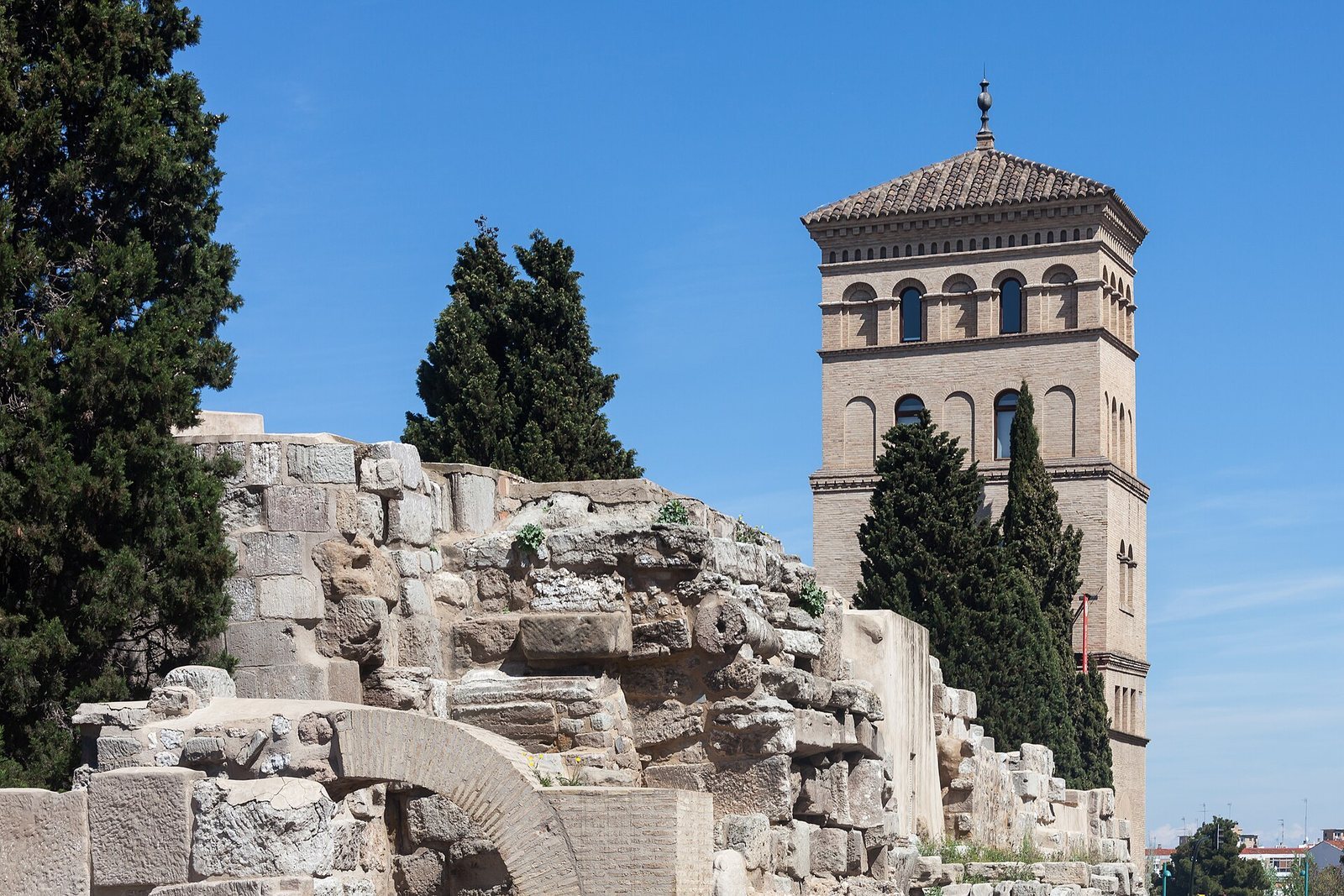
The surviving remains occupy Zaragoza’s northwestern corner beside the Ebro River, over the line of the Roman walls. At the western end of Plaza del Pilar, the slightly inclined tower stands behind a fountain and beside the Church of San Juan de los Panetes. The tower, Roman walls, and church are the principal surviving structures of the former palace site.
Surviving structures
Zuda Tower
The tower’s present form dates to the second half of the 16th century. Its slight inclination remains visible, while its earlier function was as the palace’s principal defensive tower.
Roman walls
The Roman walls enclosed a nearly square city and extended for 3 kilometres. They were more than 7 metres thick in places and included over 120 towers, some exceeding 8 metres in diameter. Sections of the walls remain at the site.
Church of San Juan de los Panetes
The present church stands beside the tower as part of the surviving group of structures. It replaced the medieval church built by the Hospitallers.