Mariä Himmelfahrt: A Former Pilgrimage Church in Lippertskirchen, Germany
Site at a Glance
- Popularity
- Very Low
- Country
- Germany
- Primary era
- Medieval
- Eras represented
- Medieval, Early Modern, Modern
- Civilizations
- Duchy of Bavaria, Electorate of Bavaria, German, Holy Roman Empire, Kingdom of Bavaria
- Site type
- Religious
- Remains
- Church
On this page14 sections
History
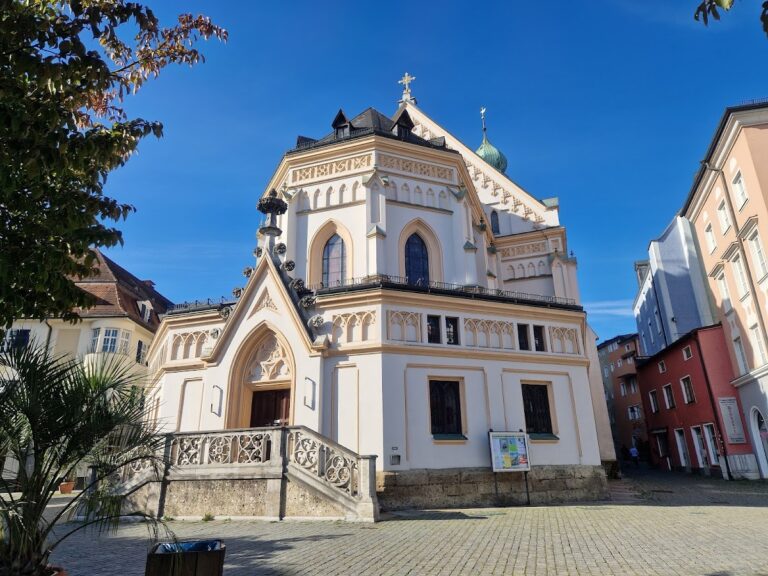
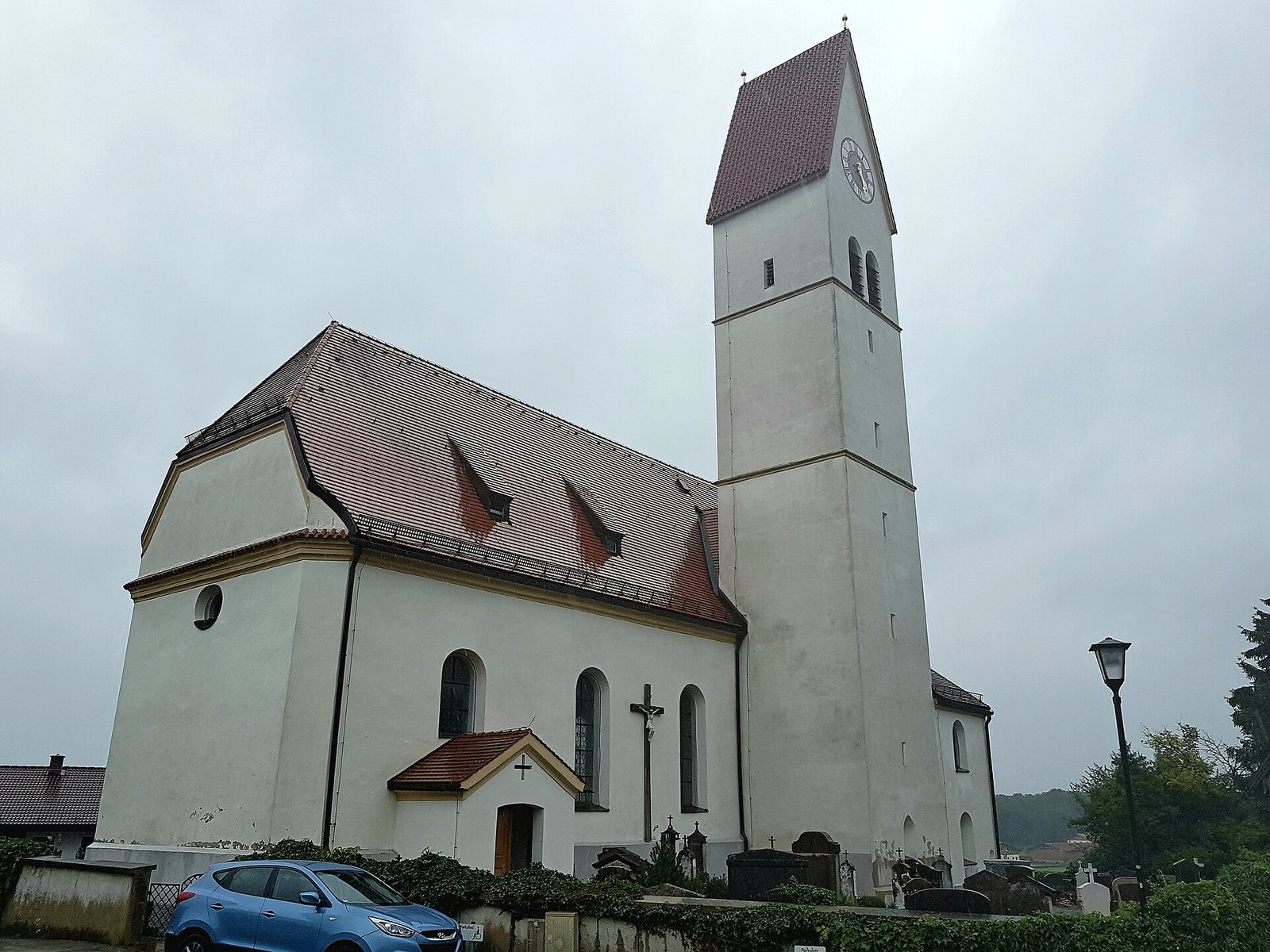
Mariä Himmelfahrt is a Roman Catholic branch church, a subsidiary place of worship attached to a parish church, in Lippertskirchen, within Bad Feilnbach, Germany. Built in the fifteenth century as a late Gothic church, from the final phase of Gothic architecture, it was formerly a pilgrimage church called Maria Morgenstern.
Baroque Remodeling
In 1788, the Bavarian master builder Franz Anton Kirchgrabner directed a remodeling in the Baroque style, a later European artistic style. The work transformed the church’s appearance while retaining its medieval foundation.
Church Life and Bell History
The church belongs to the Rosenheim deanery, a regional subdivision of the Archdiocese of Munich and Freising, which is led by an archbishop. Its patronal feast is held on August 15 for the Assumption of Mary, the Christian belief that Mary was taken into heaven at the end of her earthly life.
Four bells were cast for the church in 1899. During the First World War, two were surrendered to be melted down for weapons, and replacement bells were cast in 1927.
Remains
The church has a single main worship space, or nave, and a narrower choir, the sanctuary area at its eastern end. This choir ends in three sides and is covered by a dome. The nave has a ceiling divided into four sections, with curved transitions to the walls. A tower stands against the choir’s south side; its top storey holds the bell frame, and clock faces are set into the crosswise roof gables.
Altars and Sculptures
High Altar
Joseph Götsch’s high altar centers on a probably circa-1520 statue of the crowned Madonna seated with the infant Jesus. The half-life-size figures show a crescent moon beneath Mary’s feet. Half-life-size statues of Barbara of Nicomedia and Catherine of Alexandria stand beside the central image. Above it, the altar’s upper section depicts the Holy Trinity and carries vases, childlike figures called putti, floral garlands, and rocaille ornament, made up of shell-like and scrolling forms.
Side Altars
The two side altars stand at a slight angle where the nave meets the choir. Their upper sections have canopy-like forms that echo the high altar. The left altar’s central high-relief scene, in which figures project strongly from the background, shows Saint Leonard kneeling before a halo amid clouds. Saint Vitus appears above, while the lower section depicts Saint Anne with her daughter Mary. Saints Stephen and Bartholomew flank the main scene.
The right altar presents the martyrdom of Saint Sebastian in high relief, with Saint Florian above. Its lower section shows Saint Joseph with the infant Jesus. Saints George and Helena stand beside the central relief.
Frescoes and Interior Furnishings
Ceiling Frescoes and Wall Cross
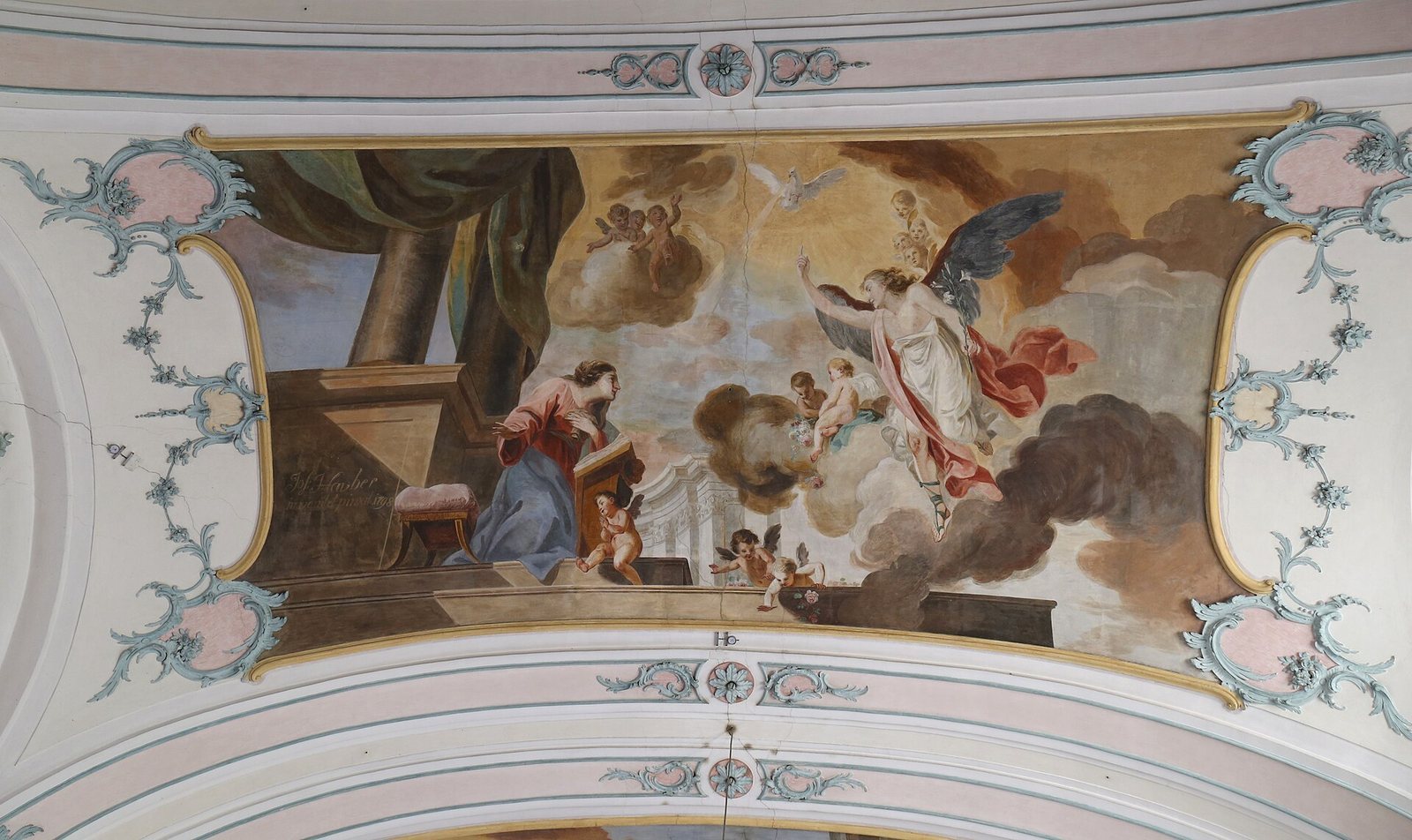
Ceiling frescoes showing episodes from Mary’s life are attributed to the German painter Joseph Hauber. A wall cross on the nave’s left side, made by Götsch, includes a sorrowful Mary with a sword piercing her breast. The image refers to Simeon’s prophecy in Luke 2:25–35, which foretells Mary’s suffering.
Pulpit
Götsch’s pulpit dates to 1785. Floral garlands decorate its basket, whose lower edge bears gilded symbols of the four Evangelists: a human figure for Matthew, a lion for Mark, an ox for Luke, and an eagle for John. On the sounding board above, a putto holds the tablets of the Ten Commandments. Tassels and rocaille ornament decorate the board, and a haloed dove beneath it represents the Holy Spirit.
Baptismal Font
The marble baptismal font has an eight-sided basin and probably dates from the Late Gothic period. Its lid was added later and carries a group sculpture of the Baptism of Jesus.
Stations of the Cross
Richard Walberer painted the Stations of the Cross in 1965, using a Baroque original as his model.
Organ
Built by Linder in 1997, the organ has nine stops, each selecting a set of pipes, and mechanical action, in which a physical mechanism connects the keys to the pipes. It has one manual keyboard played by the hands and a pedal keyboard played by the feet.
Bells
The five-bell set sounds the notes h°, d’, e’, fis’, and a’. All were cast by the Grassmayr foundry in Innsbruck. The second-largest bell dates to 1869; the largest and one middle-sized bell were cast in 1899, and the two smallest in 1927.