Schilda Village Church: A Late Gothic Protestant Church in Germany
Site at a Glance
- Popularity
- Very Low
- Country
- Germany
- Primary era
- Early Modern
- Eras represented
- Medieval, Early Modern, Modern
- Civilizations
- Electorate of Saxony, German, Holy Roman Empire, Kingdom of Prussia
- Site type
- Religious
- Remains
- Church
On this page13 sections
History
Church and village
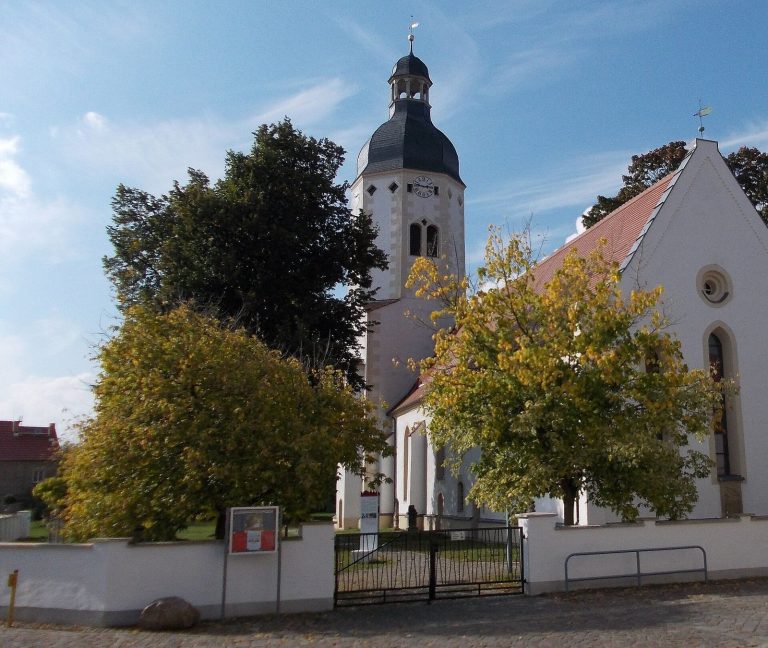
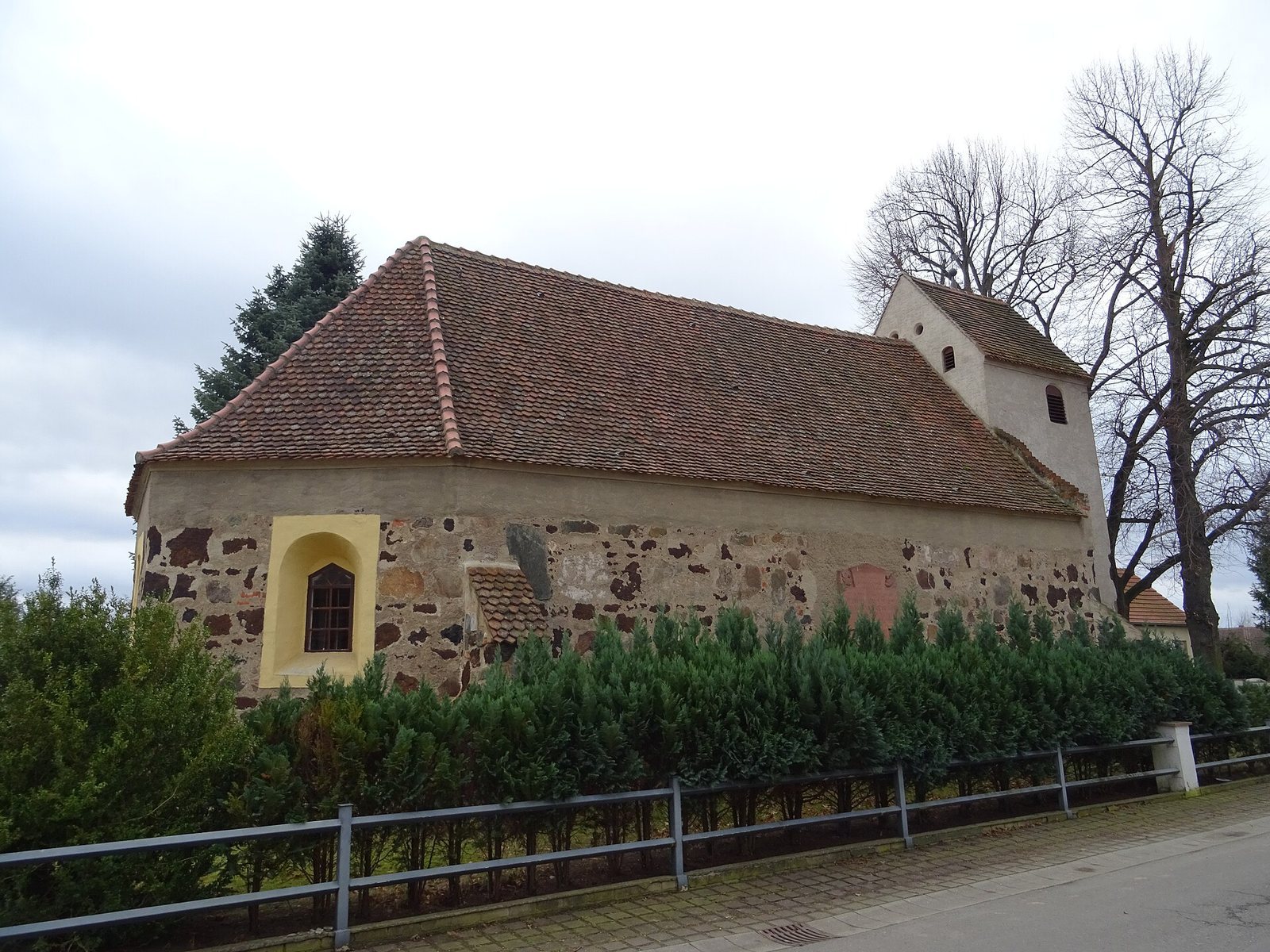
Schilda Village Church is a Protestant church in Germany, probably rebuilt and enlarged into its present late Gothic form in the early sixteenth century. Late Gothic was a later phase of medieval European art and architecture. The village is mentioned from around 1300, but this date does not establish when the church was founded. Its tower was probably added during the early sixteenth-century building works.
Parish organization
Schilda and Schadewitz belong to the Tröbitz parish grouping, part of the Niederlausitz church district within the Evangelical Church in Berlin-Brandenburg-Silesian Upper Lusatia. The grouping dates from 1969. In 1991, congregations from Tröbitz, Schilda, and Schadewitz established a diaconal service in Doberlug-Kirchhain; diaconal work refers to Christian charitable and social services. In May 1992, the Tröbitz congregation took responsibility for that village’s daycare center.
The windowless wall and local stories
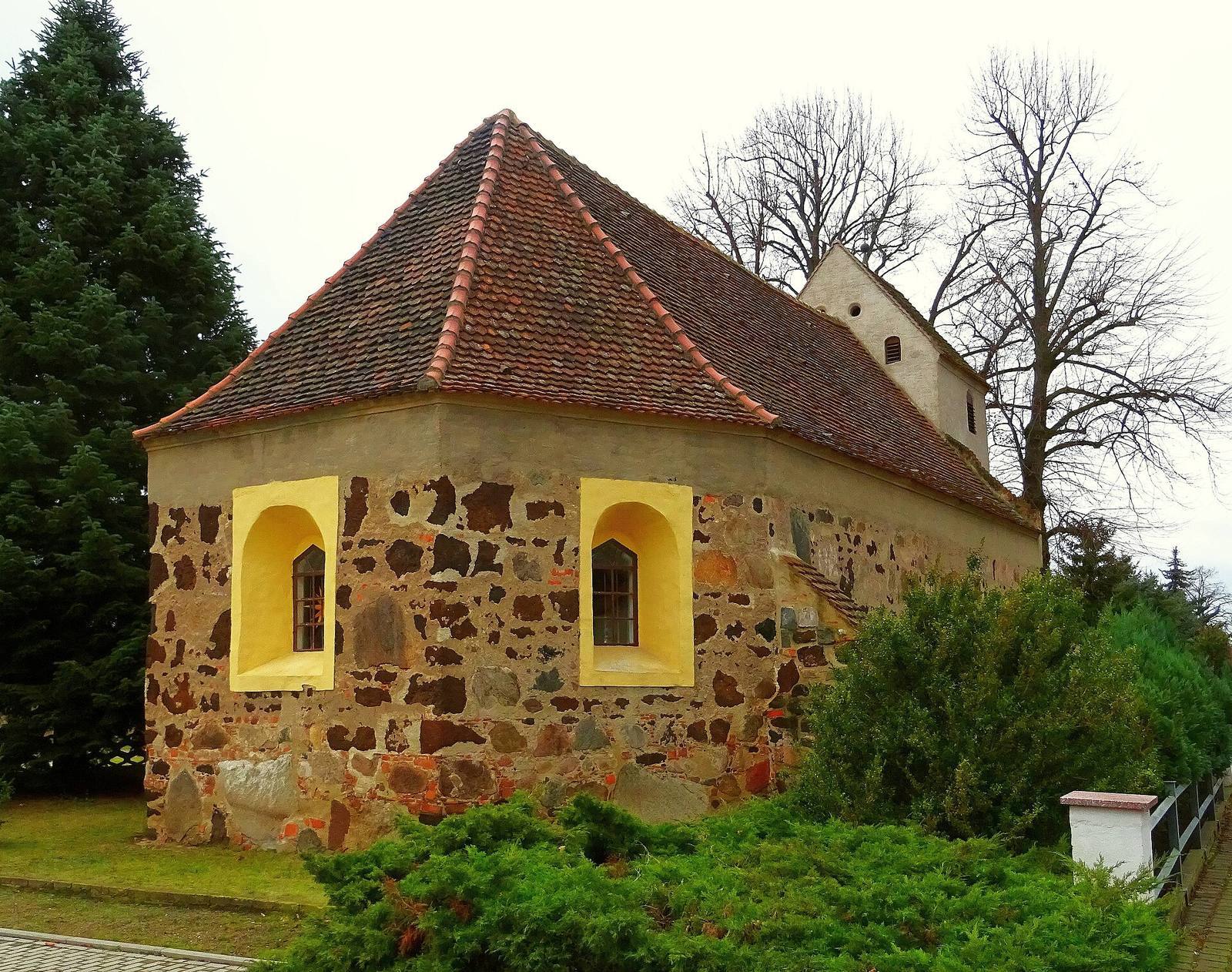
A local legend explains the church’s windowless north wall through the reasoning of a village head: sunlight came only by day, and services did not take place at night, so windows there seemed an unnecessary expense. Schilda is also sometimes connected, because of its name and the wall, with the Schildbürger, fictional comic townspeople whose stories include a town hall built without windows.
Johann Friedrich von Schönberg (1543–1614), a German writer traditionally associated with the Schildbürger tales, was born and raised in Sitzenroda near Schildau, about 30 kilometers southwest of Schilda. Schildau was sometimes also spelled Schilda. Schönberg later inherited family property in the nearer places of Falkenberg/Elster and Uebigau.
Remains
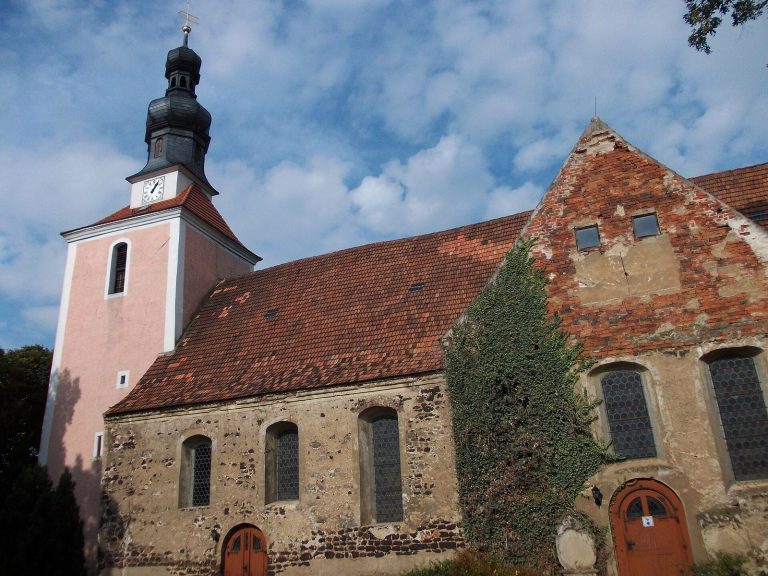
On the old village green at the center of Schilda, the church has a hall plan, with its main body and side aisles at roughly equal height. It is built mainly from fieldstone, naturally occurring stone gathered from fields, and ends in a three-sided eastern section.
Exterior
Plan and structure
The nave, or main body of the church, has substantial buttresses, projecting supports that reinforce walls, at all four corners. At its western end stands a low, recessed tower with a square plan and a saddle roof.
Entrances and windows
A round-arched doorway framed by stepped layers opens through the south wall. A triangular niche sits above it, with a cross at its peak. The tower’s western entrance has a similarly stepped, round-arched doorway. The windows have shallow basket-shaped arches.
Interior
Ceiling and galleries
The ceiling forms a hollow barrel vault, a curved, tunnel-like structure, with rural-style paintings from the eighteenth century. Galleries have stood along the north and south sides since the seventeenth century.
Pulpit and altarpiece
The square pulpit dates to the mid-eighteenth century. Its parapet is painted with the Evangelists, traditionally understood as the authors of the four Gospels. The altarpiece’s main panel contains a relief of the Holy Trinity, the Christian understanding of one God as Father, Son, and Holy Spirit, set against a cloudy sky. An oval painting occupies the predella, the lower part of an altarpiece beneath its main panel.
Baptismal font and carvings
The baptismal font incorporates a late Romanesque capital, the upper part of a column or pier, shaped as a chalice block. Late Romanesque was an earlier phase of medieval art and architecture. The capital dates to around 1230 and is decorated with leaves, tendrils, and grapes. It is thought to have come from Dobrilugk Monastery and is believed to have been brought to Schilda during the nineteenth century. A font of similar form and date stands in the village church at Gruhno, about 10 kilometers northeast. Together, the two fonts are regarded as valuable evidence of the quality of building components used at the medieval monastery.
Two limewood carvings are associated with the church. One, dating to around 1400, survives as part of a crucifix, a cross bearing a representation of Jesus. The other is a Madonna and Child, an image of Mary with Jesus, probably made around 1300 and measuring 82 centimeters high. It was found severely damaged in the organ’s wind channel and was later restored. The church also contains a figurative grave slab for a child dating to the seventeenth century.
Organ
Robert Knauf & Sohn of Bleicherode made the organ in 1898; its catalogue number is opus 198. It has one manual, or keyboard, and seven stops, controls that select sets of pipes. Its pneumatic cone-chest mechanism uses air pressure to operate cone-shaped valves that direct wind to the pipes.