Calabazas Mission: A Spanish Jesuit Mission in Arizona
Site at a Glance
- Popularity
- Medium
- Country
- United States
- Primary era
- Early Modern
- Eras represented
- Early Modern
- Civilizations
- Spanish
- Site type
- Religious
- Remains
- Church
On this page6 sections
History
Calabazas Mission was a Spanish Jesuit mission dedicated to Saint Cajetan in Rio Rico, Arizona, United States. The Jesuits were a Catholic religious order. The mission was moved to its present site in 1756, and its architecture is classified as Spanish Renaissance and Mission. Also called Calabasas, its name means “Mission of Saint Cajetan of the Gourds”; Cajetan was a Catholic saint and religious reformer.
Origins and relocation
The mission’s predecessor was founded at Tumacácori in 1691 by Jesuit missionary and explorer Eusebio Kino, during his first major expedition through Pimería Alta, the O’odham homeland and the surrounding northern frontier of New Spain. The settlement was destroyed during the O’odham rebellion of 1751.
In 1756, Jesuit missionary Francisco Xavier Pauer re-established the mission and brought at least 78 O’odham from Toacuquita, a village near the Santa Cruz River. He performed the first baptism there on April 20. On November 1, he moved the mission south to its later location.
Mission life and abandonment
In May 1761, the mission had a house with a lock and a church that was still partly under construction. By 1772, 64 people lived there: 21 men, 24 women, and 19 children. The settlement lay on open, fertile land, but residents farmed little or not at all, and there was then no church or house for the missionary. The church was in use by 1773. Two years later, Franciscan missionary Pedro Font celebrated Mass there during Spanish officer and explorer Juan Bautista de Anza’s first expedition to upper Las Californias.
In 1777, Apaches, O’odham who had left Christianity, and Seris raided the mission. They looted and burned the church, houses, and a storehouse filled with maize. The mission’s O’odham residents killed 14 of the raiders, while seven of their own people died. The attackers had also struck Magdalena and other Pimería Alta communities in 1776. Continuing Apache attacks contributed to the mission’s abandonment in 1786, when its last O’odham residents departed.
Ranch and military posts
From 1807 to 1830, the settlement served as a farm for nearby Mission San José de Tumacácori. Spanish settlers and Christian Indigenous residents moved there in 1808 and repaired the chapel. In 1830, Apaches attacked again, set buildings on fire, and took sacred vessels and religious clothing. The raid discouraged settlement for more than two decades, although cattle herders from Tumacácori continued working nearby.
In 1837, the Mexican government built the Presidio de Calabasas, a fortified military settlement, to protect the area. The mission and its lands were sold at auction in 1844 to the brother-in-law of Manuel María Gándara, then governor of Sonora. Gándara established a ranch there with 6,000 cattle. The 1854 Gadsden Purchase, through which the United States acquired territory from Mexico, brought the area into New Mexico Territory. Mexican troops withdrew in early 1856, bringing Gándara’s ranch to an end.
Late in 1856, the former mission church, then serving as a ranch house, temporarily sheltered Major Enoch Steen, who commanded four companies of the First Regiment of United States Dragoons, or mounted soldiers. Steen established Camp Moore at the old presidio. It was the first U.S. military post in the area acquired through the Gadsden Purchase. Sonora’s new governor, Ignacio Pesqueira, allowed military supply wagons to cross into Sonora. The arrival of U.S. military protection was followed by an influx of American squatters around the former ranch.
In 1857, Steen was ordered by Colonel Benjamin Bonneville to move closer to Tucson. Worried that Tucson’s vices would damage military discipline, he instead relocated his camp 25 miles northeast, to the headwaters of Sonoita Creek. The new post, Fort Buchanan, was named for James Buchanan, who had recently become the fifteenth U.S. president. That year, one of the old mission buildings housed a customs office. Before September 1859, the ranch house was occupied by the family of Larcena Pennington Page.
Later military use and preservation
In September 1865, Union troops stationed at Tubac moved to Old Camp Moore at Calabasas. The post was first called the Post at Calabasas and then Fort Mason, named for the general commanding the California Volunteers in Arizona. The First Battalion of Native Cavalry, California Volunteers, and the Seventh Regiment of California Volunteer Infantry remained there until U.S. Army troops took over in May 1866. Persistent malaria led the regular troops to leave in October and establish Camp Cameron.
By 1878, the mission stood abandoned and in ruins. In 1960, Father Norman Whalen organized volunteers to preserve it. The Arizona Historical Society assumed ownership and management in October 1974. The site entered the National Register of Historic Places in 1971; in 1990, it was designated a National Historic Landmark and became part of Tumacácori National Historical Park.
Remains
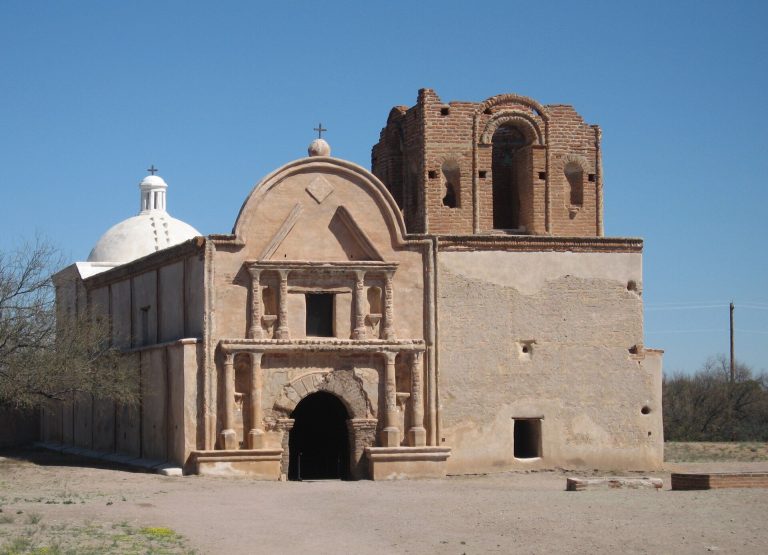
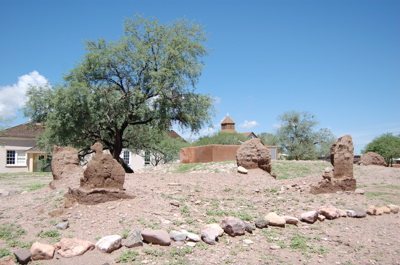
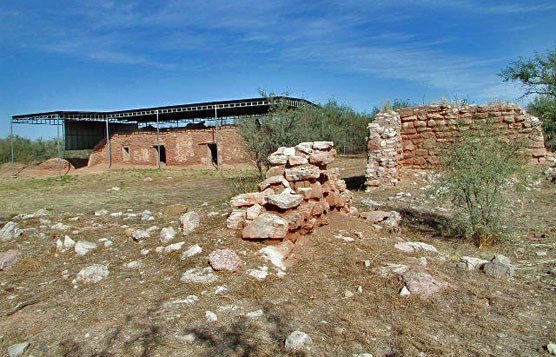
The ruins occupy bluffs east of the Santa Cruz River, upstream from its junction with Sonoita Creek. The remains include the mission compound and church, with adobe walls forming part of the surviving fabric. By 1878, the church was reduced to a roofless shell. A channel cuts through its eastern wall. During preservation work in 1960, volunteers capped the adobe walls and installed a concrete foundation.