Church of Saint Demetrius of Thessaloniki in Staraya Ladoga: A Wooden Orthodox Church
Site at a Glance
- Popularity
- Medium
- Country
- Russia
- Primary era
- Early Modern
- Eras represented
- Early Modern
- Civilizations
- Russian
- Site type
- Religious
- Remains
- Church
On this page7 sections
History
The Church of Saint Demetrius of Thessaloniki in Staraya Ladoga, Russia, is a wooden Orthodox church within the town’s fortress, dating to the 1620s. It was probably built as Ladoga recovered from the Time of Troubles, a period of dynastic crisis and political upheaval in Russia in the late 16th and early 17th centuries. The church is first mentioned in 1646 as a “building of the sovereign” and served for winter worship.
Repairs and rebuilding
In 1731, rotten roofing boards were burned, and their ashes, wrapped in cloth, were set adrift on the river. Logs that could still be used from the dismantled church went into the construction of a new church. On 26 November 1782, fire destroyed the roof and cupola and damaged icons. Repairs followed, and the church was consecrated again on 29 October 1783.
Nineteenth-century preservation
In 1860, some icons valued by the church community were taken to St Petersburg; they later entered the collection of the Museum of Emperor Alexander III. Five years later, Damaskin, abbot of Valaam Monastery, proposed selling the wooden church and moving it to the monastery. Parishioners and clergy opposed the plan, regarding the building as a local antiquity and fearing changes to its facade.
By the end of the 19th century, the church had deteriorated and was thought likely to collapse. Merchant R. G. Gerasimov provided money for repairs. By summer 1901, restoration had returned the building to its earlier form, preserving its details, and it was consecrated.
Closure and renewed use
The church closed after the 1917 Revolution. Archaeologists later used the building during excavations at Staraya Ladoga Fortress. Following the establishment of the museum-reserve in 1971, it housed an exhibition on peasant life. The church is now part of the Staraya Ladoga Historical, Architectural and Archaeological Museum-Reserve and has federal cultural-heritage status.
The Russian Orthodox Church resumed services in the building in autumn 2014 under an agreement with the museum-reserve. Restoration was completed in 2017, when an exhibition about the frescoes in the 12th-century Church of St George opened there. The church belongs to the Diocese of St Petersburg and the Novoladozhsky Deanery, a group of local parishes within a diocese.
Remains
Plan and exterior
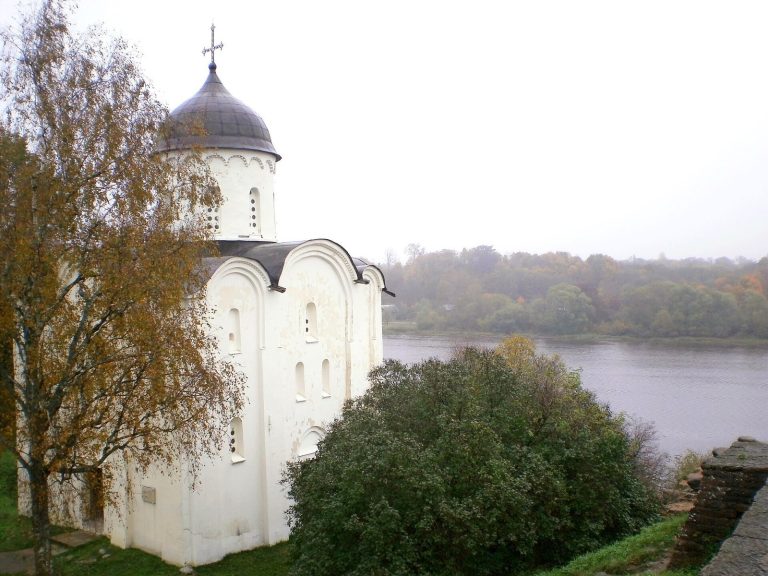
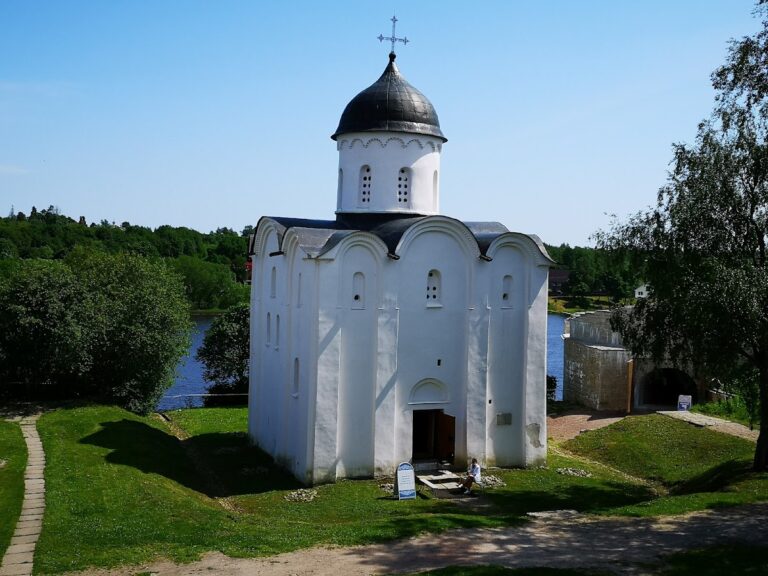
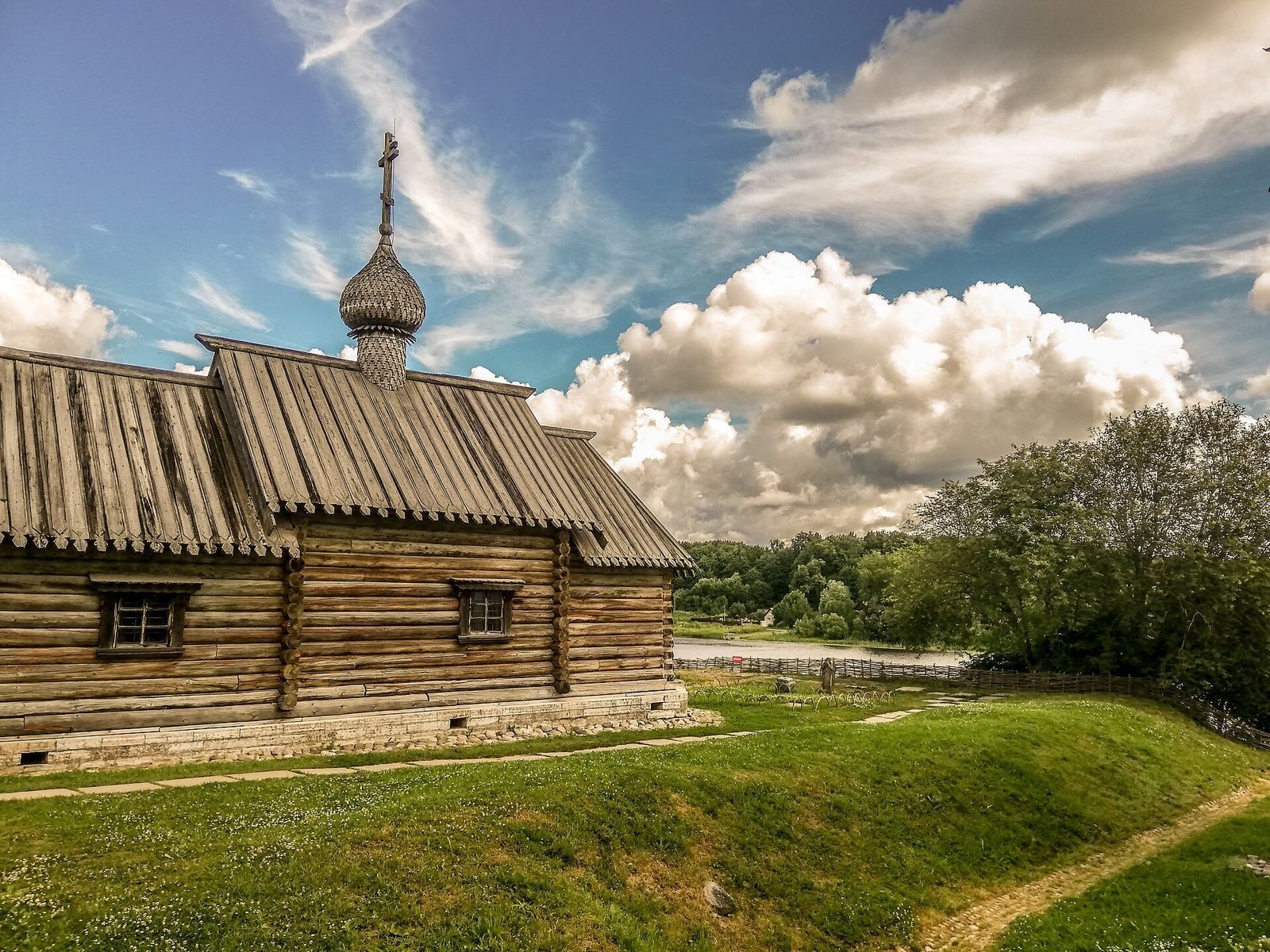
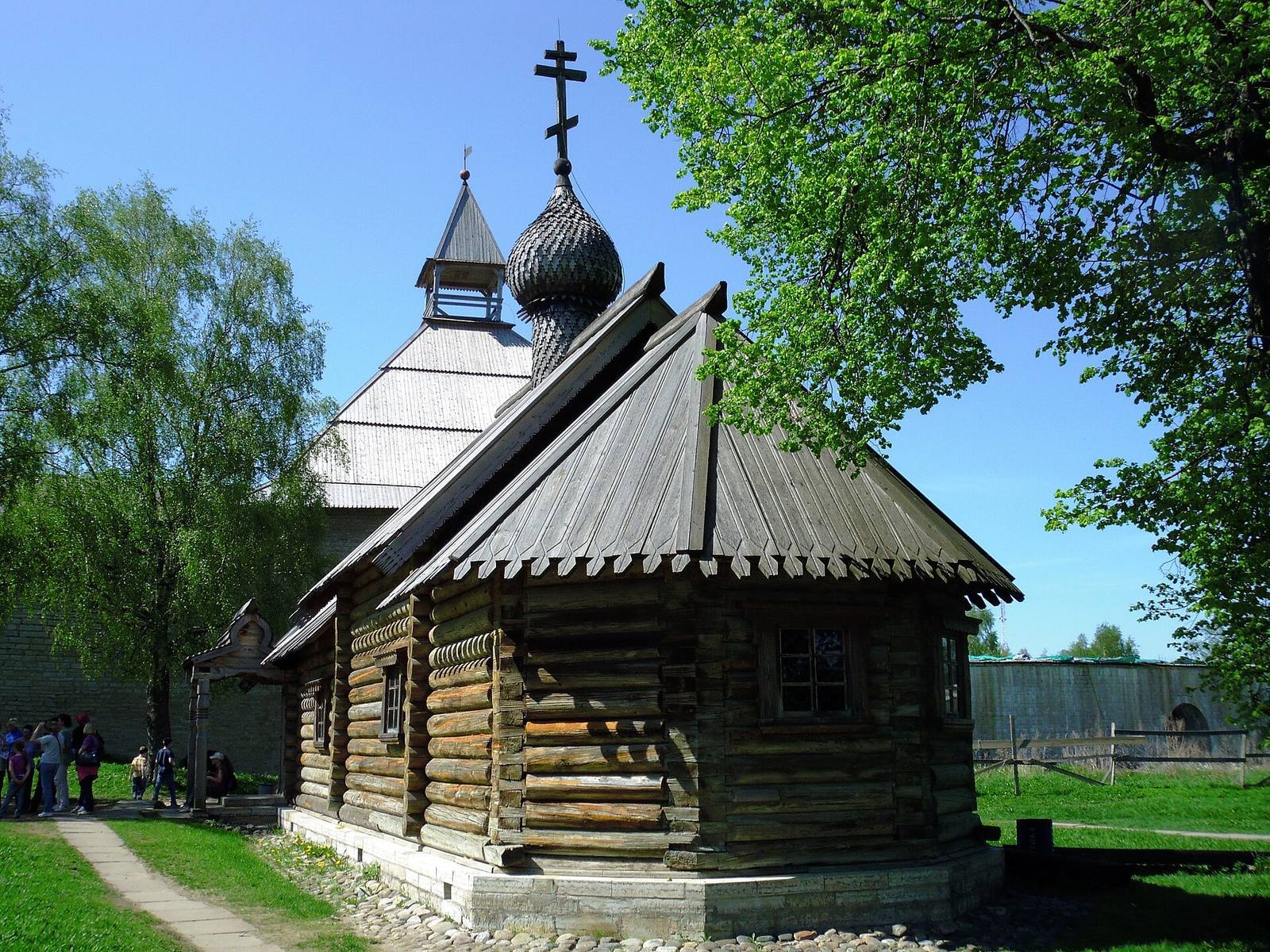
The church is built from logs and has three connected sections: an entrance porch, a refectory, and the main worship space, which ends in a five-sided apse, an end space projecting from the building. A canopy shelters the entrance. Its barrel-shaped roof has roofing boards with arrow-shaped cutwork at their ends. Above the main gabled roof, a neck supports a small cupola; both are clad in aspen shingles, and a cross tops the cupola. An early-20th-century description compared the building to a village log house and noted that its dimensions, vestibule, beams, and the number, size, and placement of its windows followed the old arrangement.
Interior furnishings
An iconostasis, a screen separating the sanctuary from the main worship space, had narrow shelves where worshippers placed their own icons. The Royal Doors at its center were taken to St Petersburg for cleaning; their backs were left as they were, darkened with soot and marked by whitewash. Images of St Demetrius and St Basil the Great, along with other icons, were also left uncleaned. Architectural historian and collector Nicholas Romanchenko dated the painting on the Royal Doors to the 15th century. Early historian Konstantin Borozdin noted a tradition that some icons had been installed by an “Italian conqueror.” An early-20th-century description also mentions four printed-linen tunics for deacons and two priestly outer vestments with red shoulder pieces, kept in a cupboard. A 17th-century copper baptismal font among the church’s furnishings came from the Church of the Savior Not Made by Hands on Konyushennaya Square in St Petersburg.