Tubac Presidio: A Spanish Frontier Fortification in Arizona
Site at a Glance
- Rating
- 4.6
- Popularity
- Low
- Country
- United States
- Primary era
- Early Modern
- External website
- Open
- Eras represented
- Early Modern
- Civilizations
- Spanish
- Site type
- Military
- Remains
- Fort
On this page11 sections
History
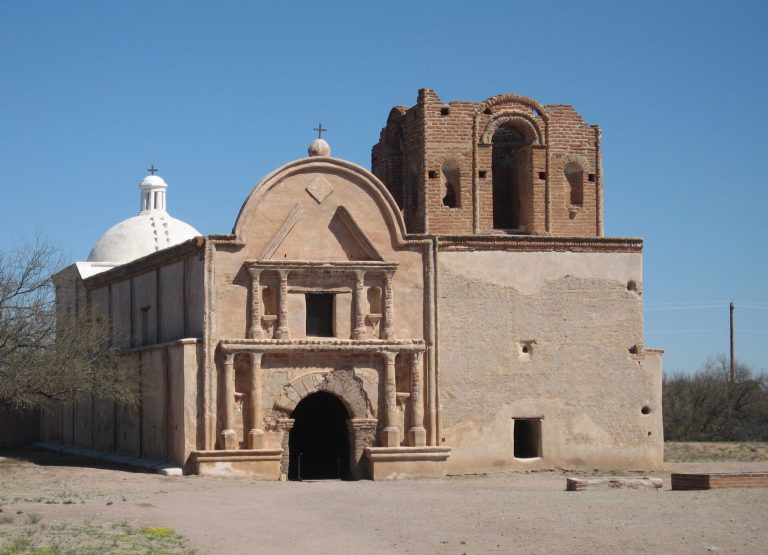
Tubac Presidio, also known as Presidio San Ignacio de Tubac or Fort Tubac, is a former Spanish frontier fortification in Tubac, Arizona, United States. Established by the Spanish Army in 1752, it was the first fortification founded in what is now Arizona and formed part of Spain’s defensive system in the northern frontier of New Spain, the colonial territory that included much of present-day Mexico and the American Southwest.
Spanish foundation and frontier defense
The presidio was founded after the Pima Rebellion of 1751, an Indigenous uprising against Spanish colonial authorities and settlements in the northern frontier. Its purpose was to protect Spanish settlements and missions in the Santa Cruz River Valley from Apache attacks. The post was one of several frontier installations developed after Brigadier Inspector General Pedro Rivera y Villalón surveyed the northern frontier and promoted a reorganization of its military defenses.
A presidio was a fortified military settlement that combined a garrison with a civilian community. Tubac’s original garrison contained about fifty cavalry and infantry soldiers. By 1766, the post had 51 officers and men, while a settlement of forty families had grown around it.
Juan Bautista de Anza and the northern frontier
In 1774, Captain Juan Bautista de Anza, then commander of Tubac, organized an expedition to explore a land route from the Santa Cruz Valley to California. In 1775 and 1776, he escorted 240 colonists from San Miguel de Horcasitas in Sonora to Monterey. He then continued to present-day San Francisco, where he selected sites for a mission and presidio.
A reorganization of frontier defenses in 1775 transferred the Tubac garrison northward. Lieutenant Juan Fernandez Carmona led an enlarged force of 56 officers and men to a new site about 40 miles north. There they helped establish the Presidio San Agustin del Tucson under Captain Hugh O’Conor. A new garrison later returned to Tubac, where it campaigned against Apache forces for decades.
Late Spanish and Mexican periods
During the early nineteenth century, Tubac continued to defend the area from Apache raids. In 1804, its garrison consisted of two officers, two sergeants, and 84 men. Spanish and Indigenous families lived within the presidio’s five-square-mile land allotment. Cattle and sheep raising, along with the cultivation of wheat and maize, supported the community’s economy.
The presidio and its settlement were abandoned after Mexican independence from Spain in 1821, and Tubac fell into ruin. Mexican troops temporarily occupied the post during the Mexican-American War in 1846 after retreating from the Presidio of Tucson. The site was abandoned again after the Treaty of Guadalupe Hidalgo in 1848, which ended the war and transferred extensive Mexican territory to the United States.
American settlement and military decline
Americans resettled Tubac after the Gadsden Purchase of 1853–1854, when the United States acquired territory from Mexico that included much of present-day southern Arizona and southwestern New Mexico. During the 1850s, Tubac became a company town associated with Charles D. Poston’s copper-mining enterprise, and a small militia force occupied the post to defend the settlement.
In 1861, Apache forces besieged the American militia and civilians in the fort during the Siege of Tubac. They occupied and looted the presidio before Confederate militia led by Captain Granville H. Oury from Fort Tucson drove them away. Tubac was abandoned again after the siege. The United States Army later reoccupied the presidio during and after the American Civil War, and the fort was reconstructed after the attack.
Military use continued until Apache resistance declined. After Geronimo’s surrender in 1886, an event that marked the end of major Apache resistance in the region, the presidio no longer had strategic military value. Its recorded military period, from 1752 to 1886, included occupation by the Spanish Army, Mexican Army, United States Army, and Confederate forces.
Preservation
The surviving site was designated a State Historic Park in 1958 and entered on the National Register of Historic Places in 1970. It is preserved within Tubac Presidio State Historic Park, where the former military settlement has cultural and interpretive functions.
Remains
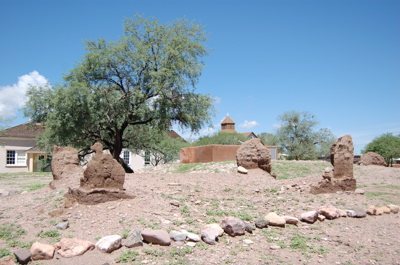
The preserved site contains foundations and traces of auxiliary buildings from the small original fortification, together with an excavated archaeological area that exposes the presidio’s foundations. The remains reflect an adobe construction tradition, with pine or American cottonwood beams, roofs covered with ocotillo and other vegetation, and mud finishing.
Fortification remains
Foundations and auxiliary buildings
The excavated area exposes the foundations of the presidio and traces of associated auxiliary buildings. These remains define the surviving archaeological evidence of the fortification and its supporting structures.
Adobe construction
The original buildings were made from adobe and supported by beams of pine or American cottonwood. Their roofs used vegetal materials, including ocotillo and other plants, which were finished with mud. The buildings remained standing into the early twentieth century. Two original structures were still intact after the beginning of that century, while the site was recorded in ruins in 1905.
Interpretation and historical layout
A museum and interpretation center form part of the preserved site, and a commemorative plaque is associated with Presidio San Ignacio de Tubac. The presidio’s historical arrangement is also represented by a map made by engineer Josef Urrutia in 1775–1776. A copy of that map is held by the Library of Congress.