Falsterbohus: A Succession of Danish Fortresses in Sweden
Site at a Glance
- Popularity
- Medium
- Country
- Sweden
- Primary era
- Medieval
- Eras represented
- Medieval
- Civilizations
- Danish
- Site type
- Military
- Remains
- Castle
On this page7 sections
History
Falsterbohus was the name given to successive Danish fortresses at Falsterbo, Sweden, beginning in the mid-13th century. The stronghold became closely connected with royal authority over the Scanian Market and the income it generated.
Early fortresses and royal authority
The original castle is first mentioned in surviving records in 1311, when forces of the Hanseatic League, a network of trading towns and merchants around the Baltic and northern Europe, destroyed it during an attack directed against King Erik Menved. A replacement was built a few years later, but Swedish forces destroyed it, and the fortress was rebuilt. A later fortress, established in the early 14th century, gradually took over functions of nearby Skanör Castle.
During Erik Menved’s reign (1286–1319), Falsterbohus was enlarged and given a square tower at its core. It was intended to enforce order at the Scanian Market and secure income for the royal treasury, by force if necessary.
The royal seat and political crises
In the late 14th century, the king’s local representative, or bailiff, moved from Skanör Castle to Falsterbohus because the latter was in better condition and more strongly fortified. At around the same time, the Scanian Market shifted from Skanör to Falsterbo.
Olav Håkonsson, the 17-year-old son of Queen Margaret I and Haakon VI Magnusson, died at Falsterbohus in 1387. His body was embalmed and displayed in Falsterbo Church before being taken to Sorø Abbey Church for burial. Some alleged that he had been poisoned. His death cleared the way for Margaret, a Danish and Norwegian queen, to pursue the unification of the Nordic kingdoms.
In 1402, Margaret summoned a man who claimed to be her deceased son Olav to Falsterbo during market time. He accused the queen of trying to kill him and sought his inheritance with support from the pope and Hanseatic towns. He was judged an impostor: he had been born in Bohemia, spoke no Danish, and had been misled by advisers. His mother was also named Margaret, and he was said to resemble the dead king. Sentenced to death by burning, he was executed on 28 September 1402 on the ground between Falsterbohus and the beach. He wore a fool’s cap, while his letters and false royal seal were fastened to the stake.
Decline and archaeological investigation
As the Scanian Market declined during the 15th century, Falsterbo’s strategic importance diminished. Falsterbohus ceased to be used in 1540, after Malmöhus took over regional administration. The castle was demolished in 1596.
Georg J:son Karlin, founder of the Cultural History Museum in Lund, led the first excavations in the early 20th century. Ragnar Blomqvist conducted another investigation in 1934–35, which was considered more historically important.
Remains
The castle island and defenses
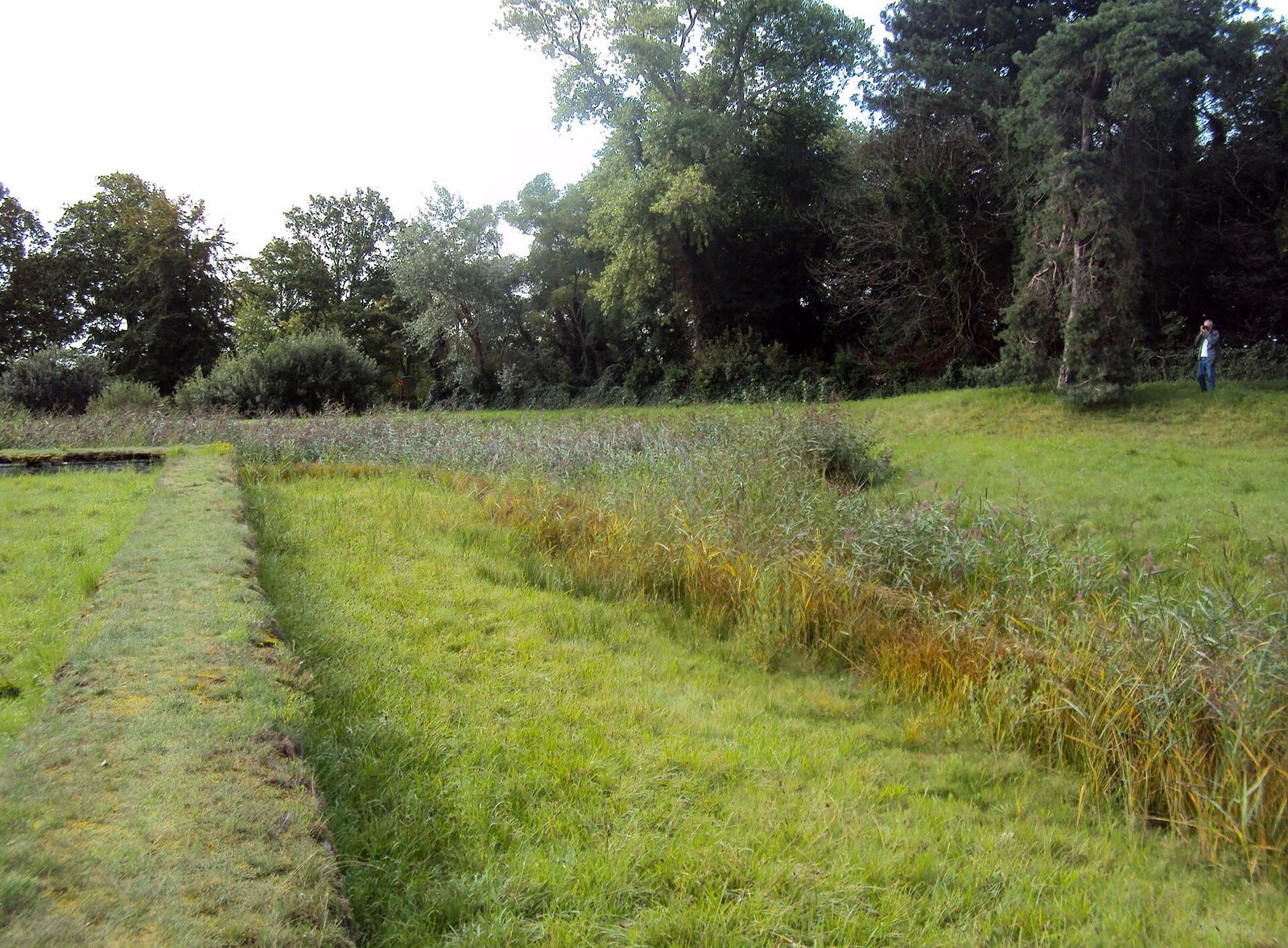
The complex was arranged around a nearly square walled courtyard measuring about 33 by 28 metres, set on an artificial island measuring 42 metres on each side. An inner moat, about 12 metres wide, was bounded by a raised bank of almost the same width. Beyond it lay an outer moat, also about 12 metres wide. On the seaward side, the bank between the two moats rested on six large barges sunk as foundations.
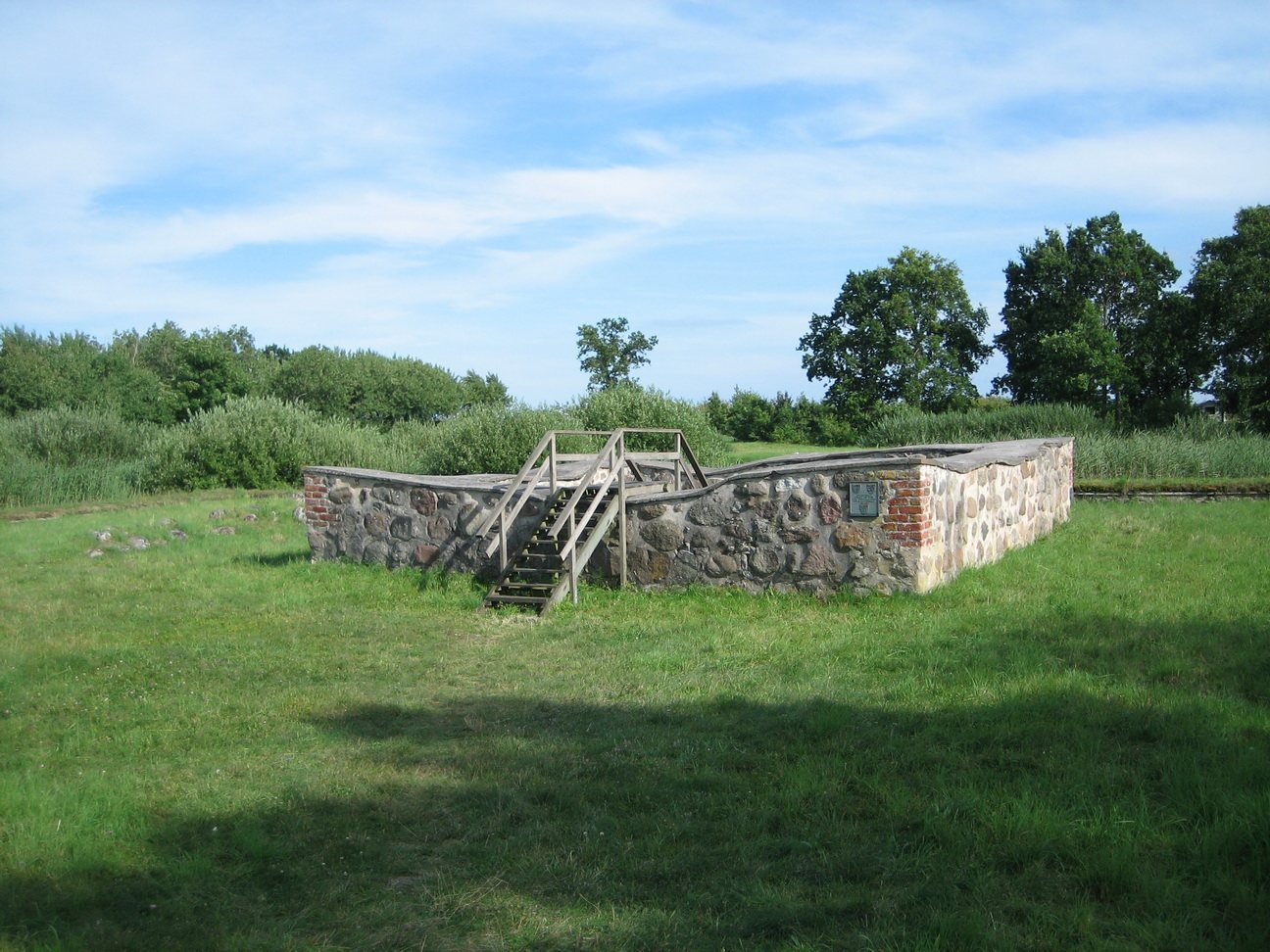
Remains of a lime-making kiln lie at the southeastern corner of the bank, probably beside the open sea. A stone barrier outside the outer moat served as a breakwater against storms and high water. A ruin survives at the site.
Finds from the castle
Most archaeological finds from Falsterbohus are now in Stockholm. Finds from Karlin’s earlier investigation are held at the Cultural History Museum in Lund and Falsterbo Museum.