San Nicola alla Carità: A Roman Catholic Church in Naples
Site at a Glance
- Popularity
- Medium
- Country
- Italy
- Primary era
- Early Modern
- Eras represented
- Early Modern, Modern
- Civilizations
- Habsburg, Italian, Kingdom of Naples, Spanish
- Site type
- Religious
- Remains
- Church
On this page24 sections
History
Foundation and construction
San Nicola alla Carità is a Roman Catholic church on Via Toledo in Naples, Italy, founded in 1647. It is dedicated to Saint Nicholas of Bari, also known as Nicholas of Myra, an early Christian bishop venerated as a saint. The church is associated with the Pious Workers, a Catholic religious order engaged in charitable and pastoral work, and belongs to the Archdiocese of Naples.
A nobleman gave the Pious Workers about 6,000 ducats in recognition of their charitable work. The order first built a small chapel dedicated to Saint Nicholas, then began work on a larger church in the same year. Onofrio Antonio Gisolfi designed the new building. Construction was interrupted in 1656, when a plague struck Naples and Gisolfi died. Work resumed in 1668 under Cosimo Fanzago, who directed it until his death in 1678. The church was completed in 1682 with support from Cardinal Diego Innico Caracciolo di Martina.
On completion, a bone from Saint Nicholas’s index finger was brought from Scala as a relic, and the church was dedicated to the saint. Cardinal Francesco Pignatelli consecrated it in 1716.
Changes in use and later history
In the eighteenth century, Salvatore Gandolfo rebuilt the façade as part of a modernization project begun by Francesco Solimena but left incomplete. During the decade of French presence in Naples at the start of the nineteenth century, the Pious Workers were expelled. The church lost its consecrated religious use and served the Corps of Engineers. Guglielmo Turi restored the building in 1843.
At the direction of the Holy See, the Pious Workers joined the Congregation of Rural Catechists in 1943. The congregation is a Catholic institution concerned with religious instruction in rural communities; the union was intended to keep the order from dying out. Major structural and conservation work followed in the middle of the twentieth century.
The church is the burial place of Neapolitan painter Bernardo Cavallino and Father Antonio Torres, a Pious Worker who served people during the 1656 plague. Four members of the order, including Torres, survived after other members died following contact with infected people. Carlo Carafa, founder of the Pious Workers, was transferred here from San Giorgio Maggiore in 1969 and is also buried in the church.
Remains
Plan and façade
Church plan
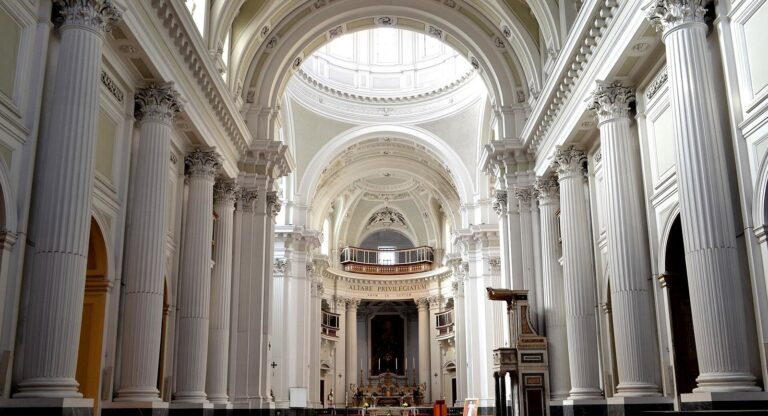
The church has a cross-shaped plan, with a central nave (the main body of the church), two side aisles, and chapels along the sides. Its other named spaces include a transept (the cross-arm of a church), an apse (the area behind the main altar), a dome, and a sacristy.
Façade
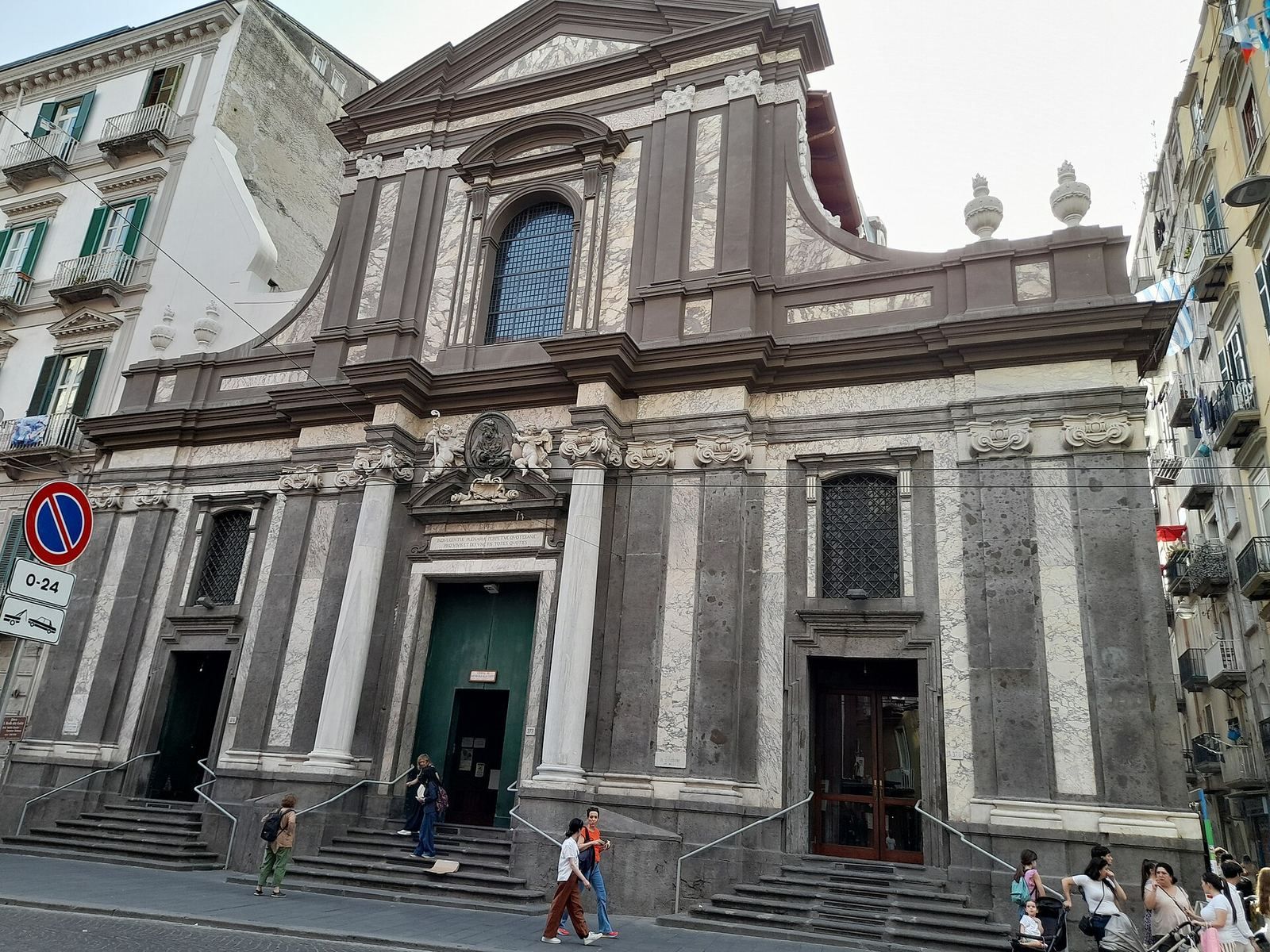
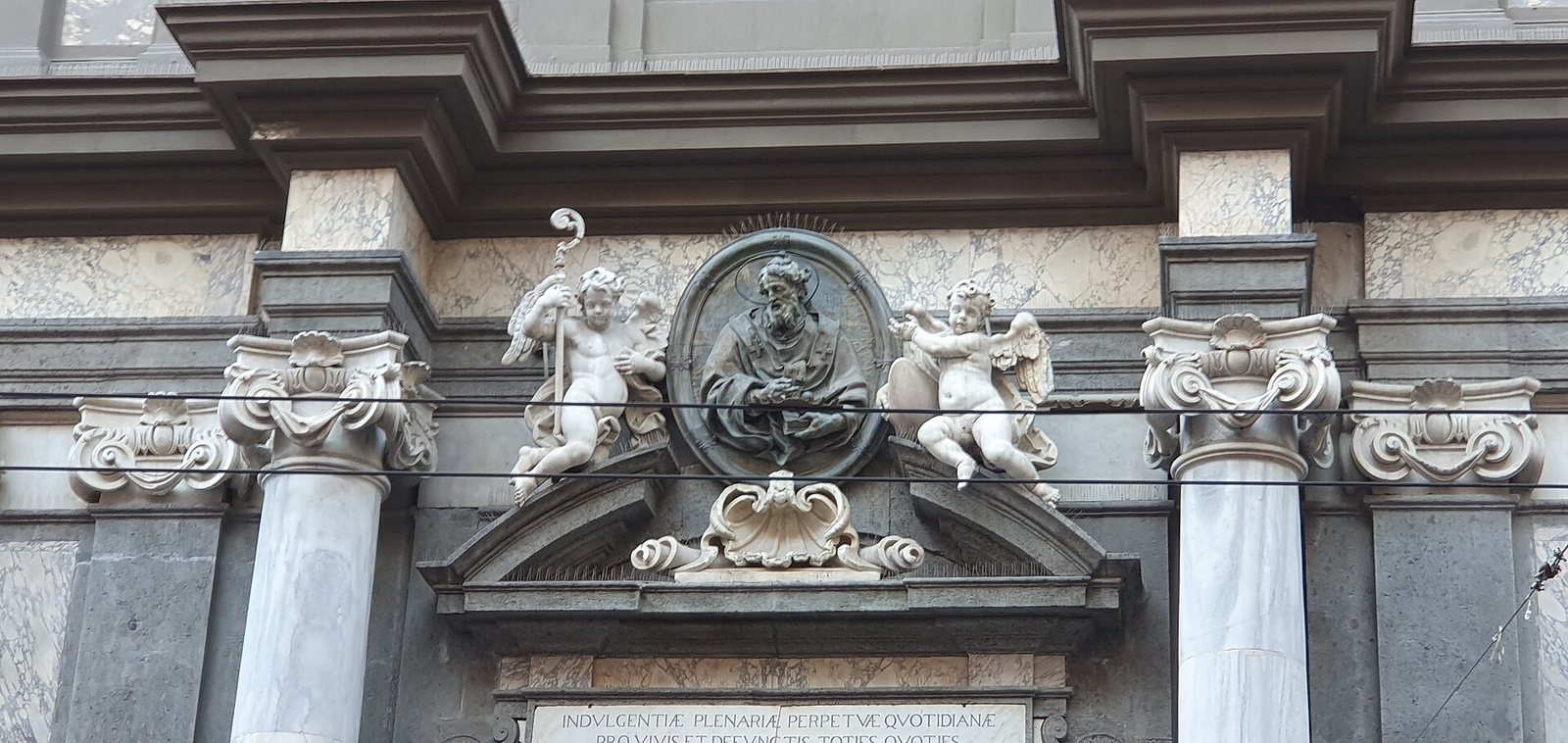
The façade has two levels, with the lower following Solimena’s design and the upper associated with Gandolfo. Three entrances stand above short stairways made of piperno, a volcanic stone used in the Naples region. Two marble angels above the central entrance support a bronze shield bearing a bust of Saint Nicholas. Francesco Pagano began the angels in 1725, and Paolo Persico completed them in 1775. A railing designed by Solimena once stood before the façade; it was removed during the 1957 renovation.
Nave and entrance end
Nave ceiling
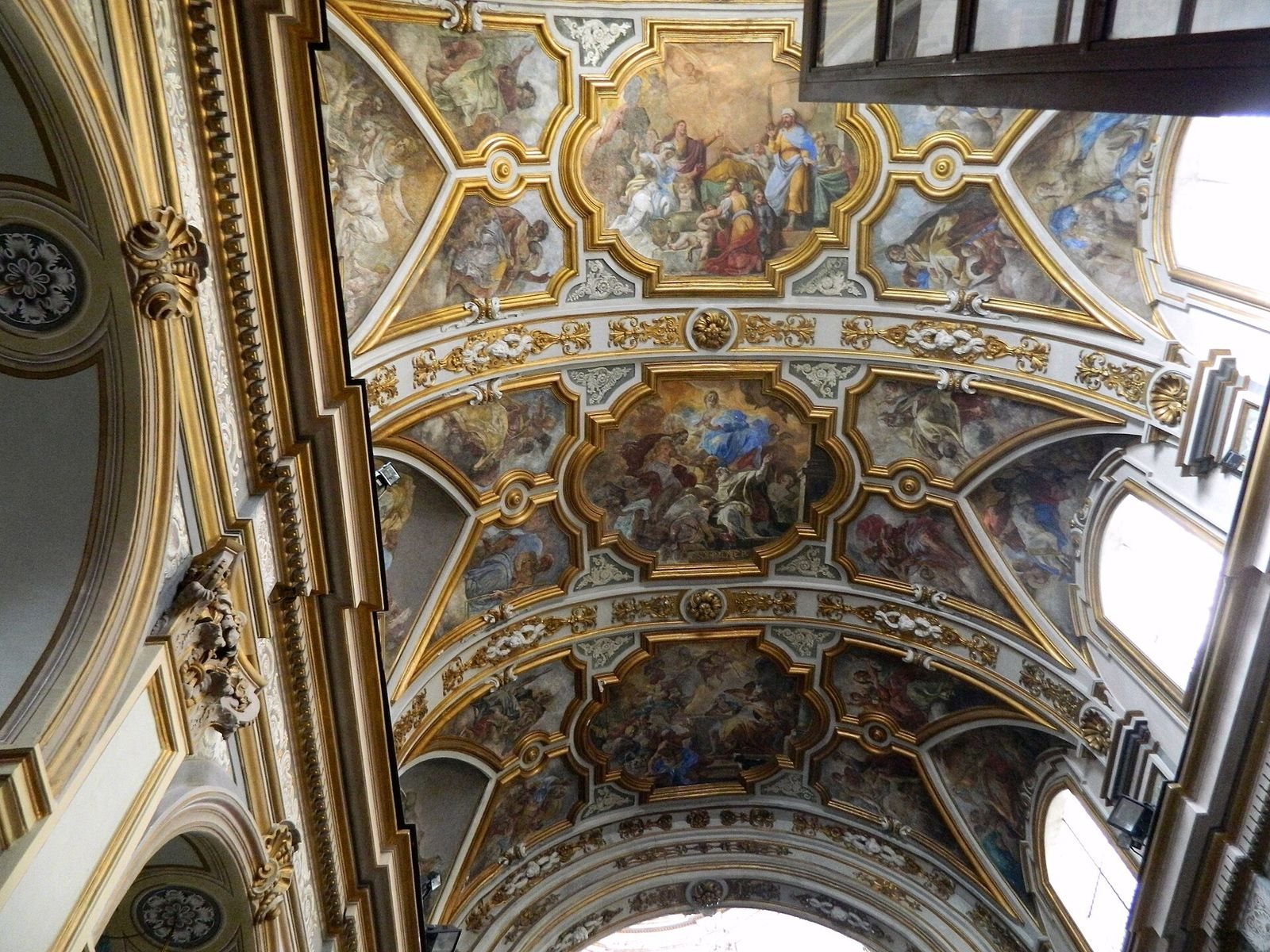
Francesco Solimena painted a three-part fresco cycle on the nave’s curved ceiling in 1696. Its central scenes show episodes from Saint Nicholas’s life, while the sections beside the windows depict virtues and apostles. From the entrance toward the transept, the scenes are the Birth of Saint Nicholas, the Liberation of the Saint, and the Abduction of the Child Basil.
Inside entrance wall
The wall opposite the entrance carries Paolo de Matteis’s 1712 painting of Saint Nicholas driving demons from a tree. Curved panels beside the central window contain two paintings by Solimena, dated 1697, showing the Preaching of Saint Paul and the Preaching of Saint John the Baptist.
Side chapels
Chapel of Saint Joseph
The first chapel on the left is dedicated to Saint Joseph. Paolo De Majo painted its altarpiece (an artwork placed on or behind an altar), which shows the Marriage of the Virgin and Saint Joseph. His paintings of Saint Charles Borromeo and Saint Andrew of Avellino are also in the chapel.
Chapel of Saint Nicholas
Built in 1646, this is described as the church’s oldest chapel. Its seventeenth-century altarpiece depicts Saint Nicholas of Bari as Bishop of Myra. Nicola Maria Rossi painted a cycle showing the Eternal Father, and three paintings by Francesco De Mura and Rossi depict miracles attributed to Saint Nicholas. De Mura also painted a cycle in the small dome before the chapel in 1729.
Chapel of the Guardian Angel
Giovanni Battista Lama’s altarpiece depicts the Guardian Angel. Two paintings by Pietro Bardellino show Saint Francis of Paola and Saint Apollonia. In the space between this chapel and the transept, an unidentified artist working in Mannerist style, which developed between the Renaissance and Baroque, painted Saint Nicholas with Christ and the Virgin. A painting of Saint Sebastian tended by Saint Irene there is attributed to Francesco Peresi.
Chapel of the Holy Trinity
In the first chapel on the right, Nicola Maria Rossi’s altarpiece depicts the Trinity. Giacinto Diano painted two scenes on the side walls, showing Tobias’s departure and arrival. The chapel also contains a seventeenth-century bust of Carlo Carafa and a wax death mask made on the day he died.
Chapel of the Crucifix
A wooden crucifix carved by Nicola Fumo in the late seventeenth century stands in this chapel. Leonardo Pozzolano’s paintings on its side walls depict Saint Mary Magdalene and Saint John the Evangelist.
Chapel of Saint Liborius
The third chapel on the right was first dedicated to Saint Michael and took the name of Saint Liborius in 1773. Francesco De Mura painted its altarpiece of Saint Liborius, as well as images of the Archangels Michael and Raphael. In the space between the chapel and the transept hang two paintings by an unidentified follower of Luca Giordano.
Transept and altar area
Transept ceiling and left chapel
Frescoes by Alessio D’Elia decorate the transept ceiling. The chapel on the left is dedicated to Saints Peter and Paul and has a 1684 altarpiece by Solimena showing the Virgin among the two saints. A painting by De Mura of the Visitation of the Virgin Mary to Saint Elizabeth is on the sacristy door, beside the single chapel in the presbytery (the area around the main altar) on the left of the apse.
Chapel of the Saints in Glory
The right transept chapel, dedicated to the Saints in Glory, contains Solimena’s altar painting of Saint Francis and Saint Anthony. A sculpture of the Ecce Homo, Christ shown before his crucifixion, occupies a side niche. De Mura’s Adoration of the Shepherds is set at an angle beside the presbytery wall. A room opening from this side of the transept serves as a private parish space.
Dome, apse, and associated spaces
Dome
Traces of frescoes by Francesco De Mura remain in the dome. Paradise occupies the center, while eight saints recognized in Catholic tradition for the importance of their teaching appear in the short wall sections between the upper windows. Four curved triangular supports beneath the dome carry scenes of the Evangelists by De Matteis.
Apse and main altar
The apse contains a high altar of marble in several colors, decorated with inlaid marble. Antonio Troccola made it in 1743 to a design by Mario Gioffredo. Behind the altar is De Matteis’s large painting of the Death of Saint Nicholas, dated 1707. The church’s original floor, laid in the middle of the eighteenth century, was replaced during the building-wide renovation of 1957.
Nativity scenes
Church-owned Nativity scenes are displayed in a room beneath the building during the Christmas period.