Santa Maria Maddalena: A Roman Catholic Church in Ellera, Italy
Site at a Glance
- Popularity
- Very Low
- Country
- Italy
- Primary era
- Early Modern
- Eras represented
- Medieval, Early Modern
- Civilizations
- Genoese, Holy Roman Empire
- Site type
- Religious
- Remains
- Church
On this page12 sections
History
Santa Maria Maddalena is a Roman Catholic church in Ellera, Italy, consecrated in 1590 to replace a ruined medieval church dedicated to Santa Maria. The earlier church stood in the locality of Eremita, where its position allowed control of the road through the valley. The complex remains a place of worship in the Diocese of Savona-Noli, a church district overseen by a bishop.
Medieval origins
The predecessor church was probably founded in the second half of the tenth century, as Ellera began to take shape. Monks from San Salvatore Abbey at Giusvalla may have established it. Local legend instead attributes the church’s foundation to a hermit who settled nearby; a traditional saying also recalls a nearby well associated with the hermit.
In 991, Anselm, Marquis of Savona, a high-ranking territorial noble, granted San Quintino Abbey at Spigno Monferrato land that included the church site. San Quintino was a monastery governed by an abbot and had been founded after Giusvalla was destroyed. A papal bull, a formal document issued by a pope, from Alexander III in 1179 confirmed the abbey’s properties and referred to two churches at Ellera. These are identified as Santa Maria and San Salvatore, a church that has since vanished. A notarial document from 1213 records work at Santa Maria.
Rebuilding and parish use
A church list from 1530 described Santa Maria as ruined. During a visit in 1585, Bishop Nicolò Mascardi ordered repairs to the rural chapel of Our Lady, giving the community two months to complete them before demolition. The villagers chose to build a new place of worship instead. Santa Maria Maddalena was consecrated in 1590.
The larger church could accommodate Ellera’s population. In 1621, the parish priest of D’Atu authorized a permanent priest there. Ellera separated from the parish of San Nicolò of D’Atu in 1628, and Santa Maria Maddalena served as its parish church until 1643, when San Bartolomeo was consecrated.
After 1643, Santa Maria Maddalena became the seat of the Disciplinati, a lay religious association whose members practiced penitential devotion. It served this role for about forty years. A new chapel beside San Bartolomeo was inaugurated in 1682.
Hermit, burials, and restoration
During the first half of the eighteenth century, the complex housed Michele Manica, a hermit from Sardinia. Local tradition credits him with introducing olive cultivation to the valley. Ellera’s inhabitants held him in high regard, and he was buried in the church after his death in 1742.
Burials took place at Santa Maria Maddalena from 1829 to 1832. A cemetery was planned afterward, but limited space led to the selection of the site of Ellera’s present cemetery. During a cholera epidemic in 1835, land below the church was used again for temporary burials.
The church was restored in 1965 at the initiative of the priest Giovanni Vallarino, and further repairs followed. Mass continues to be celebrated there on the feast of its titular saint.
Remains
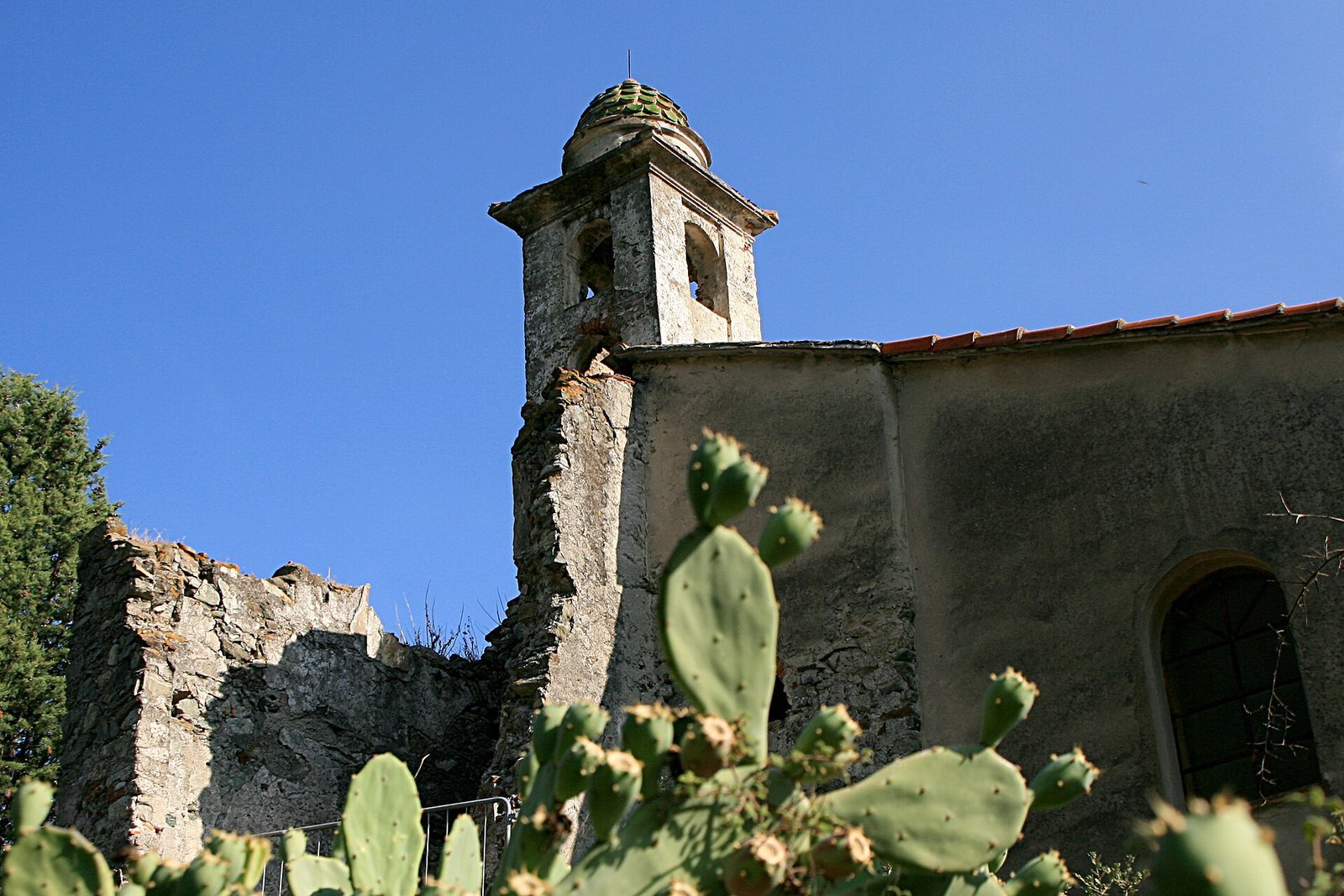
The complex brings together the small medieval ruin and a later rectangular church, with a bell tower partly supported by the older walls. The medieval building has a cross-shaped ground plan, while the later church is arranged as a single main hall beneath a vaulted ceiling.
Medieval Santa Maria
Plan and surviving fabric
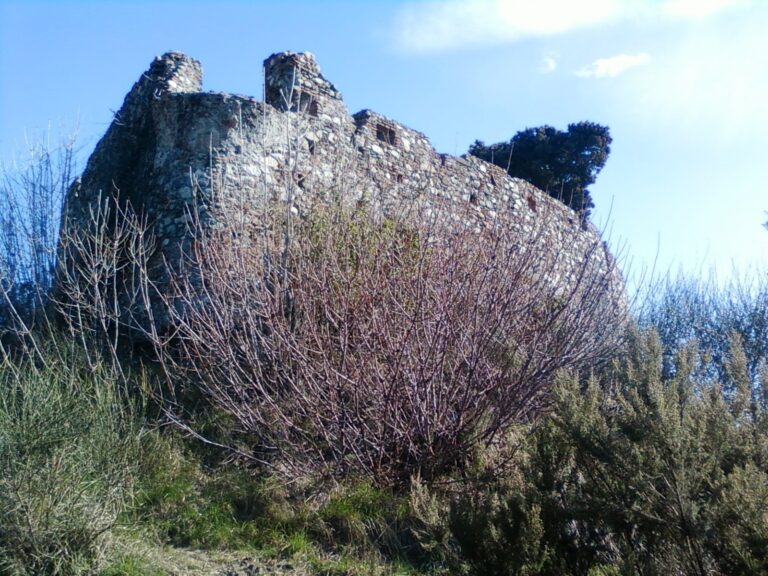
The medieval ruin stands on a rocky base beside a bend in the Sansobbia, about 500 metres downstream from the village. It measures approximately 6.4 metres long by 6 metres wide. Its west-facing entrance end lies opposite the choir at the east. The narrow, elongated main hall bends left near two square side chapels, both oriented east and originally covered by barrel vaults, or continuous arched ceilings. Excavation marks remain in the ground, and the rock is prone to breaking apart, a possible cause of the building’s ruin.
The walls, about 60 to 65 centimetres thick, consist of river stones set in lime mortar. Much of the entrance facade and the first half of the right wall have collapsed, while the standing side walls retain traces of one niche on each side. A portion of the vault above the main hall survives at the base of the bell tower. The floor remains in patches, made of roughly beaten lime laid directly on the stone.
Choir and painted decoration
The elongated, rounded choir, the area associated with the clergy, ends in a rounded apse, a projecting end of the church. Its curved ceiling and a small, partly altered window survive, along with a square niche with a flat back used to store church furnishings.
Painted fragments remain on the rear wall. In the apse, Christ appears against a starry background, his head framed by a mandorla, an almond-shaped border. Outlines of two heads beside him may represent angels. The painting can be dated only broadly to the thirteenth through fifteenth centuries. A red band decorates the choir arch, and a lower border about a metre high carries brown rosettes on a white ground.
The later church and bell tower
Church hall and additions
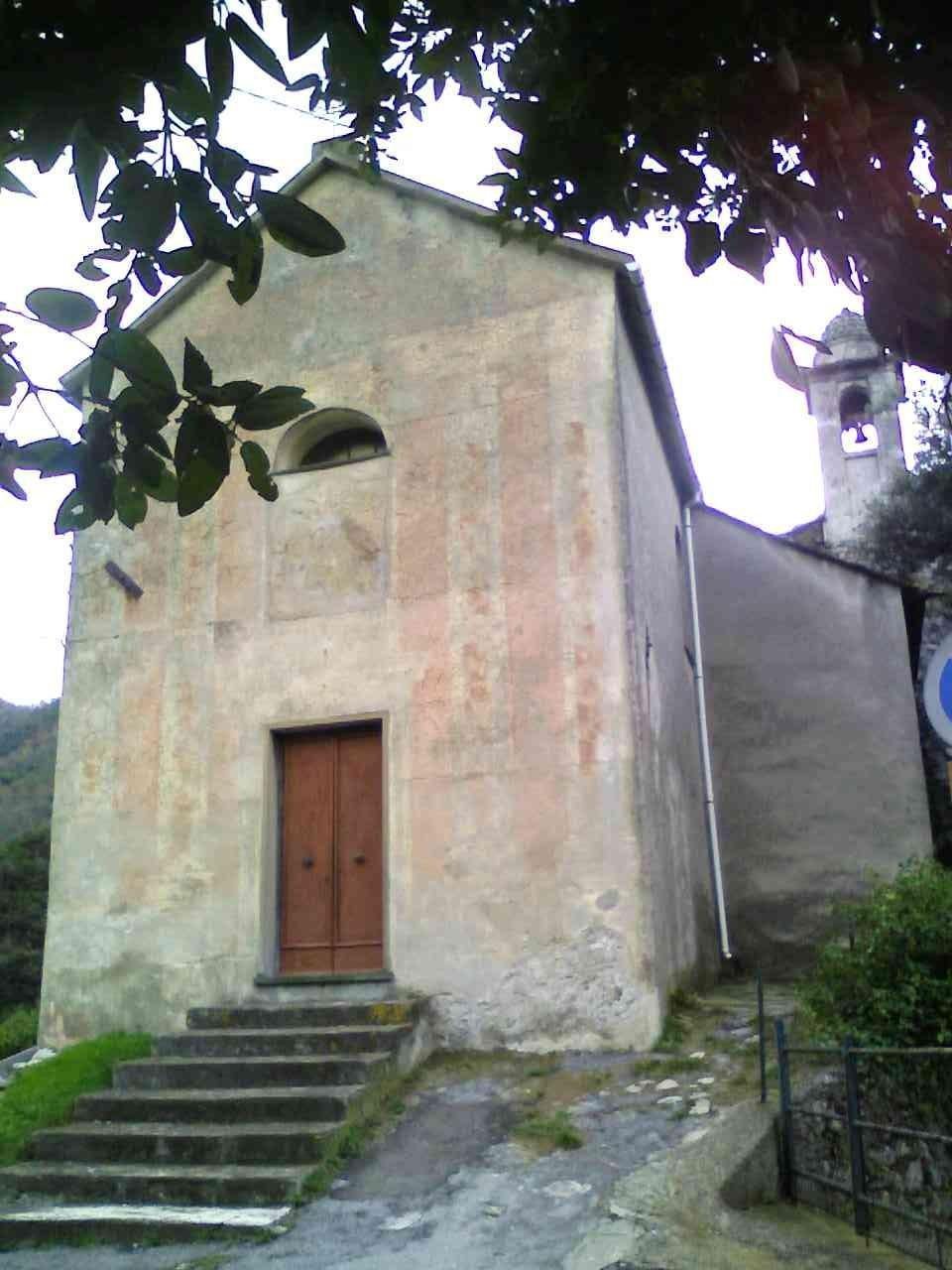
The later church has a simple rectangular hall with a single main space. Its two-sloped roof rests on wooden supports, and the interior ceiling is a barrel vault. Decorative imitation columns on the side walls meet a projecting horizontal molding that runs along part of the perimeter. The peaked facade has a large central semicircular window above the entrance. The church was enlarged and repaired several times: the choir was extended, and a sacristy, a room for clergy and church furnishings, was added on the river-facing side.
Bell tower
The bell tower partly rests on the medieval church’s walls and was probably built while Santa Maria Maddalena served as the parish church. Its upper dome is covered with glazed, curved tiles. One tile bears the date 1774 and the name Giuliano Giuseppe Grasso, pointing to a probable repair at that time.
Wooden statue
The church contains a wooden statue of Saint Mary Magdalene, the New Testament figure traditionally identified as a follower of Jesus.