Methven Castle: A Historic House and Estate in Scotland
Site at a Glance
- Popularity
- High
- Country
- United Kingdom
- Primary era
- Early Modern
- External website
- Open
- Eras represented
- Early Modern, Modern
- Civilizations
- British, Kingdom of Scotland
- Site type
- Domestic
- Remains
- Castle
On this page10 sections
History
Methven Castle is a historic house near Perth in Scotland, United Kingdom. Its present house was built in 1664, while the estate’s earlier history reaches back to the 12th century and includes its connection with Margaret Tudor, queen of James IV.
Medieval landholding and royal visits
The Mowbray family held the lands of Methven from the 12th century. They supported John Balliol’s claim to the Scottish throne against Robert the Bruce, who later became King of Scots. After Bruce prevailed, the Mowbrays lost the estate, and the Crown granted it to Walter Stewart, Bruce’s son-in-law. Walter’s descendant, Walter Stewart, Earl of Atholl, was later deprived of the lands after becoming involved in a plot to kill King James I.
Methven Castle was besieged in 1444. King James II visited in 1450, and James IV came several times during the 1490s.
Margaret Tudor and the Stewart estate
On 29 May 1503, James IV gave the castle to Margaret Tudor, daughter of Henry VII of England, as part of her marriage gift. After marrying Henry Stewart, 1st Lord Methven, in 1528, she lived at the castle and died there on 18 October 1541.
When the 3rd Lord Methven died without an heir in 1584, James VI granted the lands to his favorite, Ludovic Stewart, 2nd Duke of Lennox. Patrick Smythe of Braco bought the estate in 1664.
The Smythe house and estate
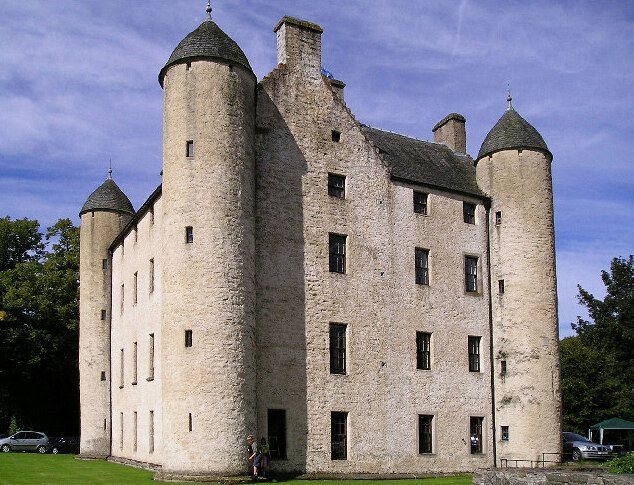
The present house was designed and built in 1664 by mason-architect John Mylne, and may incorporate earlier work. An early plan by Patrick Smythe resembles the plan of Pitreavie Castle near Dunfermline. James Smith may also have been involved in the design. An eastern wing was added, followed by a western extension with a bay window around 1815, probably designed by James Gillespie Graham.
The Smythe family retained the estate through the 18th and 19th centuries. Parkland was laid out from the late 18th century, and David Smythe, Lord Methven, planted many of the estate’s woodlands. His son William expanded the estate. Woodland management continued into the 20th century, but the gardens were neglected; many trees were cut down in the 1950s, including much of the pinetum.
Changes in the 20th century
The castle was sold in 1923 and changed hands several times. The west wing had been removed in the 1950s, and the clock tower was demolished around 1965. In 1984, owner and architect Kenneth Murdoch began extensive restoration. The east wing was demolished during this work, and the surviving 17th-century house received a new roof.
Methven Castle is a Category A listed building, a Scottish designation for buildings of special architectural or historic interest regarded as nationally or internationally important. Its parks and gardens are included in Scotland’s national Inventory of Gardens and Designed Landscapes.
Remains
The surviving house forms the core of the estate, whose grounds include parkland, a walled garden, conifer planting and glasshouses. The main building is a compact, four-storey block with narrow round towers at its corners.
The house
The house is square in plan and finished with harling, a rough coating applied to external walls. Each corner tower has a curved roof that changes direction along its profile. On the north front, two gables with stepped edges are connected by a balustrade. A central wall running through the house may preserve earlier work. The original interiors were remodelled in 1800; a staircase is the sole surviving element from that earlier interior.
Grounds and trees
Gardens and conifer planting
A walled garden was created in 1796, and a pinetum, a collection of coniferous trees, was established in 1830. It is considered the first pinetum in Scotland. Glasshouses were also built as the estate expanded.
Pepperwell Oak
The Pepperwell Oak is the estate’s largest surviving tree. Its girth measured 22 feet 10 inches (6.96 metres) in 1985. In 1883, the tree was thought to be already about 400 years old.