Riedebeck Village Church: A Late Romanesque Parish Church in Germany
Site at a Glance
- Popularity
- Very Low
- Country
- Germany
- Primary era
- Medieval
- Eras represented
- Medieval, Early Modern, Modern
- Civilizations
- German, Holy Roman Empire
- Site type
- Religious
- Remains
- Church
On this page15 sections
History
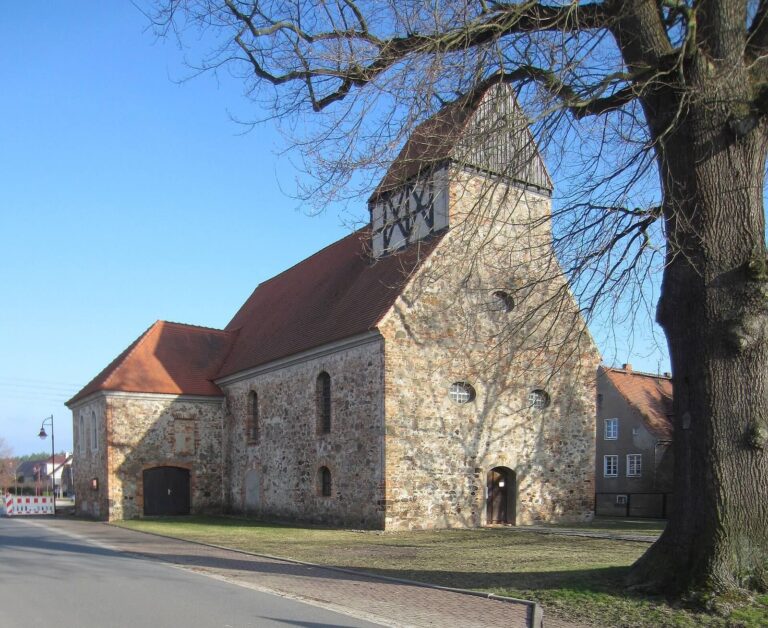
Riedebeck village church is a medieval church in Riedebeck, Germany, built in the late Romanesque style, a later phase of Romanesque architecture. Its choir and nave were completed in a largely unified campaign during the first half of the thirteenth century. The church preserves extensive late Gothic wall paintings in its eastern interior.
It belongs to Langengrassau parish, within the Gehren parish district and the Niederlausitz church district of the Evangelical Church of Berlin-Brandenburg-Silesian Upper Lusatia.
Construction and medieval development
Architectural historian Dirk Schumann places construction of the eastern parts around 1220–1230 and considers the choir and nave to have been built as part of a broadly unified campaign in the first half of the thirteenth century. He dates the west tower to the second half of that century. Dates of 1192–1204 probably concern an earlier church. Timbers used for scaffolding have been dated to 1178 and 1179, but neither these dates nor the earlier building dates establish that construction of the present church began before 1200.
Schumann considers it possible that the medieval noble family of von Ileburg supported the church. The family held property at Riedebeck, and such patronage may help account for the scale of a church serving a small parish district.
Baroque changes
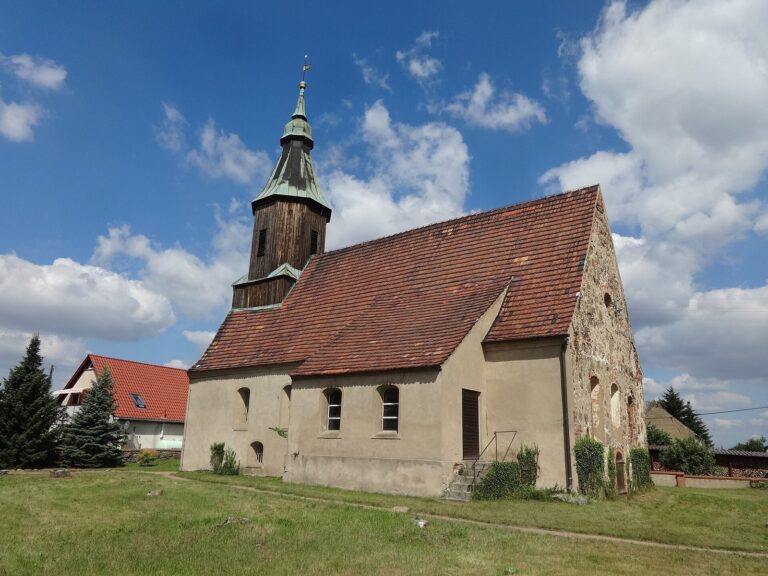
During the Baroque period, a later European artistic and architectural style, the nave’s south windows were enlarged and the arch between nave and choir was blocked to accommodate a new pulpit altar, which combined pulpit and altar. The winged altarpiece was moved to the nave’s north corner, while a stucco ceiling and a baptismal angel were added.
War damage and modern restoration
The church apparently suffered damage during the Second World War. In spring 1954, the parish council reported fallen ceiling plaster and a leaking roof. By 1957, insect damage had weakened the roof structure enough to threaten collapse.
Restoration between 1952 and 1962 removed most of the Baroque interior and reduced the enlarged windows to their earlier dimensions. The Baroque altar and other furnishings were transferred to the church at Werben, while the late Gothic carved altar remained at Riedebeck. Opening the arch between nave and choir exposed wall paintings in the choir and apse. During floor work in summer 1960, workers also uncovered a medieval tiled floor 30–40 centimetres beneath the previous level.
Rain entering through renewed roof leaks at the four gable corners damaged the wall paintings in 1964. Experts considered shock waves from supersonic aircraft a possible cause. About a decade later, aircraft shock waves damaged a cornice, and fungal decay again harmed the interior. By 1995, water ingress had destroyed several paintings; fungal damage led to the church’s official closure in May. Roof repairs followed from 1995 to 1998, with work on windows and walls continuing through 2010.
Conservation of the painted interior, except for the Crucifixion, took place between 2009 and 2011. By 2024, parts of the apse paintings had been restored, while other areas had received emergency treatment that year. Further restoration began in November 2025, with completion targeted for summer 2026.
Remains
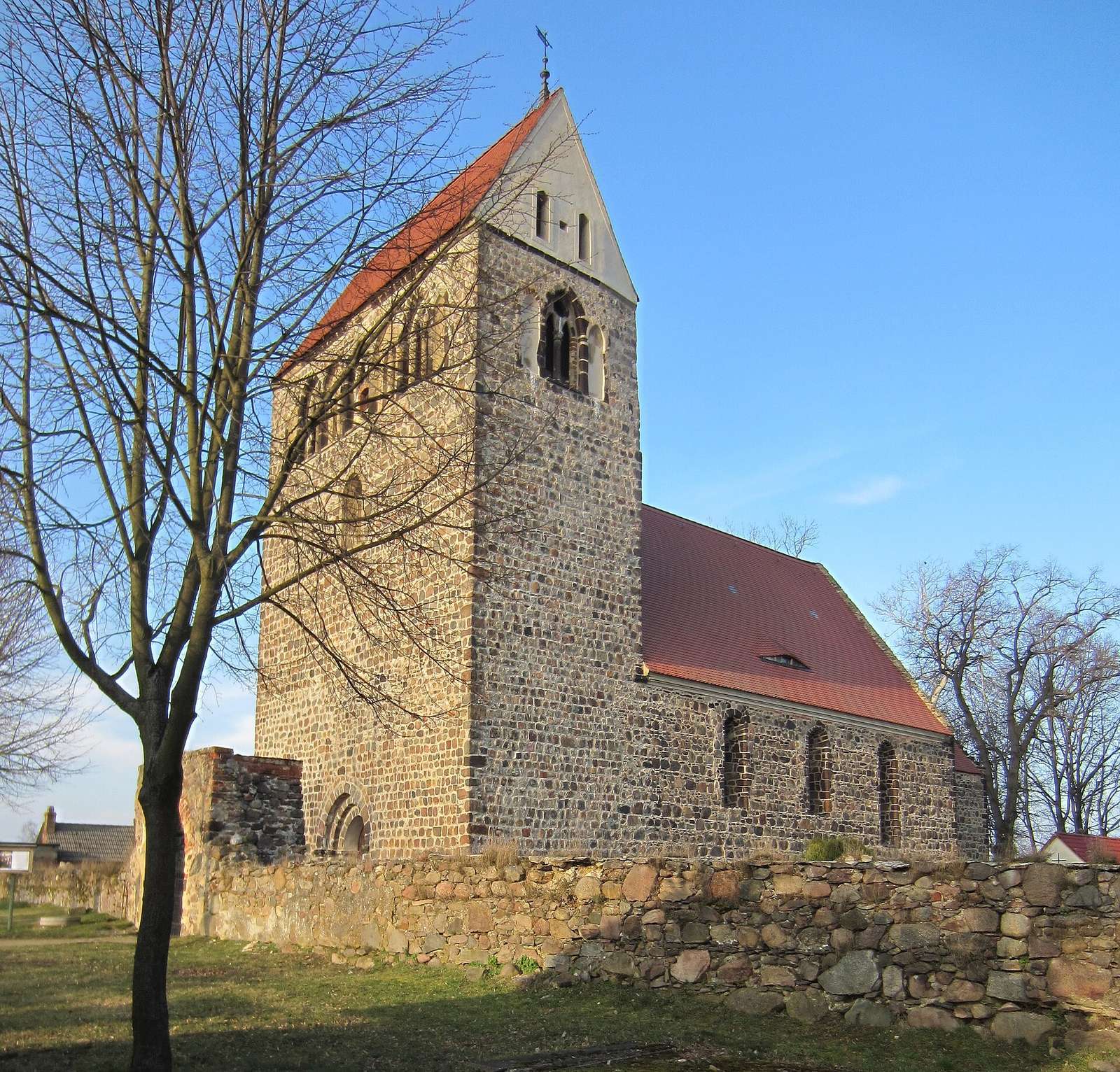
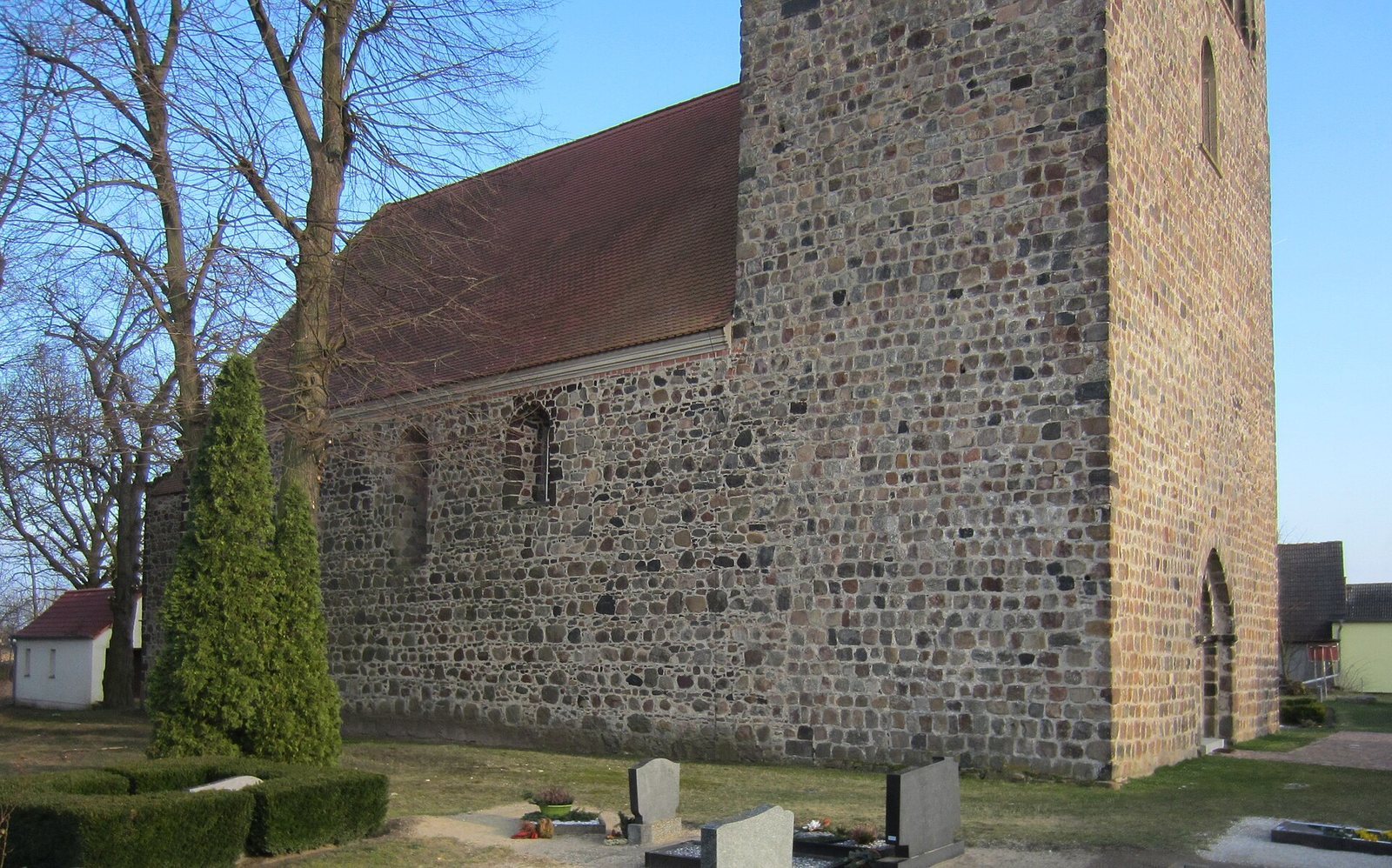
The church’s plan follows a stepped sequence of apse, choir, nave, and tower. Its walls are chiefly fieldstone masonry, made from naturally gathered stones; carefully dressed granite blocks form the apse and tower, while shaped architectural details use bog ironstone, an iron-rich stone formed in wetlands.
Exterior and tower
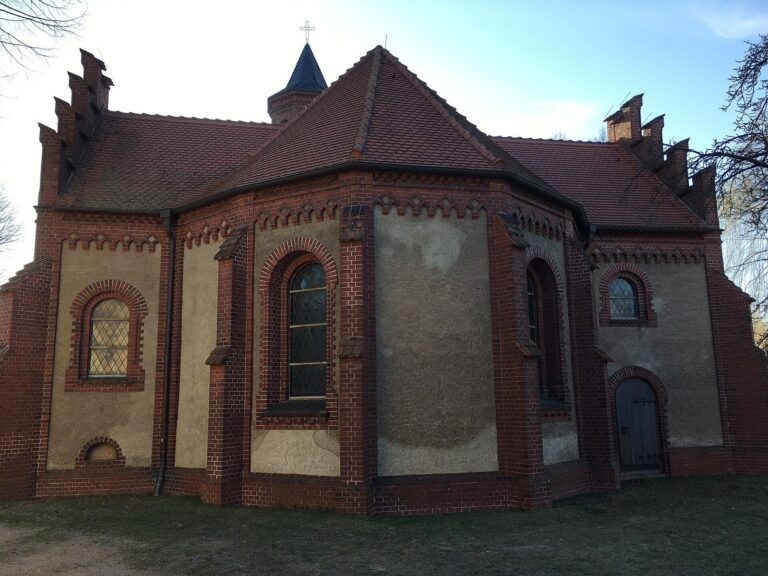
The apse is built from carefully worked fieldstones and is set apart by a round-arched frieze of bog ironstone. It joins the choir without a clear construction break; Schumann interprets its distinct treatment as emphasis on the eastern end rather than proof of a separate building phase. Late Romanesque windows survive in both apse and choir. Two south-side doorways have round arches supported by projecting impost blocks. The recessed west-tower doorway has a blunt-pointed arch and bog-ironstone imposts. Several blocks on the tower’s west face bear carved faces.
Tower and cemetery entrance
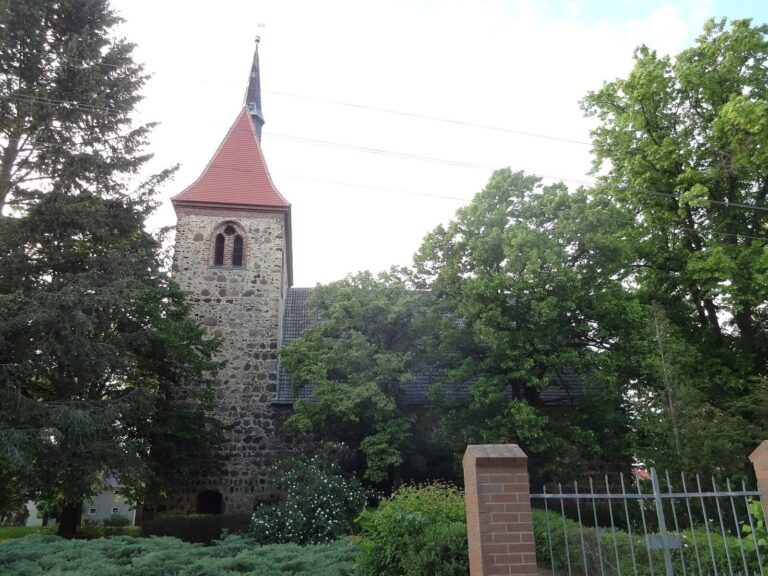
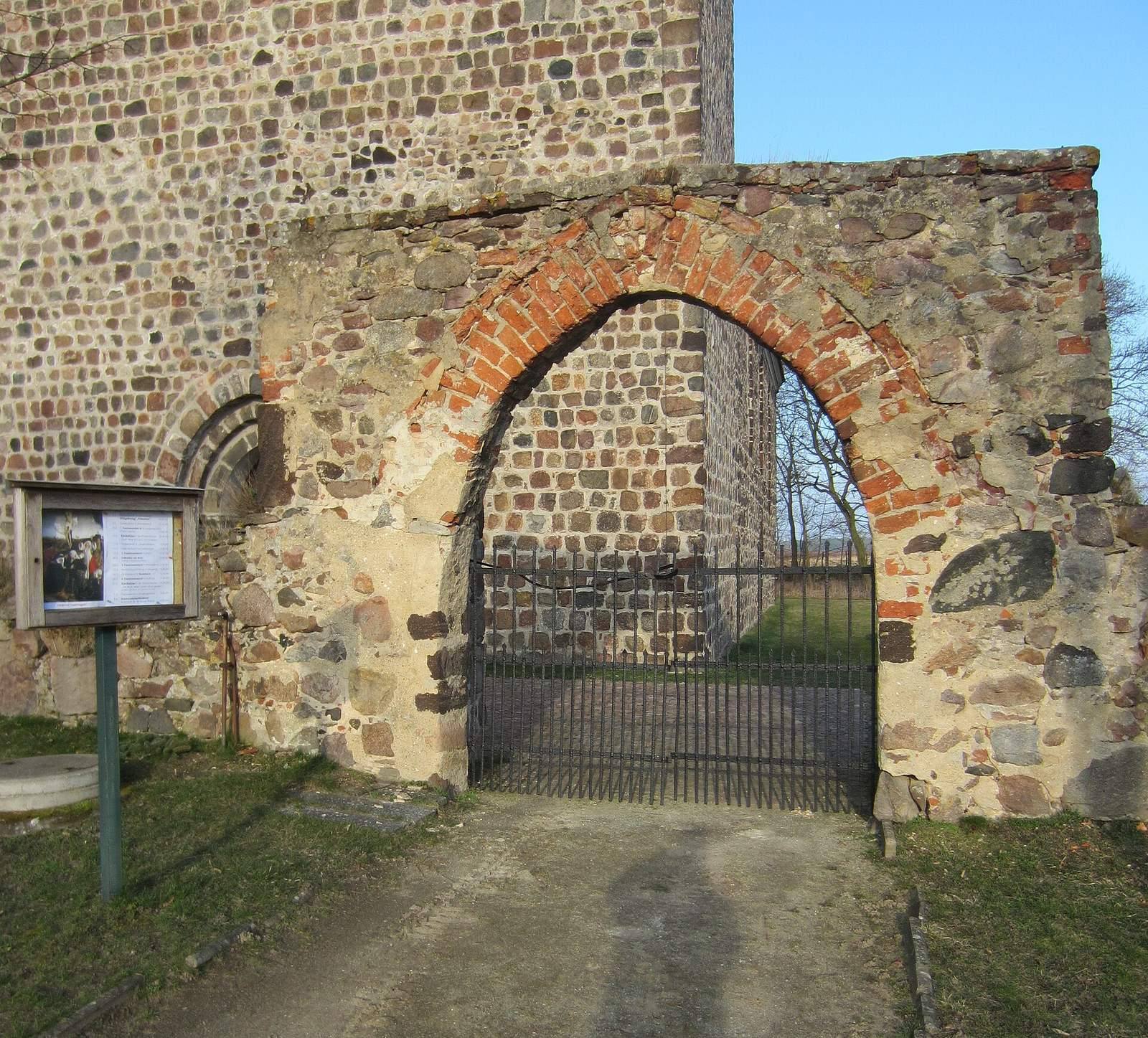
The tower’s bell stage, probably dating to around 1300, has pointed-arch decorative panels, some paired with openings for sound, as well as niches. Openings in the gables beneath its transverse gabled roof were added in 1902. At the cemetery entrance, a broad, slightly pointed portal survives from the late Gothic period.
Interior paintings
Triumphal arch
Remains of a monumental Crucifixion arranged as a Calvary, a depiction of Christ’s crucifixion at Golgotha, cover part of the wall around the arch between nave and choir. It is considered the largest known depiction of this type in Niederlausitz. The arch’s underside carries painted acanthus scrolls, which end below in a consecration cross on each side and the remains of a saint’s figure.
Choir walls
The south wall has large scenes from the legends of Saints Lawrence and George. Fragments of an inscription in small Gothic lettering run beneath them, with traces of painted curtain decoration lower on the wall. Six saints appear in framed panels at the northeast corner.
Seven further panels on the choir’s south wall show women riding animals; the figures may represent the seven deadly sins. An older painting above and to the left depicts standing figures against a red background. Another scene above and to the right has not been interpreted. The paintings, dating to around 1480, resemble work in the village churches of Beesdau, Goßmar, and Waltersdorf (Schönefeld), suggesting a regional workshop. Art-historical links have also been drawn with the church at Briesen. Water damage has severely harmed some paintings and destroyed others.
Apse paintings
The half-dome above the apse is richly painted with the risen Christ and a Deesis, an image of Christ accompanied by figures who intercede on behalf of humanity, commonly Mary and John the Baptist. A figure identified as a butter witch, a character in German folk beliefs about witchcraft and butter-making, appears beside John the Baptist. Two figures between the apse windows have been interpreted either as personifications of the Christian Church and Judaism or as the apostles Philip, carrying a cross, and Jude Thaddaeus, carrying a club.
Altars and furnishings
Carved altarpiece
The late Gothic carved altar stands before the arch between nave and choir. After receiving an unsuitable finish in 1962, it was restored toward its original appearance between 1998 and 2002. Its predella, the lower section of an altarpiece, shows Saint Catherine between two other saints on each side. In the central shrine, Saint Anne appears with the Virgin Mary and the infant Jesus, between Saints Barbara and Margaret. The inner faces of the wings show the Adoration of the Magi and three pairs of saints; their painted outer faces depict the Annunciation.
Carved decoration above the shrine includes the Crucified Christ between Mary and John, with the risen Christ above. Remains of another Annunciation are visible on the backs of the wings.
Altars in the apse
An early Gothic altar table of bog ironstone survives in the apse, with a late Gothic crucifix standing on it. The crucifix is probably about a century older than the carved altar, which dates to around 1500. A second medieval altar block also stands in the apse. Its altar-table slab has incised consecration crosses, marks associated with the ritual consecration of a church or altar; the block’s liturgical use remains unresolved.
Other furnishings
A large Romanesque baptismal font with a squat bowl was brought from Crinitz in the early 1960s. A Baroque pastor’s pew, with a grilled upper section, remains in the southwest corner of the nave. The organ, made by the Schuke firm in 1967, has seven stops, one keyboard, and a pedal.