White Lodge: A Georgian Royal Hunting Lodge in Richmond Park
Site at a Glance
- Popularity
- Very High
- Country
- United Kingdom
- Primary era
- Early Modern
- Eras represented
- Early Modern, Modern
- Civilizations
- British
- Site type
- Domestic
- Remains
- Elite Residence
On this page12 sections
History
White Lodge is a royal hunting lodge in Richmond Park, in the London Borough of Richmond upon Thames, England, United Kingdom. George II commissioned it in the Georgian period, associated with Britain’s Hanoverian kings named George; construction began in 1727 and was completed in 1730. The house follows English Palladianism, a classical style inspired by Renaissance architect Andrea Palladio. Roger Morris and Henry Herbert, 9th Earl of Pembroke, both worked on its design.
From Stone Lodge to White Lodge
Richmond Park had served as a royal hunting ground since at least the thirteenth century. The new lodge was first called Stone Lodge and later New Lodge, names that distinguished it from nearby Old Lodge. George II had built Old Lodge for Sir Robert Walpole, Britain’s first prime minister, who used it when hunting in the park.
George II’s wife, Queen Caroline, often visited the new house. After her death in 1737, it passed to her friend Sir Robert Walpole, and in 1751 their daughter Princess Amelia received it. Amelia was also the park’s ranger, the official responsible for its management. She restricted public entry, allowing only distinguished friends and people with permits. In April 1758, a case brought by local brewer John Lewis against a park gatekeeper overturned the restriction and restored public access.
John Stuart, 3rd Earl of Bute, succeeded Amelia as ranger after she resigned in 1760 and lived at the lodge from 1761 to 1792. A former British prime minister, he used it as his official address and was also entitled to use Old Lodge, where the Meadows family lived. Lady Mary Coke’s journal first records the name White Lodge on 24 July 1768. She also noted that George III and Queen Charlotte often spent Sundays there.
Sidmouth and royal residents
After the house fell into disrepair late in the eighteenth century, it was restored. In 1801 George III gave it to Henry Addington, 1st Viscount Sidmouth, and appointed him deputy ranger. On 10 September 1805, about six weeks before the Battle of Trafalgar, the British admiral Horatio Nelson visited Sidmouth at White Lodge. Nelson reportedly illustrated his battle plan by drawing lines on a table with a finger moistened with wine. Nearby Old Lodge was demolished between 1839 and 1841.
Sidmouth died at White Lodge in 1844. Queen Victoria then gave the house to her aunt, Princess Mary, Duchess of Gloucester and Edinburgh, who lived there until her death in 1857.
The Teck family and royal births
In 1858 Prince Albert selected White Lodge for his son, the Prince of Wales, the future Edward VII, to continue his education and prepare for military examinations. The prince lived there with five companions, including the Reverend Charles Feral Tarver, his Latin tutor and chaplain, and Frederick Waymouth Gibbs. He found the years there dull, and later continued his training in Ireland. Queen Victoria and Prince Albert stayed at White Lodge in early 1861, after the death of the Duchess of Kent.
Queen Victoria granted the house to Prince Francis, Duke of Teck, and his wife, Princess Mary Adelaide of Cambridge, in 1869. Mary Adelaide’s extravagant spending contributed to mounting debts, and the family went abroad in the 1880s to escape creditors. In 1891, Victoria selected their daughter Victoria Mary as a bride for her grandson Prince Albert Victor, Duke of Clarence. After his death in 1892, Victoria Mary married his brother, Prince George, Duke of York, in 1893.
Victoria Mary gave birth at White Lodge on 23 June 1894 to her first child, the future Edward VIII. Queen Victoria visited soon afterwards. Edward was baptized in the Green Drawing Room on 16 July, receiving the names Edward Albert Christian George Andrew Patrick David. The ceremony was conducted by Edward White Benson, Archbishop of Canterbury. Mary Adelaide died at the house in 1897, and Francis in 1900.
Private residents and the Royal Ballet School
After Queen Victoria’s death in 1901, White Lodge was occupied by the wealthy widow Eliza Emma Hartmann. The costs of maintaining the property contributed to her bankruptcy in 1909. In 1923 Prince Albert, Duke of York, the future George VI, and his wife spent their honeymoon there. Queen Mary, who had lived at White Lodge with her mother, insisted that they make it their home. They left in late 1925 because frequent visitors limited their privacy and the house was considered poorly situated and expensive to maintain. The Crown Estate then leased it to private residents.
Prince Alexander of Yugoslavia was born at White Lodge in 1924 while his mother was staying there. He was baptized at the house, with the Infanta Beatriz of Spain among his godparents, and was the last royal born there. Arthur Lee, 1st Viscount Lee of Fareham, lived at White Lodge from 1927. Colonel James Veitch, its last private resident, remained until 1954.
In 1955 the Sadler’s Wells Ballet School received permanent use of the house. After gaining a Royal Charter, a formal instrument issued by the monarch to establish or recognize an organization, it became the Royal Ballet School in 1956. The school teaches students aged 11 to 16 and continues to use White Lodge. As part of redevelopment, its ballet museum was enlarged and moved to include a gallery and collections about the house’s history. The museum opened to the public in 2009 and closed in 2015. White Lodge remains part of the Crown Estate, property held by the monarch in right of the Crown and managed independently. It has been Grade I listed, England’s highest listed-building category, since 10 March 1981.
Remains
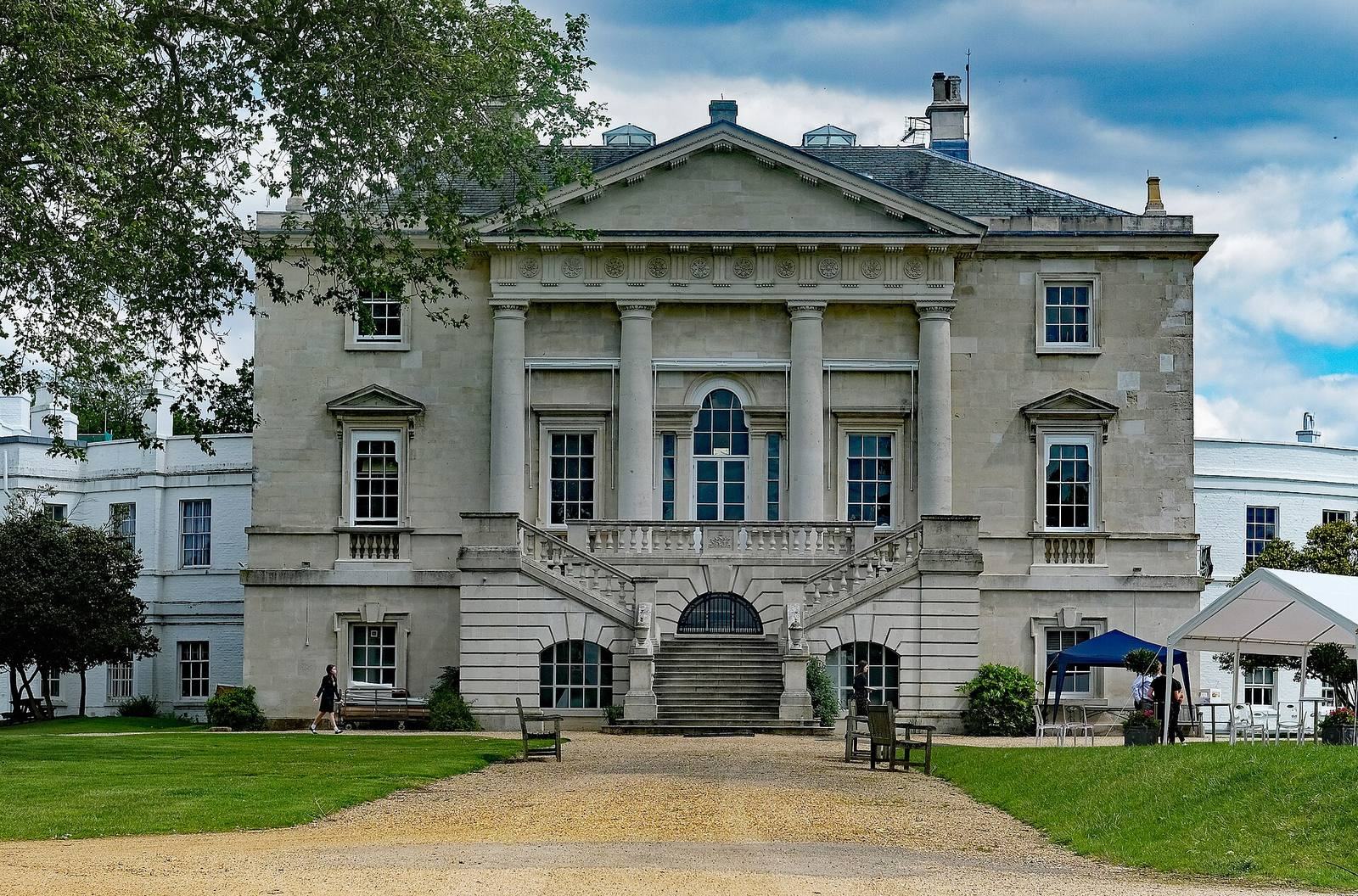
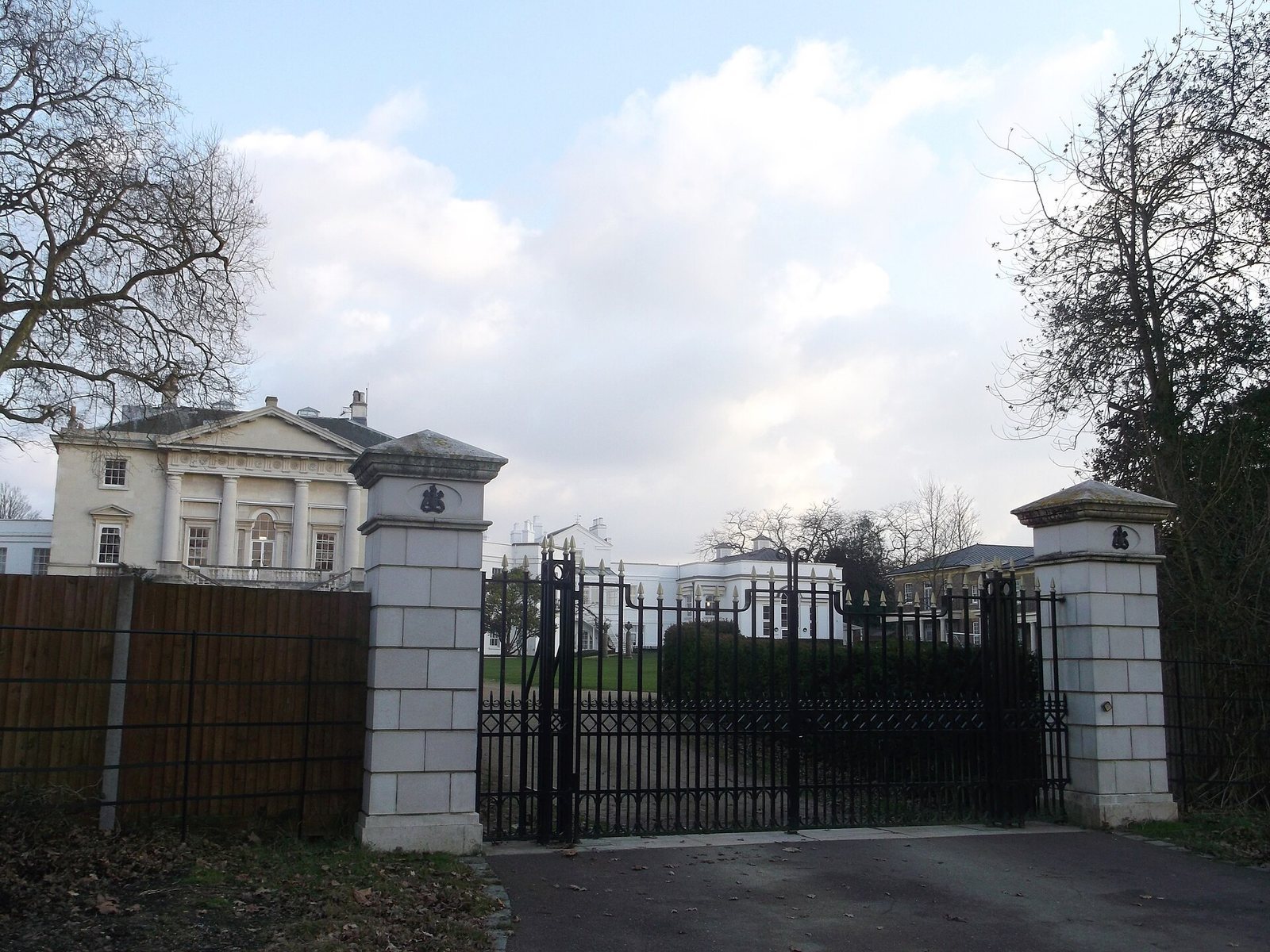
White Lodge has a cubic main block flanked by two side wings. Its English Palladian design draws on classical architecture, and its white limestone exterior is associated with the house’s name. The arrangement combines a columned entrance, a raised basement and the flanking wings.
The house
Main block
The main block has a projecting portico, a roofed entrance supported by four columns, beneath a plain pediment, the triangular feature above it. A symmetrical staircase with two flights leads up to the raised basement, the lower storey elevated above ground level. The façade is made of white limestone.
Side wings
Two white wings flank the main block. Designed by Stephen Wright, they were added during Princess Amelia’s tenure and remain part of the house.
Interior and grounds
Interior
The Green Drawing Room is a named room within the house. During their residence, the Duke and Duchess of Teck carefully decorated White Lodge and used both its main block and side wings.
Gardens
In 1805 Henry Addington enclosed the lodge’s first private gardens. Landscape designer Humphry Repton later assisted with the gardens.