Neustift Abbey: An Augustinian Monastery and Center of Hospitality in Italy
Site at a Glance
- Popularity
- High
- Country
- Italy
- Primary era
- Medieval
- Eras represented
- Medieval, Early Modern
- Civilizations
- Habsburg, Holy Roman Empire
- Site type
- Religious
- Remains
- Fortified Monastery
On this page22 sections
History
Neustift Abbey is an Augustinian monastery in Novacella, Italy, founded in 1142 by Hartmann, bishop of Brixen. Its architecture grew from Romanesque and Gothic medieval forms to Baroque and Rococo work of later centuries. The abbey became a center of religious life, learning, and hospitality, offering aid to travelers, pilgrims, sick people, and the poor.
Foundation and medieval privileges
Hartmann’s plans for reform in Brixen met resistance from the cathedral canons, who opposed the introduction of the Rule of St Augustine, a framework for communal religious life. In 1140, Archbishop Konrad I of Salzburg appointed Hartmann bishop of Brixen. Two years later, with support from Reginbert of Säben, Hartmann founded Neustift and brought Augustinian canons and lay brothers from Klosterneuburg. The new house formed part of Salzburg’s church-reform efforts, which aimed to strengthen clerical education and pastoral care amid disputes between popes and emperors.
Reginbert and his wife Christina were the principal lay founders. Reginbert endowed the abbey with land and estates across the region and in Bavaria; Hartmann also contributed property. The abbey stood about three kilometres north of Brixen, near the route into the Puster Valley. Alpine north-to-south travel met east-to-west routes there, making the site useful for a community that welcomed people travelling between northern Europe, Rome, and the Holy Land. Neustift began as a double monastery, housing communities of men and women, with women mentioned in records until about 1300.
In 1143 Pope Innocent II confirmed the foundation and its possessions, exempted it from ordinary church jurisdiction, and granted it rights that included electing its head, the provost, and its lay protector, or advocate. The abbey could also bury people from outside its community. In 1157, Emperor Frederick Barbarossa of the Holy Roman Empire, a central European polity, issued a protection charter. Hartmann confirmed Neustift’s rights and property and granted it the parish of Natz. In 1177, Emperor Frederick reaffirmed earlier privileges, including ownership of the silver mines at Villanders. Pope Alexander III confirmed the abbey’s rights that year and granted it exemption from public taxes and a degree of legal immunity.
Control over the election of the provost remained contested. In 1164, Bishop Otto of Andechs set aside the preference of the deceased provost Heinrich I. Neustift initially remained under its advocate’s jurisdiction, but gradually gained its own court authority over its connected estates. The advocates came first from the counts of Morit-Greifenstein, then the Andechs family; after the Andechs margrave Heinrich was outlawed, Albert III of Tyrol took the role. Their protection also brought a measure of dependence. A peace settlement in 1271, reached during conflict between the regional ruler and the bishops of Brixen and Trento, secured a judicial privilege for Neustift. Emperor Sigismund confirmed it in 1434.
Rebuilding, growth, and pilgrimage
A major fire in 1190 led to rebuilding under Konrad II of Rodank, the abbey’s provost, or head. The abbey church was reconsecrated in 1198, along with a newly built hospital chapel dedicated to the Redeemer at the complex entrance. Neustift later gained patronage rights over the parish of Olang in 1221, the parish of Völs in 1257, and the parish of Assling in 1261. Such rights could include presenting a candidate for a parish priest.
Neustift’s hospitality continued to draw travelers and pilgrims. Its hospital had ceased operating sometime between 1463 and 1557. By about 1500, the main medieval pilgrimage movement had declined, and the hospice and its chapel had completed their original work. Substantial cells on the lower level were later used as prison cells. The abbey’s landholding had meanwhile grown: by 1500 it held 542 farms and at least 82 vineyards, along with houses, farmsteads, mills, meadows, fields, gardens, and tithes.
The monastery also developed as a center of learning and religious culture. Between 1439 and 1446, canon Friedrich Zollner produced a two-volume gradual, a book of liturgical chants. Stephan Stetner made a missal, a book containing texts for Mass, which was displayed at the Vienna World’s Fair in the late nineteenth century. The abbey’s choral singing was also noted for its quality. In 1483, the Dominican theologian Felix Faber described the church, its ornaments, and its manuscript library.
Fortification and peasant unrest
Fear of attacks by the Ottoman Empire, a major power expanding across southeastern Europe and the eastern Mediterranean, grew after Constantinople fell in 1453. Concern increased when Ottoman forces approached Klagenfurt in 1474 and entered Carinthia in 1476. From 1483, Provost Lukas Härber expanded Neustift’s fortifications. Material for a defensive wall came from a Gothic church building then being dismantled.
The early sixteenth century brought a cattle epidemic, a serious crop failure in 1520, and flooding by the Eisack that destroyed a bridge and parts of an inn. A fire also damaged service buildings. Heavy peasant dues and resentment of clerical and aristocratic privilege contributed to unrest, and revolt was narrowly avoided in 1520. During the wider uprising that reached Tyrol in 1524, Michael Gaismair became a leading figure. After negotiations failed, insurgent peasants stormed and plundered Neustift, causing serious damage. The revolts of 1525 also cost the abbey archive some of its records.
Suppression and restoration
After Napoleon I’s campaigns brought Tyrol into the Kingdom of Bavaria in 1805, Bavarian authorities dissolved Neustift in 1807 as part of their suppression of religious orders. Tyrol returned to the Austrian Empire in 1813, and Emperor Francis II ordered the abbey restored in 1816. A small community of canons returned to a plundered and deteriorated complex. By the middle of the nineteenth century, the abbey had largely recovered.
Brixen’s bishops retained rights to visit the abbey, oversee the election of provosts, and consecrate them until 1907. They also influenced elections and appointments within the community. That year, Neustift joined the Congregation of Austrian Augustinian Canons and gained full exemption from the diocese of Brixen. In May 1956, Pope Pius XII granted the abbey church the title of minor basilica, an honorific recognition given by the pope to a church of particular importance.
War and continuing life
Parts of the abbey were requisitioned during the First World War. After German forces entered the region during the Nazi period, the complex served as a supply depot, and some canons of Italian background had to flee. At Christmas, the priest and nativity-scene maker Ferdinand Plattner protested before senior Nazis by presenting an “Aryan” nativity scene with only the ox and donkey, saying that the other figures were of Jewish descent. Allied bombing in March 1945 caused extensive damage across the abbey; repairs were largely completed by 1949.
The abbey’s winery has operated since its foundation in 1142. Today the canons serve parishes in South and East Tyrol and run a boarding residence, an external branch of Brixen’s Oswald von Wolkenstein secondary school, an education center, and a winery. Their work also includes vineyards and farming at Girlan and Bolzano, as well as alpine pasture and forestry operations at Riol and Schalders.
Remains
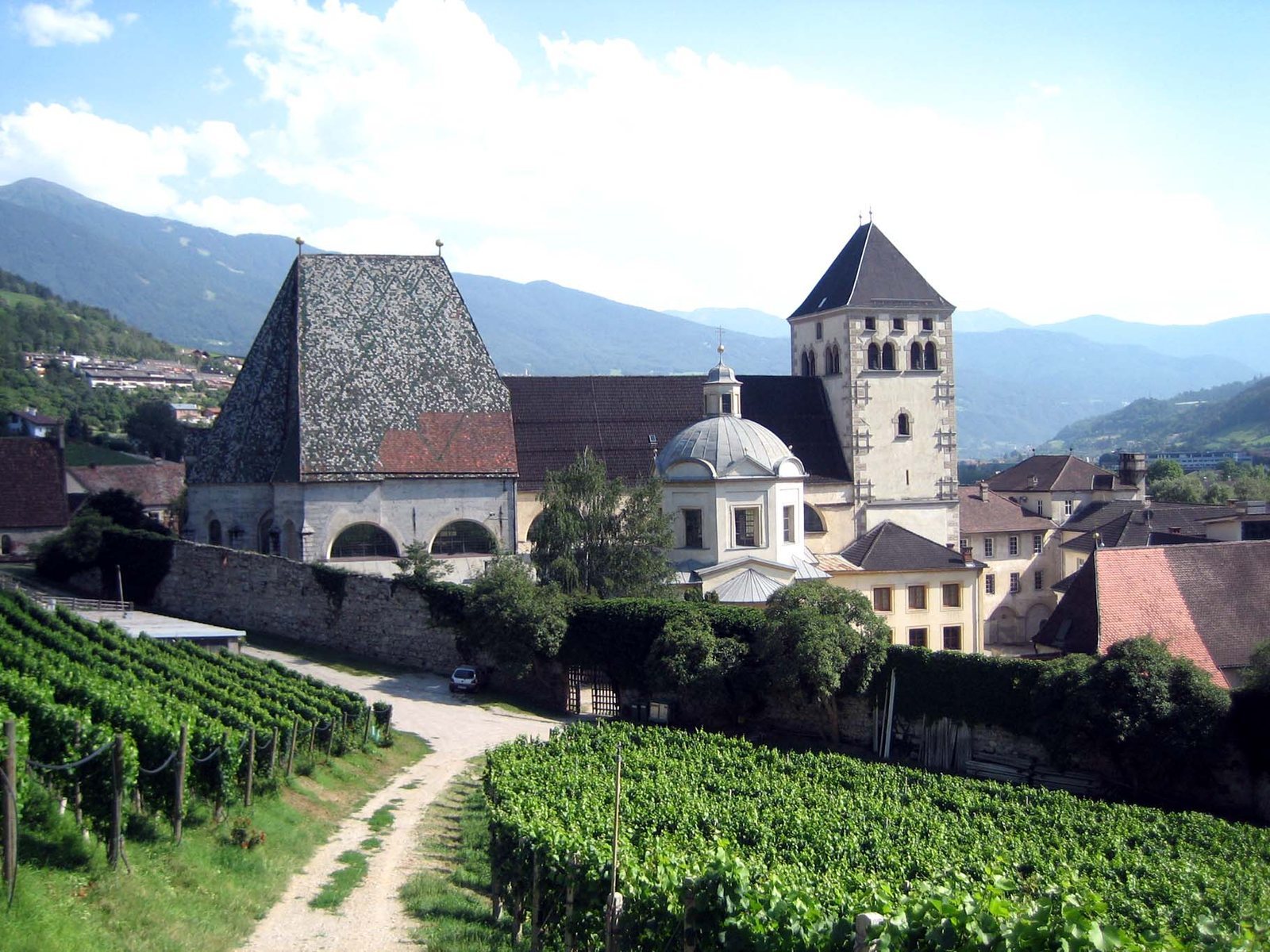
Neustift is a fortified complex built over several centuries and reached by a small bridge. Its buildings bring together Romanesque, Gothic, Baroque, and Rococo styles, and the complex is regarded as the largest monastic complex in Tyrol. The abbey church and cloister form a central group; the chapel of St Michael stands in the outer courtyard at the entrance, while the library, well house, parish church, and working grounds form other parts of the site.
Abbey church and adjoining chapel
Abbey church
Dedicated to Our Lady, the abbey church has a Romanesque nave and bell tower associated with the rebuilding after the 1190 fire. A late-Gothic choir was added from the second half of the fifteenth century into the early sixteenth century. Its steep roof, covered with green-glazed tiles, rises well above the nave roof and nearly reaches the tower’s height. Gothic altarpieces in the choir are associated with Michael and Friedrich Pacher, the Master of Uttenheim, and Max Reichlich.
Between 1734 and 1738, Joseph Delai of Bolzano reshaped the interior in the Baroque style, bringing the Romanesque nave and Gothic choir into a unified design. Anton Gigl’s Rococo stucco decoration and Matthäus Günther’s frescoes, painted in 1735–36, define much of the interior. One fresco shows Hartmann presenting the monastery plan to Reginbert and Christina, with their four-year-old son Ulrich, who had died, at their feet.
The church organ was made by Metzler Orgelbau in 2014 using the earlier case, dating from 1759–61, and historic pipes on its front. It has 42 stops, each controlling a set of pipes, three hand keyboards, and a pedal keyboard.
Marian chapel
The Marian chapel adjoins the north side of the church nave. J. B. and S. Delai built it in 1655.
Cloister
The cloister adjoins the south side of the church and dates to around 1200. A rib vault, a vaulted ceiling framed by intersecting ribs, was added in the fourteenth century. The cloister contains late-Gothic frescoes by Michael Pacher and numerous tombstones, including a white-marble memorial to Oswald of Säben, who died in 1465. The church is also connected with a museum and an art gallery containing late-medieval paintings and wall paintings.
Outer courtyard and well house
Chapel of St Michael
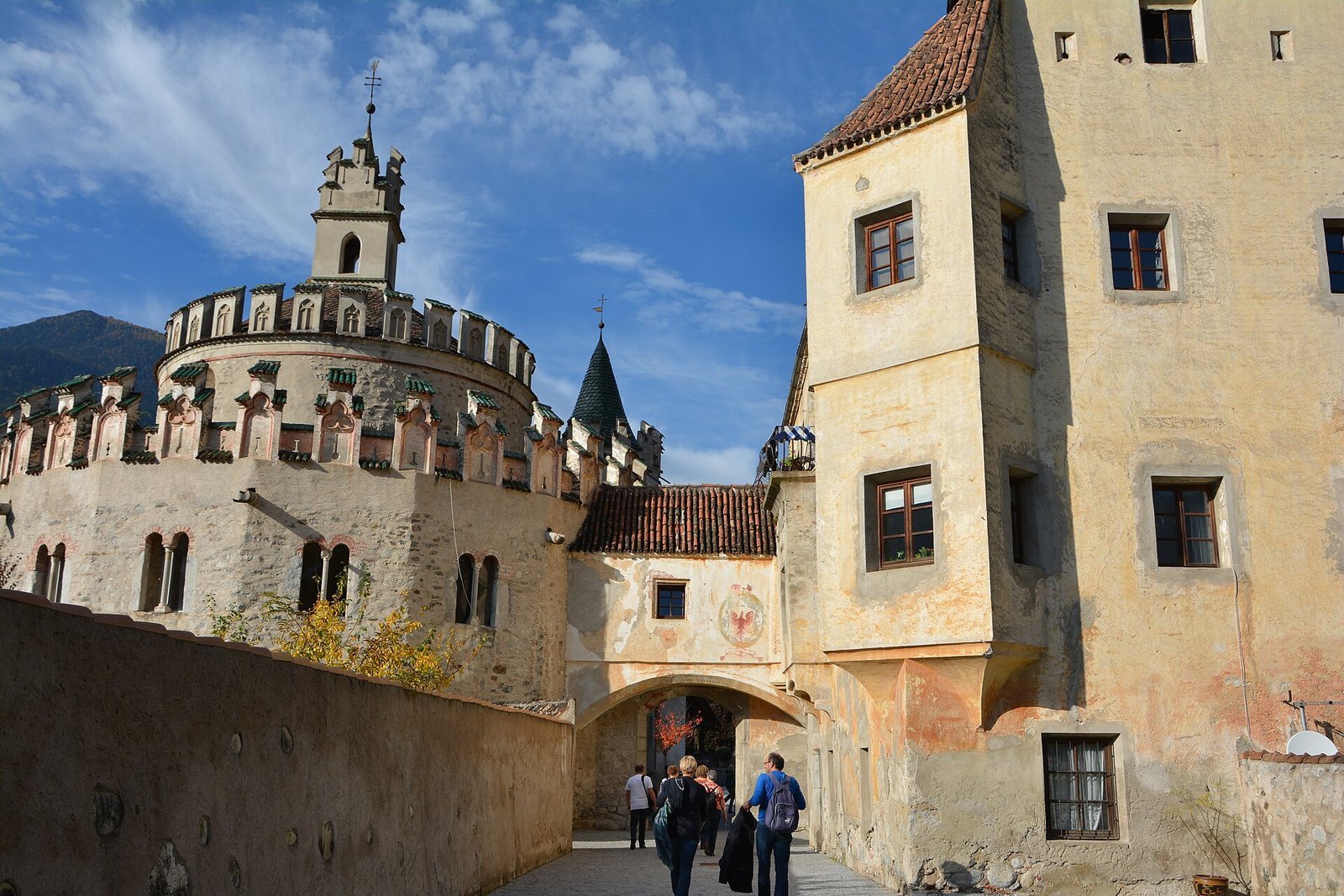
At the entrance to the complex, in the outer courtyard, stands the chapel of St Michael, also called the Castle of Angels. This round, two-storey building was erected around 1200 and later given the appearance of a defensive tower, with battlements. Its form resembles Rome’s Castel Sant’Angelo. The chapel is now used for exhibitions.
Covered well
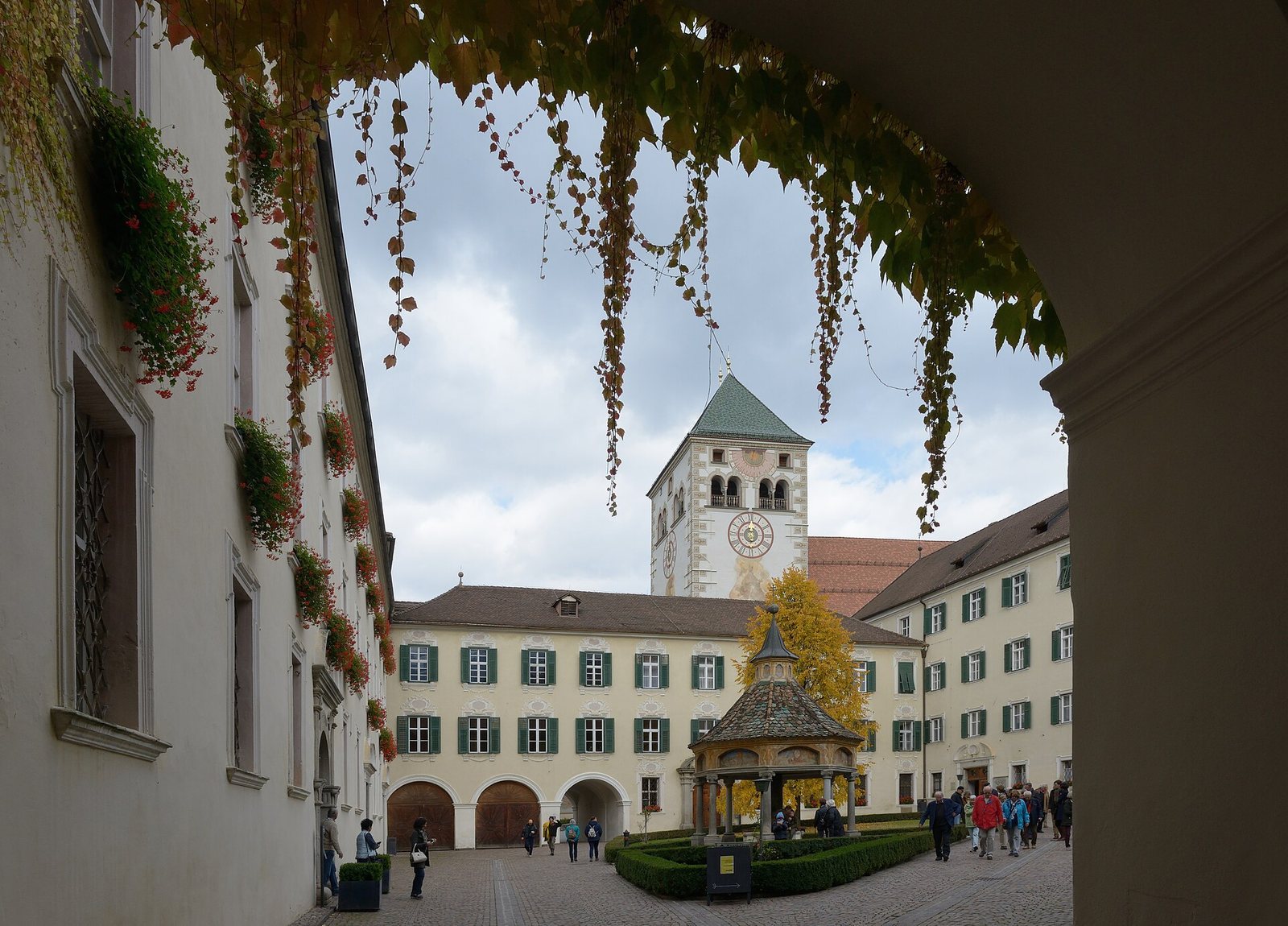
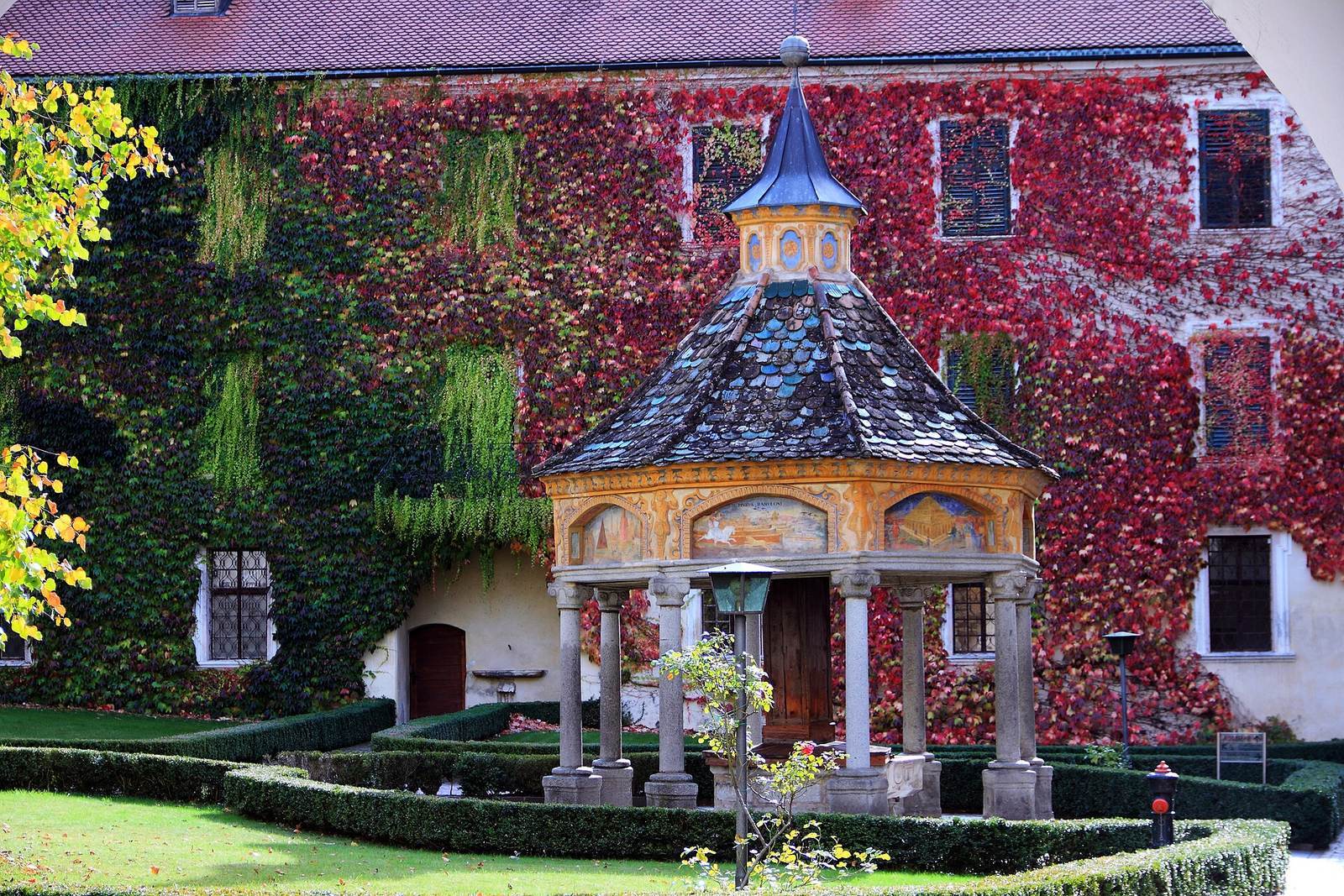
In the courtyard before the library is an octagonal covered well house, with open arched panels beneath its roof. The small octagonal pavilion above the well carries images of the Seven Wonders of the Ancient World; an eighth image presents the abbey as an additional wonder. Nikolaus Schiel painted the images in 1670.
Library and archive
Library
The library occupies two floors and holds about 92,000 books, manuscripts, and maps, including roughly 65,000 printed volumes and numerous manuscripts with colored miniatures. Antonio Giuseppe Sartori designed its Rococo main hall, built between 1771 and 1778. A Chinese room in front of the hall, decorated with Chinese paintings and prints, was restored in 2020–21.
Archive
The abbey archive contains thousands of original documents, the oldest dated 1143, as well as a book of grants and endowments, estate registers, and cartularies. Its holdings have been systematically arranged since the fifteenth century. The archive is divided into the main, convent, and administrative collections; the last is also known as the Waldmeister archive.
Refectory
Stephan Kessler’s painting The Supper at the House of Simon once hung above the Baroque wainscoting on the refectory’s north wall. It measures 10.20 metres wide by 2.35 metres high. The date 1660 appears on Simon’s chair, and Kessler’s initials are on a dog collar. During restoration of the refectory in 2021, the painting was moved to the corridor connecting the convent with the abbey church.
Parish church of St Margaret
The parish church of St Margaret stands in the northern part of the abbey grounds, between the abbey church, the cemetery, and the Oswald von Wolkenstein House. A chapel on the site is recorded in 1293. The church contains an organ made in 1905 by Anton Behmann of Schwarzach, Vorarlberg, whose keys operate its pipes through air pressure. Oswald Kaufmann overhauled the instrument in 2004.
Gardens and working grounds
Gardens and vineyards
The historic garden is divided into botanical and tree-garden areas. Vineyards spread through the Eisack Valley and onto the surrounding slopes. Old dry-stone terraces support the ground and absorb warmth during the day; stonemasons monitor their condition.
Cellar and utilities
The complex includes a wine cellar more than 850 years old, a winery, and an electricity plant. A wood-chip-fired district heating plant supplies the abbey and some surrounding buildings.