St. Mary’s Church with St. Luke’s Belltower: A Medieval Church and Former Mosque in Jajce
Site at a Glance
- Popularity
- Medium
- Country
- Bosnia and Herzegovina
- Primary era
- Medieval
- Eras represented
- Medieval, Early Modern
- Civilizations
- Kingdom of Bosnia, Ottoman
- Site type
- Religious
- Remains
- Church
On this page12 sections
History
St. Mary’s Church with St. Luke’s Belltower is a medieval Roman Catholic church and tower complex in Jajce, Bosnia and Herzegovina, associated with a Franciscan monastery. The church was remodelled in the early 15th century in the Gothic style, a medieval European architectural style that followed Romanesque design. The site is regarded as a symbol of Bosnia and Herzegovina’s statehood.
Early church and Franciscan presence
The Franciscans, members of a Catholic religious order founded by Francis of Assisi, were in Jajce by the late 14th century. The monastery’s founding date is uncertain, although it was built in 1404. The church was already old and in ruins when the Franciscans arrived. Its restoration and dedication to the Virgin Mary took place around the turn of the 15th century. The Franciscans are considered the likelier patrons, though the Bosnian nobleman Hrvoje Vukčić Hrvatinić has also been proposed.
The early 15th-century remodelling followed the Bosnian kings’ acquisition of Jajce, associated with King Ostoja’s marriage to Jelena Nelipić, the widow of Hrvoje. In a will made in 1484, Stanica, also called Stana, Radosalić, wife of the Jajce merchant Radič Radosalić, credited herself with building the church. Its origins, however, predate her claim. The church is also associated with Catholic indulgences, which concern remission of temporal punishment for sins, and is described as votive, meaning connected with a vow or devotional offering.
Coronation and the relics of St. Luke
Relics of Luke the Evangelist were bought from the Ottoman sultan in 1453 by the Serbian ruler Đurađ Branković for 30,000 ducats. Stephen Tomašević’s wife brought them to Bosnia as part of her dowry in 1459, and they were kept at the church. The adjacent tower, built between 1460 and 1463, was named for the saint.
On 17 November 1461, the church hosted Stephen Tomašević, the last king of medieval Bosnia, for his coronation. It was the final royal coronation in Bosnia. Stephen was executed during the Ottoman conquest of Bosnia in 1463, but Jajce remained uncaptured until 1527–1528. After the conquest, Queen Mara Branković took the relics and sold them to the Republic of Venice, a maritime state centered on Venice. They are now held in Venice’s Church of San Giobbe.
Ottoman use and abandonment
After capturing Jajce, the Ottomans took the church from the Franciscans in 1528, without purchasing it or receiving it as a gift, and converted it into a mosque. It was called Fethija, meaning conquered, or Sultan Suleiman’s Mosque. The tower served as the mosque’s minaret, a tower associated with a mosque and often used for the call to prayer.
Several fires damaged the building. A fire in 1658 caused severe harm, and the fire of 1832 left the church walls standing while destroying the tower’s minaret. The complex has not been used since 1832.
Conservation and modern claims
Conservation work on the complex took place during broader campaigns of the 1880s, when Bosnia and Herzegovina was under Austro-Hungarian administration. Further tower repairs followed in 1985–1986 and 2001. Stone conservation in 1987 treated damaged projecting ledges, columns and their bases, carved tops, and other surface damage. On 21 January 2003, the church-and-tower ensemble was designated a National Monument of Bosnia and Herzegovina.
Ownership and control became disputed in the 2010s. Jajce’s local council of the Islamic Community asserted a claim, while Catholic advocates called for the church’s return to the Catholic Church, citing its Franciscan history and its seizure in 1528.
Remains
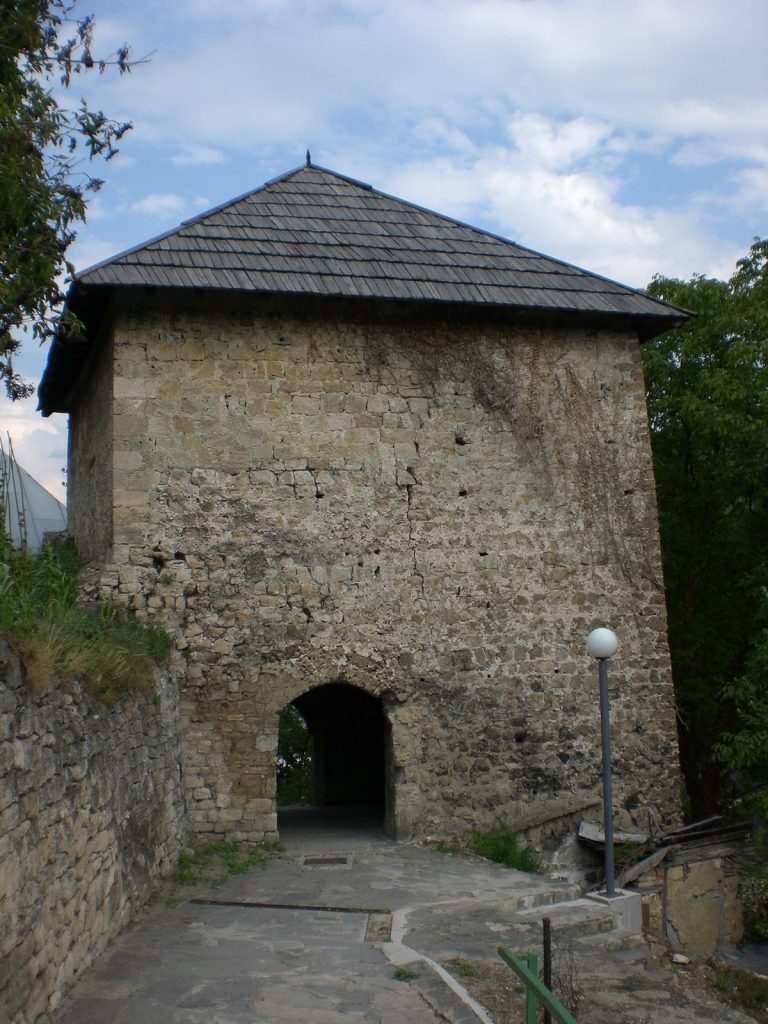
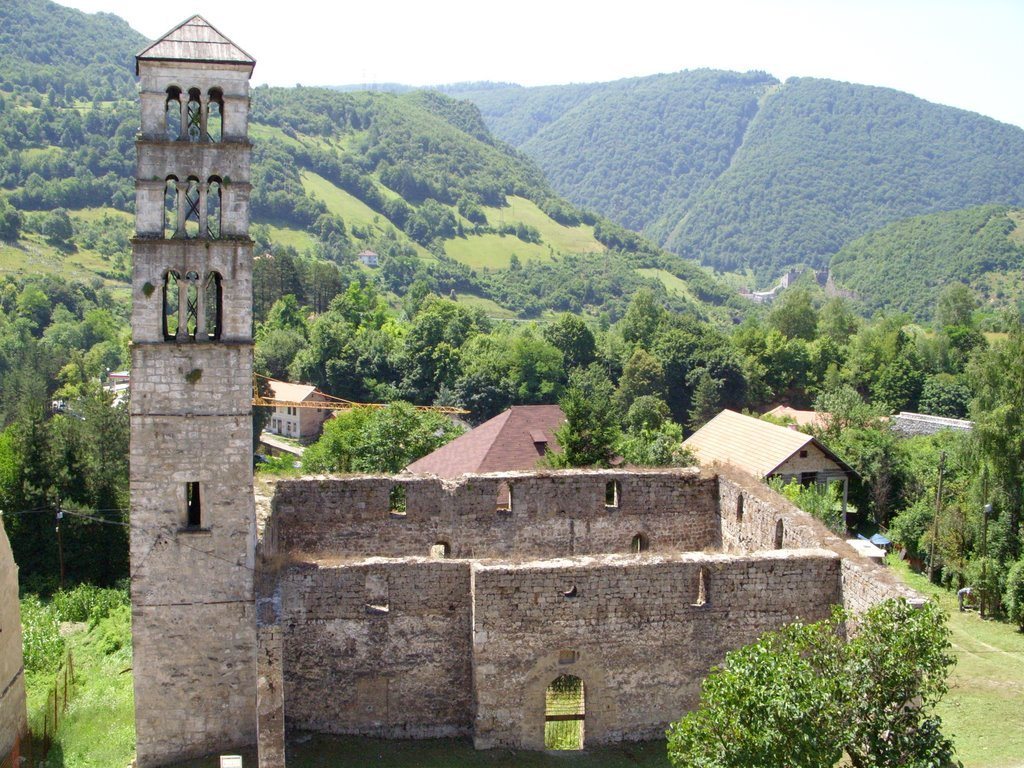
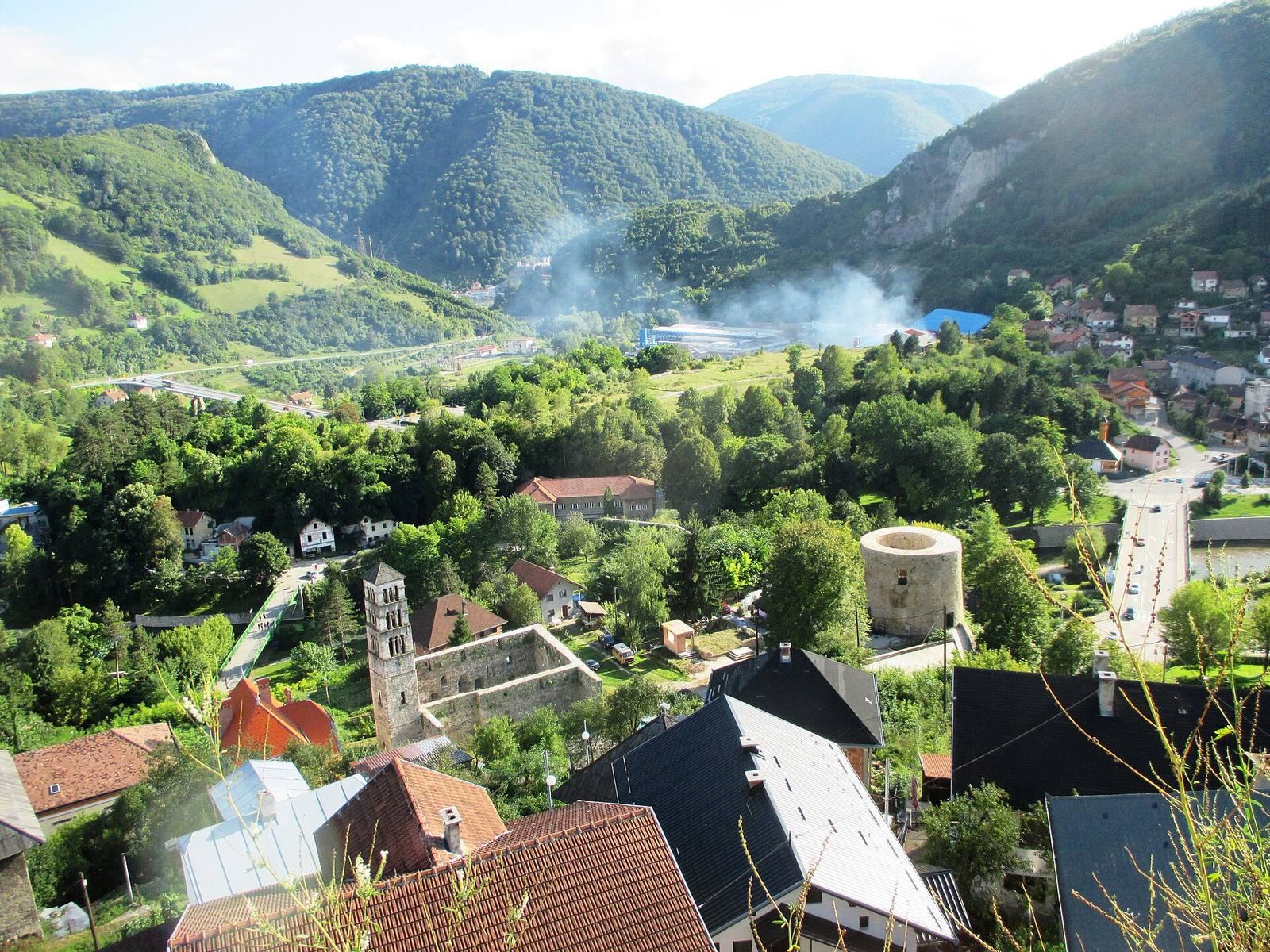
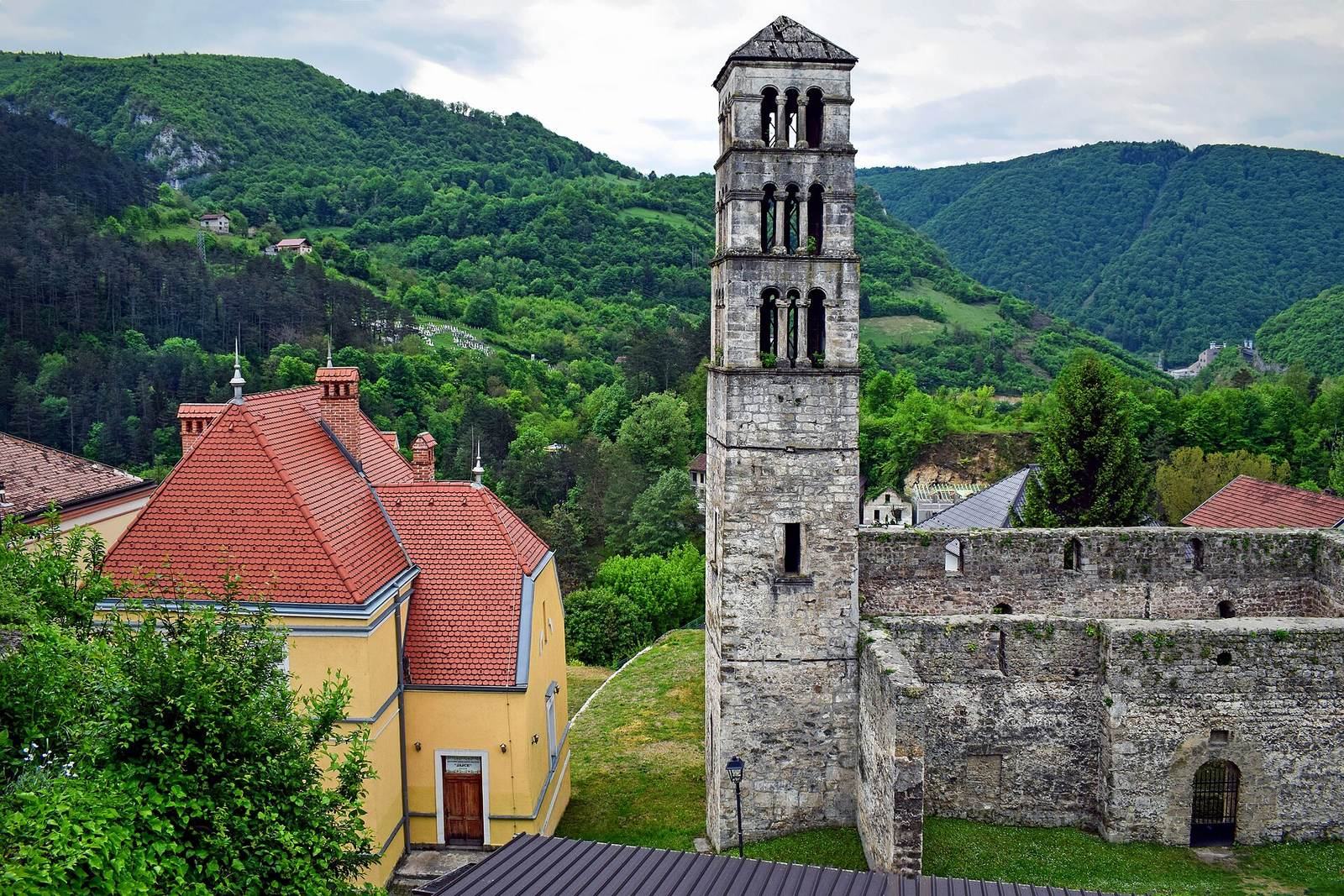
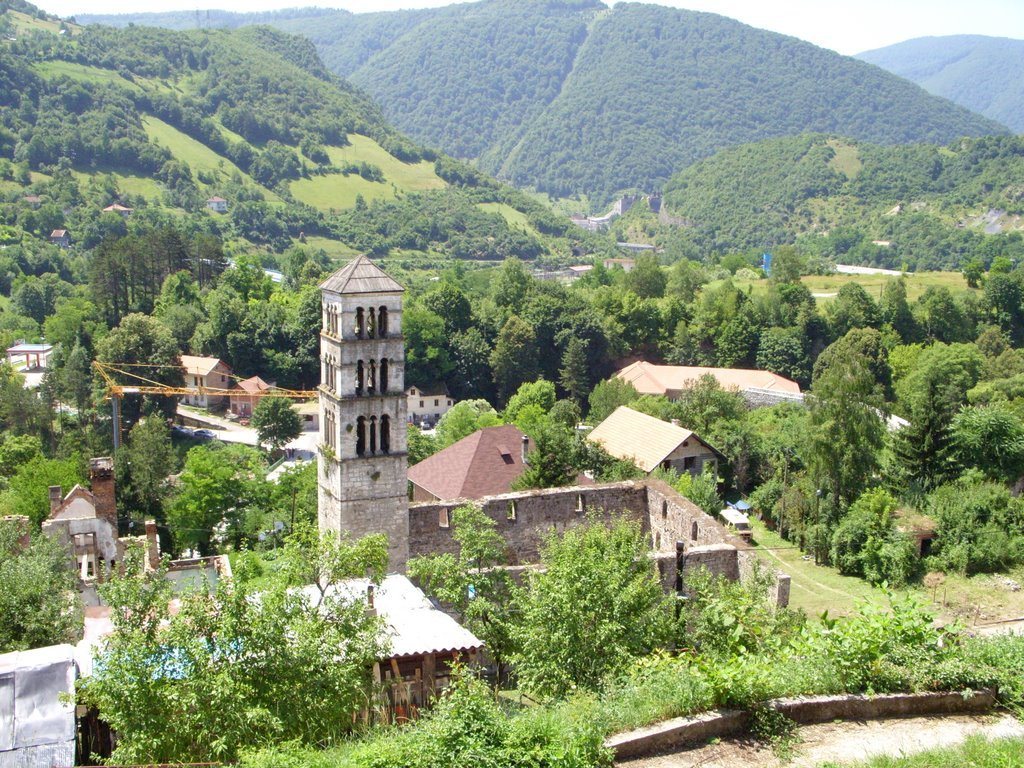
The church and tower stand in Jajce’s historic center, southwest of and below the citadel, near the city walls. The church survives as a ruin beside the tower. Their remaining fabric includes both Romanesque and Gothic features.
Church and tower
Church fabric
The church probably began as a simple Romanesque basilica, a church commonly organized around a long central nave, in the 12th or 13th century. Its later Gothic remodelling added a rose window, a circular window, to the west wall. The building is now ruined, with its walls surviving.
St. Luke’s Tower
The tower survives intact. Its lower part is Gothic, while the upper three galleries have Romanesque features.
Wall paintings
The church was decorated with frescoes, paintings made on wet plaster, dating to the first half of the 15th century and associated in style with western late Gothic art. Fragments remain in the lower parts of the north wall and on the south wall, where the painting is somewhat later. The north wall carried a large Last Judgment scene, depicting God’s judgment of humanity at the end of time in Christian belief. The painter Martin Petković has sometimes been credited with the work.
Carved stone fragments
Stone fragments recovered in 1961 show Gothic forms and, in some pieces, Renaissance forms.
Mosque-era interior
Traces on the interior walls mark a niche indicating the direction of Muslim prayer, a raised pulpit, and beams that supported an elevated gallery. The mosque interior was decorated in several colors.