Schloss Truppach: A Castle Rebuilt after 1523
Site at a Glance
- Rating
- 1
- Popularity
- Very Low
- Country
- Germany
- Primary era
- Medieval
- Eras represented
- Medieval
- Civilizations
- Holy Roman Empire
- Site type
- Domestic
- Remains
- Castle
On this page11 sections
History
Schloss Truppach is a castle in the village of Truppach, within the municipality of Mistelgau, Germany; its medieval predecessor was a lowland moated stronghold.
The family and the medieval castle
The von Truppach family appears in records in 1059 as de Trubaha. It was associated with the Walpoten, a medieval noble family in Franconia. The von Truppach line later became a lower-noble family of ministeriales, originally unfree retainers who could rise into the nobility. Its members joined the Imperial Knighthood, an association of nobles whose territories were held directly from the emperor, and belonged to the Knight Canton of Gebürg, a regional division. The family had imperial-immediate status, owing allegiance to the emperor rather than an intermediate lord, and died out in 1550.
The castle is first mentioned in 1380, but its ownership then is uncertain. The record associates it with the von Truppach family, whose noble residence there is documented from that year, and with Conrad the Elder of Christanz, of the House of Groß von Trockau. A register from 1499 lists two noble residences in Truppach, one belonging to the von Aufseß family and the other to the von Truppach family. The latter residence was abandoned soon afterward, and Klaus von Truppach moved to Alladorf.
Destruction and rebuilding
Before 1523, Hans Thomas von Absberg abducted merchants travelling on business from imperial cities in Franconia and Swabia, then demanded large ransoms for their release. As the danger of capture increased, he sought allies who could assist his raids and shelter captives. Wolf Heinrich von Aufseß was among those allies. The Swabian League, an alliance of estates and cities formed to uphold public peace and defend its members, mounted a campaign against strongholds used by raiders.
In 1523, the League sent troops to destroy 23 such strongholds. Its force included 10,000 infantry and 1,000 cavalry, along with 100 cannons, 30 guns, and 900 hundredweight of gunpowder. The troops reached Truppach on 4 July and blew up the castle to prevent the von Truppach family from returning.
The castle was rebuilt soon afterward with timber authorized by the Bishop of Bamberg. Friedrich von Vietinghoff acquired it in 1792 and made several minor alterations. In 1830 it passed to the von Aufseß family, which sold it to Johann Georg Brey in 1840. A later owner burned the castle records for reasons that remain unexplained, leaving its subsequent history unknown. The property is now privately owned.
Remains
Layout and buildings
The physical picture of Schloss Truppach combines the present residence with a woodcut depicting the medieval castle. The image shows a lowland complex enclosed by a wooden fence and moat, with an inner wall around its buildings. It also portrays stone construction below and timber framing above in the residential hall and principal tower.
Outer enclosure and entrance
The woodcut shows a small turret at each corner of the inner wall. A comparatively large main gate has a small building above it.
Residential hall
The multi-storey hall has massive stone walls on its lowest level, with one window opening shown on the left. Timber framing forms the upper storeys, and small watch turrets stand at the hall’s corners. A tower at the centre of the roof has a notably large opening, compared in the image with one at Waldstein Castle.
Principal tower
The castle’s principal fortified tower stands to the right of the hall and connects to it only by a passage. Its upper part is timber-framed. A projecting machicolation, a defence with openings for dropping objects on attackers, extends from its right side.
Chapel
A chapel appears in the upper-left corner of the woodcut.
Scene shown in the woodcut
The image also portrays five mounted soldiers on the left and just over 30 foot soldiers on the right, with seized objects laid out in front of them. A drummer and a senior officer examine the objects near the centre. The Swabian League flag, normally red and white, appears blue and white in the image, probably because of faulty colouring.
Present residence
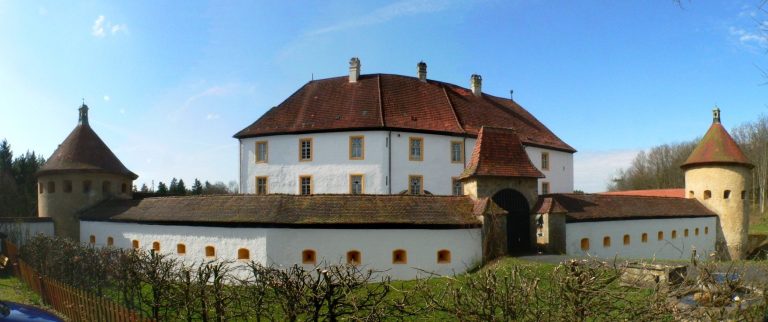
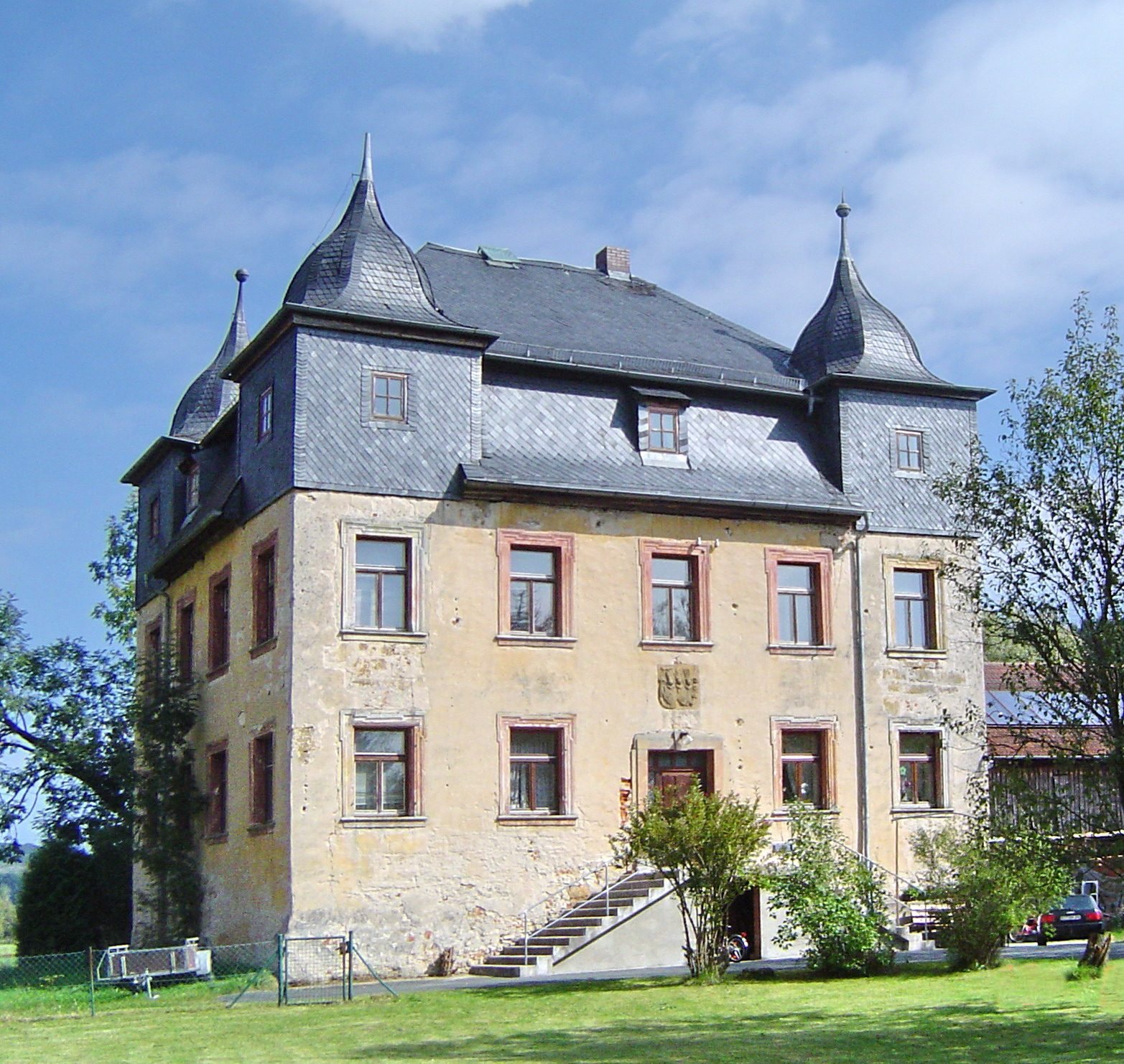
The ground floor of the later Schloss has been modernized and is inhabited. The staircase and first floor remain largely in their original state but are uninhabitable. The attic is partly renovated and unoccupied.