’s Hertogenmolens: A Fortified Watermill Complex in Aarschot
Site at a Glance
- Popularity
- Low
- Country
- Belgium
- Primary era
- Early Modern
- Eras represented
- Early Modern, Modern
- Civilizations
- Belgian, Duchy of Brabant, Habsburg, Holy Roman Empire, Spanish
- Site type
- Economic
- Remains
- Watermill
On this page13 sections
History
The former watermill complex known as ’s Hertogenmolens stands on the Demer in Aarschot, Belgium. Built around 1515 in a simple traditional style, it combined industrial production with a defensive plan that used the river to help protect the town.
Foundation and defensive purpose
Troops of the Habsburg ruler Maximilian of Austria destroyed Aarschot in 1489, after which the town began a gradual recovery. Gelderland’s revolt against Habsburg authority in 1502 and nearby fighting in 1507 brought further danger. William II de Croÿ, lord of Aarschot, responded by planning stronger defenses.
His plan replaced three earlier watermills east of town with a fortified complex on both banks of the Demer, near the point where the river leaves Aarschot and the Beguinage, a residential community for lay religious women. Closing the sluice, a gate controlling river flow, could flood land north of the town and impede approaching troops. The southern mill was a ban mill, where local inhabitants could be required to grind their grain, and began operating as a grain mill in May 1517. The northern mill, which processed grain, oil, and bark, was leased about six months later.
War and changing uses
A fire around 1522 put the northern mill out of service, prompting the installation of a second pair of millstones in the southern grain mill. The northern building was repaired some decades later and operated as a copper mill from 1548 to 1552. A bark mill followed there in 1558. A contract from 1552–1555 refers to three bridges at the complex.
In 1578, Protestant troops captured and burned Aarschot after Spanish forces were defeated nearby at Rijmenam. The mills and their machinery suffered heavy damage, but the southern grain mill was working again in 1579 for the Spanish garrison. By order of Alexander Farnese, governor-general of the Spanish Netherlands, the complex became part of a Spanish fort in 1582. A central building over the sluice was constructed between 1580 and 1590.
Ownership and nineteenth-century change
The complex passed to the Arenberg family, a prominent European noble house, in 1635. In 1663–1664, a fulling mill, which beat cloth to clean and thicken it, and a fat-processing operation were established in the former bark mill. The northern mill later experienced periods of inactivity and shifting uses, including oil pressing, cloth fulling, bark grinding, and, at times, grain milling. The southern mill remained mainly devoted to grain.
Milling could be profitable: in 1794, miller Luyten was counted among Aarschot’s ten wealthiest citizens. The mills were sold at public auction in 1795 to Thomas Trouet of Leuven. Ownership changed several times before Peter Ectors acquired the complex in 1816; his family held it for nearly a century. A fire damaged the northern bark and malt mill in 1817, but it was repaired.
From 1851, the government dug a new branch of the Demer and built a separate lock beside the mills. Completed in 1853, the works allowed boats to avoid being hauled through the passage beneath the central arch. Around 1855, the southern grain mill was renewed on an English model to produce flour for retail sale. The railway station opened in 1863, improving transport and distribution; the waterwheel spaces were probably enclosed and roofed around this period.
By the early 1870s, the northern bark and oil mills could not compete with the petroleum and chemical industries. They were converted to grain milling in 1875, and the northern wing was altered several times afterward. In the early twentieth century, the complex also struggled against mills that did not rely on water power.
Industrial decline and conservation
The Belgian State acquired the mills in 1910 and leased them to the Le Cerf family. After the First World War, milling continued on a limited scale, alongside new industrial work. A saw installation in the northern mill was replaced in 1920 by a commercially successful glass-crushing operation. The glass was ground into different grades for makers of sandpaper, cleaning products, and matches, and the products were exported. Allied bombing damaged the mills in 1944, and the State carried out repairs from 1953 to 1955.
Le Cerf installed electrically powered glass mills in the northern wing in 1961. Falling sales and a fire there on 6 October 1970 led the business to stop operating in 1973. Le Cerf left the complex in September 1985. The mills became protected monuments in 1986, their surroundings received townscape protection, and the complex was designated built heritage in 2009. Redevelopment work from 2007 to 2010 renewed the site and strengthened its structure.
Remains
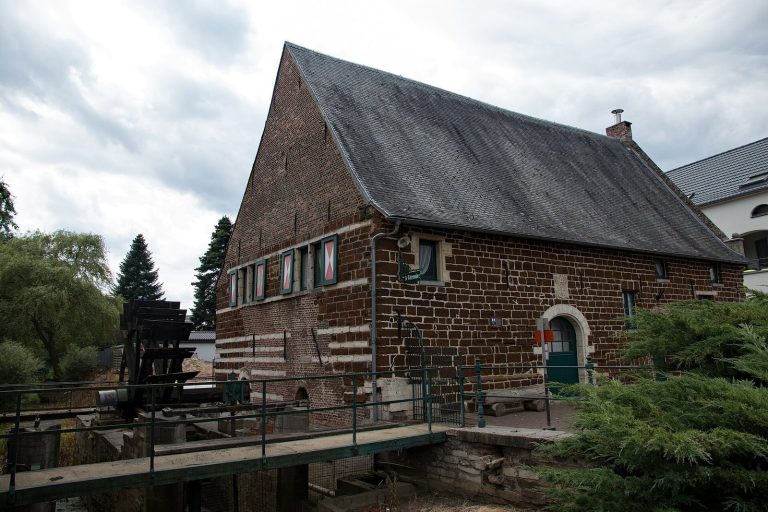
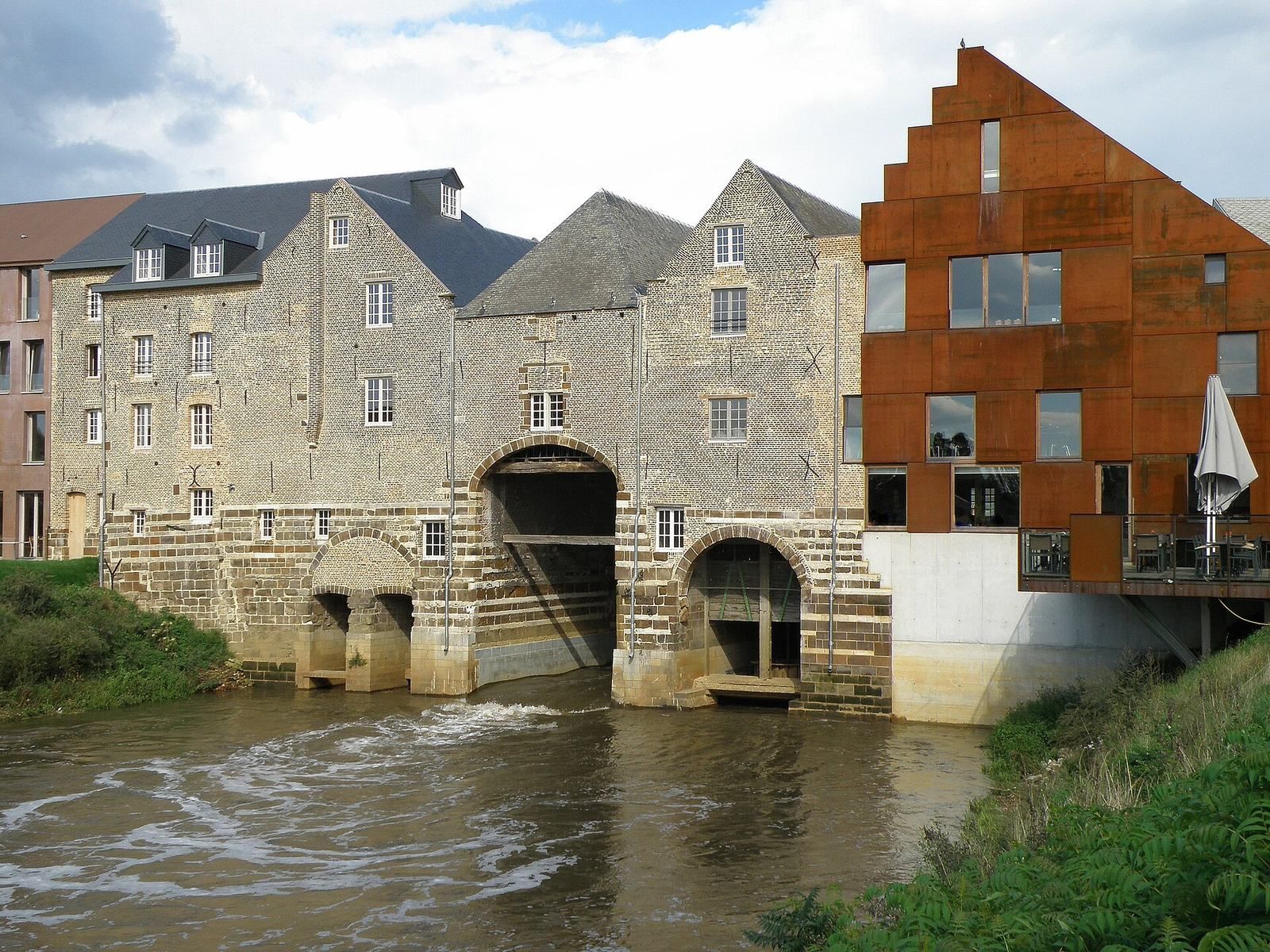
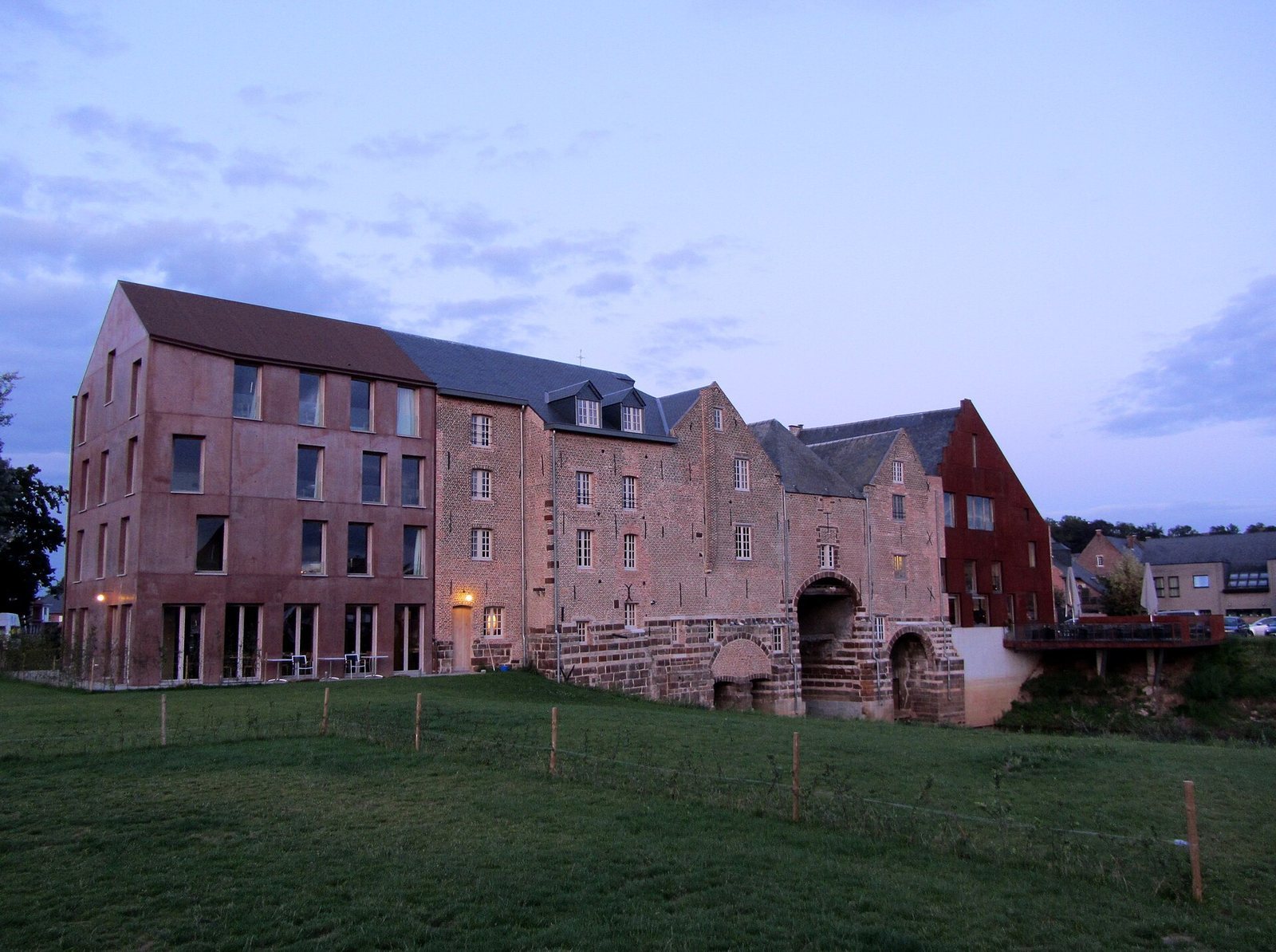
The complex occupies both banks of the Demer near the point where the river leaves Aarschot. Its three principal buildings comprise a mill on either bank and a central structure over the sluice, with a passage for boats through the middle. Open passages for the waterwheels lay between each mill and the sluice.
Plan and foundations
Construction began in a pit in the Beguinage orchard, some distance from the river. A new channel was then dug between the mills. The foundations rested on oak piles with square sides measuring about 30 centimetres, driven into stable sand. Beams laid across the current supported a wooden floor, above which builders placed a masonry layer several metres thick, made from brick and natural stone.
The buildings have elongated forms, stepped gables, gabled fronts, and roofs covered with natural slate. Local iron sandstone, interspersed with white sandstone, forms much of the lower walls; brick was used for the remaining original construction.
Mill buildings and machinery
Southern mill
An inventory from 1759 lists four pairs of millstones in the southern mill, driven by two waterwheels, each about 6.125 metres in diameter. Around 1855, the two wheels powered seven pairs of millstones. The spaces containing the wheels were probably enclosed and roofed around 1863. The rear façade on the south side collapsed in October 1986. In the later renewal, Corten steel, a weathering steel that develops a protective rust-colored surface, helped shape the mill’s appearance.
Northern mill
The 1759 inventory lists a bark mill and an oil press on the north bank, powered by wheels about 6.6 and 6 metres in diameter, respectively. The northern buildings have since been renewed using architectural concrete colored with iron oxides. Their changing industrial uses were reflected in repeated alterations to this wing.
Sluice and river works
Central sluice
The large sluice has a metal frame with four gates that can be lifted independently. The frame was probably installed around 1889 and was made by Usine de Graffenstaden in Alsace. The central structure also contains the passage for boats. Renewal work added stilling basins behind the large passage; these basins slow water flowing from the sluice and help reduce erosion.
Navigation lock
A separate navigation lock stands beside the mills as part of the Demer river works. It is distinct from the boat passage beneath the central structure.