Palazzo Sabajno: An Eighteenth-Century Holiday Residence in Italy
Site at a Glance
- Popularity
- Very Low
- Country
- Italy
- Primary era
- Early Modern
- Eras represented
- Early Modern
- Civilizations
- Duchy of Milan
- Site type
- Domestic
- Remains
- Elite Residence
On this page10 sections
History
Family residence and chapel
Palazzo Sabajno is an eighteenth-century holiday residence in Cuasso al Monte, Italy, built for the wealthy Sabajno family of Milan. The family had visited the area since the sixteenth century, drawn by its proximity to Lake Ceresio, also known as Lake Lugano, and the chance to spend holidays away from the city. It owned extensive land around the residence and across much of the local territory.
The small church beside the palace began as the family’s private chapel. Its original construction date is uncertain, and its founding is attributed to Charles Borromeo, a sixteenth-century cardinal and archbishop of Milan who was later recognized as a saint. This attribution predates the palace’s eighteenth-century construction, though the church’s own date remains unknown.
Later condition and use
The palace is now abandoned and has suffered repeated collapses and thefts. A proposal to move municipal offices into the building was rejected because of its poor condition and the high cost of renovation. The adjoining church remains under the parish of Sant’Ambrogio in Cuasso al Monte and is used occasionally for particular events in the liturgical year.
Remains
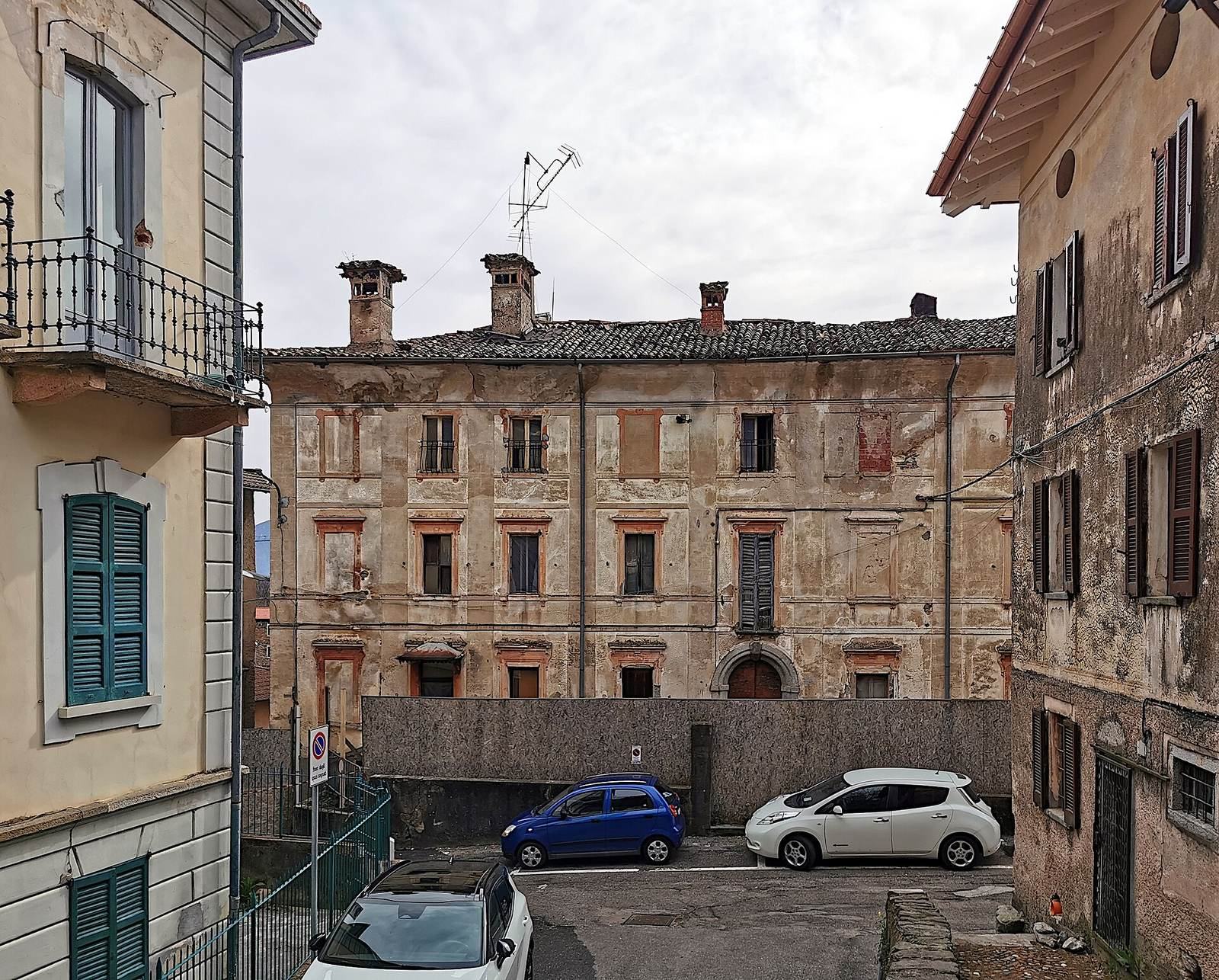
The palace stands at the intersection of Via Sabajno and Via San Carlo. Its three-storey, U-shaped plan encloses a central courtyard, with arched balconies facing inward. The façade visible from Via Sabajno has a stone portal and windows framed by Baroque stuccowork, an elaborate European artistic style associated especially with the seventeenth and eighteenth centuries. Painted shutters and false openings create illusions of real, three-dimensional features.
Palace and grounds
Interior decoration
The palace interiors were decorated with frescoes, stuccowork, and floors. Exposure to the elements after the building was left unprotected has caused much of this decoration to be lost. One surviving subject in the interior’s decorative scheme is a late-eighteenth-century fresco of the Virgin and Child. The palace also had valuable fireplaces and chimney stacks, along with objects made from precious materials. Theft removed original fireplaces, chimney stacks, materials, and windows.
Park and service features
Stables for horses and sheds for carriages stood on the property, alongside a large park to the south. The park’s walls once reached as far as present-day Via Gramsci, and sections remain visible. A small public washhouse formerly stood in the square in front of the residence.
Church of the Holy Family
Façade and bell gable
The Church of the Holy Family, commonly called the Church of Saint Charles Borromeo, stands south of the residence and to the right of its façade. Its front has a gabled outline, with Doric pilasters, flat column-like features in the Doric style, supporting a cornice and projecting pediment. A round-arched panel above the entrance contains a fresco of the infant Jesus with Mary and Joseph, representing the Holy Family. To the left, a bell gable, a wall-like projection with an opening for a bell, retains its bell in a single opening.
Interior and paintings
The church has a single nave, the main body of the church, covered by a barrel vault, a continuous tunnel-shaped ceiling. It ends in a presbytery, the area around the altar, with a sail vault, a ceiling that curves upward over a space. A low railing encloses the apse, a recess at the end of the church. The interior retains an altar of a type associated with Catholic liturgy before the Second Vatican Council, with an altarpiece, an artwork placed behind or above an altar, depicting Saint Charles Borromeo. Well-preserved frescoes portray the cardinal, the Virgin Mary, and Christ. Another shows a climbing vine symbolizing the biblical parable of the vine and branches, while a flock of sheep against a celestial background fills the sail vault.