Santa Croce Church: A Late-Renaissance Catholic Church in Riva San Vitale
Site at a Glance
- Popularity
- Low
- Country
- Switzerland
- Primary era
- Early Modern
- Eras represented
- Early Modern
- Civilizations
- Holy Roman Empire, Swiss
- Site type
- Religious
- Remains
- Church
On this page14 sections
History
Santa Croce Church is a Catholic church in Riva San Vitale, Switzerland, dedicated to the Holy Cross. Built in the late Renaissance, the later phase of Renaissance art and architecture before the Baroque, it was commissioned by Giovanni Andrea della Croce, archpriest, a senior priest with district responsibilities, from 1553 to 1563. He intended the church to honor his family name. Construction is dated to 1580–84. Architect Giovanni Antonio Piotti’s work is dated to 1588–92, while the completion date is given as 1591.
Foundation and patronage
The Della Croce family had settled in Riva San Vitale toward the end of the fifteenth century. In his will, Giovanni Andrea provided income from his land and buildings in the territories of Mendrisio and Riva San Vitale for the church. His family retained the right to appoint its rector, who was responsible for ensuring daily religious services.
Consecration and later history
On May 30, 1599, Filippo Archinti, Bishop of Como, solemnly consecrated the church. Santa Croce belongs to the Diocese of Lugano, a territory administered by a bishop.
A restoration carried out between 1967 and 1975 changed the church’s physical condition. In 2010, thieves took ten paintings from the lower panels of its altarpieces.
Remains
The church’s exterior is arranged in three parts, while its interior is a square, single-space hall beneath a dome. The main entrance aligns with the central chapel, and two side chapels extend the plan into a Greek cross, a layout with four arms of roughly equal length.
Exterior
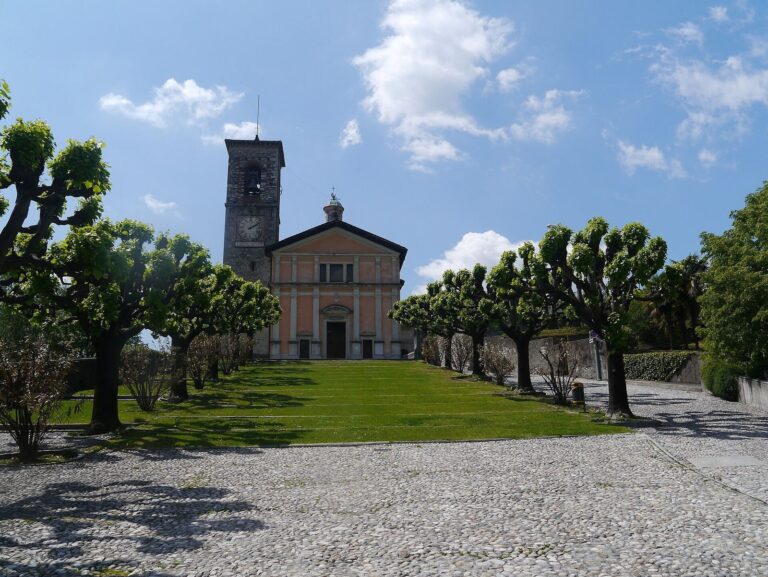
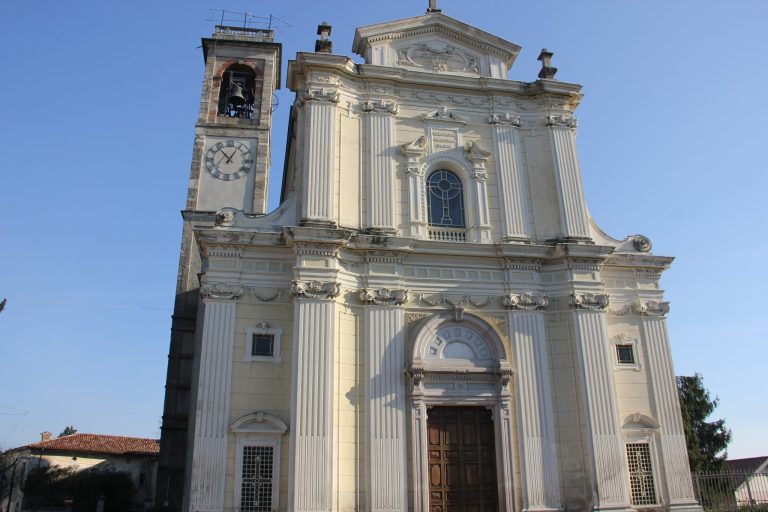
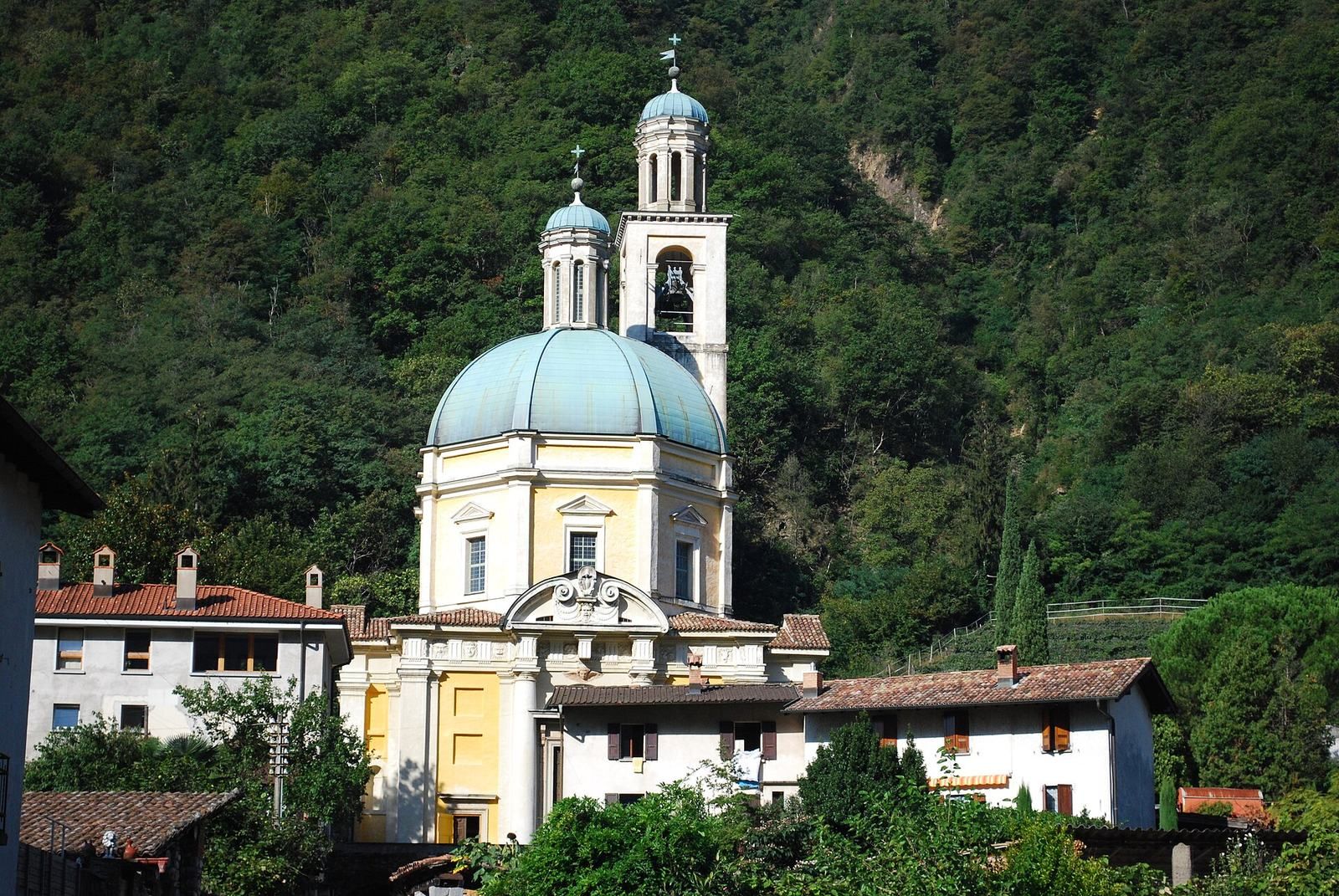
The façade’s central portal is flanked by two smaller doors, creating an arrangement that suggests three aisles despite the single interior space. Two Tuscan columns, a simplified classical column style, frame the main entrance and support a curved, intersecting pediment whose forms anticipate Baroque design. Flat side supports, a classical band of alternating raised blocks and panels, and the dome’s raised support also draw on Renaissance motifs. All three walnut doors have carved masks that echo figures in the façade band. Above, a large copper dome with a small light-admitting structure at its top rises from an octagonal drum, the raised structure supporting a dome. Eight broad windows in the drum illuminate the interior.
The bell tower holds three bells. Two were cast in 1588 and the third in 1590; the Barigozzi foundry in Milan recast them in 1946.
Interior plan and floor
The square hall has three chapels arranged to form the Greek-cross plan. The central chapel, with the main altar, faces the principal entrance, while a chapel on each side forms the other arms. Columns separate four additional chapels set into the corners. Above this square arrangement, the space becomes octagonal, and the dome is divided into eight sections.
The floor repeats the dome’s division in patterns of red, black, and gray stone tiles. These form perspective cubes, scale-like shapes, and checkerboards. At the center, a stone disk is ringed by alternating white and black rays. Recessed images on the disk show the column used to scourge Christ, the ladder used to take him down from the Cross, and the spear that pierced his side.
Painted decoration
Dome paintings
The dome’s frescoes, paintings made on wet plaster, are almost entirely destroyed by water infiltration. Their subject is uncertain: they have been interpreted as either Paradise or the Last Judgment, the latter also regarded as the culmination of the church’s decorative scheme. The composition included 47 figures, among them God the Father, Christ, the Virgin Mary, angels, and saints. Deterioration was already evident in 1627. The paintings are attributed to the workshop of the Pozzi brothers of Gandria in Valsolda.
Interior ornament
In the corner niches, masks and other fantastical motifs frame landscapes and imagined views. Eight columns supporting the frieze and the dome’s ribs are painted to imitate marble using encaustic, a technique that binds pigment with wax. False doors in the corners are painted to resemble marble as well. Half-woman, half-bird figures decorate the lower wall base, while stucco emblems and symbols of the arts appear higher up. The decorative scheme has been interpreted as a movement from earthly landscapes and material forms toward spiritual and divine subjects in the dome. A Doric-style frieze, a classical horizontal band, marks the transition. Its panels show sacred objects including tiaras, mitres, the keys of Saint Peter, containers for Eucharistic bread, and vessels for displaying consecrated hosts. The overall program evokes a passage from life’s transience to the spirit’s eternity.
Chapels and paintings above the altars
Holy Cross chapel
The central altar is dedicated to the Legend of the True Cross, the cross Christians believe was used in Jesus’s crucifixion. Paintings by Camillo Procaccini and his school show Saint Helena carrying the Cross to Jerusalem, where the Church of the Holy Sepulchre would be built. The large canvas on the right depicts the Finding of the True Cross; the canvas on the left shows Constantine’s dream of the Cross before the Battle of the Milvian Bridge, a decisive battle in his rise to power. Paintings on the vault are attributed to Procaccini’s school. The painted panel at the base of the altar once included Saint Helena witnessing a corpse restored to life before the Cross, along with the Four Evangelists.
Madonna chapel
The chapel to the left is dedicated to the Virgin Mary. Its altar painting depicts the Assumption with the Apostles, while paintings on the left and right show the Annunciation and the Visitation. The painted panel at the altar’s base included the Death of Mary and images of the Church Fathers Saint Jerome and Saint Augustine.
Saint Bernardino chapel
The chapel to the right of the main altar honors Saint Bernardino of Siena, a Franciscan preacher and religious leader to whom Bishop Bernardino della Croce was devoted. Bernardino della Croce served as an officer in Pope Paul III’s household; Paul III was pope from 1534 to 1549. He was also a canon, a member of the clergy of a cathedral or collegiate church, at Saint Peter’s Basilica, and bishop of Casale Monferrato before becoming bishop of Como. The altar painting shows Saint Bernardino preaching; side paintings depict him distributing bread to the poor and receiving the religious habit. The altar’s painted base included scenes of the saint assisting the sick and an image of Saint Ambrose. A painting of Saint Gregory remains in place.
Marble furnishings and tomb
The church’s balustrades and holy-water basins are made of Arzo marble. The tomb of Giovanni Andrea della Croce is also inside the church.