Engestofte: A Neoclassical Manor House in Denmark
Site at a Glance
- Popularity
- Low
- Country
- Denmark
- Primary era
- Modern
- Eras represented
- Modern
- Civilizations
- Danish, Denmark–Norway
- Site type
- Domestic
- Remains
- Manor House
On this page6 sections
History
Engestofte is a manor house on Lolland, about six kilometres east of Maribo in Denmark. Built in 1807 in the Neoclassical style, which revived forms associated with ancient Greek and Roman architecture, the estate later became a base for resistance activity during the Second World War.
From Crown property to Wichmand ownership
Engestofte was first mentioned in the 13th century. The Crown held it from 1457 to 1496, after which it passed through a series of noble families, including Baad, Grubendal, Urne, Huitfeldt, Grabow, Wittrup, Friis, Juul, Lerche, Reichau, and Hausmann.
In 1727, the wealthy merchant Bertel Wichmand of Nykøbing Falster acquired the estate. His widow, Bodil Cathrine From, retained it after his death in 1732, and their eldest son, Jørgen, took ownership in 1751. Jørgen and his brother Thomas Frederik were ennobled as Wichfeld on 23 July 1777.
The Wichfeld estate
Jørgen Wichfeld, who never married and had no children, left Engestofte and Ulriksdal to his nephew Henning. The arrangement took effect on 8 November 1799, requiring the properties to form an entailed family estate, one kept undivided and passed on under fixed succession rules. The house was enlarged in 1889. Wichfeld owners included Henning from 1799 to 1846, Jørgen from 1846 to 1888, another Henning from 1888 to 1907, and Jørgen Adalbert from 1907 to 1965.
Resistance activity during the Second World War
With Monica Emily Wichfeld, an Irish-born member of the Danish resistance, the estate cottage and grounds supported resistance work. They sheltered fugitives and Jewish families hiding from the Gestapo, Nazi Germany’s secret state police; trained saboteurs; concealed weapons, ammunition, and explosives; and helped organize resistance activity. Engestofte also served as a covert landing ground for the British Special Operations Executive, a wartime organization that conducted espionage and sabotage and supported resistance movements. Its deliveries included parachutists, information, weapons, and explosives.
Later ownership
After Jørgen Adalbert Wichfeld died in 1965, his son Viggo Dimitri inherited Engestofte and carried out a complete renovation. Financial difficulties later led Viggo to sell the estate to William Erik Berntsen. William Ole Berntsen inherited it in 1995 and bought neighbouring Søholt in 1996, then left both properties to a foundation. The authorities refused the foundation an exemption from the Agriculture Act and required the estates to be sold. Frederik von Lüttichau bought both in 2003 and sold Engestofte to Hans Peter Egeskov in 2011.
Remains
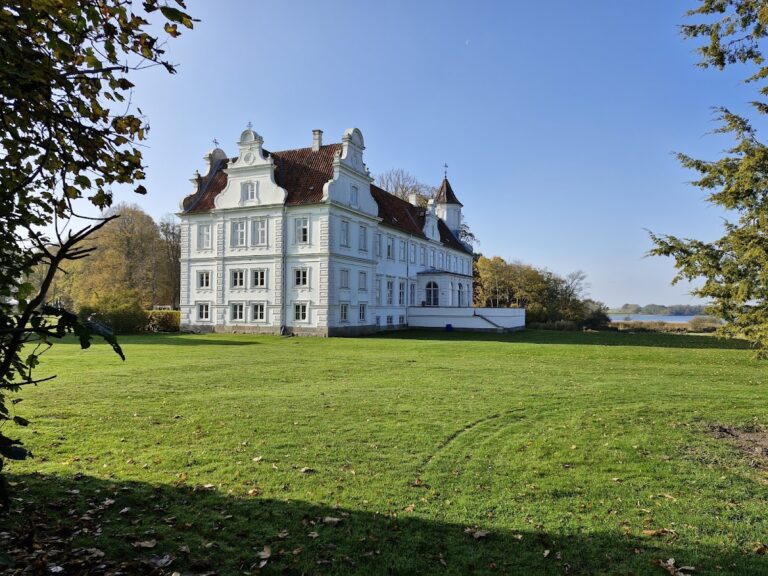
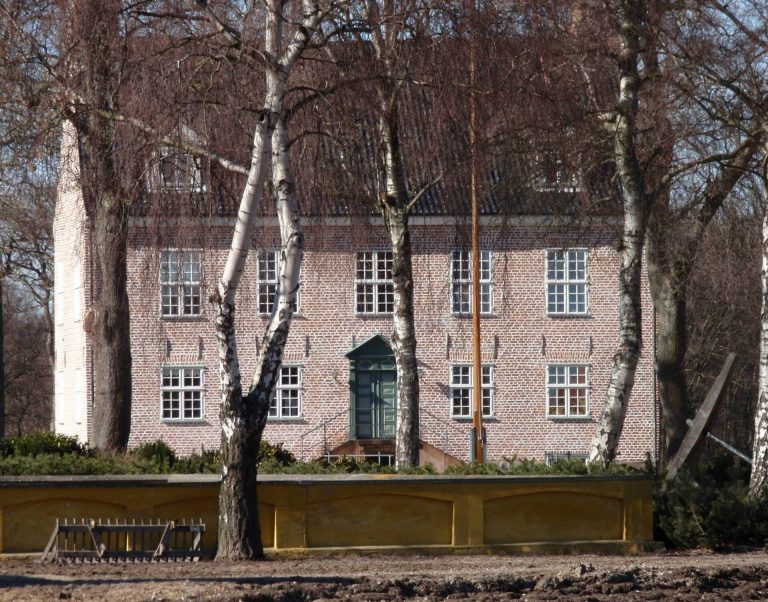
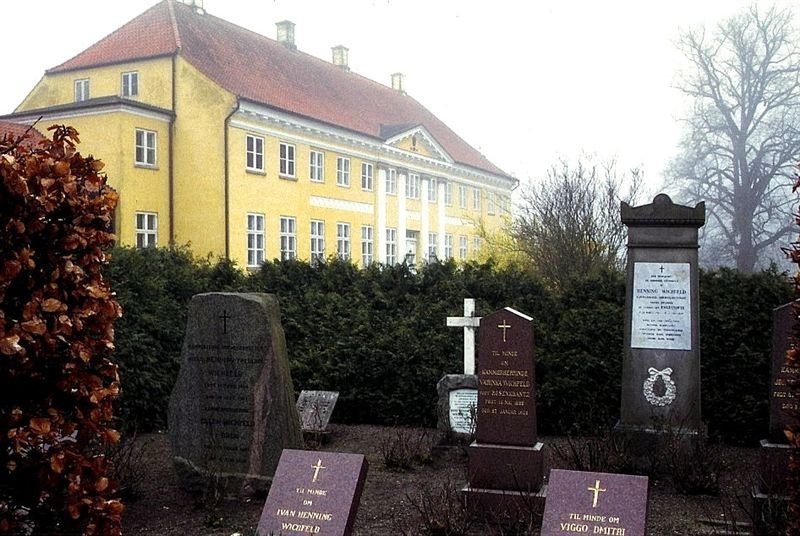
The manor house is a two-storey Neoclassical residence with a simply designed facade and forty rooms. Four pilasters, shallow column-like features attached to the wall, articulate the facade, which is topped by a triangular pediment.
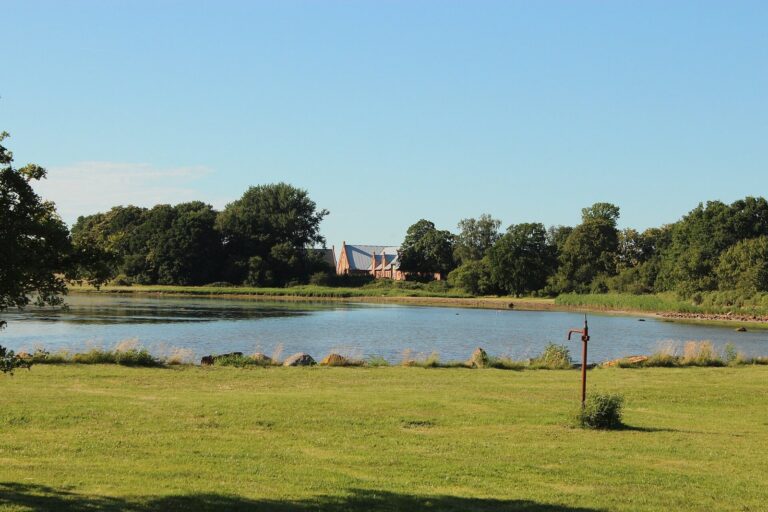
A long driveway lined with linden trees and elms leads toward the house. Terraces descend from the residence to a lake below, while an estate cottage is among the surrounding buildings.