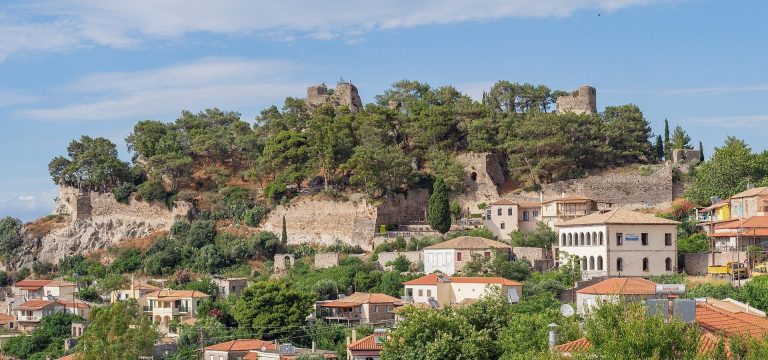
Samiko: An Ancient Triphylian City and Sanctuary in Greece
Site at a Glance
- Popularity
- Low
- Country
- Greece
- Primary era
- Classical
- Eras represented
- Bronze Age, Classical, Medieval, Modern
- Civilizations
- Ancient Greek, Mycenaean, Ottoman, Roman
- Site type
- City
On this page22 sections
History
Samiko was an ancient city of Triphylia near Kato Samiko, Greece. It may be identified with Arene, a city associated with Homeric tradition. Ancient accounts preserve several traditions about its foundation and names, while its coastal sanctuary became a religious and political center for Triphylia.
Origins and changing names
One foundation legend credits the Pelasgians, a people described in Greek tradition, with establishing the settlement. It says the Epeians, a people known from Greek epic, later called it Samos. The Minyans, a legendary people said to have come from Lesbos, then captured it and named it Macistus after their leader, a brother of Phrixus. The same tradition says they expelled the Neleid ruling house, descendants of Neleus, a legendary king of Pylos, and made Macistus Triphylia’s political and religious center.
Ancient writers used the city’s names in different ways. Strabo explains Samos as meaning “heights” and says Samicum first referred to the fortress, then to the surrounding plain. Pausanias mentions a city called Samia, apparently distinct from Samicum. Another tradition says that after the Eleans took the city with Spartan help, they restored the name Samia or Samiko instead of keeping Arene or Macistus. Myth also places Atreus and Thyestes there after Pelops drove them from Pisa.
The sanctuary and Triphylian community
The coastal sanctuary of Poseidon, the Greek god associated with the sea, served the religious life of Triphylia’s cities. Their communities contributed to its upkeep, while Macistus had supervisory authority. Representatives met at the sanctuary to discuss shared affairs. At an annual festival, a truce called the Samian truce was proclaimed, and delegations from nine cities sacrificed nine black bulls to Poseidon.
In the Odyssey, the epic attributed to Homer, Telemachus lands at the coastal sanctuary while travelling from Ithaca to Pylos. He finds people of Pylos offering a sacrifice to Poseidon. This episode is part of the poem’s account of his journey.
Military use and later history
The commander Polysperchon occupied Samiko’s stronghold during conflict with the Arcadians, repaired its fortifications, and used it as a base. Philip V, king of Macedon, captured Samiko in 219 BCE. Much later, Ibrahim Pasha, an Ottoman-Egyptian military commander, built a tower near the acropolis in 1826.
Archaeological investigations
Geophysical investigations in 2017, 2018, and 2021 sought the location of Poseidon’s sanctuary. Excavations beginning in 2022 opened the first phase of a five-year research program on the sanctuary and Samiko’s ancient harbor. The work involved Greece’s Ministry of Culture and Ephorate of Antiquities of Ilia, the Austrian Archaeological Institute in Athens, Johannes Gutenberg University Mainz, and the Christian-Albrecht University of Kiel.
Remains
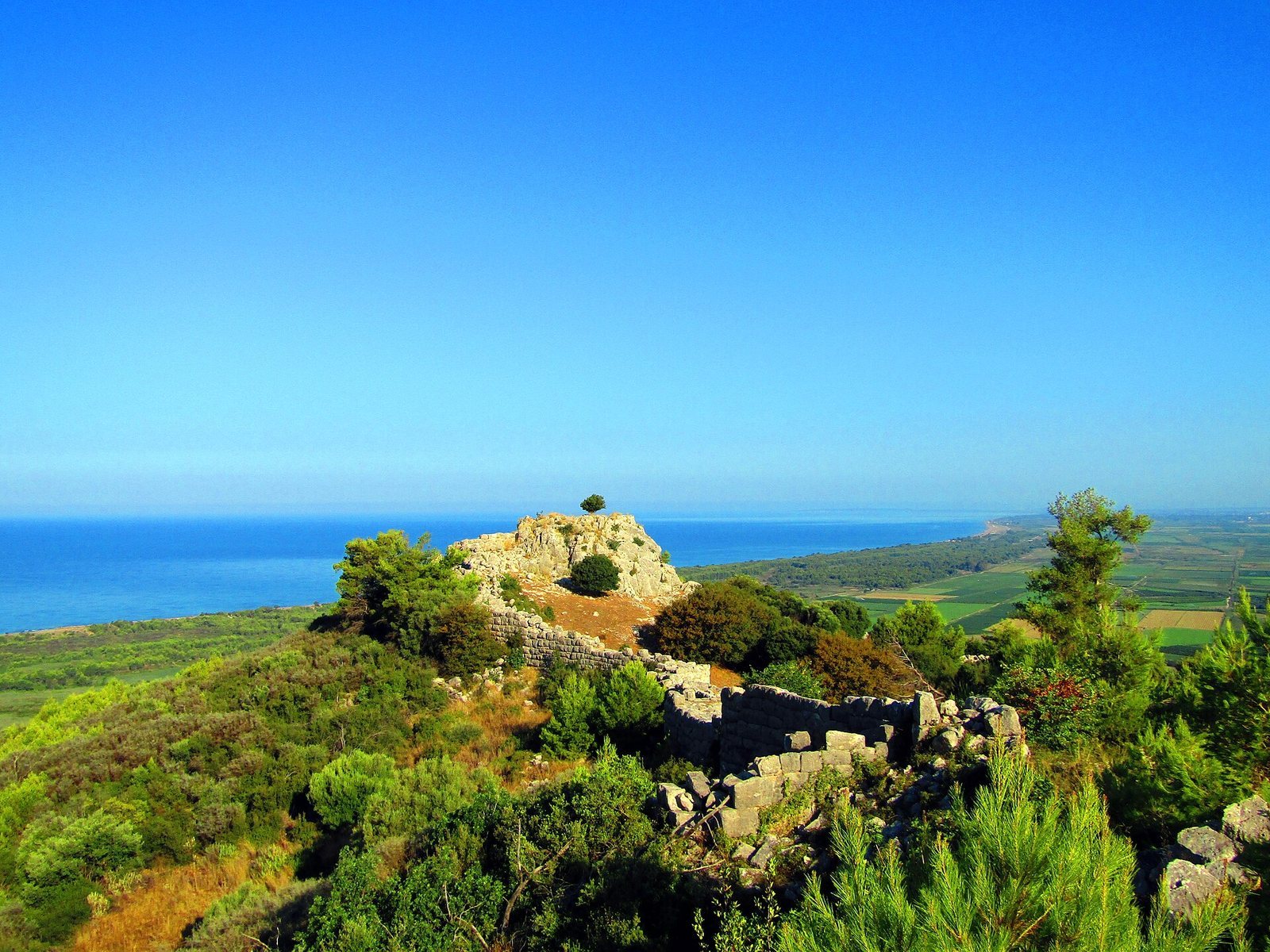
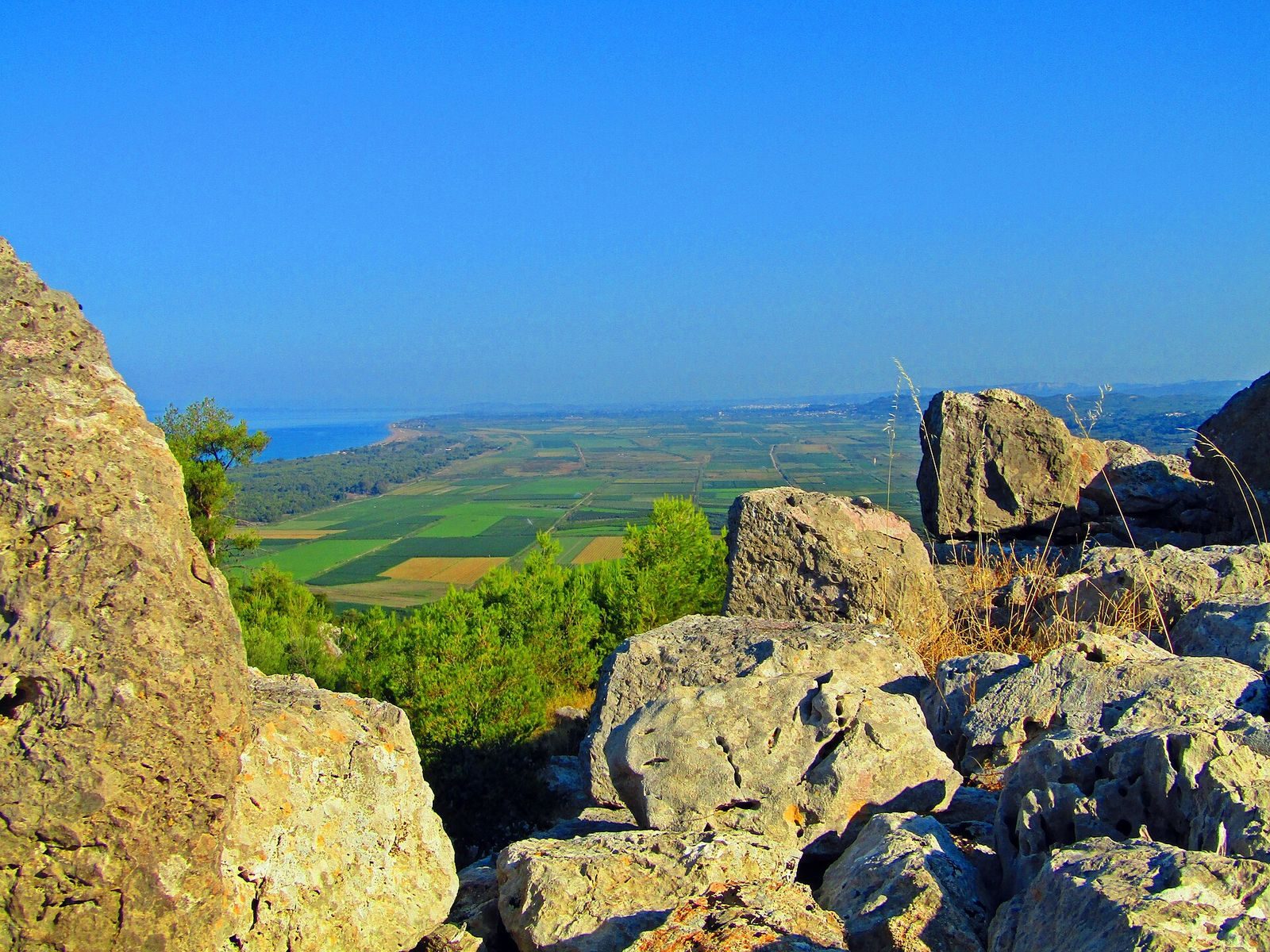
The remains occupy a coastal mountain spur between the mouths of the Alpheius and Neda rivers, just north of the Anigrus. The spur narrowed the strip of land between mountain and sea. The surviving acropolis stands on the final spur of Mount Lapitha, about 200 metres above sea level and around two kilometres from Kato Samiko. The ancient city’s remains extend across Kleidi Hill and Elliniko Hill to its east, with the coastal sanctuary and lagoons forming part of the surrounding landscape.
Kleidi Hill
City fortifications
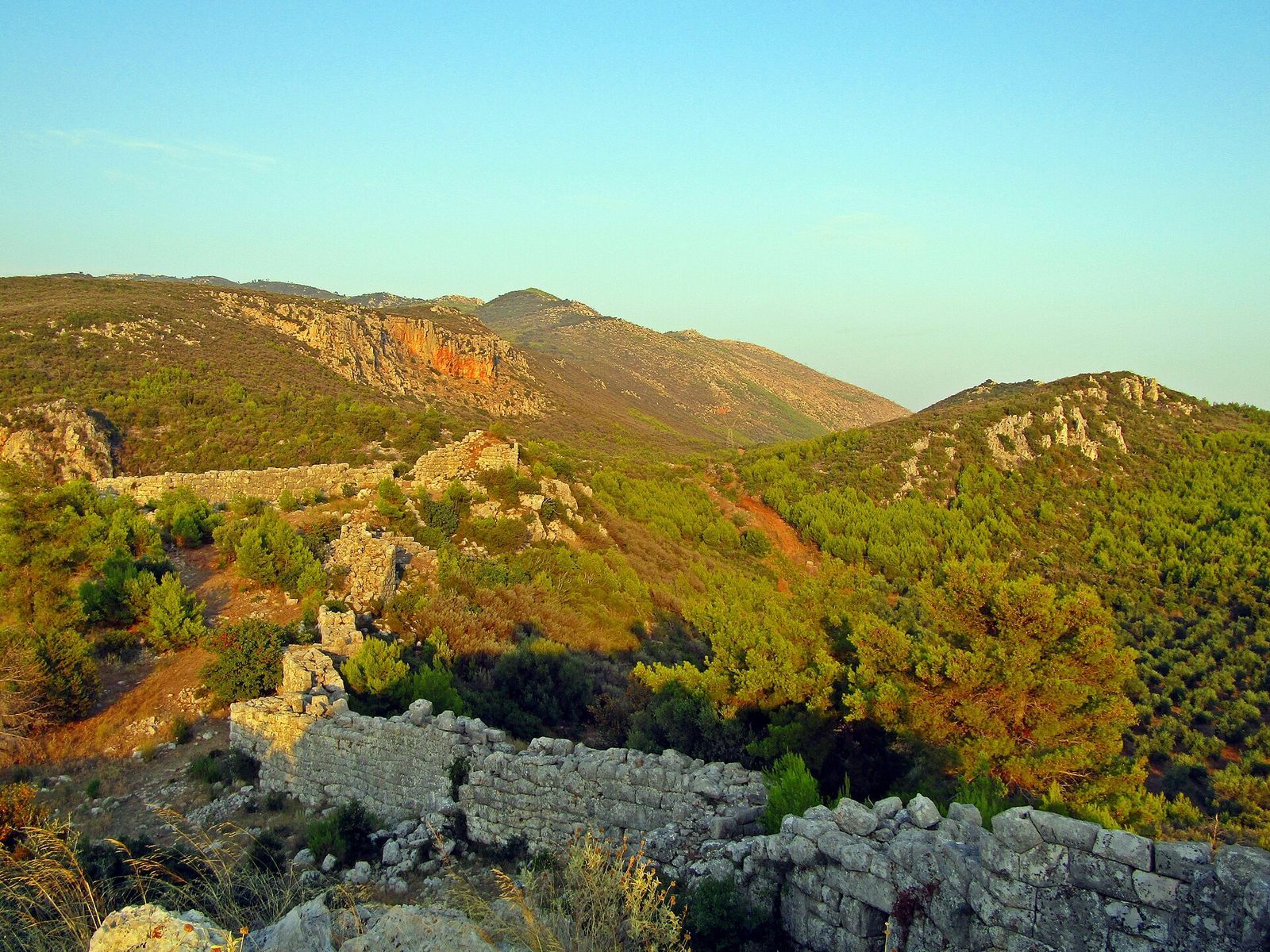
The ruined walls enclose a sloping, roughly triangular area on Kleidi Hill. They are about two metres thick and extend for approximately 2.4 kilometres, surviving in places to around five metres high. Built in regular courses of large cubic or polygonal blocks, they include three intact small openings. Jambs on the outer faces and holes for crossbars survive at these openings. The towers on the seaward side were added later than the walls.
Prehistoric settlement and burials
Kleidi also has walls of Cyclopean masonry, built from massive stone blocks, and settlement remains from the Middle and Late Helladic periods. A large prehistoric burial ground includes a mound excavated by Nikos Yaluris in 1954. It contained 16 tombs and yielded finds dated from 1600 to 1200 BCE. Locally made pottery bears geometric or stylized plant designs; it is held at the Archaeological Museum of Ancient Olympia. Tradition attributes the mound to the mythical hero Iardanus.
Elliniko Hill and later buildings
Classical acropolis
Elliniko Hill, east of Kleidi, contains the acropolis, the fortified high part of an ancient Greek city. It was in use from the fourth century BCE into Roman times. Late Helladic III pottery found there may have belonged to a guard tower.
Roman and early Christian remains
Remains of Roman baths and an early Christian sanctuary lie north of the acropolis. The ruins of the Ottoman tower built near the acropolis also survive in this area.
Sanctuary precinct
Excavated building
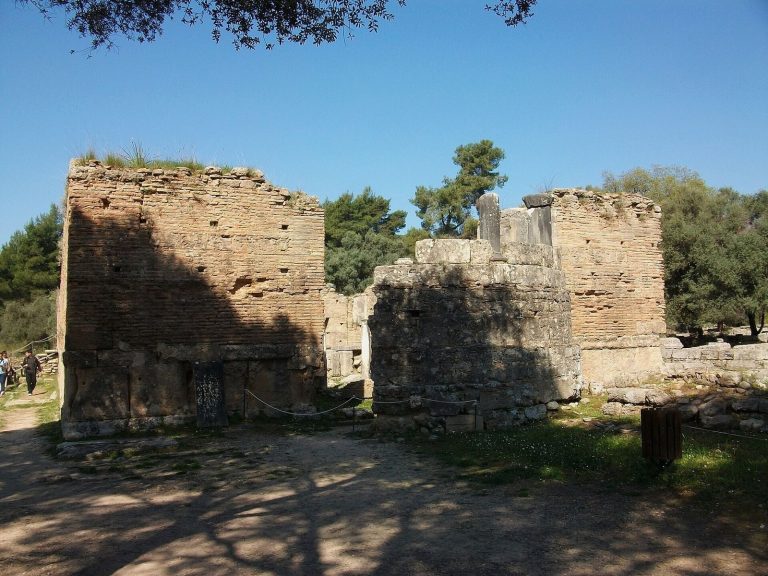
Excavations within the acropolis precinct revealed a building dated to the sixth century BCE. It measures about 28 by 9.4 metres and has stone walls approximately 0.8 metres thick, dividing its interior into two rooms. It may have served two deities, or one room may have been used as a meeting hall for the Triphylian League, a political association of cities in Triphylia. The structure was renovated in the second half of the fourth century BCE or the first third of the third century BCE. Old roof tiles were placed beneath a new floor, a method interpreted as helping to limit groundwater and stabilize the building. Finds include an inscribed bronze plaque and fragments of a marble ritual purification basin about one metre across.
Double wall
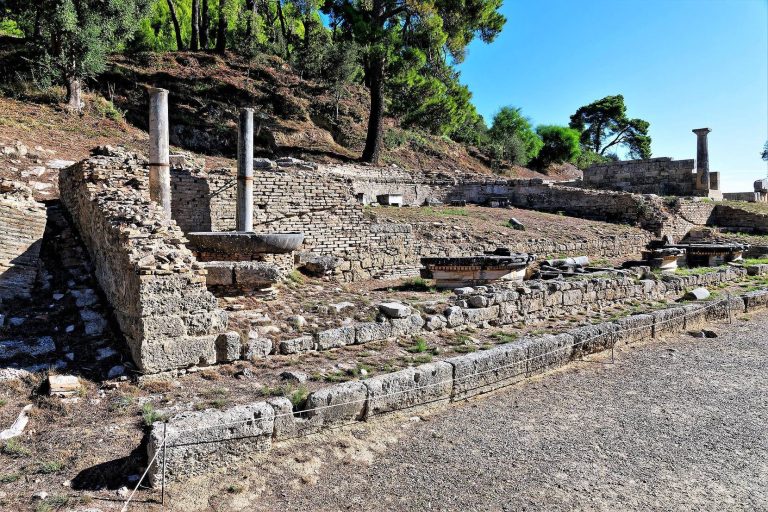
A double wall north of the sanctuary, noted by William Dörpfeld in the early twentieth century, was exposed in the excavations begun in 2022. It may have marked the sanctuary’s boundary and also served as a barrier against flooding from nearby lagoons.
Coastal sanctuary
The coastal sanctuary was surrounded by a grove of wild olive trees. Its temple of Poseidon had widely spaced columns, and a temple to Heracles, the Greek mythological hero, also stood within the precinct. A beardless statue of Poseidon was shown with its hands resting on a trident. Linen and cotton cloth woven by young women of Samia covered the god’s body and was brought to the sanctuary in procession.
Later defenses and baths
Medieval fortifications
Kleidi Hill was fortified again in the medieval period, adding a later phase to the hill’s defensive history.
Byzantine bathhouse
About one kilometre east of Kato Samiko, beside a stream, are the remains of a Byzantine bathhouse. Part of its hypocaust, an underfloor heating system, and its western side remain visible; the stream has eroded the other sides.
Lagoons and healing springs
Coastal waters
The Anigrus fed a southern lagoon that ran along steep slopes known in antiquity as the Achaean Rocks, then flowed out to sea. Underground springs also supplied the lagoon. Its water was reputed to smell foul, and the surrounding area was considered extremely unhealthy in summer. A larger lagoon stretched from the northern foot of the city’s hill towards the mouth of the Alpheius.
Springs and caves
Medicinal springs near Samiko were associated with the treatment of skin diseases. One nearby cave was sacred to the Anigrid nymphs and another to the Atlantides, groups of nymphs in Greek mythology. People seeking healing prayed in the Anigrid cave before entering the Anigrus. The cave and river are now part of the Kaiafas thermal baths.