Grynau Castle: A Medieval Fortress Guarding the Linth Crossing
Site at a Glance
- Popularity
- Medium
- Country
- Switzerland
- Primary era
- Medieval
- Eras represented
- Medieval, Early Modern, Modern
- Civilizations
- Holy Roman Empire, Swiss
- Site type
- Military
- Remains
- Castle
On this page13 sections
History
Grynau Castle is a medieval fortress at Tuggen, Switzerland, built by the House of Rapperswil probably in the early 13th century. Its tower secured a crossing of the Linth between Rapperswil lands around Uznach and March and helped control river traffic between Lake Zurich and Lake Walenstadt. Until the 20th century, only four bridges crossed the Linth, at Grynau, Benken, Ziegelbrücke and Weesen.
Early castle and river crossing
The place appears as Chrinecum in 1253 and as Grinowe in 1290 or 1293. For a long time, people mistakenly believed the tower was Roman. In 1311, Rudolf von Laufenburg-Rapperswil took the castle by force, probably from the Toggenburg family.
Battle and rival claims
In 1336, Grynau became a base for the Outer Zürich alliance, formed during the Rapperswil family’s feud with the city of Zürich. On 21 September 1337, the castle was the site of a battle between Zürich’s forces and an aristocratic coalition led by Count Johann I of Habsburg-Laufenburg. Count Diethelm of Toggenburg brought ships, troops and siege equipment from Zürich across the upper basin of Lake Zurich. Johann’s men attacked the Zürich troops encamped at Grynau, who fled toward their ships. Diethelm was captured and later killed by Johann’s followers; a Zürich counterattack killed Johann.
After the Rapperswil line ended, around 1343, the castle passed through the Habsburg-Laufenburg family to the counts of Toggenburg. Johann I’s sons, including Johann II, later transferred it to Friedrich V of Toggenburg.
By 1436–37, Grynau and its rights, particularly the bridge toll, had passed into the hands of the Old Swiss Confederacy, an alliance of Swiss cantons that preceded the modern federal state. Schwyz claimed the castle, whose control offered leverage over routes linking eastern and central Switzerland, including roads between Zürich and the Gotthard Pass and between Zürich and Chur. Zürich also sought possession. After its defeat in the Old Zürich War, a conflict with the Confederacy, Grynau came under Schwyz.
In 1436, Elisabeth von Matsch, Countess of Toggenburg and sole heir, transferred Uznach, Schmerikon and Uznachberg to Zürich while retaining certain rights for her lifetime. Zürich agreed to respect local inheritance and church-patronage rights and not to impose taxes. Elisabeth also undertook to honor Friedrich’s agreement with Schwyz concerning the tower. On 16 February 1437, after Schwyz and Glarus had taken Toggenburg lands, she authorized Zürich’s mayor and council to act for her and secure Grynau.
Schwyz rule and changing landscape
Schwyz administered the castle through an appointed official and collected income from customs, ferry, bridge and fishing fees. In the 17th century, the complex was enlarged and rebuilt as a contemporary residence.
During the Helvetic Republic, a centralized Swiss state established in the French Revolutionary era, Grynau briefly became national property. In the summer of 1799, French and Austrian troops fought at its strategically important bridge during the Second Coalition War, a European conflict in which Austria fought France. The bridge was destroyed and rebuilt three times. After Austrian general Friedrich von Hotze was killed in fighting near Schänis, Grynau returned to French control.
The castle returned to Schwyz in 1803. The Linth correction, a major project that redirected the river into a canal, substantially changed the complex and its crossing between 1807 and 1816. In 1833, 8,000 federal troops from Appenzell Ausserrhoden assembled at Grynau bridge during a proposed division of the canton of Schwyz. The plan was abandoned without armed intervention.
During the 1847 Sonderbund War, a civil conflict between federal forces and a group of Catholic cantons, about 60 soldiers guarded the tower. Federal troops crossed the Linth at Grynau and Giessen and entered the March without firing. Shortly beforehand, the Schwyz commander, Colonel Franz Auf der Maur, shot himself, believing defeat was certain. Grynau passed in 1836 to a Schwyz public corporation that administered communal lands. After internal customs were abolished in 1848, the remaining complex was sold to the Kälin family in 1879. The family converted surrounding buildings into a country inn and still owns the tower and inn.
Military role and modern status
From March 1940 to November 1942, Fortress Grynau was built on Buechberg behind the castle tower to protect the Linth crossing. It formed part of the Limmat position, a Swiss defensive line, under plans for a possible German advance through Switzerland around the French Maginot Line, a system of border fortifications. From June 1940, it was also included in planning for the northern frontier of the Swiss National Redoubt, a strategy that envisioned a final Swiss stronghold in the Alps. Grynau was a key position in plans to flood the Linth plain for defense.
Since 1990, the castle group between the two bridges has been listed as an object of national importance in the Swiss Inventory of Cultural Property of National and Regional Significance.
Remains
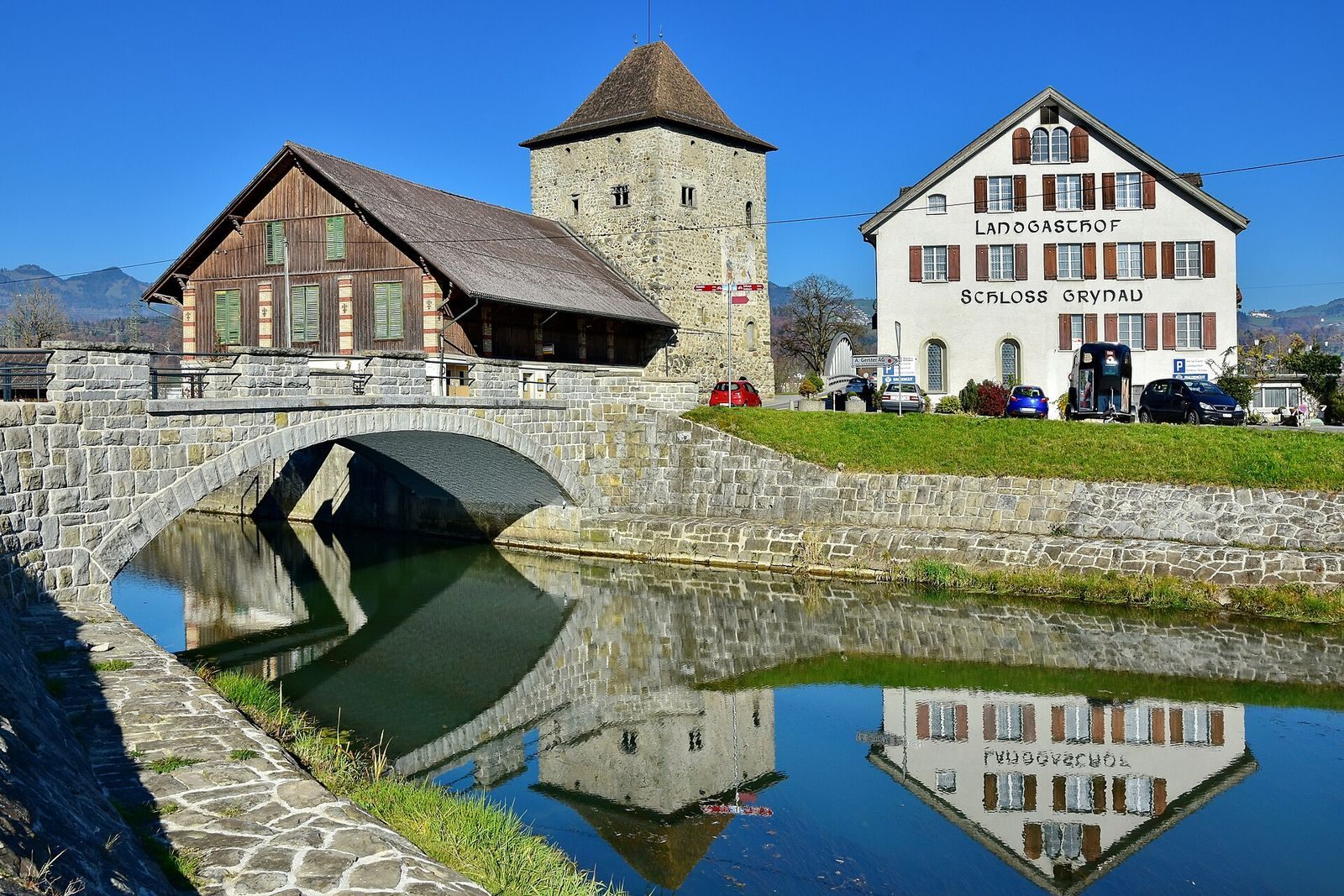
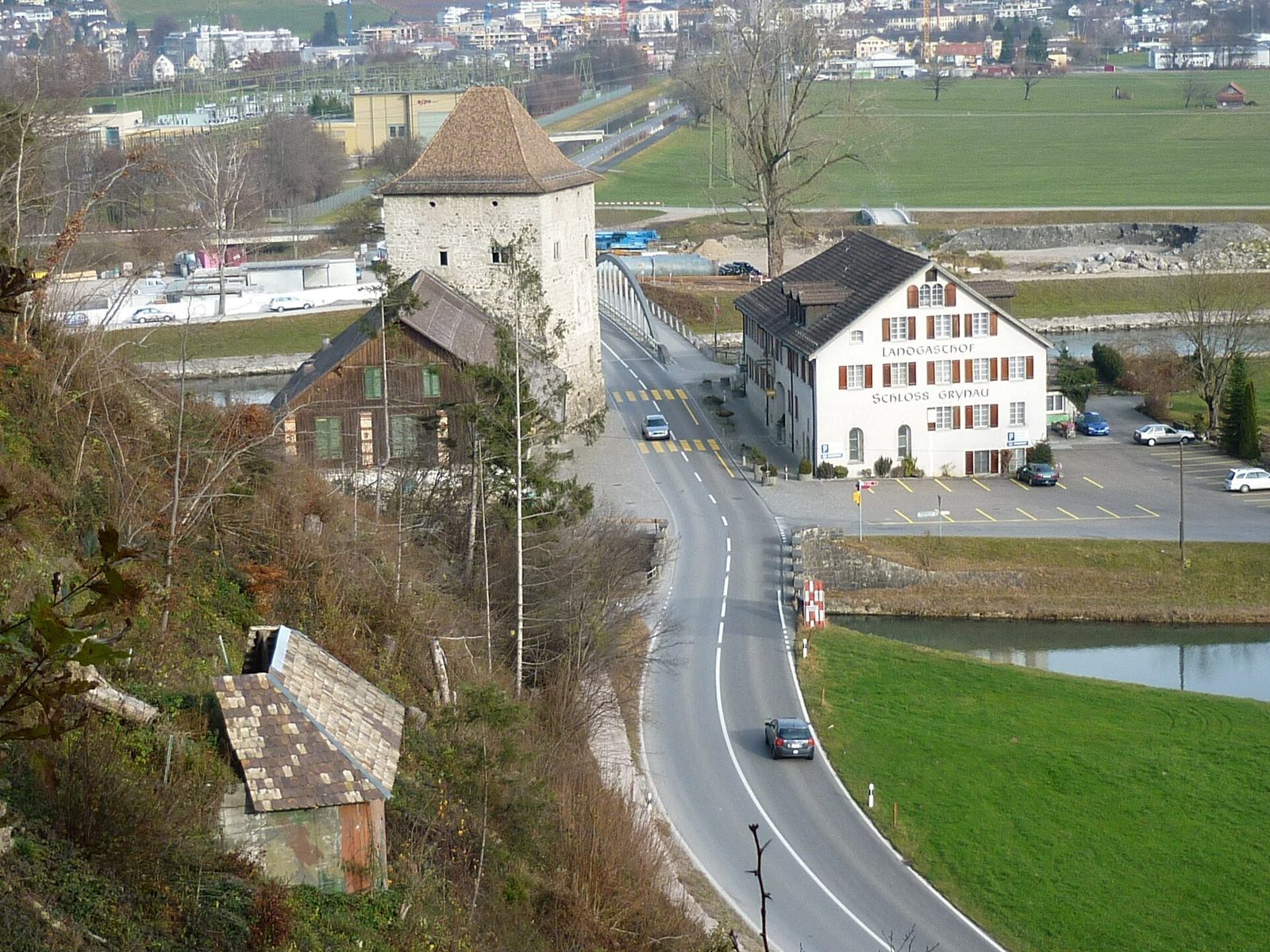
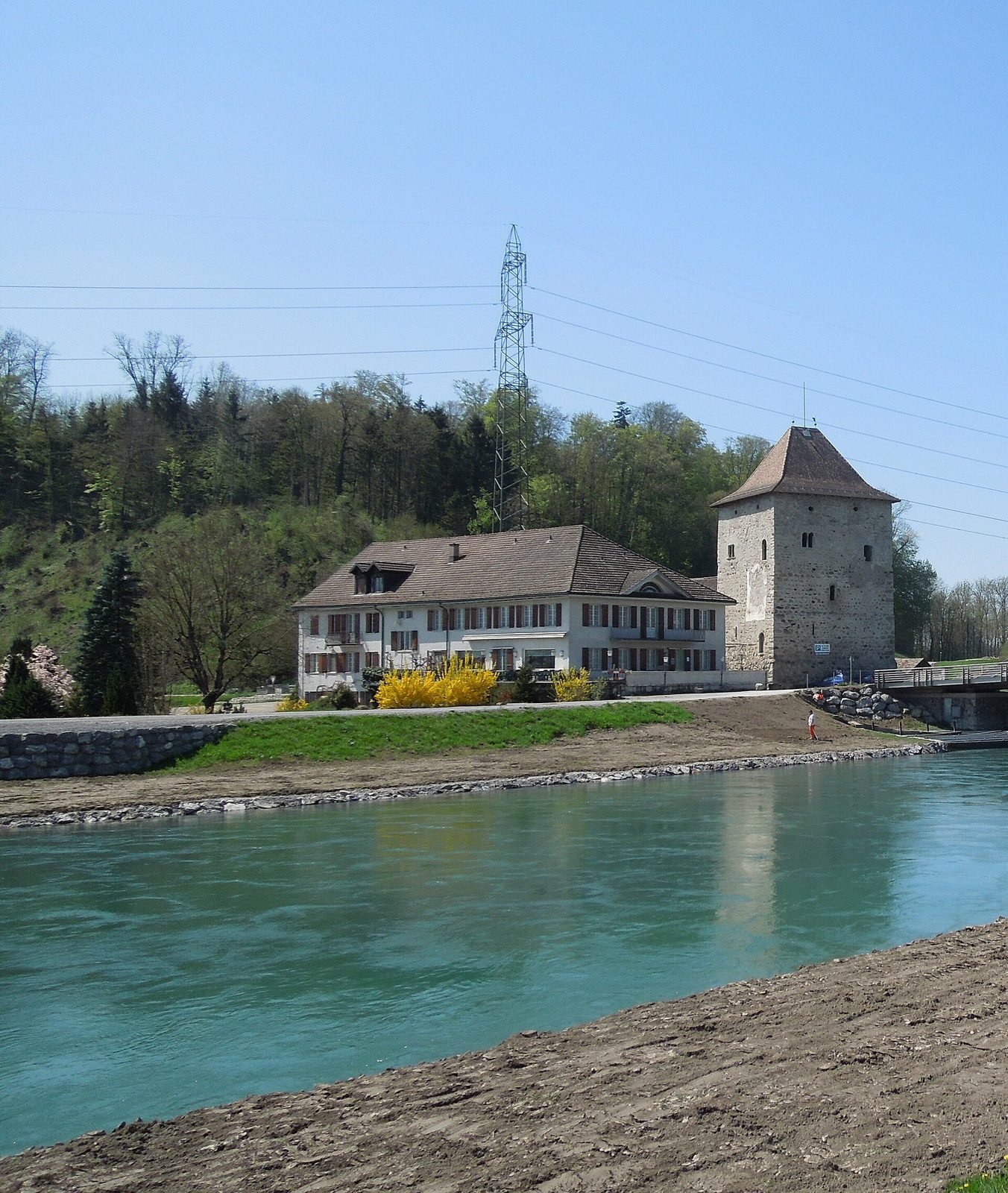
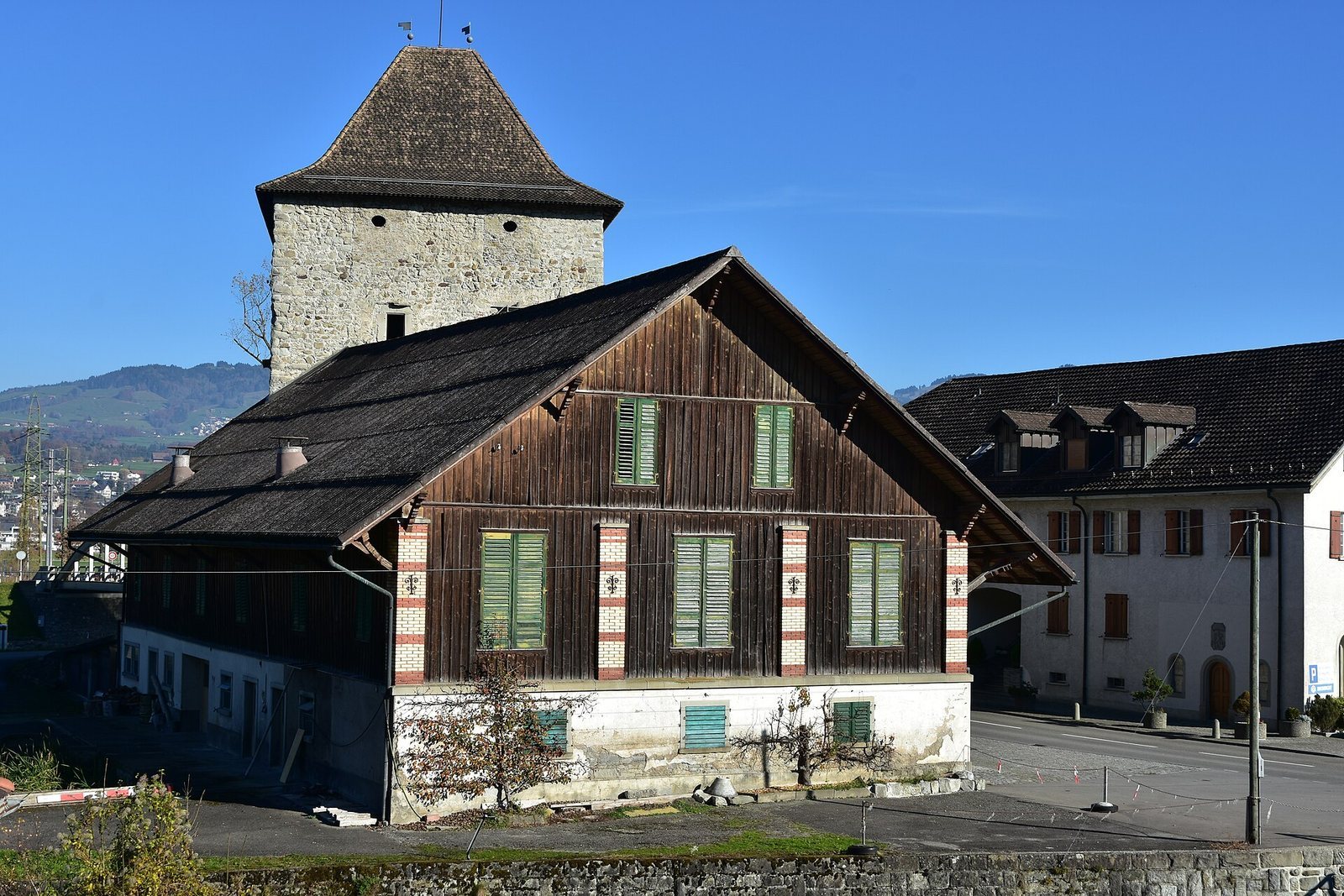
The surviving complex is organized around a square tower, with a chapel built into the castle group and former service buildings nearby. River engineering and later roads changed the site’s layout: the road and bridge now pass between the preserved tower and the former economic buildings, while the Linth canal runs between the tower and the road. The site lies at the southern end of Buechberg, east of the former shore of the now-dried Tuggenersee. The original castle stood where the Linth entered the lake, at an elevation of 412 metres above sea level.
Castle core
Castle tower
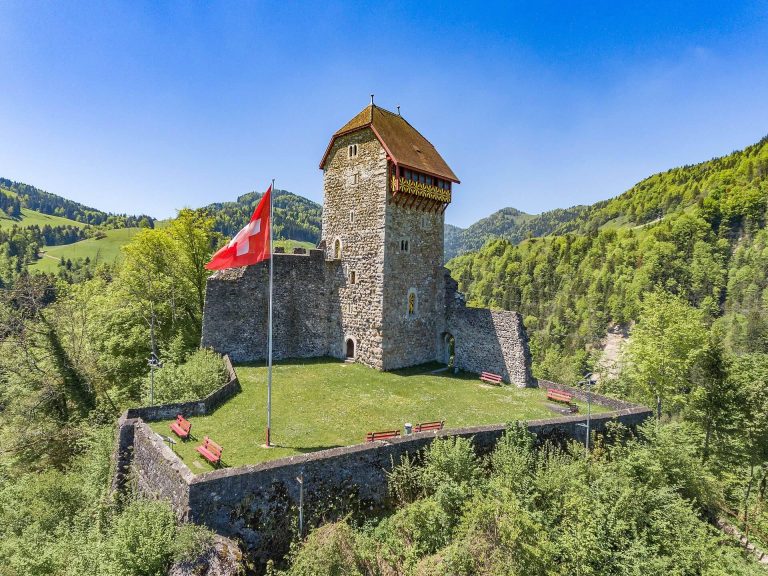
The surviving tower has five storeys and a square plan measuring 12.5 metres on each side. Its foundation walls are 2.2 metres thick. The original entrance was a high doorway on the south side of the second floor; a ground-floor doorway was cut in the 17th century.
A fire in the adjacent barn in 1906 destroyed the tower’s roof and interior. The tower was redecorated and reroofed, and its peaked roof dates from that year. A new barn was built in 1907. A damaged fresco on the tower’s southeast wall depicts the legendary fight between the brothers Suito and Scheyo, who are associated in tradition with the founding of Schwyz.
Chapel and former service buildings
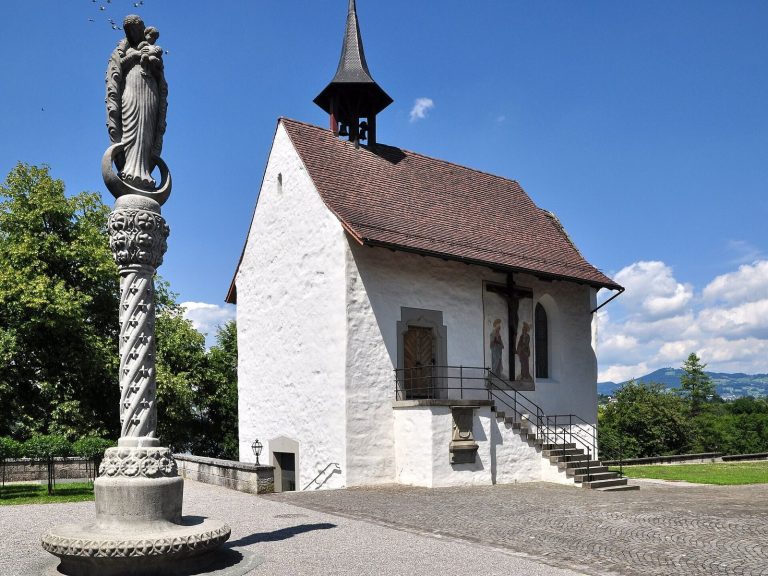
A chapel within the complex is dedicated to the Fourteen Holy Helpers, a group of Christian saints traditionally invoked for aid in times of need. Its portal bears the date 1675. A country inn now occupies the former surrounding buildings. The castle complex also included a barn beside the tower and an accommodation building; many of its other service structures were demolished during the Linth-channel works.
River crossing and later infrastructure
Old Linth crossing
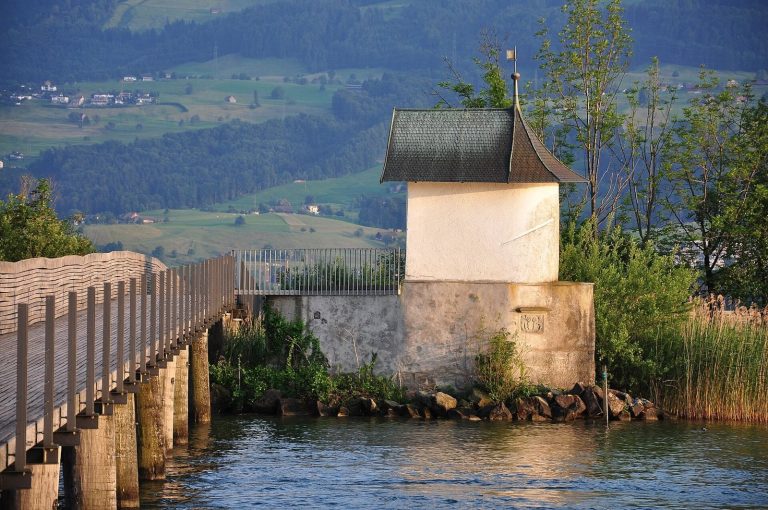
A stone bridge crosses the narrow bed of the old Linth. The present road and bridge pass between the tower and former economic buildings, rather than through the middle of the castle complex.
Canal and railway bridge
The Linth canal separates the tower from the road. The Fridgraben, St. Gallerstrasse toward Tuggen, the canal and Grynaustrasse toward Uznach separate the property from the former Linth channel. A concrete railway bridge, built in 1995, crosses the canal.
Fortress Grynau
Fortress Grynau occupies Buechberg behind the castle tower, forming a separate part of the site’s defensive landscape.