Nordenberg Castle: A Medieval Seat of the Lords of Nordenberg
Site at a Glance
- Rating
- 4
- Popularity
- Very Low
- Country
- Germany
- Primary era
- Medieval
- External website
- Open
- Eras represented
- Medieval
- Civilizations
- Holy Roman Empire
- Site type
- Military
- Remains
- Castle
On this page10 sections
History
Nordenberg Castle, also known as Obernordenberg, is a medieval fortress near Nordenberg in Windelsbach, Franconia, Germany, with origins in the twelfth century. From the mid-twelfth century until 1383, it was the seat of the Lords of Nordenberg, imperial officials from Rothenburg. They held the title of imperial kitchen master, a senior position in the emperor’s household rather than a reference to everyday cooking.
The Lords of Nordenberg
Lupold von Nordenberg, the earliest known member of the family, is named in 1156. In 1234–1235, Konrad von Nordenberg joined the revolt of Henry VII, a German king, against his father, Emperor Frederick II of the Hohenstaufen dynasty. After the revolt was suppressed, the castle first passed to Count Gottfried of Hohenlohe. In 1240, Gottfried relinquished it in favor of Lupold I, a member of Rothenburg’s imperial ministerial family, a service elite whose members could hold administrative or military responsibilities.
Rothenburg’s control
In 1345, Emperor Louis the Bavarian ordered Rothenburg’s citizens to pay 200 Haller for Nordenberg Castle, which he had purchased. The transaction apparently did not proceed. Debt later forced the Lords of Nordenberg of the Lupold line to sell their ancestral castle and surrounding settlements to the citizens and council of the imperial city of Rothenburg. The sale took place in 1383 for 7,000 gulden.
In 1386, Rothenburg transferred the castle to Heinrich Schenk of Leutershausen for his lifetime. He relinquished his rights in 1390, after which the city administered the castle through its officials.
Siege and dismantling
In 1407, during a conflict over Rothenburg’s territorial policy, the Nuremberg burgraves Friedrich and Johann, medieval officials with administrative and military responsibilities, and the Bishop of Würzburg captured the castle after a three-week siege. It then passed to Burgrave Friedrich.
In 1408, King Rupert of the Palatinate ordered the captured castles returned and their fortifications dismantled. Rothenburg carried out the order at Nordenberg, using gunpowder to demolish the main defensive tower.
Remains
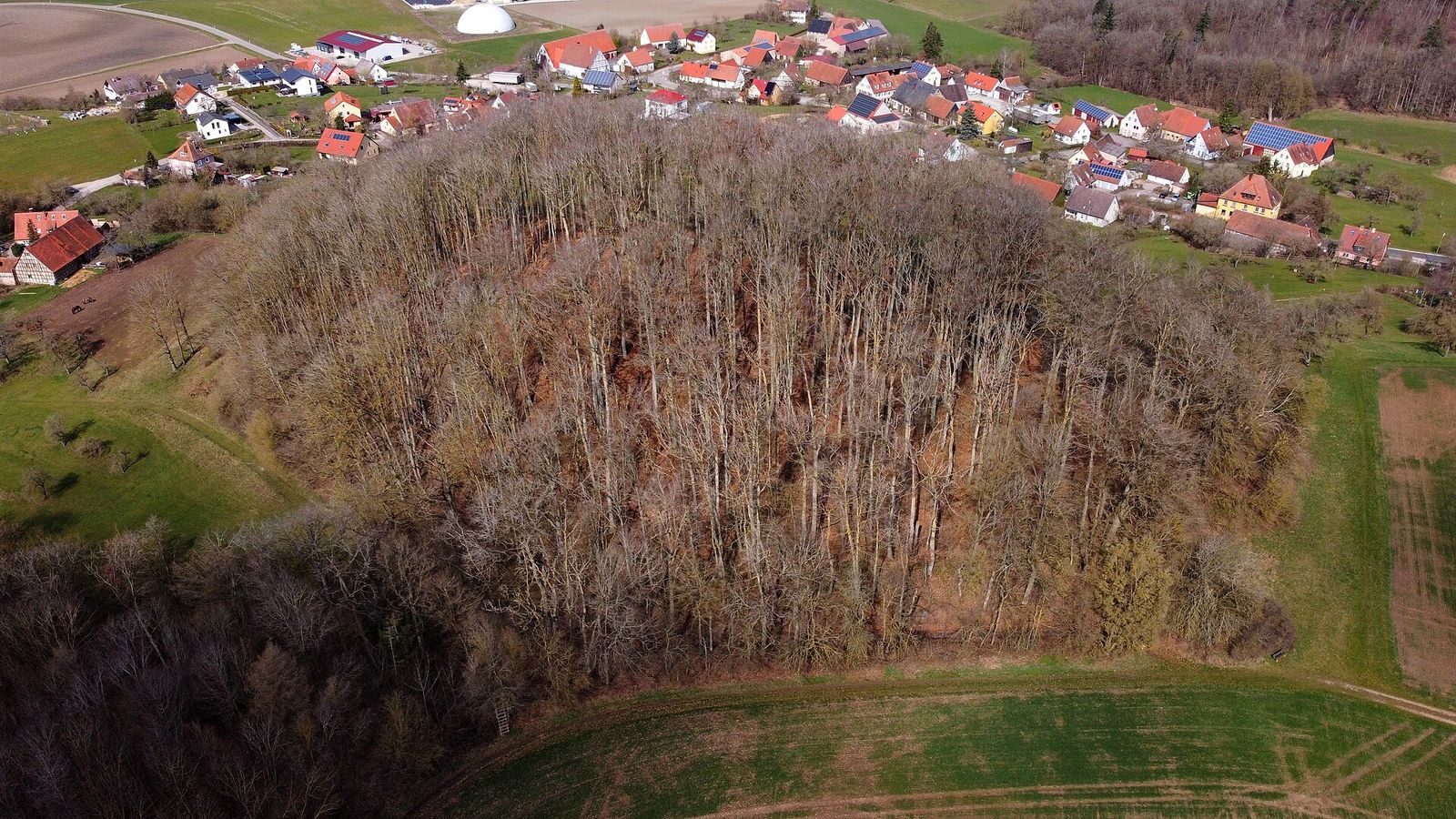
The hilltop complex stood about 490 metres above sea level on a flat summit projecting west from the steep escarpment of the Frankenhöhe. It extended roughly 380 by 210 metres and comprised a core castle, a small eastern outwork, and a large outer bailey, an enclosed outer part of the castle, to the south and west.
Enclosures and defenses
Core and outer enclosures
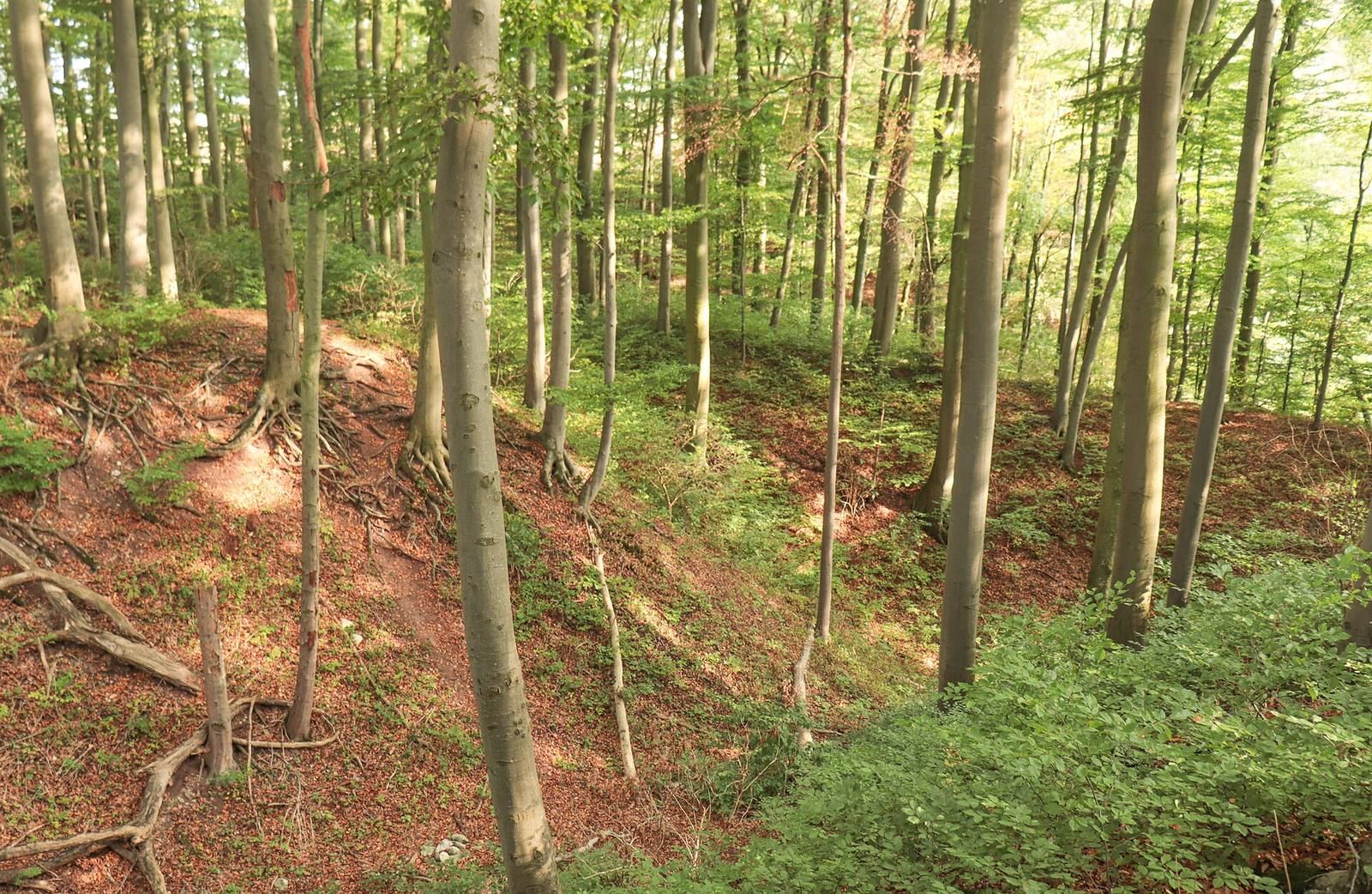
The core occupied an approximately rectangular plateau measuring 45 by 40 metres. Its slopes had been steepened artificially, and its defenses included a ditch up to 15 metres deep and an outer bank as high as 7 metres. A separate neck ditch, 15 metres wide and 3 metres deep, divided the core from the upland. A larger outer ditch, reaching 24 metres in width and 7 metres in depth, together with an outer rampart, enclosed the core and the large outer bailey.
Eastern outwork
The outwork, a defensive work extending beyond the main enclosure, measured 75 metres long and up to 15 metres wide. A ditch surrounded it, with an outer bank reaching 5 metres in height.
Main defensive tower
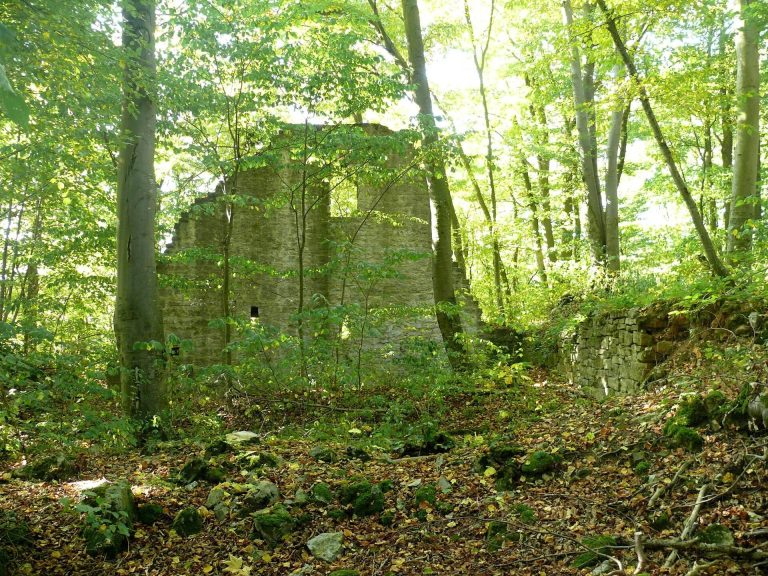
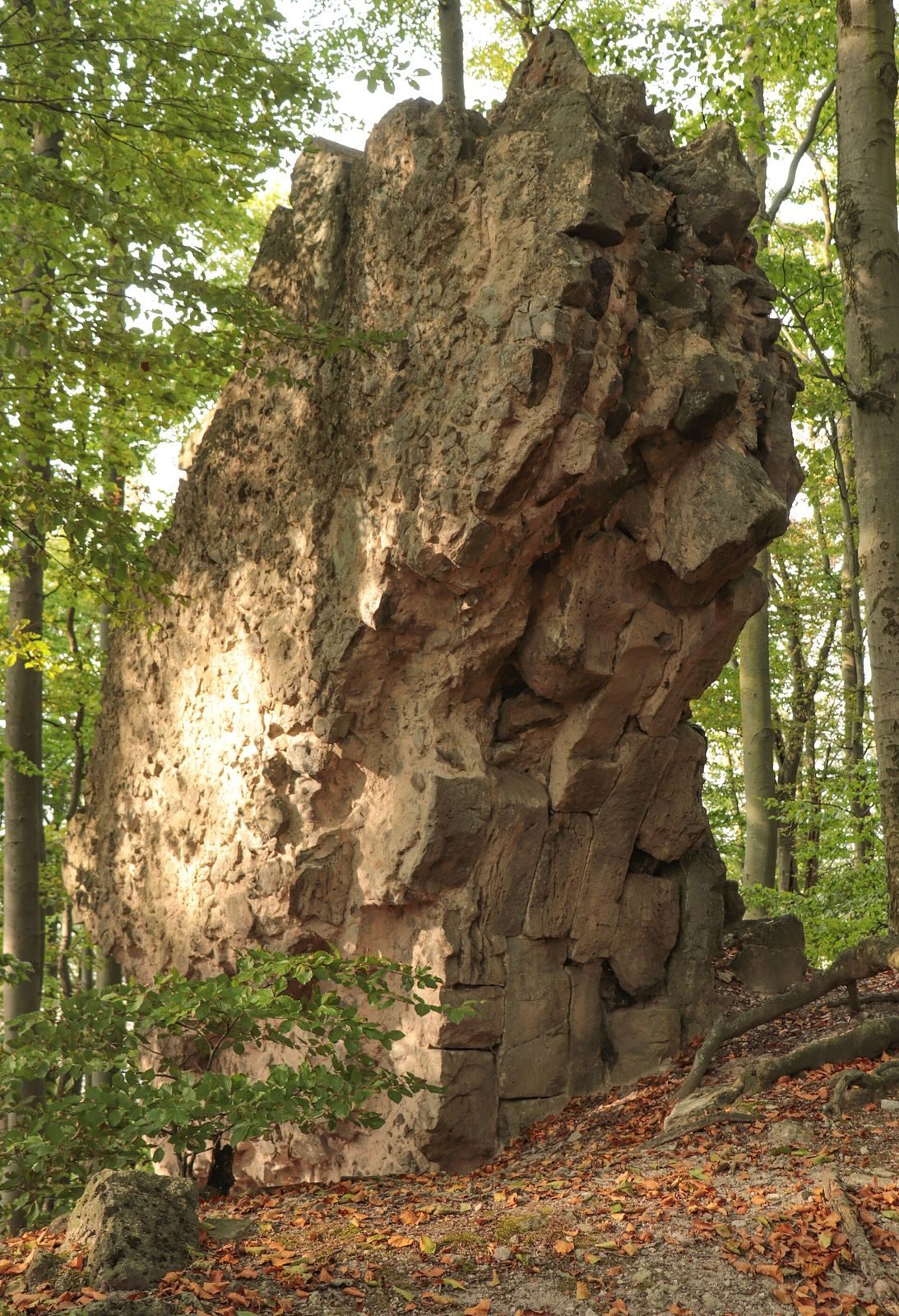
Part of the tower’s foundation remains in its original position in the northeast corner of the core. The foundation is 12 metres in diameter, with walls 3.5 metres thick. Projecting, roughly worked stone blocks, holes used by lifting tongs, and masons’ marks date the tower to the second third of the thirteenth century. Stone removal for reuse has damaged the plateau, while debris from the tower is scattered across the core. One substantial wall section was turned 90 degrees during the tower’s demolition and remains embedded upright in the ground.
Pottery
The oldest pottery collected from the castle area dates to the mid-twelfth century.