Kordin Temples: Prehistoric Megalithic Temples in Malta
Site at a Glance
- Country
- Malta
- Primary era
- Stone Age
- Eras represented
- Stone Age, Modern
- Civilizations
- British, Maltese Temple Culture
- Site type
- Religious
- Remains
- Temple
On this page9 sections
History
Prehistoric temple phases
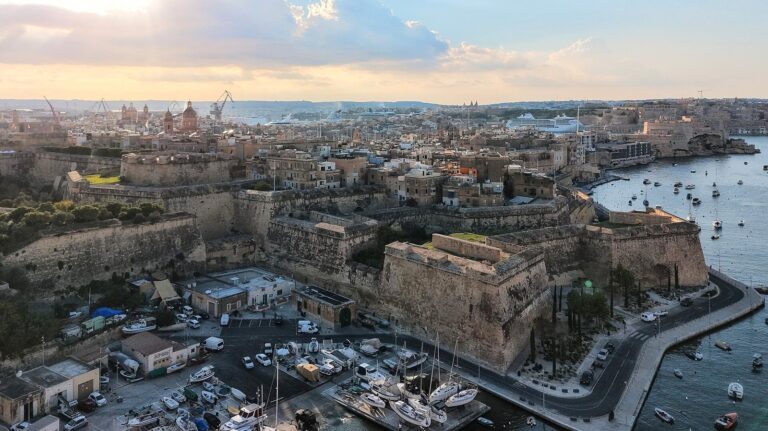
The Kordin Temples are a group of megalithic temple complexes on Corradino Heights in Paola, Malta, used from prehistoric times and later during the Phoenician, Greek, and Roman periods. Three complexes, Kordin I, II, and III, were excavated. Kordin III is the one whose remains survive.
The earliest part of Kordin III is believed to date to around 3700 BCE, during the Mġarr phase of Malta’s prehistoric temple sequence. Most of the complex belongs to the Ġgantija phase. It continued in use during the Tarxien phase, when its façade was rebuilt, and was probably abandoned around 2500 BCE.
Pottery from Kordin II represents every phase of the Maltese Temple period, indicating use throughout that sequence. The building’s chronology is uncertain, however, and it remains debatable whether the entire structure dates to the Temple period. Two further sites, Kordin IV and V, may also have been megalithic complexes; they may have been obliterated during the twentieth century.
Land ownership and early investigations
In the seventeenth century, the land belonged to Giovanni Francesco Abela, a Maltese historian and antiquarian who had a country residence nearby and investigated archaeological remains in the area. Although he first intended to leave his property to the Order of St John, he ultimately bequeathed his villa and surrounding land to the Jesuits, members of the Catholic Society of Jesus. The villa became Malta’s first museum, the Museo di San Giacomo. The Jesuits held the property until the Order of St John, a Catholic religious and military order that governed Malta before British rule, expelled them in the eighteenth century and transferred their land to its treasury.
During the Order’s rule, Grand Master Manuel Pinto da Fonseca commissioned archaeologist Gio Antonio Barbaro to investigate the site. Later, under British rule, Themistocles Zammit carried out extensive excavations at Malta’s megalithic temples.
Excavations, damage, and survival
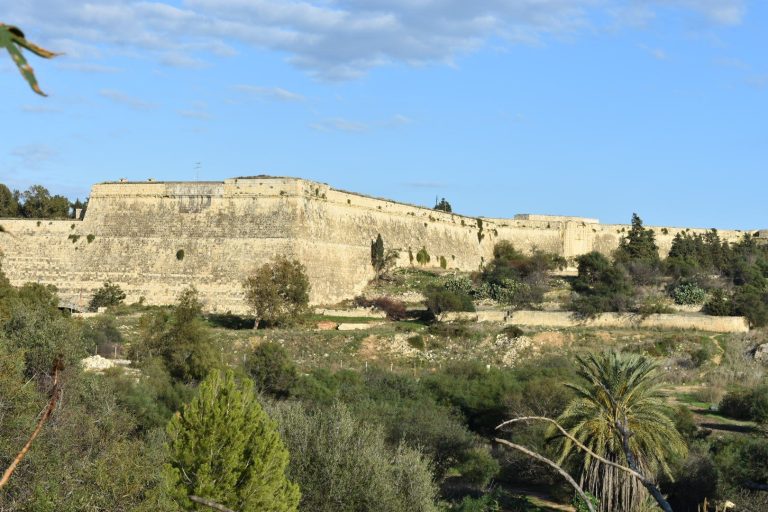
Kordin II was investigated by Cesare Vassallo in 1840. The Royal Engineers destroyed part of the complex in 1871 while digging a ditch for the Corradino Lines, the fortifications on Corradino. Antonio Annetto Caruana began more systematic excavations in 1892; Albert Mayer followed in 1901, and Thomas Ashby and Thomas Eric Peet worked there in 1908 and 1909. Second World War bombing caused further damage. Construction of an industrial estate in the 1960s obliterated the site.
Kordin I was first surveyed in the 1880s, and Caruana undertook its initial excavations. Zammit continued work in 1908, followed by Ashby and Peet in 1909. Weather exposure and aerial bombing during the Second World War damaged the temple. By the 1950s little remained, and construction of an industrial estate in the 1960s destroyed what was left.
Vassallo cleared debris from Kordin III in the 1870s. Caruana identified further clusters of megalithic monuments in the area in 1882, and Ashby and Peet excavated the temple in 1909. John Davies Evans investigated it in 1953, followed by David Trump in 1961. Excavation in the surrounding area began again in 2015, led by Caroline Malone with University of Malta students. The temple was damaged during the Second World War but was not built over afterward. It was included on Malta’s Antiquities List in 1925.
Remains
Kordin III
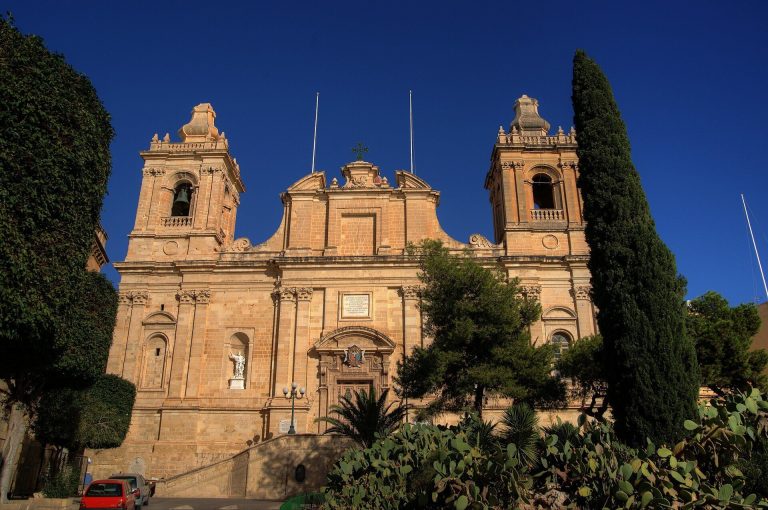
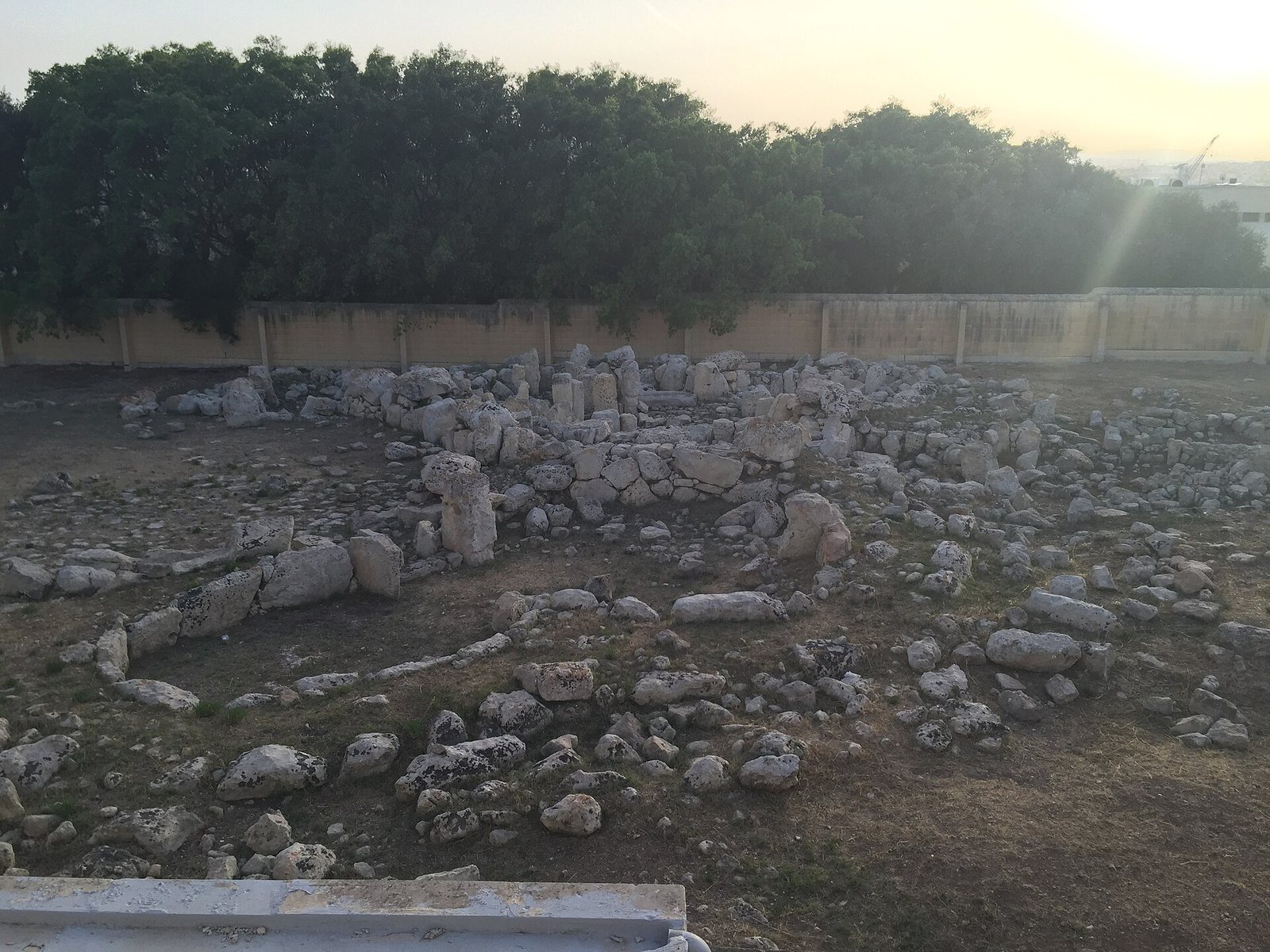
The surviving complex occupies a plateau overlooking the Grand Harbour. Kordin III lies just outside the Corradino Lines, near the Church of St Anthony of Padua and Mariam Al-Batool Mosque. Its ruined remains comprise a large temple and a smaller area behind it, both built of limestone. A walled enclosure surrounds the complex and was built in 1925.
Main temple
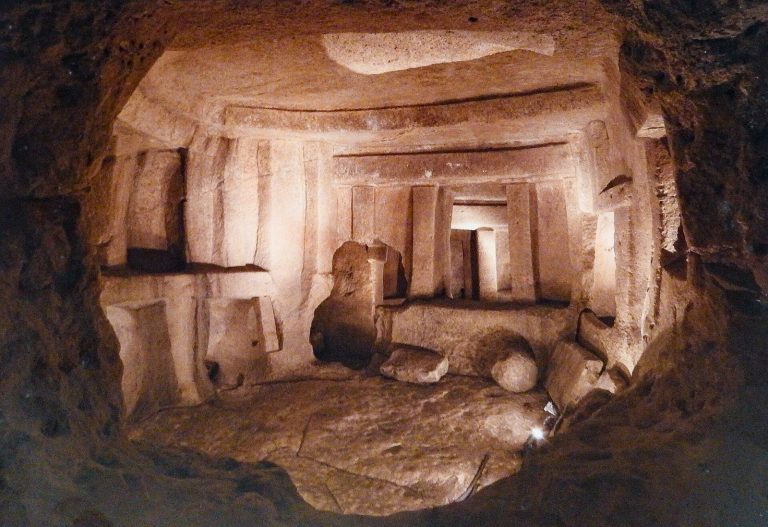
The larger temple has a three-apse plan, with three recessed spaces at the building’s end. Its inward-curving façade faces a forecourt, and an entrance passage leads to a central court surfaced with stone slabs. The passage also has stone paving, a feature unique among Malta’s temples. Despite its ruined condition, Kordin III is considered one of the most complete of the smaller temples.
Rooms behind the temple
Small rooms stand behind the main temple. They may have served as storerooms, though they could instead be the remains of a smaller temple with an irregular plan.
Stone trough
A trough 2.75 metres long was found lying across the entrance to the left apse. It was made from hard limestone brought from more than two kilometres away and has seven deep grooves cut across it by grinding. It may have served as a multiple quern, a stone tool for grinding corn, and could be contemporary with the temple. Alternatively, it may have been used to grind deffun, a traditional Maltese roofing material, which would place it considerably later.