Quzhou City Walls: Historic Defenses of Quzhou, China
Site at a Glance
- Country
- China
- Primary era
- Early Modern
- Eras represented
- Classical, Medieval, Early Modern, Modern
- Civilizations
- Han, Ming, Qing, Song, Tang, Yuan
- Site type
- Military
- Remains
- Wall
On this page11 sections
History
Quzhou city walls are historic urban defenses in Kecheng District, Quzhou, China, first built as earthen fortifications in AD 192 during the Eastern Han dynasty. Brick-and-stone construction began around or after the Tang dynasty. The walls guarded a city whose position made it a strategic gateway to western Zhejiang and a route between the coast and Fujian and Jiangxi.
Early defenses and rebuilding
In 1121, Quzhou’s prefect, the chief administrator of a prefecture, rebuilt the old city and set the general scale followed by later walls. The work included six gates and an outer moat. The walls were repaired repeatedly during the Southern Song, Yuan, Ming, and Qing dynasties.
Military role and gate names
Quzhou’s position brought it into conflicts across several periods. Attacks associated with the uprisings led by Fang La and Huang Chao, the Taiping movement, and Northern Expedition forces fighting Sun Chuanfang’s troops were repulsed in the area. The eastern gate, on Turtle Peak and a ridge called Prefectural Hill, gained the name “Iron Gate of Quzhou” because it was difficult to capture. During the Taiping conflict, leaders Shi Dakai, known as the Wing King, and Li Shixian, the Attendant King, besieged the city repeatedly. Their longest siege lasted about six months. Quzhou’s high, sturdy defenses resisted the attacks, and the besieging forces withdrew after suffering losses. The city became known as “Iron Quzhou.”
The six gates established in 1121 later became associated with a set of names that changed little between a prefectural gazetteer, a local history and geography reference work compiled in 1503, and a county gazetteer compiled in 1926. The Main West Gate was linked to the Song-era Sailing Afar Gate. The Qu River outside it served as a principal waterway for departures, and the gate was also called the Water Pavilion Gate and the Gate Facing the Capital. The Main South Gate was associated with the Song-era Honoring the Worthy Gate, which led toward Jiangshan, then known by a name meaning “Honoring the Worthy County.” Later names included Thoroughfare, Far-Reaching, and Light-Reaching gates.
The Little West Gate was associated with the Song-era Harmony and Abundance Gate and later called the Dyke Weir Gate and Broad Access Gate. The Little South Gate was linked to the Clear Radiance Gate, with later names including Front Lake, Kui Star, and Gate to the Immortals. Kui Star is a deity associated with success in literary examinations; a Song poet wrote about an incident outside this gate. The North Gate was associated with the Eternal Purity Gate and later called the Gate of Homage to the Emperor and Floating Stone Gate, the latter name reflecting its direct route to Floating Stone Ferry. The East Gate was linked to the Welcoming Harmony Gate, a name connected with its position facing the morning sun and with auspicious harmony. Two more gates opened in 1932, one named for an earlier name for Quzhou and the other called the New City Gate.
Repairs and modern changes
Repairs continued through the Qing dynasty and into the fifth year of the Chinese Republic period, with more than twenty additional rounds of work. Quzhou city walls were designated a Major Historical and Cultural Site Protected at the National Level in 2006. Municipal projects have created parks around wall remains near several gates and selectively restored parts of the old defenses, including the Main West Gate’s upper structure and the bell tower.
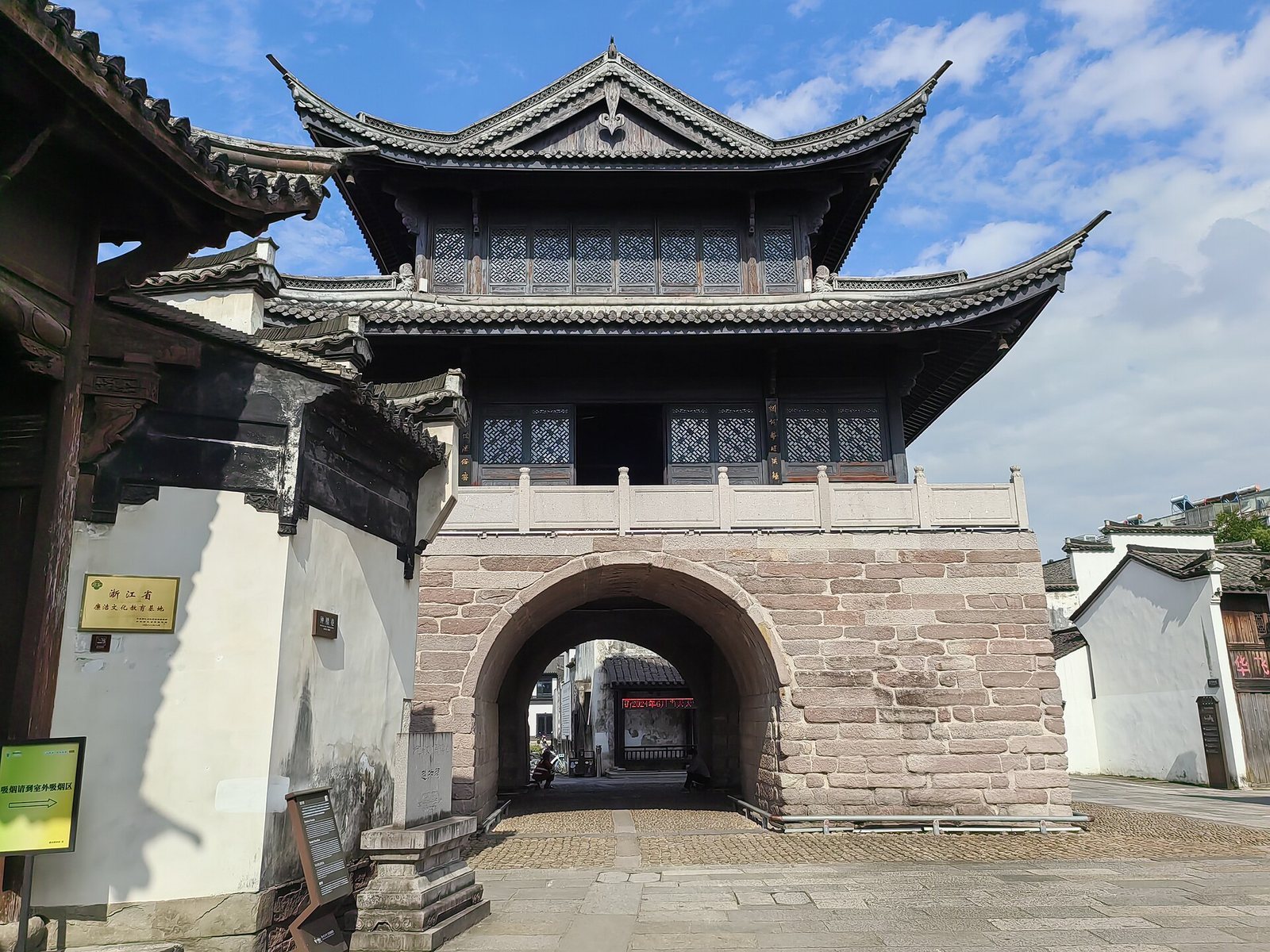
The bell tower was built in 1325 within a Buddhist temple, under the direction of a monk from Jingci Temple, a Buddhist temple in Hangzhou. Its wooden upper structure was taken down in the early 1970s after falling into disrepair and becoming unsafe. Restoration was completed in 2010, guided in part by a 1965 photograph found after a twelve-year search. A legend recorded by Qing writer Pu Songling, known for supernatural tales, places one of Quzhou’s three legendary monsters, a one-horned creature, at the tower.
In June 2024, prolonged heavy rain caused part of the west side of the north-wall section at the Water Pavilion Gate to collapse. The masonry that failed had been repaired in 1995; repairs to the damaged section were completed in 2025.
Remains
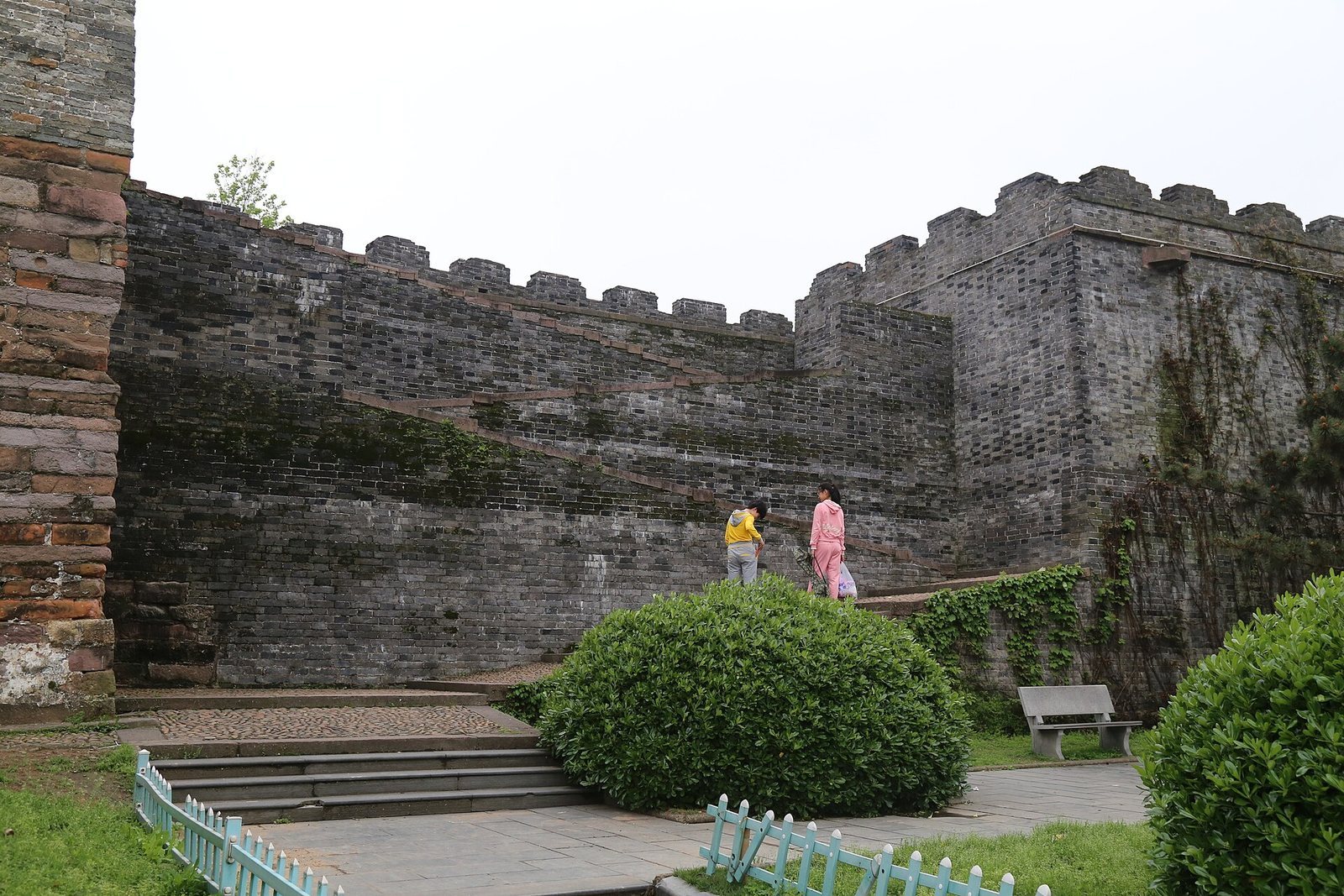
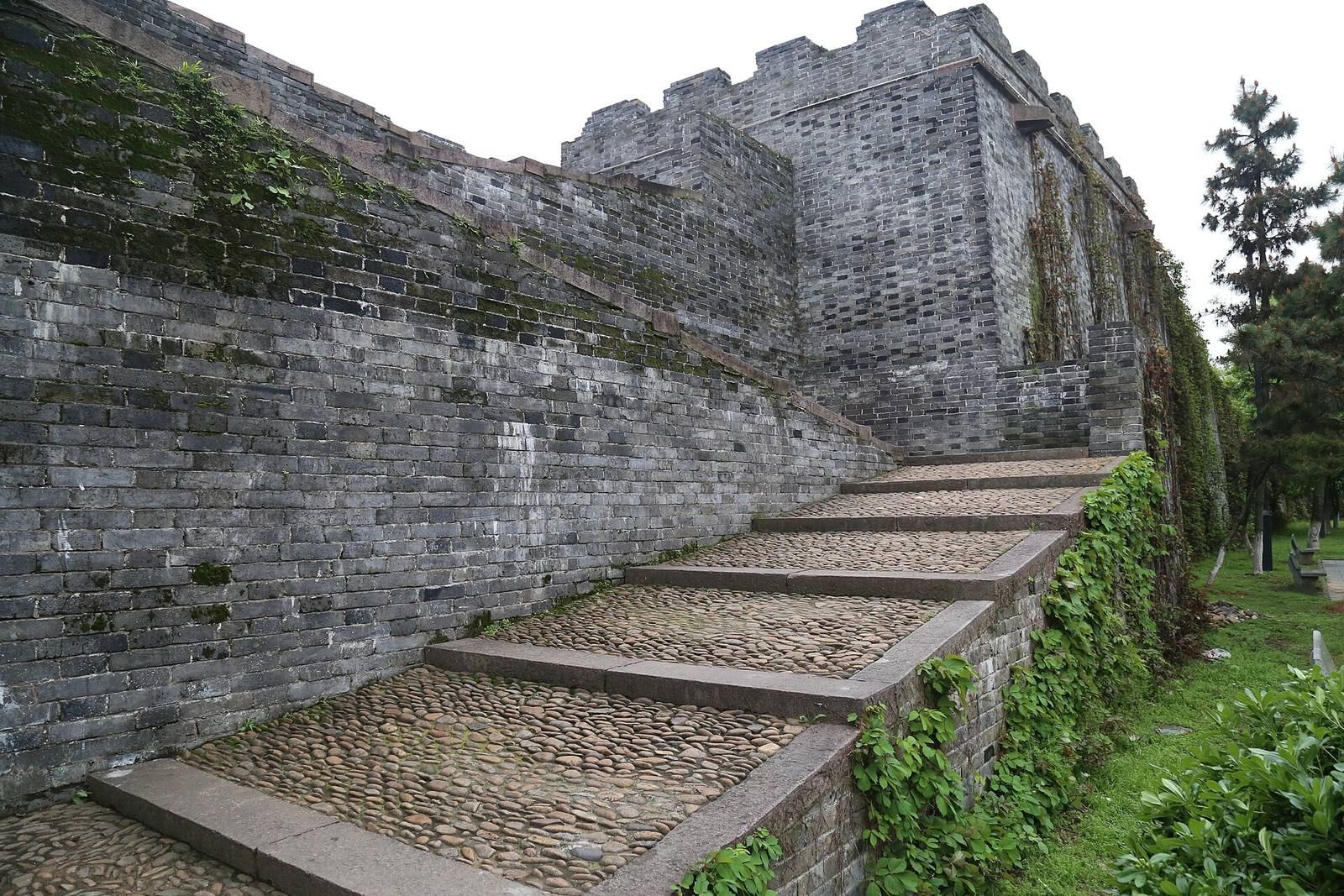
The surviving defenses comprise stretches of wall, six gates preserved to varying degrees, and the bell tower. The original 1121 wall enclosed a perimeter of 4,050 paces, with a moat outside it. Today, wall sections extend for about 700 metres on the east, 300 metres on the north, 120 metres on the west, and 65 metres on the south; about 1,000 metres of wall ruins are also present. The surviving fabric is mainly from the Ming, Qing, and Republic periods. Walls are generally about five metres high and two metres wide, with a smooth, level top broad enough for carts and horses.
Gate architecture and inscriptions
Main West Gate
The Main West Gate stands directly beside the Qu River, leaving no room for an outer barbican, an additional defensive enclosure beyond a gate. A pavilion was built outside it instead. Plaques sit above the arched opening on both sides of the passage. The inner plaque is 0.38 metres high and 4.8 metres wide, positioned 0.32 metres above the arch crown; the outer one is 0.57 metres high and 0.42 metres above it. Both have central inscriptions on blue stone reading “Gate Facing the Capital.” A calligrapher from Kaihua, then executive deputy director of the Zhejiang Provincial Museum, carved the inscriptions in 1997.
Main South Gate
Plaques are set on both the inner and outer sides of the gate, each with a central inscription carved on a blue-stone slab. Luo Zhewen, a scholar of ancient Chinese architecture and a student of Liang Sicheng, carved the inscriptions in 2000.
Little South Gate
A brick plaque above the Little South Gate’s arch bears the inscription “Clear Radiance Gate.” It is 0.5 metres high, set 0.3 metres above the arch crown, and framed by two layers, each 0.07 metres wide.
Gate named for an earlier name of Quzhou
At the gate opened in 1932 and named for an earlier name for Quzhou, a plaque bearing the gate’s name sits immediately above the arch crown.
Bell tower
The tower’s surviving base is a square stone structure inside the city, with openings on all four sides. Above it stands a restored, two-storey timber pavilion in a Qing architectural style. It has a square plan with three bays, or spaces between columns, on each side, and a double-eaved hip-and-gable roof combining sloping hip sections with gabled ends. Its raised-beam frame uses beams supported by columns. A replica bronze bell was made as part of the restoration.