Fountain of the 99 Water Spouts: A Medieval Civic Fountain in L’Aquila
Site at a Glance
- Country
- Italy
- Primary era
- Medieval
- Eras represented
- Medieval, Early Modern, Modern
- Civilizations
- Italian, Kingdom of Naples, Kingdom of Sicily, Spanish
- Site type
- Civic
- Remains
- Fountain
On this page7 sections
History
Foundation and civic origins
The Fountain of the 99 Water Spouts is a medieval civic fountain in the Rivera district of L’Aquila, Italy, probably built in 1272. It is regarded as one of the city’s earliest civic monuments and as a celebration of L’Aquila’s independent origins.
L’Aquila’s foundation is dated to 1254–1266, and Conrad IV, king of Germany and Sicily, granted the city municipal rights in 1254. The city grew from local communities that included small castles, estates, and manor houses. Tradition counts 99 founding communities, although historical estimates put their number at about 60. A related tradition associates each community with a square, a church, and a fountain. The fountain’s 99 outlets are linked to the castles said to have contributed to the city’s foundation.
The Rivera district occupies the site of the ancient castle of Acquili, from which L’Aquila took its name. Its abundant water and established craft activities made the area important when the city was founded. The fountain was probably designed by Tancredi da Pentima, though the extent of his contribution is uncertain and may have been limited to the wall opposite the entrance. Much of the monument’s present appearance may date to the fifteenth century.
Alterations and restoration
Work in the fifteenth century included stone cladding and the city’s coat of arms. In 1582, Alessandro Ciccarone was credited with work on the left side. The right side dates to the eighteenth century and was probably rebuilt after the 1703 earthquake damaged a frontage. An inscription associates the right frontage with 1744, while another records restoration in 1871.
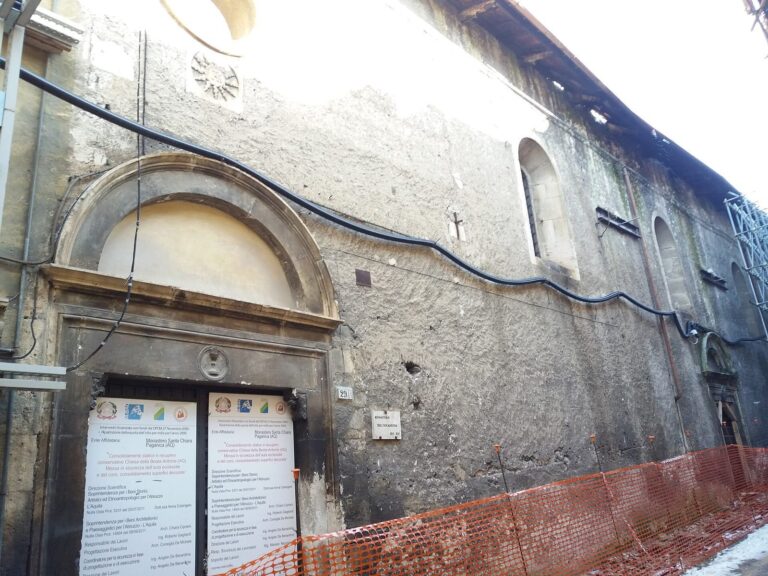
The fountain’s basins served as a public laundry, with washing carried out there daily until the early decades of the twentieth century. The water source was traditionally kept secret to prevent a local lord or governor from gaining control of it and using that control to pressure the city. A legend says the designer was executed to protect the secret and that Tancredi da Pentima’s remains lie beneath the paving. The spring is thought to be near the church of Santa Chiara, in northeastern Rivera.
The fountain entered Italy’s national-monuments list in 1902. It was restored in 1994 and 2008. The 2009 earthquake caused slight damage, chiefly to the right side resting against the city wall. Subsequent work consolidated the structure and cleaned its stone cladding and basins.
Remains
Setting and layout
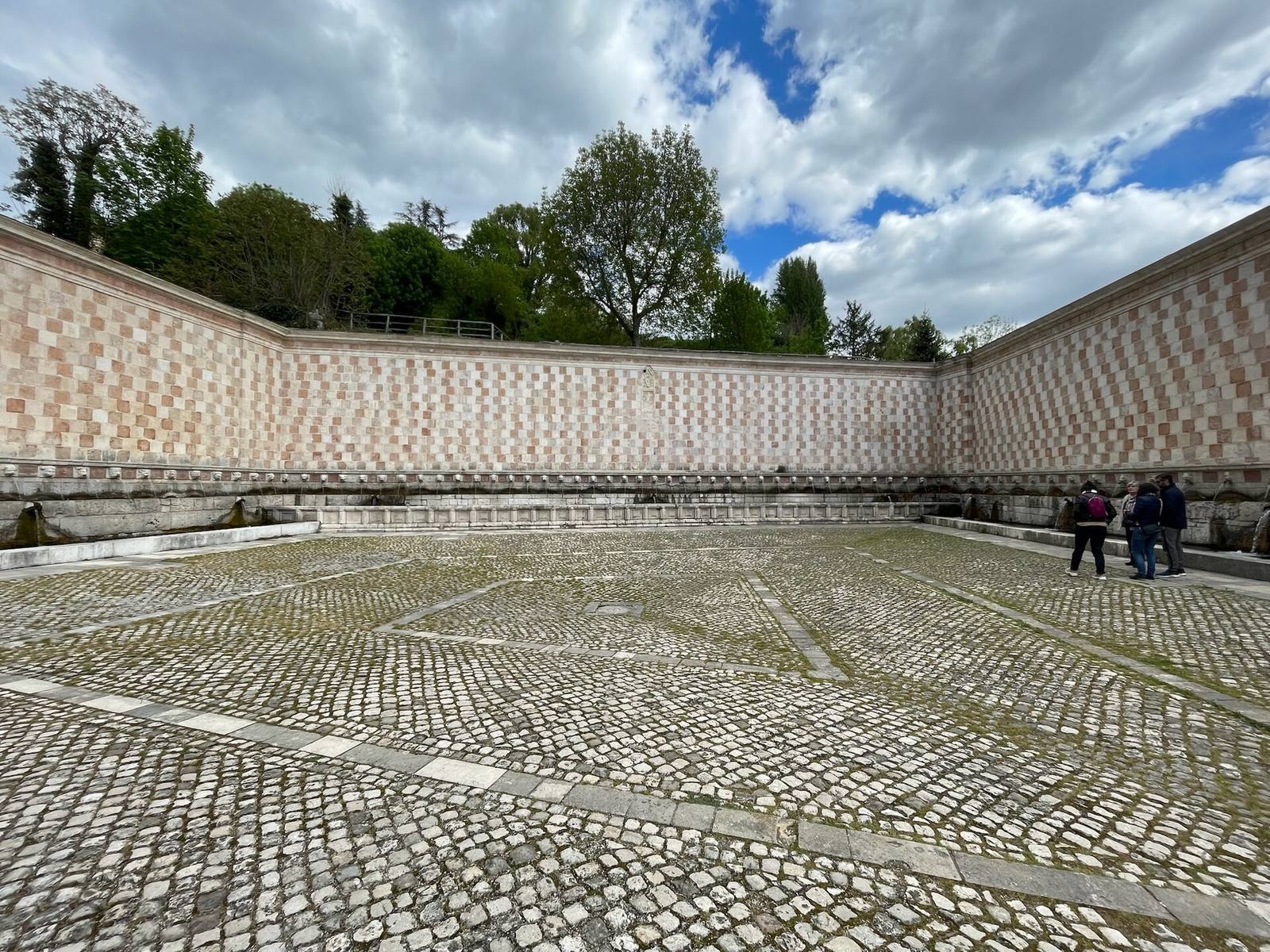
Beside the city walls near the Aterno River and the church of San Vito, the fountain occupies almost the full perimeter of a quadrangular square. Its footprint is trapezoidal, a four-sided shape with one pair of parallel sides. Three built sides lie below street level, while a staircase faces the medieval church at the open frontage. An iron enclosure was added across that frontage in 1934. One side rests against the city wall. The oldest wall dates to the late thirteenth century, and two further walls were added in the fourteenth and fifteenth centuries.
Stonework and basins
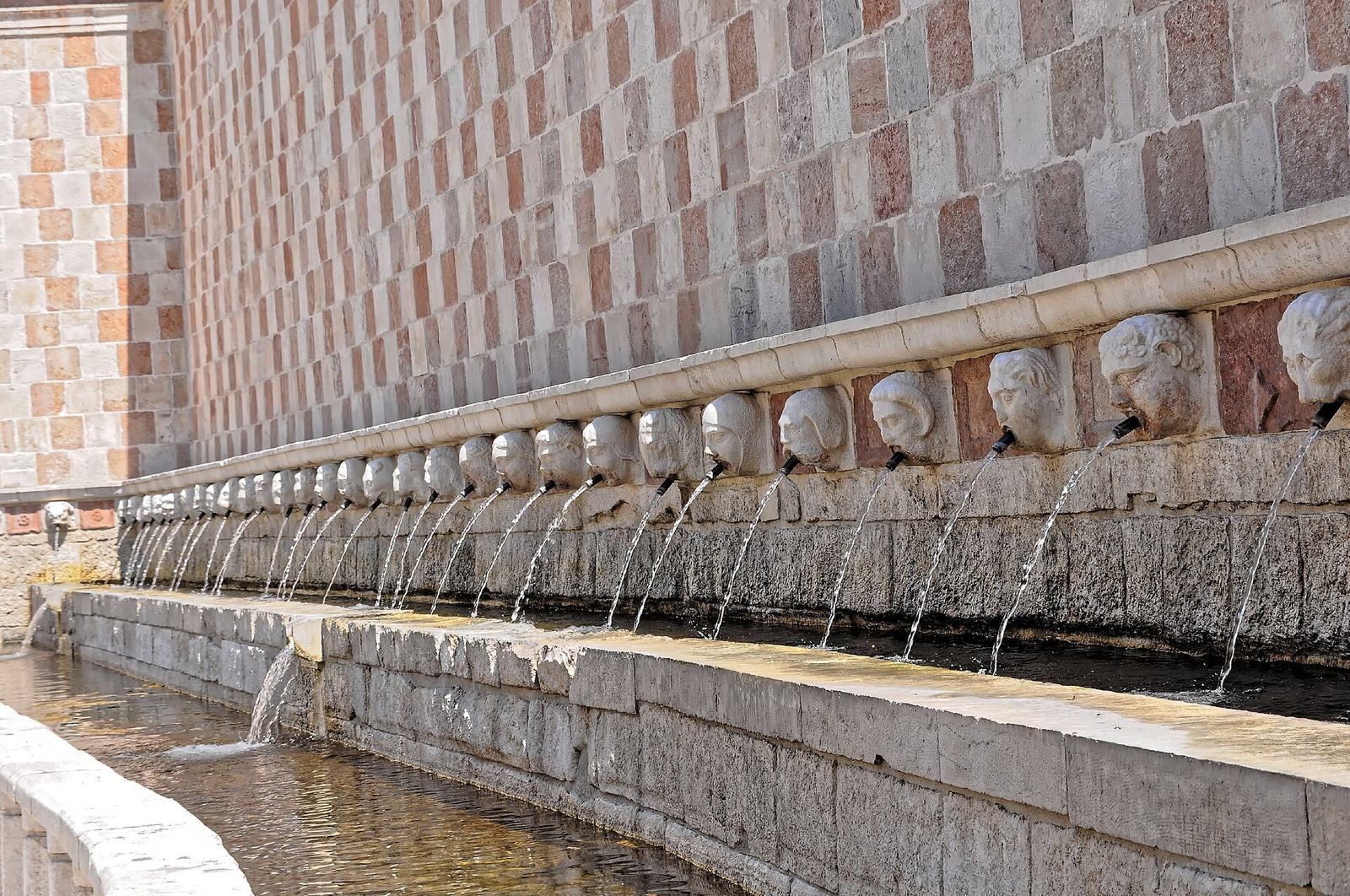
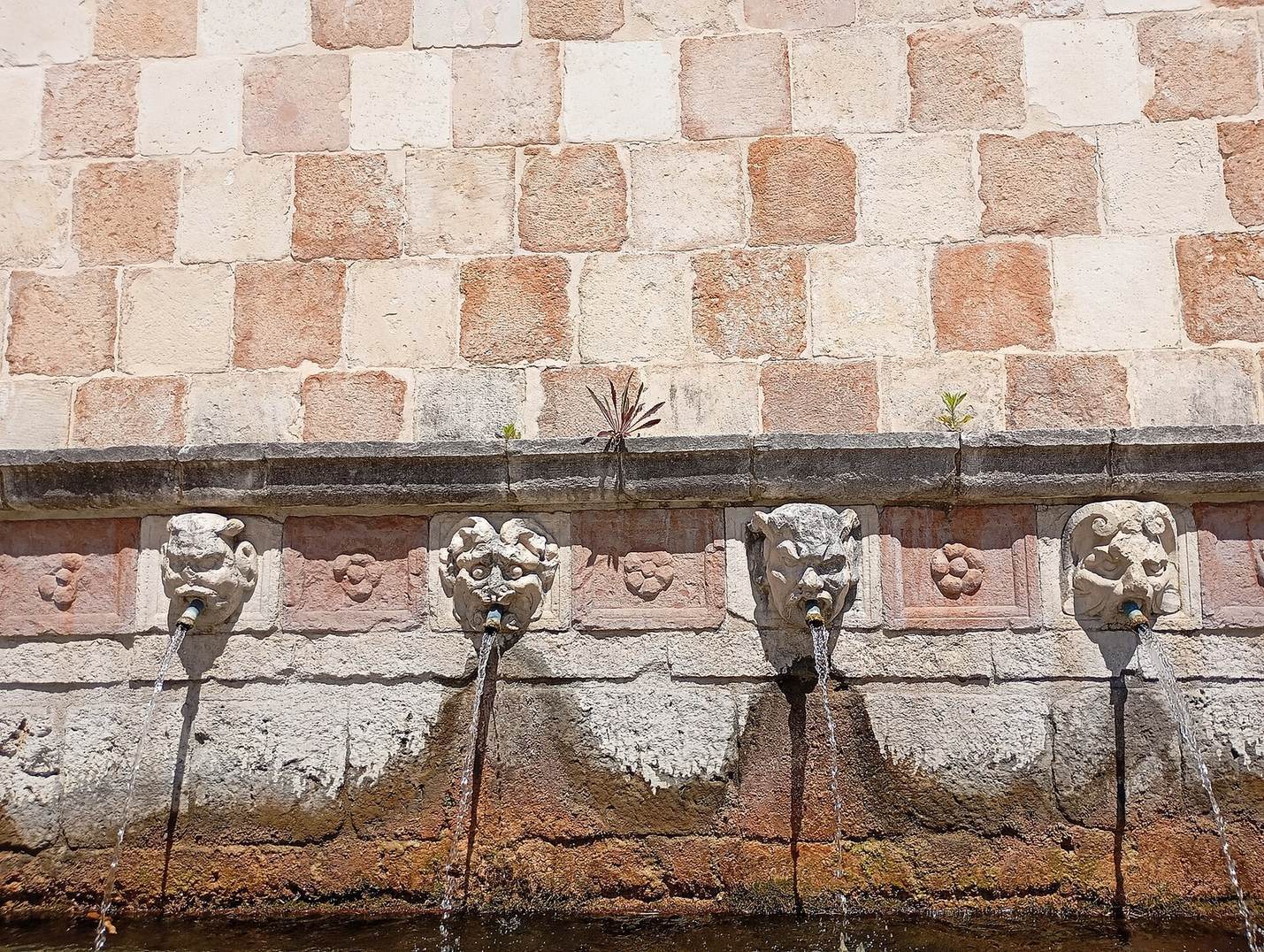
The fountain is built of travertine and marble, with white and pink stone from the nearby Genzano di Sassa quarry arranged in a checkerboard pattern. A similar treatment appears on the facade of the Basilica of Santa Maria di Collemaggio. Five basins sit at slightly offset heights. Water enters the highest through spouts in carved stone masks and passes down through the lower basins. An elongated basin feeds a lower basin used for washing.
Spouts, carving, and inscriptions
The principal outlets consist of 93 carved stone masks and six plain channels. The masks are interspersed with rectangular panels: 93 bear a raised flower and rosette, while six are blank. The blank panels are traditionally interpreted as Christ’s wounds, and the rosette as a sign of life’s cycle and eternity. The masks depict figures associated with medieval L’Aquila, including monks and jesters, and tradition reads them as representations of the lords of the 99 founding castles. Six additional, smaller outlets sit beneath the low wall on the right side. They have no practical function and may have been added to reinforce the tradition of the number 99.
A mask at the right-hand corner depicts a man with a fish’s head. It is associated with Colapesce, a legendary Sicilian figure said to live underwater, and with a tradition connecting L’Aquila’s foundation to Frederick II, Conrad IV’s father and a Holy Roman Emperor and king of Sicily. Astrological imagery formed part of the fountain’s original design and was repeated in the 1582 additions. On the wall opposite the entrance, a plaque records the year 1272 and credits the work to Master Tancredus de Pentoma of Valva, a name associated with Tancredi da Pentima. The city’s coat of arms is set above it.