Navio Roman Fort: A Roman Military Installation in Hope Valley
Site at a Glance
- Country
- United Kingdom
- Primary era
- Classical
- Eras represented
- Classical
- Civilizations
- Roman
- Site type
- Military
- Remains
- Fort
On this page12 sections
History
Navio Roman fort was a Roman military installation in Hope Valley, United Kingdom, built around AD 80. It guarded a river crossing and a network of Roman routes across the Peak District.
Military role and Roman occupation
Doctor’s Gate ran northwest from Navio to the larger fort of Melandra near Glossop, while the Portway led south. Batham Gate connected Templeborough with the spa town of Aquae Arnemetiae, now Buxton, and gave access to lead-producing sites in the Peak District. Navio formed part of a line of forts that also included Templeborough and earlier forts at Chesterfield.
The fort was abandoned in AD 125 when troops were needed farther north. It was occupied again between AD 154 and 158, then rebuilt and altered in later phases. Military use continued until about AD 350.
Names and the civilian settlement
The Latin name Navio means “on the river.” It was later replaced by the Old English word brough, meaning “fort.” Around AD 700, the Ravenna Cosmography, a medieval geographical compilation, listed the place as Nauione. It linked Navio by road with Aquis Arnemeza (Buxton), Zerdotalia or Ardotalia (later Melandra, near Glossop), and Mantio (Manchester). The compilation also placed the river Anava beside Dorvantium, a name associated with the River Derwent.
A civilian settlement beside the fort extended to its south and east. It was probably abandoned during the fourth century, around the time the fort ceased to be used.
Excavation and protection
Archaeologist John Garstang excavated at Navio in 1903. Work by Sir Ian Richmond and J. P. Gillam in the 1930s established the boundaries of successive forts. Later investigations included geophysical surveys in the 1980s and excavations in the 1990s and 2019.
Navio Roman fort and its civilian settlement have been a Scheduled Monument since 30 November 1925. In England, this status protects an archaeological or historic site by law.
Remains
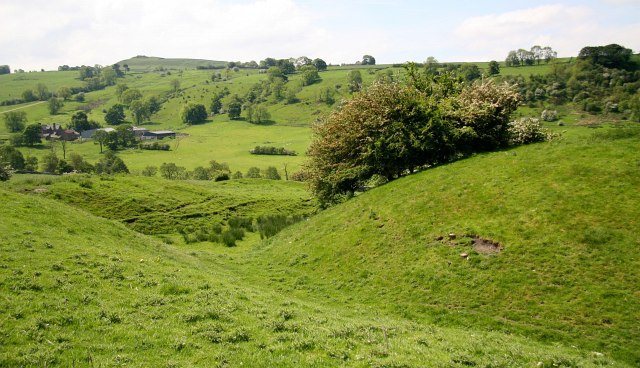
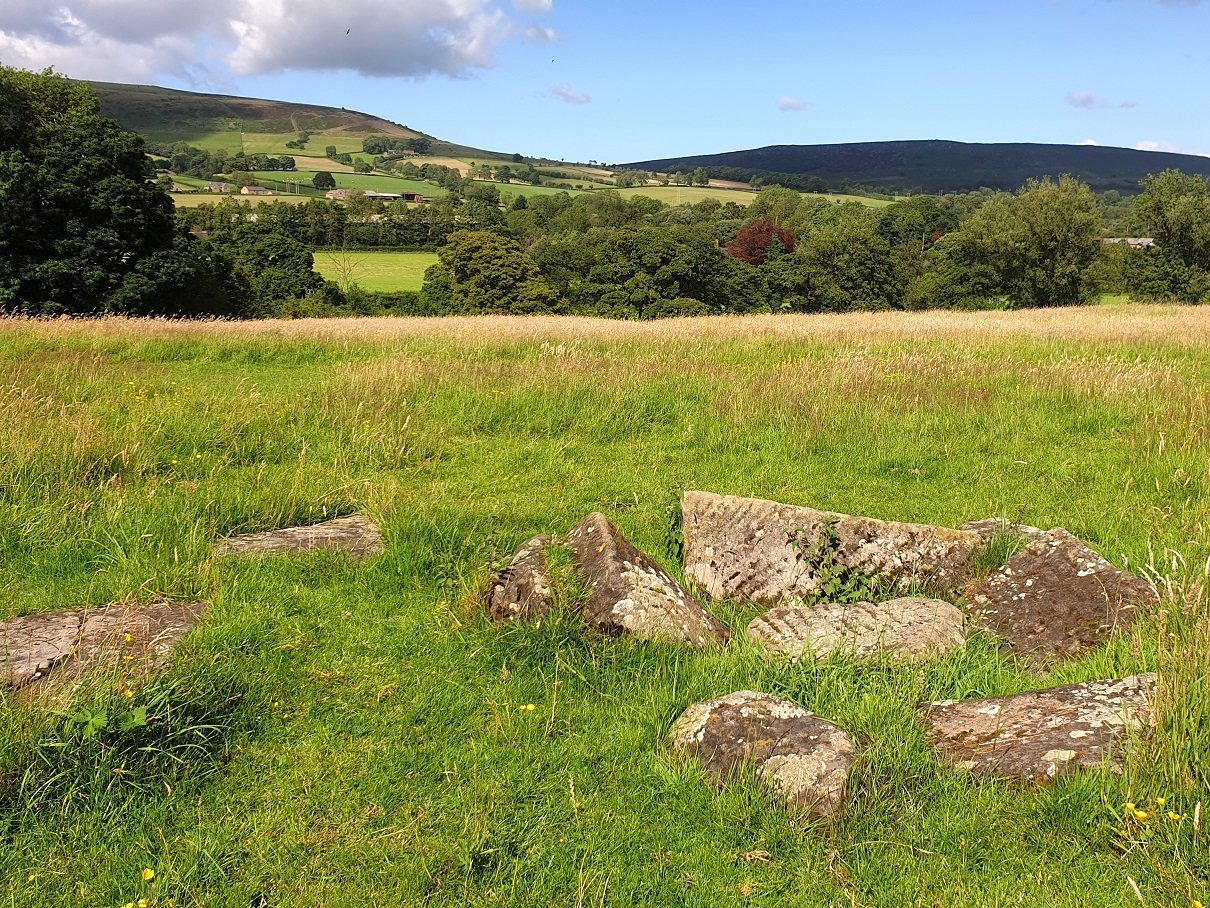
The remains occupy elevated ground at the northern end of Bradwell Dale, overlooking a sharp bend in the River Noe and its meeting with Bradwell Brook. The fort developed from timber and earthwork construction into a stone enclosure. Earthworks, buried remains, and a few exposed stone slabs survive at the site.
Fort enclosure and defenses
The first fort covered about 3 acres (1.2 hectares). The later stone fort, built around AD 150, had a rectangular plan measuring approximately 90 by 105 metres. Four construction phases are represented. The River Noe and Bradwell Brook provided natural defenses to the north and east, although the river gradually eroded part of the fort’s eastern side. Earthwork banks and ditches surround the earthen platform.
Headquarters and inscribed finds
Headquarters building
An inscription dates the fort’s headquarters building to AD 158. Excavations found steps leading down from beneath the building to a stone-walled underground chamber.
Centurial stone
The centurial stone is an inscribed Roman military marker associated with building work or a unit’s responsibilities. It relates to rebuilding in AD 154, although AD 158 is also proposed as its date. Its inscription says that Cohort I of the Aquitanians, a Roman military unit, erected the stone in honor of Emperor Antoninus Pius. The work was carried out under Julius Verus, governor of Roman Britain, on the instructions of the cohort prefect Capitonius Fuscus, its commanding officer. The soldiers involved came from southwest France. The stone was recovered from the fort’s secure room and is displayed at Buxton Museum.
Gritstone altar
A gritstone altar from the fort is dedicated to Arnemetia, also called Arnomecta, a goddess associated with Buxton’s sacred waters. Its inscription names Aelius Motio and states that he fulfilled his vow willingly and deservedly. The altar is displayed at Buxton Museum.
Milestone linked to Navio
A milestone found in Buxton’s Silverlands district in 1862 is the oldest inscribed milestone found in Derbyshire. Its inscription gives the distance from Navio as 11 miles and includes the imperial titles “with tribunician power, twice consul, father of the country.” Tribunician power was authority based on the powers of Rome’s tribunes. The milestone is displayed at Buxton Museum.
Civilian settlement
The settlement extended south and east of the fort, continuing east beyond Bradwell Brook. Excavations uncovered foundations of stone and timber buildings, along with pottery fragments, carved stone pieces, coins, and ammunition for a ballista, a large missile-throwing weapon. More than 1,700 pottery fragments included locally made vessels, imported red-gloss Roman fineware, and pieces of large transport jars.