Sheffield Cathedral: A Parish Church and Cathedral in Sheffield


Site at a Glance
- Rating
- 4.7
- Popularity
- Medium
- Country
- United Kingdom
- Primary era
- Medieval
- External website
- Open
- Eras represented
- Medieval, Early Modern, Modern
- Civilizations
- British, English
- Site type
- Religious
- Remains
- Cathedral
On this page12 sections
History
Sheffield Cathedral, formally the Cathedral Church of St Peter and St Paul, is a historic Christian church in Sheffield, United Kingdom. It began as a medieval parish church, probably founded around 1200 by William de Lovetot, and its present fabric developed through successive medieval, Victorian, and twentieth-century phases until the west-end extension of 1966. The church became the cathedral of the newly created Diocese of Sheffield in 1914, joining the Church of England, the established Anglican church in England, within the Province of York.
Medieval parish church
The site has a long Christian history. The shaft of the ninth-century Sheffield Cross, believed to have once stood here, is now held by the British Museum. A parish church was probably built on the site in the twelfth century by William de Lovetot, a medieval lord associated with Hallamshire. Positioned at the end of the town opposite Sheffield Castle, it was a satellite of Worksop Priory. Its foundation established the area of Sheffield parish, whose boundaries remained unchanged until the nineteenth century.
The church was burned in 1266 during the Second Barons’ War, a conflict between King Henry III and rebellious English barons. A replacement parish church was completed in 1280. Around 1430, much of that building was demolished and replaced by a larger church on a cruciform plan, meaning one laid out in the form of a cross. The dedication changed from Saint Peter to Holy Trinity sometime after the Reformation and retained that name until the nineteenth century. It is now dedicated to Saints Peter and Paul.
Tudor and Georgian changes
The Shrewsbury Chapel was added during the sixteenth century to accommodate monuments to the Earls of Shrewsbury. The vestry chapel, now the Chapel of Saint Katherine, followed in 1777. Rebuilding during the 1770s introduced new window tracery and covered the walls with moorstone, a rough stone obtained from upland moorland. The addition of the chapel altered the earlier cruciform arrangement.
The nave’s north and south walls were rebuilt between 1790 and 1793. The church’s parish role also changed during this period of broader ecclesiastical reorganisation. In 1848, the large Parish of Sheffield was divided into smaller parishes, ending a territorial arrangement that had lasted since the medieval foundation.
Victorian restoration and cathedral status
A major restoration by Flockton & Gibbs was completed in 1880. It added new north and south transepts, crosswise arms of the church, and contributed to the building’s transition into its present combination of medieval and modern architecture. The galleries were removed, the organ was moved to the north transept to clear the chancel, and new oak pews were installed. The transepts and west end were also extended.
When the church became the cathedral of the Diocese of Sheffield in 1914, Charles Nicholson prepared plans to enlarge it and turn its orientation through 90 degrees. War and financial limitations reduced the scheme, and the proposed additions were carried out progressively during the twentieth century. Later work associated with George Pace and Ansell & Bailey substantially expanded the northern part of the cathedral. The west-end extension was completed in 1966, when the church was rededicated.
Fire, restoration, and recent history
On 17 July 1979, a major fire broke out in the belltower. It spread between the belfry, the ground floor, and the clockroom, severely damaging the belltower and ringing room. At least 35 firefighters contained the blaze and prevented the destruction of the spire. Burst water pipes flooded the choir stalls and damaged the choir area. Six centuries of bell-ringers’ records were destroyed, while much of the clock mechanism was lost or damaged. The cathedral itself sustained only mild structural damage and was operational again by 26 July at the latest. Police determined that the fire was arson, but no perpetrator was found.
A major interior and exterior refurbishment took place in 2013 and 2014. Restoration work in 2013 also revealed that several coffins formerly associated with the Shrewsbury burials were missing from the crypt. The cathedral has held Grade I listed status since 1952. This is the highest category in England’s statutory system for buildings of exceptional architectural or historic interest, and the cathedral is one of five Grade I listed buildings in Sheffield.
On 2 April 2015, the cathedral hosted the first Royal Maundy service held in South Yorkshire. Royal Maundy is an Anglican service traditionally held on the Thursday before Easter, when the monarch distributes specially minted money to selected recipients. Queen Elizabeth II gave the money to 89 men and 89 women from the Sheffield area, each receiving two leather pouches containing an amount equivalent to 89 pence.
A second fire occurred on 14 May 2020, when the cathedral was empty. No one was injured, and the fire was extinguished that evening. It was believed to have been deliberate after a smashed rear window was found. A 40-year-old woman was arrested and charged in connection with arson, burglary, and assaulting an emergency worker.
The 2020 fire destroyed the rooms and contents used by the Cathedral Archer Project, a homelessness charity that had operated from the rear of the cathedral. Founded in 1989 amid economic decline and rising homelessness after the collapse of Sheffield’s steelmaking and coal-mining industries, the project moved into refurbished cathedral rooms in 2007. Those rooms contained showers, laundry facilities, computer access, lounge areas, and a kitchen. Before the fire, the project distributed about 180 free meals each day to homeless people in Sheffield city centre. Its activities were temporarily reduced, and it later continued from temporary premises after receiving increased public support.
On 22 July 2020, the cathedral chapter, the body of clergy responsible for the governance and administration of a cathedral, announced the closure of the approximately 40-member cathedral choir. It intended to establish a new Music Department and choir while retaining Anglican choral traditions. The N. P. Mander organ had been decommissioned in 1998 and had not been replaced by 2020, when a digital organ by Phoenix Organs was in use. Negotiations to acquire a Cavaillé-Coll organ from Parr Hall in Warrington began in 2008 but ended without agreement in 2011.
Remains
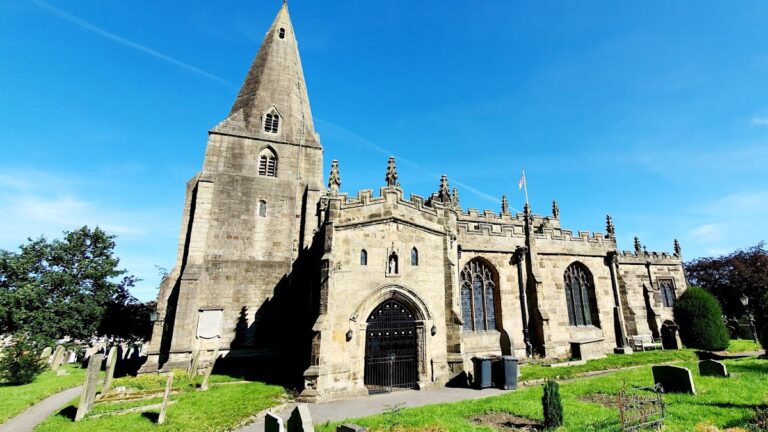
Sheffield Cathedral stands on Church Street in the city centre near the head of Fargate. Its surviving fabric brings together an east end rooted in the medieval church, later chapels and monuments, Victorian rebuilding, and a substantial northern and western expansion. The spire rises 49 metres, while the building’s final major extension, at the west end, dates from 1966.
Medieval and Tudor fabric
East end and chancel
The east end is the oldest part of the present church. Stones from the thirteenth-century building survive in the east wall of the sanctuary, while the sanctuary and chancel, the eastern part around the principal altar and clergy seating, largely date from the fifteenth century. The fifteenth-century cruciform church included lofts and a rood chapel, a chapel associated with a representation of Christ’s Crucifixion. Elizabeth I ordered their removal, and the scars left by these structures remain visible on the walls.
The chancel roof probably dates from the sixteenth century. It is a hammerbeam roof, a timber structure whose projecting beams support the roof framing without full-length tie beams. Gilded angels decorate it, and their outstretched wings were added as a modern gift by George Bailey during the 1960s. The east window serves as a memorial to James Montgomery, a nineteenth-century poet associated with Sheffield.
Shrewsbury Chapel
The Shrewsbury Chapel contains a probably medieval altarpiece and several important Tudor monuments. On its south wall, an alabaster monument to George Talbot, 6th Earl of Shrewsbury, has an architectural surround, an armoured effigy, and a Latin inscription. A second monument to George Talbot, 4th Earl of Shrewsbury, is made from fine marble carved in an Italian style. It shows the earl and his two wives in prayer. Together, the two monuments represent examples of Tudor funerary art. Several members of the Shrewsbury family were buried in the vault beneath the chapel.
The chapel’s screen was made by local craftsmen. During the early twentieth century it was modified and moved to the north aisle. Burials associated with the cathedral include George Talbot, 4th and 6th Earls of Shrewsbury, Anne Hastings and Elizabeth Walden, the wives of George Talbot, 4th Earl, and Mary Percy, Countess of Northumberland. The ashes of the Reverend Arthur Herbert Procter, a recipient of the Victoria Cross, are also interred there.
Victorian and twentieth-century additions
Chapels on the northern side
The principal twentieth-century expansion affected the cathedral’s northern side. Immediately north of the nave, the Chapel of Saint George commemorates the York and Lancaster Regiment. It contains regimental flags and a screen made from bayonets and swords associated with the regiment. Beneath it lies the vaulted crypt chapel of All Saints. A crypt is a chamber beneath a church, used here for worship and associated with the cathedral’s lower architectural spaces.
At the northern end of the cathedral is the Chapel of the Holy Spirit, which has four-part vaulting and a painted screen. The Te Deum window in the crypt chapel was designed by Christopher Webb. Te Deum is a traditional Christian hymn of praise and thanksgiving.
West end and fittings
The main entrance is located in the west-end extension completed in 1966, which also contains the baptismal font. A lantern tower was added to improve the interior light. Its glazing was later replaced with an abstract design by Amber Hiscott, dated 1998 to 1999.
The cathedral has twelve bells hung for English change ringing, a system in which tuned bells are rung in changing mathematical sequences rather than fixed tunes. The set includes a flat sixth and an extra treble. The building also houses the stainless-steel ship’s bell from HMS Sheffield.
Nearby sites