Kagoshima Castle: The Shimazu Clan’s Residence-Fortress in Japan
Site at a Glance
- Country
- Japan
- Primary era
- Early Modern
- Eras represented
- Early Modern
- Civilizations
- Tokugawa
- Site type
- Military
- Remains
- Castle
On this page10 sections
History
Kagoshima Castle is a residence-fortress built by the Shimazu clan in Japan, with construction beginning in 1601 and ending in 1604. It became the clan’s new seat in Satsuma and a center of its rule.
Medieval stronghold and new seat
Before the castle was built, Shiroyama held a medieval stronghold belonging to the Ueyama clan, which later yielded control of the site to the Shimazu. In 1600, the Shimazu fought on the losing Western side at the Battle of Sekigahara, against the Eastern Army led by Tokugawa Ieyasu, who founded the Tokugawa shogunate. After the clan’s defeat and a settlement with Tokugawa authority, the Shimazu retained Satsuma and Ōsumi. Shimazu Tadatsune, also known as Iehisa, became clan head after his father, Shimazu Yoshihiro, retired, and began building a new seat to replace the family’s former residence at the inner castle.
The new location lay south of the former seat, at the eastern foot of Shiroyama. Its mountain setting was intended to reduce the risk of a possible Tokugawa attack, and the site was chosen according to a geomantic principle that aligned symbolic guardians with the four cardinal directions. Yoshihiro objected to the coastal location, believing it difficult to defend.
Castle and domain in the Edo period
During the Edo period, the era of Tokugawa rule in Japan, the castle’s restrained form was understood as a sign of Shimazu submission to the shogunate. The clan maintained other defences through medieval-style mountain strongholds and an outer-castle system, in which retainers guarded 113 districts. The Tokugawa never invaded Satsuma, and the castle did not see battle under Tadatsune.
A grandson of Shimazu Toshihisa became the first castle governor and lived at the site. After his early death, no successor was appointed. Shiroyama came to be regarded as sacred and was kept off-limits, while serving as a refuge if the castle faced a siege.
The castle town comprised 46 towns in five districts. Kanmachi, Shimomachi, and Nishidamachi were merchant districts; Kamihōgiri and Shimohōgiri were samurai districts. By the end of the Edo period, samurai made up about 90 percent of the town’s residents. The domain government administered the town and adjacent Kagoshima area directly, rather than through the outer-castle system.
Late Edo crisis and Meiji changes
Collapses and fires repeatedly damaged the castle, and natural disasters and termites also contributed to deterioration. Buildings were rebuilt after these episodes. During the 1863 Anglo-Satsuma War, a conflict between Satsuma and Britain, British naval fire threatened the castle, reinforcing Yoshihiro’s earlier concerns about its coastal position.
After the domains were abolished in 1871, a second unit of the regional military garrison was stationed at the castle. The main bailey, the principal enclosed area of a Japanese castle, and its main gate burned in 1873, and the main bailey was not rebuilt. During the 1877 Satsuma Rebellion, an uprising against the Meiji government led by Saigo Takamori, the secondary bailey, a subordinate enclosed area, also burned. An outlying enclosure had housed a private school associated with Saigo. In 1882, a prefectural medical school and its affiliated hospital were established in the secondary bailey. The hospital continued under different institutional names until it moved in 1974.
Later uses and commemoration
The former main bailey became the site of the Seventh High School Zoshikan in 1901. An air raid destroyed the school in 1945. Kagoshima University’s Faculty of Letters and Sciences later occupied the site, followed by university medical facilities from 1957; those facilities moved in 1974.
After the Meiji period, Tsurumaru Castle became a popular alternative name for Kagoshima Castle. The name referred to Shiroyama’s crane-like outline when viewed from the Harara side and to the spread-wing shape associated with the residence. Local people had called Shiroyama Tsurumaru Mountain since before the middle of the Edo period. An initiative to reconstruct the main gate began in 2015. The castle ruins were designated a National Historic Site in 2023, and the site is also identified as a natural monument.
Remains
Layout and construction
The castle combined Shiroyama, the earlier mountain stronghold, with a residence-fortress at its eastern foot. Its position was bounded by the Hegigawa River to the east, the Satsuma Kaidō highway to the west, Kinko Bay to the south, and Shiroyama to the north. The main bailey lay to the north and the secondary bailey to the south. Moats and low walls enclosed a simple compound whose principal buildings served as the clan residence and government offices.
Goromon gate and bridge
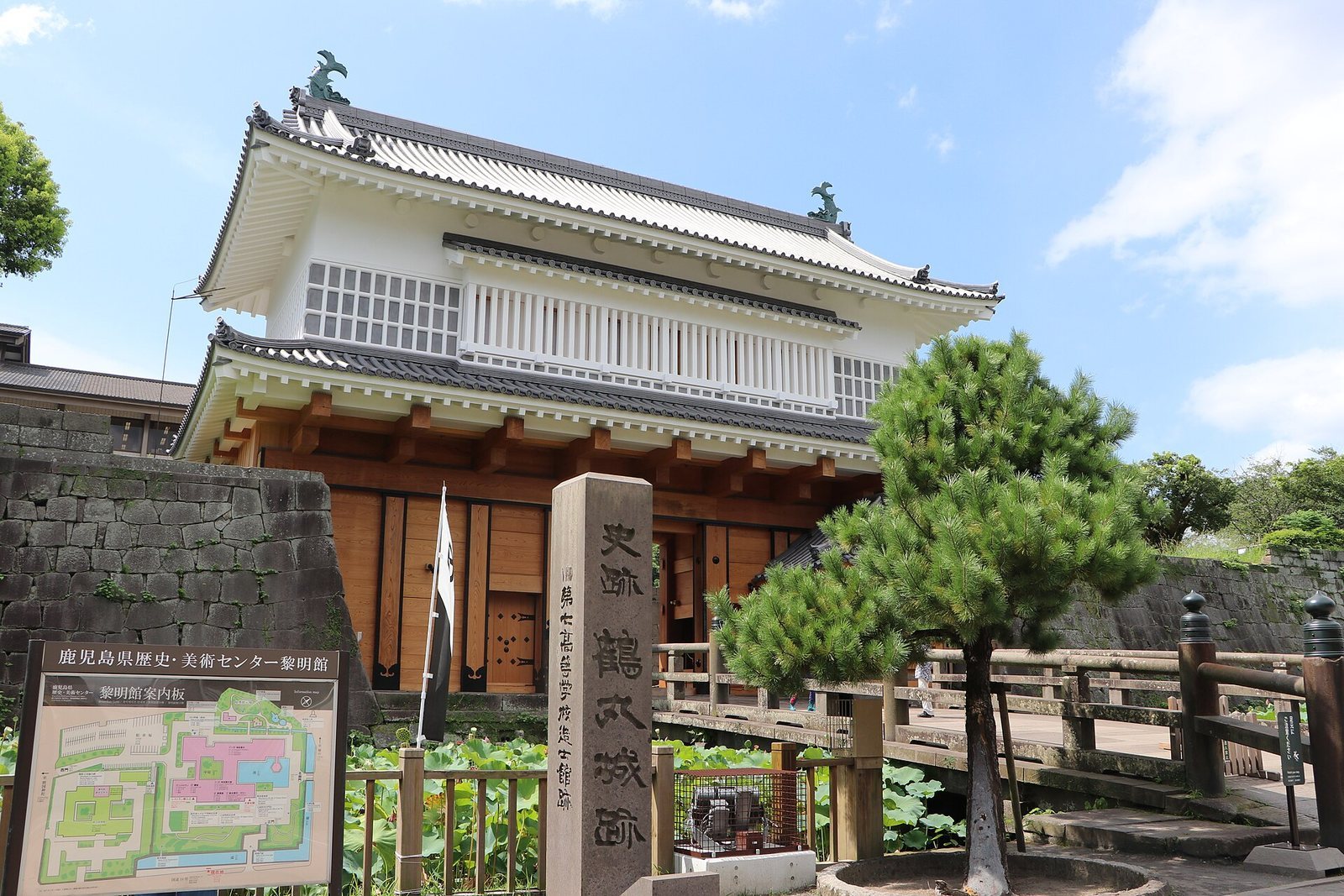
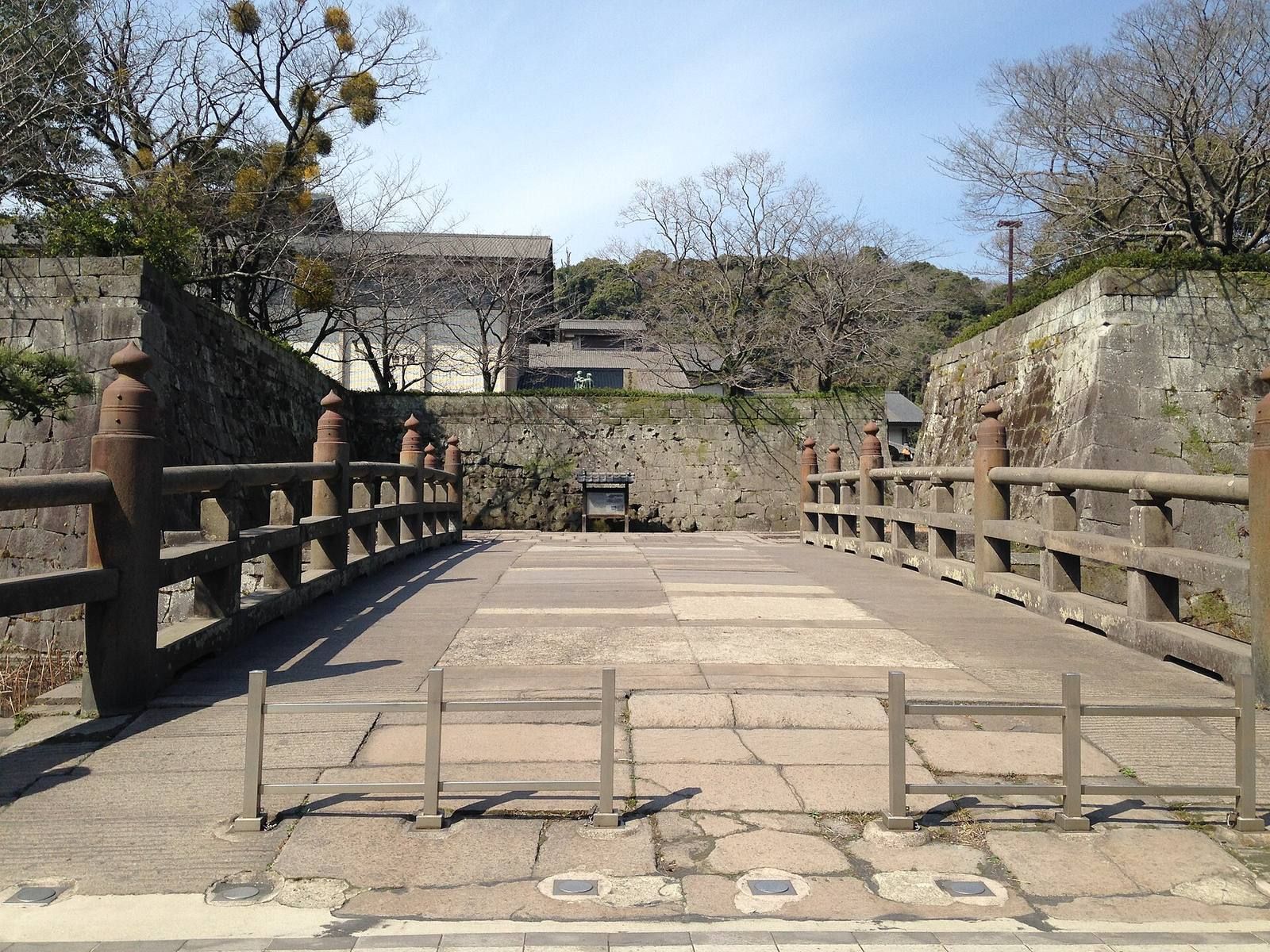
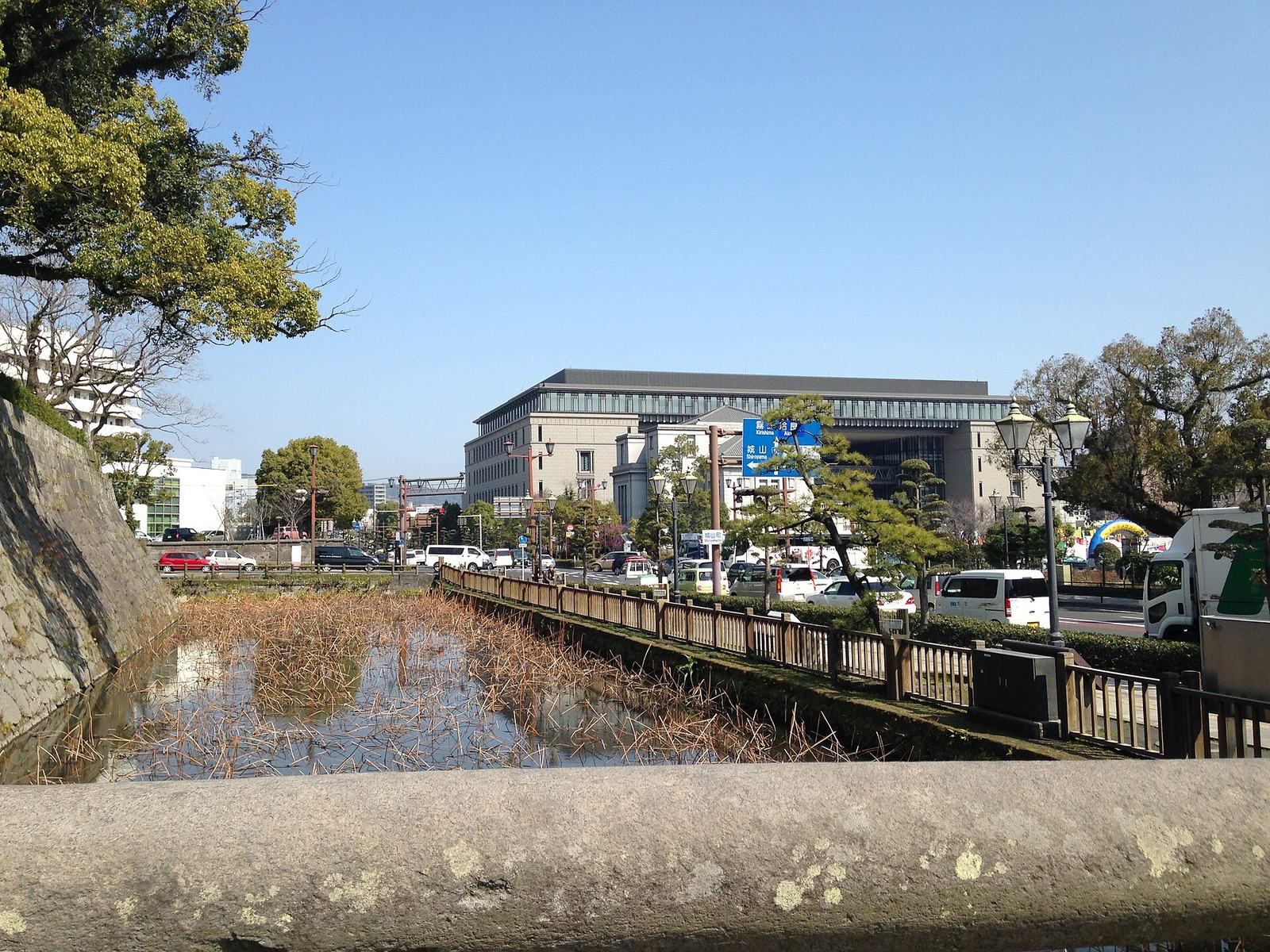
A bridge crossed the moat at the main entrance by 1606, and the main gate, known as the Goromon, was built in 1612. A stone bridge survives among the castle’s physical remains. The wooden Goromon now standing at the site was reconstructed from historical documents and photographs and completed in 2020.
Structures recorded at the castle in 1873 included the Goromon, a two-storey turret used as a weapons store, a corner turret, and a palace in a formal Japanese residential style. The weapons-store turret had an elongated form, and early Meiji photographs show the gate and turrets.
Stone walls and moat
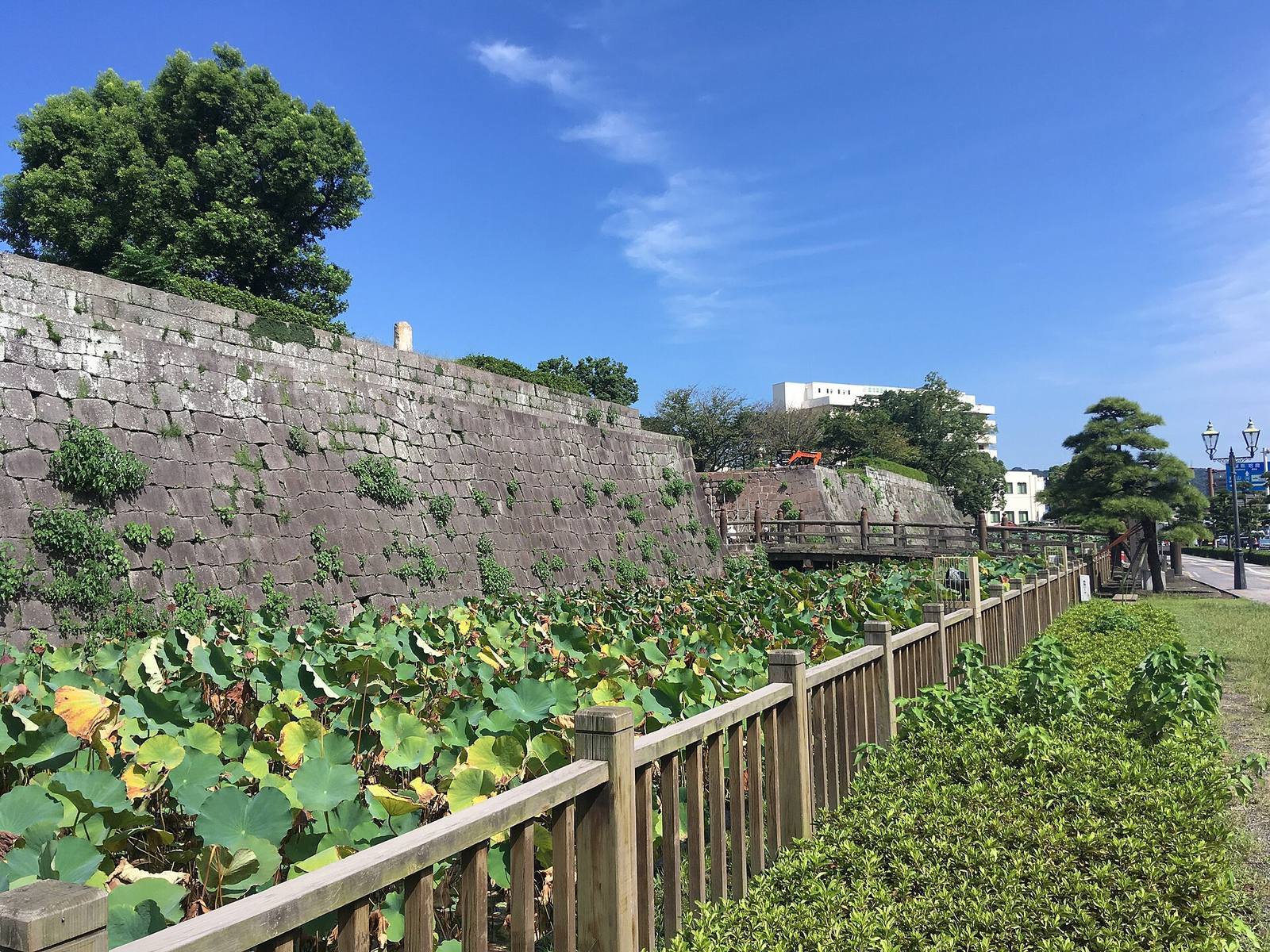
Stone walls survive at the site, including those of the outlying enclosure. Numerous marks on these walls are associated with the 1877 rebellion. Lotus plants grow in the moat; they are thought to have been planted during the Meiji period.
Present-day precinct
The former main-bailey site contains Reimeikan, the Kagoshima Prefectural Center for Historical Material, which opened in 1983. The former secondary-bailey site contains the Kagoshima Prefectural Library, Kagoshima City Museum of Art, and Kagoshima Prefectural Museum.