Aalst Schepenhuis: A Historic Aldermen’s House and Belfry
Site at a Glance
- Country
- Belgium
- Primary era
- Medieval
- Eras represented
- Medieval, Early Modern, Modern
- Civilizations
- Belgian, County of Flanders, Habsburg, Holy Roman Empire, Spanish
- Site type
- Civic
- Remains
- Town Hall
On this page8 sections
History
Origins and reconstruction
The Aalst Schepenhuis, an aldermen’s house (a civic building associated with municipal officials who served on the town council) in Aalst, Belgium, developed from a town hall first built in 1225. The present building dates to the fifteenth century and is early Gothic in style. It is regarded as one of the oldest aldermen’s houses in the Low Countries and may be the oldest surviving example of its type.
In 1380, the building was burned during a revolt by people from Ghent led by Louis of Male, Count of Flanders. Reconstruction began in 1407. Jan De Hase restored the west façade, while Jan Van Goeteghem worked on the south façade.
Civic and judicial life
An adjoining wing was erected in 1474, taken down in 1543, and later rebuilt. It served as a place for announcing laws and for newly elected mayors to swear loyalty to the city’s privileges. A bailiff, a local judicial or administrative officer, or a stadtholder, a governor representing a ruler, also proclaimed laws there.
The belfry, a civic bell tower, was built in 1460, and a carillon, a set of tuned bells played by a keyboard or mechanism, was installed the following year. The first instrument was made by Vranck, a craftsman from Mechelen, and replaced in 1714. Until 1650, an altar in the town hall was used for daily Mass. The cellars served as torture chambers. Jan de Lichte’s criminal gang was tried in the building, and its leader was executed there in 1748.
Fire, restoration, and later use
On 7 July 1879, fireworks set off during a fair caused a fire that damaged the town hall and part of the belfry. The bells were recast and the carillon enlarged; restoration of the building was completed in 1886.
The town council moved to a newer neighboring building in the 1980s. The old Schepenhuis continued to host meetings and cultural events, including exhibitions, and council sessions also resumed there during that decade. The belfry is part of the UNESCO World Heritage property Belfries of Belgium and France, inscribed in 1999 and extended in 2005.
Remains
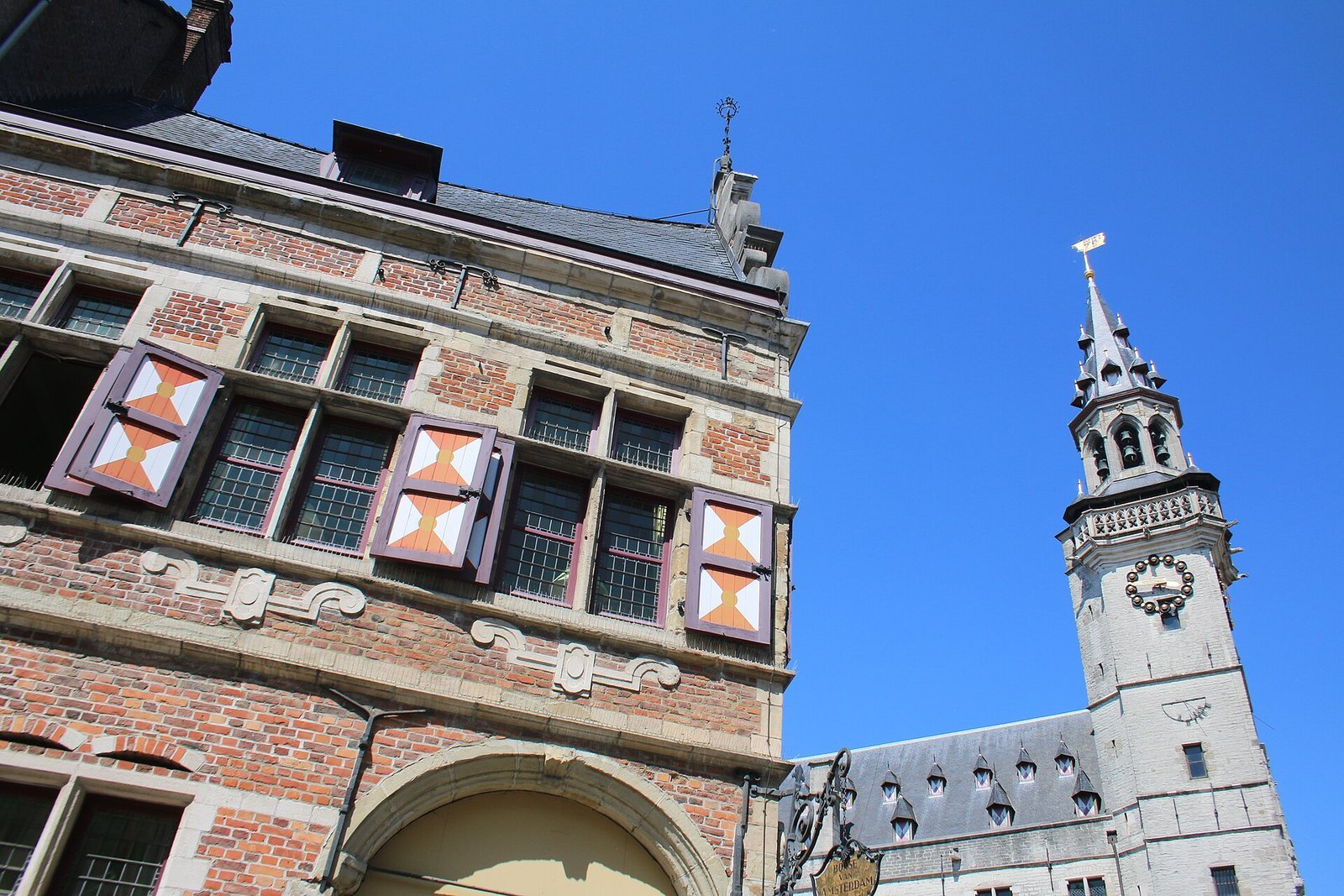
The complex covers 0.038 hectares and brings together the main town hall, its adjoining wing, and the belfry. The main building is rectangular and three storeys high, with round stair towers at three corners and the belfry occupying the southwest corner. A pyramidal roof rises above it, topped by a small decorative turret.
Main town hall
The original building was constructed from stone quarried at Lede. Its cellars and ground floor retain late Romanesque features, while the lower part of the rear façade is Romanesque and dates to around 1230. The north and east façades survived the 1380 fire. Together with the building’s early Gothic character, these features reflect different periods in its construction and survival.
Market-facing wing
The projecting wing is late Gothic and faces the market square. Its façade bears five nineteenth-century sculptures: Themis, the Greek figure associated with justice; Charles V, the Habsburg emperor; Dirk of Aalst, the last Count of Aalst; and the Flemish artists Pieter Coecke van Aelst and Cornelius de Schrijver. A staircase of 23 steps beneath the wing descends to the cellars.
Belfry and carillon
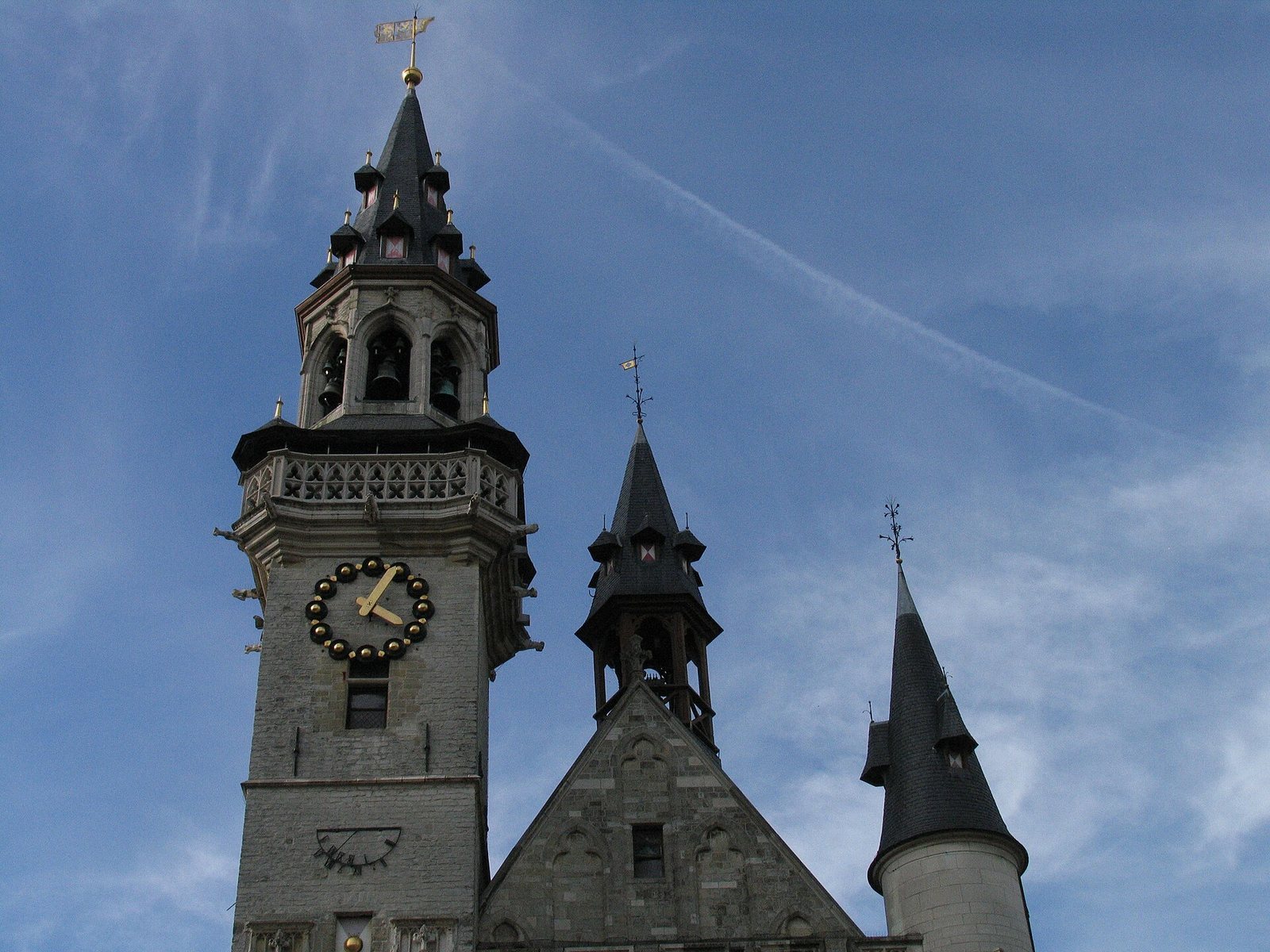
Two sculptures on the belfry façade represent the counts of Aalst and Flanders, with a sundial dating to around 1600 between them. Above the motto, niches hold figures of a warrior and a burgher, associated with the power and freedom of old Aalst and the historic territory centered on the town. The façade bears the Latin motto Nec spe, nec metu, meaning “Neither by hope nor by fear,” associated with Philip II. An inscription also includes “1200,” though that number does not represent an actual date.
A mechanical clock sits beneath the carillon. In the 1960s, golden hemispheres replaced the clock’s Neo-Gothic figures that marked the hours. Their shape led residents to nickname the belfry the “breast tower.” The sixth carillon installed in the tower has 52 bells and sounds every 15 minutes.