St. John the Evangelist’s Anglican Church: A Neo-Gothic Church in İzmir, Türkiye
Site at a Glance
- Country
- Turkey
- Primary era
- Modern
- Eras represented
- Modern
- Civilizations
- Ottoman
- Site type
- Religious
- Remains
- Church
On this page10 sections
History
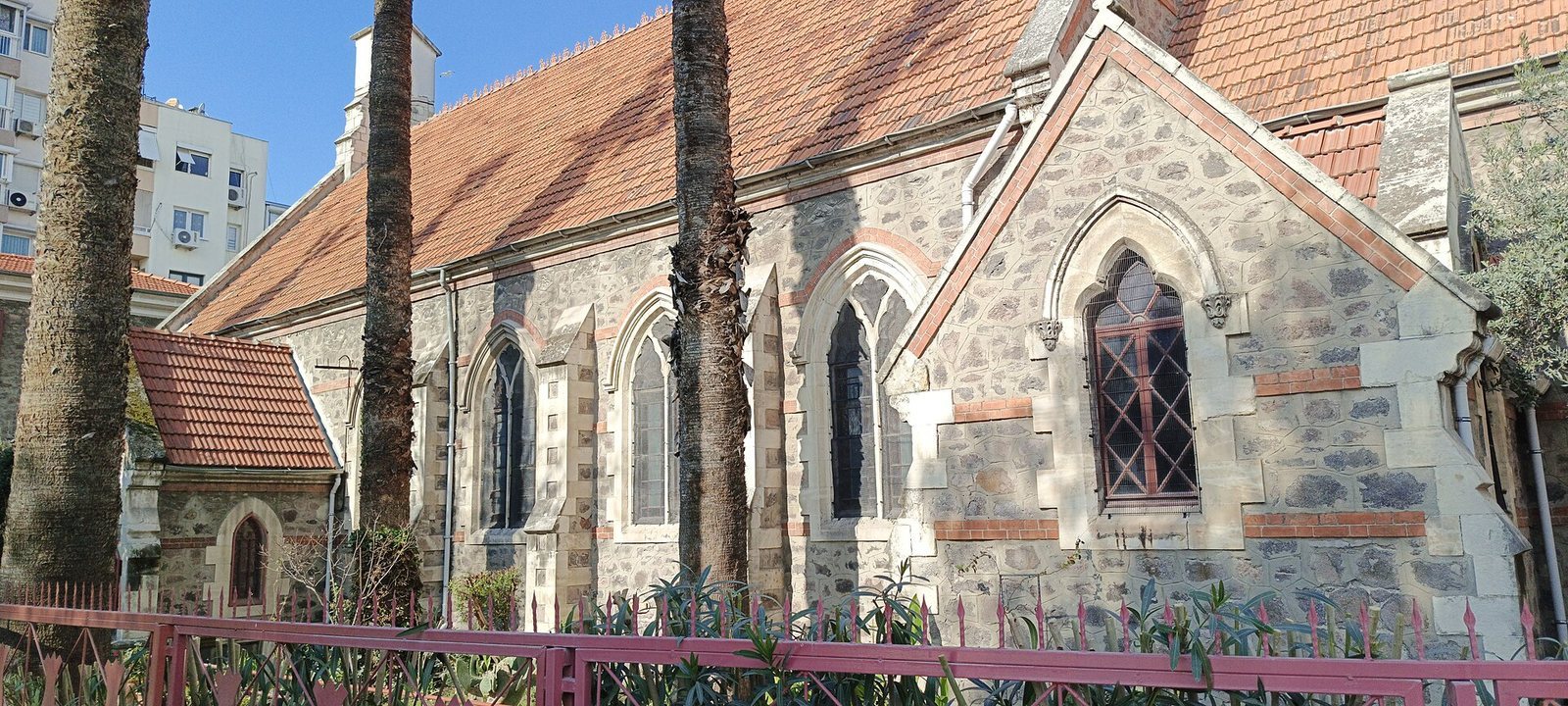
St. John the Evangelist’s Anglican Church in Alsancak, İzmir, Türkiye, is a Neo-Gothic church built for the English community in 1898 and completed in 1899. It continues an Anglican presence in Smyrna, the city now known as İzmir, that dates to the seventeenth century. The church is dedicated to John the Evangelist, who mentions Smyrna in the Book of Revelation (2:8–11).
Early Anglican worship
The English Levant Company, a trading enterprise active in the Ottoman Empire, built an earlier church in Smyrna in 1625 for its community. By 1630, Anglican chaplains were serving British Levantines, the British expatriates and their descendants in the Ottoman Levant. Thomas Curtys, the first Church of England chaplain posted to the city, arrived in 1636, and an ongoing chaplaincy followed. In 1843, a later church serving the British community was assigned to the British Consulate and named for St. John the Evangelist.
Construction and consecration
After the British Consulate was rebuilt, a new church was constructed for İzmir’s English community. Work began in November 1898 on land acquired by the consulate, while local residents paid for the building. Charles Sandford, Bishop of Gibraltar, consecrated the church on 7 April 1902.
Parish life and later events
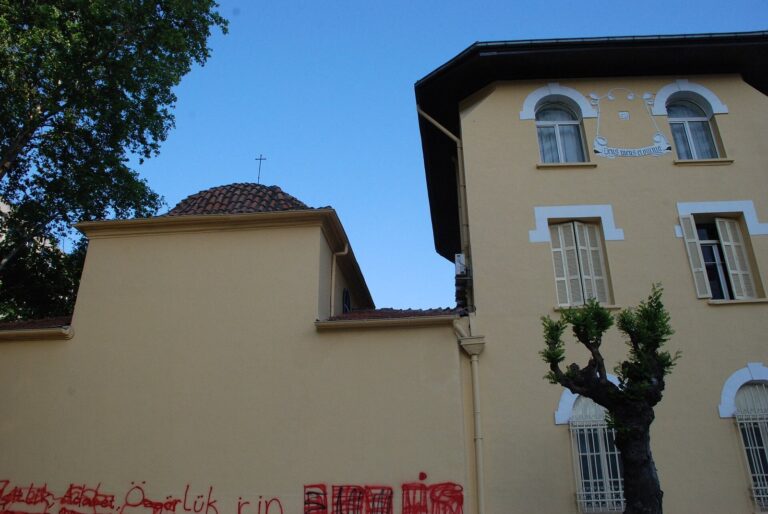
William Collins, Bishop of Gibraltar from 1904, died aboard the SS Saghalien on 22 March 1911 while travelling from Constantinople to Smyrna. He was buried in the church. A vicarage, a residence for a parish priest, was built beside the church that year and is now leased to the British Government for use as a consulate. The Bishop Collins Memorial Hall followed in 1913 and serves parish activities, including Sunday School and Sunday gatherings.
During the Great Fire of Smyrna in 1922, chaplain Charles Dobson escaped the burning city with his wife and two young daughters. He later became a key witness in the trial concerning the fire’s origins. In a later municipal dispute during mayor İhsan Alyanak’s tenure, road works removed the walls of the church and British Consulate and extended the road about four metres into the church garden. The United Kingdom responded with a diplomatic note to Turkey.
St. John’s remains an active Church of England congregation in the Anglo-Catholic tradition, which emphasizes worship practices associated with historic Catholic services. It belongs to the Diocese of Gibraltar in Europe and its Eastern Archdeaconry, an administrative subdivision. Weekly Communion, a Christian rite involving bread and wine, follows Church of England liturgy and is celebrated with vestments and a traditional hymnal.
Remains
The church accommodates about 150 people. Its main worship space is arranged with the entrance at one end and the altar at the other, with pews facing the altar.
Structure and exterior
A chamber beneath the church contains upright sections of railway line that support the floor. The west front has a small circular rose window, a spire, and three stained-glass windows below the rose window, protected by iron barriers. Small exterior support arches project from the north side.
Windows and interior furnishings
Stained glass
A west window was made in Munich in 1895. The east window, made by Charles Eamer Kempe in 1904, includes a small panel showing Ignatius of Antioch on his way to martyrdom. In the scene, Polycarp of Smyrna greets him and kisses his chains.
Interior arrangement and furnishings
Collins’s grave is to the left of the entrance, close to the baptismal font. The font, a basin used for Christian baptism, is shaped like a seashell, an ancient Christian symbol of pilgrimage. The rose window and stained glass are behind it; the pews face the altar beneath three stained-glass windows. Two crosses on the altar came as gifts from Ethiopia and Russia. An eternal light formerly kept in a Greek church was dedicated in September 1994 in memory of parishioner Patricia Ringenbach.
Church grounds
The grounds include the Bishop Collins Memorial Hall, its kitchen, the church office, and the consular building. The office is beside the hall.