Frösthult Church: A Medieval Parish Church in Sweden
Site at a Glance
- Country
- Sweden
- Primary era
- Medieval
- Eras represented
- Medieval, Early Modern, Modern
- Civilizations
- Swedish
- Site type
- Religious
- Remains
- Church
On this page13 sections
History
Medieval origins and later changes
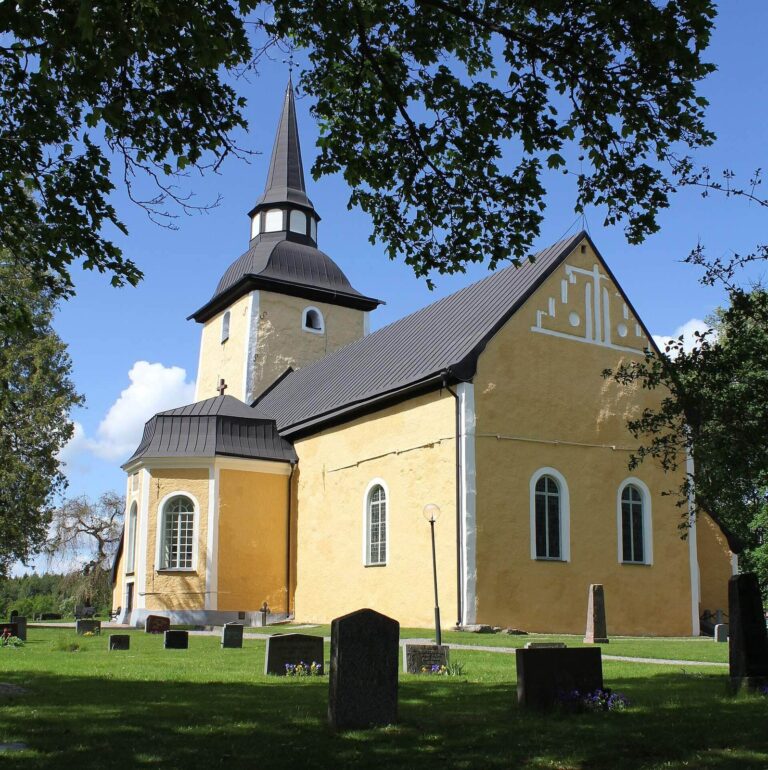
Frösthult Church is a medieval church in Frösthults parish, Sweden, consecrated around 1300. It belongs to the Church of Sweden, a Lutheran Christian church, and to Fjärdhundra parish in the Diocese of Uppsala, a church district overseen by a bishop.
In the second half of the 15th century, a porch was added outside the south doorway. Around 1470–1490, a brick star vault replaced the wooden barrel-shaped ceiling thought to have covered the original interior. A star vault has ribs arranged in a star-like pattern.
Seventeenth-century worship and music
New pews with doors were made in 1664. The following year, parish priest Johannes Campanius donated a three-armed brass candlestick. From 1642 to 1648, he had served as a missionary in New Sweden, a Swedish colony in North America during the 17th century. He also helped arrange the acquisition of the church’s smaller bell in 1656.
A raised platform for an organ was built in 1668. It was intended for an instrument sold by Anders Bengtson, an organist from Östervåla. The organ had six stops, controls for selecting sounds, and a double regal, a reed stop. That year, organist Kylander of Enköping repaired its mechanism, while Jöns Nilsson of Uppsala replaced its wooden pipes with lead ones. Sven Strömberg repaired the instrument in 1702–1703, and Olof Hedlund of Stockholm worked on its smaller organ section in 1738.
A partition separating the choir, the area around the altar, from the rest of the church remained until the mid-18th century. The large bell, cast in 1596, cracked in 1740 and was recast the following year by Isac Rockman of Sala. The smaller bell was recast in 1805 by Gerhard Horner of Stockholm. Both bells had been kept in a separate bell tower built in 1615.
Eighteenth- and nineteenth-century alterations
Pehr Lund of Lillkyrka built a ten-stop organ in 1799. In 1760, a window was opened in the north wall, which had previously had no window. The altar, altarpiece, and pulpit were made in 1747–1748 by Uppland woodcarver Magnus Granlund.
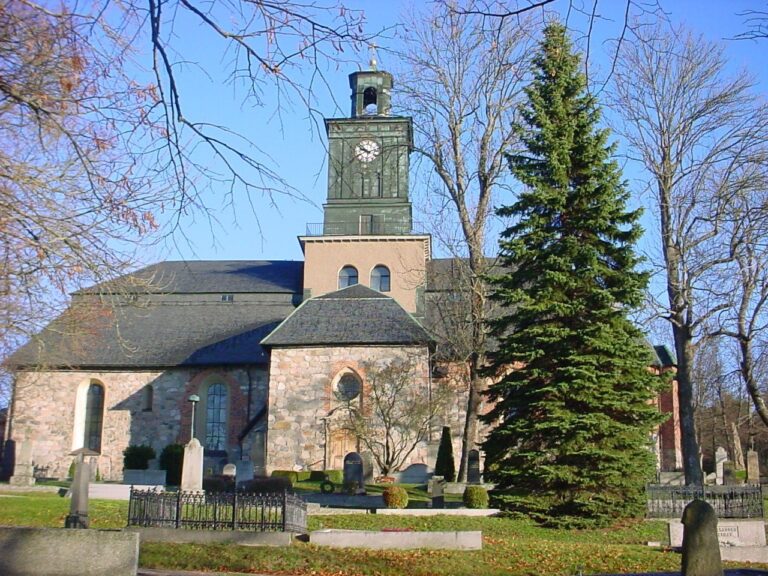
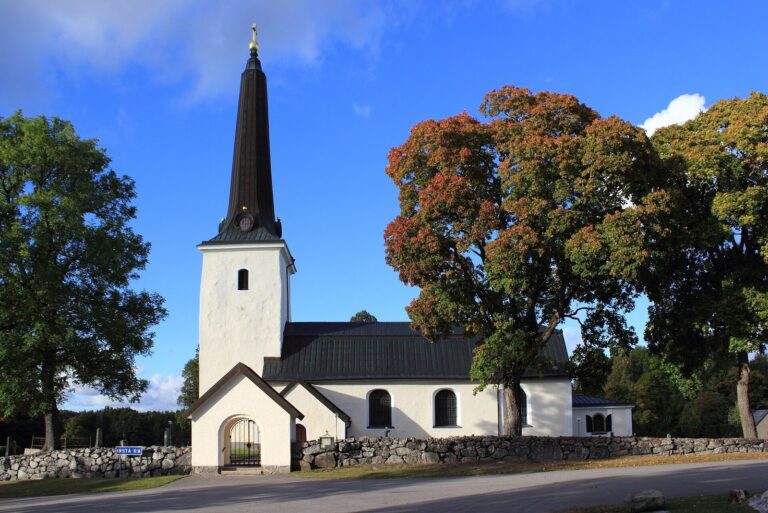
A neoclassical tower was erected between 1839 and 1843 under master builder Palmér. Its construction brought substantial changes to the church’s entrances: the medieval porch on the south side was removed, the south doorway was blocked, and a new entrance was made through the tower’s west wall. The tower’s ground floor became a porch, and the bells were transferred from their separate belfry.
Restoration and the modern organ
A major restoration led by architect Viktor Segerstedt took place from 1950 to 1953. It aimed to reverse changes made to the interior during the 19th century. Seventeenth-century paintings were uncovered and conserved, original colors on the altarpiece and pulpit were revealed, and the pews were rebuilt and repainted to recall their 18th-century appearance. A new floor was also laid. Archbishop Yngve Brilioth reconsecrated the church on Mid-Lent Sunday in 1953.
The present organ was built in Hannover by Furtwängler & Hammer in 1923. Bo Wedrup of Uppsala altered it in 1947, and Gunnar Carlsson of Borlänge revised it again in 1975, partly rearranging its range of sounds. In 1971, the roof covering was changed from shingles to sheet metal.
Remains
Plan and exterior
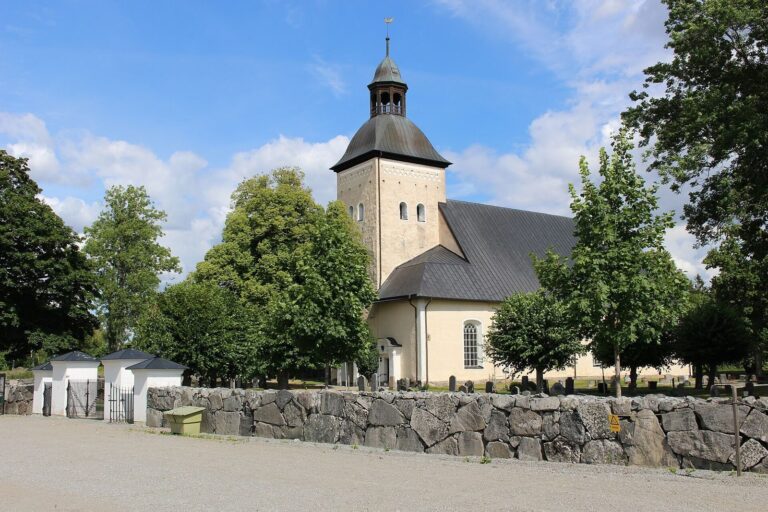
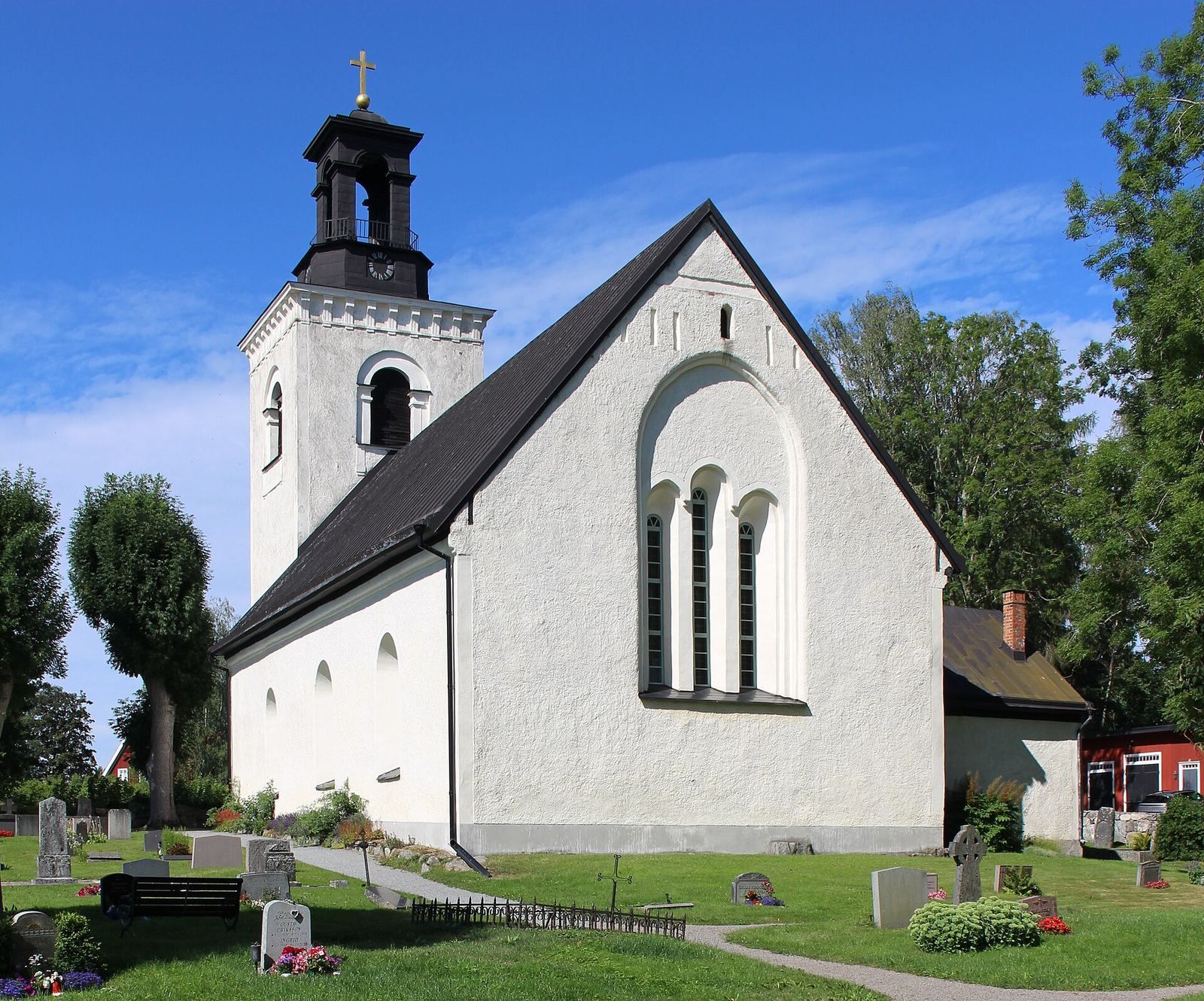
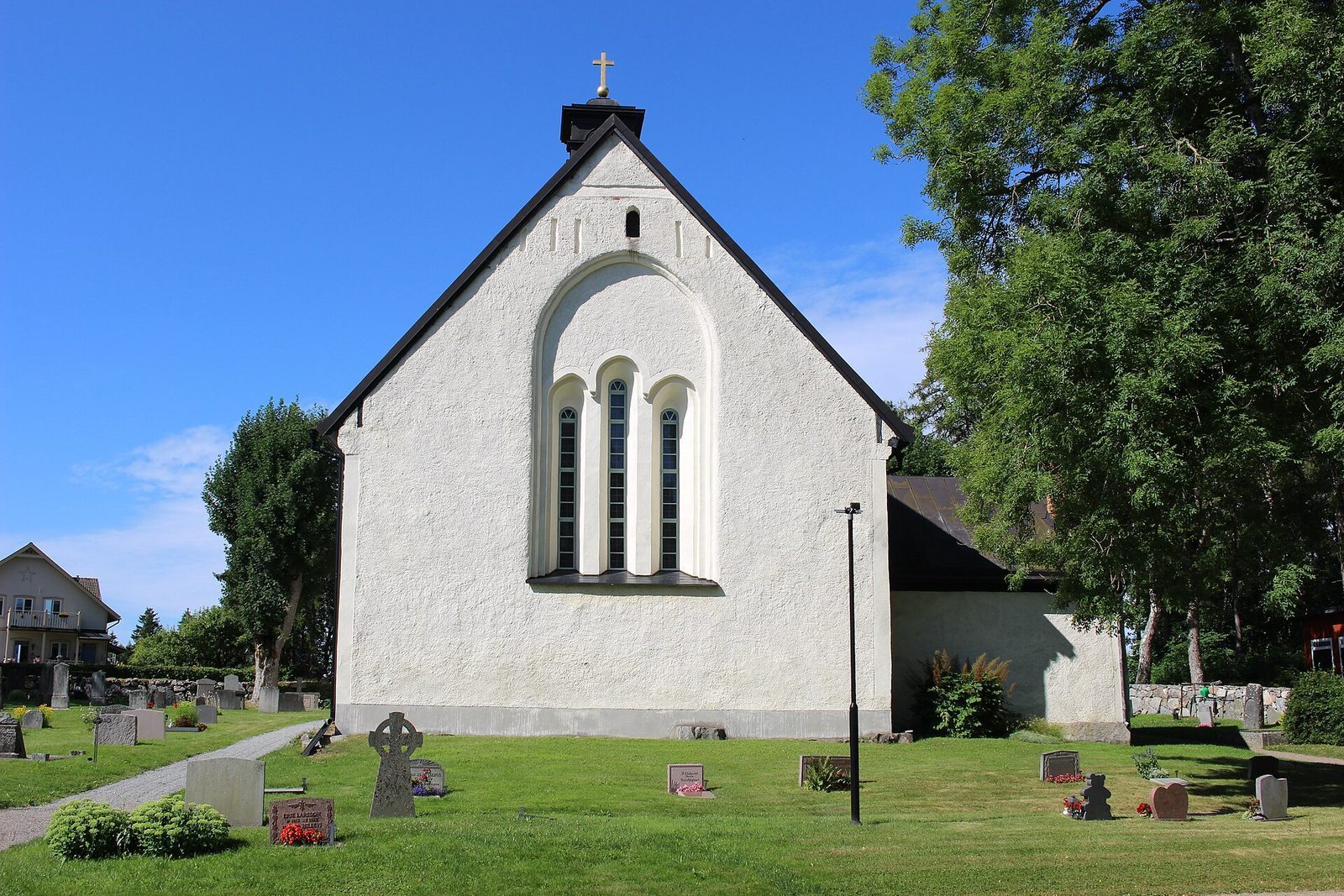
The church has a single nave, the main area used by the congregation, and an east choir, the area around the altar. Both are equal in height and width and share one gabled roof. A sacristy, a room used for preparing services and keeping sacred items, adjoins the choir on the north. Grey stone forms the exterior walls, while brickwork decorates the gable ends. The choir’s east gable has three windows in an arrangement characteristic of churches built in Uppland and Västmanland between 1280 and 1310. The exterior is chiefly neoclassical, a revival of classical architectural forms. Tower-era alterations enlarged the windows to their present form and whitewashed the outer walls. The west entrance passes through the tower, whose roof is topped by a lantern, a raised structure. North of the church stands the 18th-century rectory, whose main house has panelled exterior walls.
Interior and furnishings
Vault and painted decoration
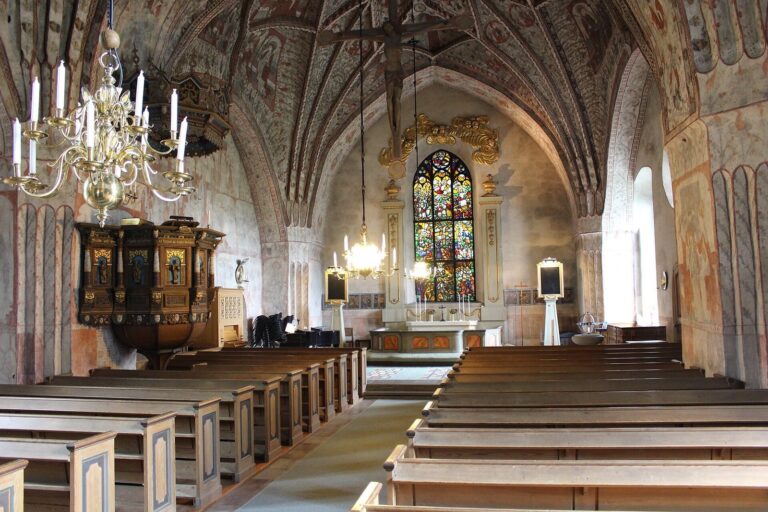
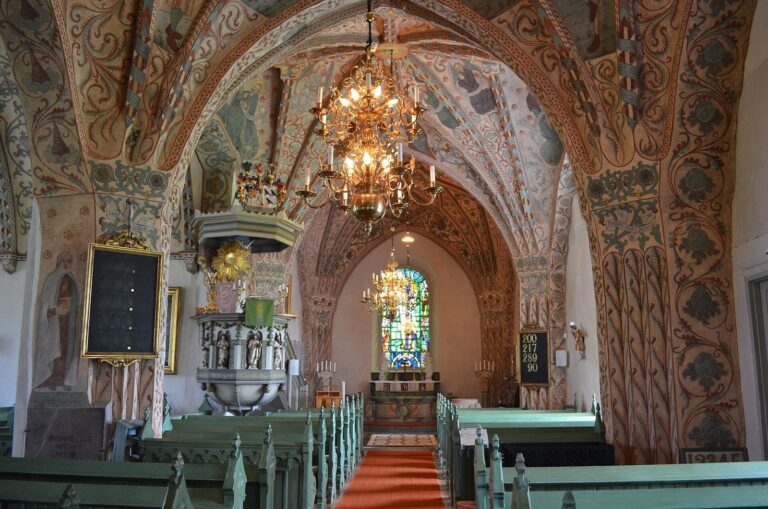
The brick star vault spans the nave and choir. Two carved faces of old men remain at the crown of the choir window. Fragments of 17th-century painted decoration survive above the choir’s three-window group, in the window niches, and in the narrow spaces between the windows. Scrolls and foliage accompany the inscription 1637 In Dei Gloriam, meaning To the glory of God. The paintings probably date to 1637.
Altar, altarpiece, and pulpit
Granlund’s altar furnishings date to 1747–1748. The altarpiece has a central carved relief showing the meal of the Paschal Lamb, a Christian image of Christ as a sacrificial lamb. The pulpit’s gilded central scene depicts Jesus praying in Gethsemane. A sun bearing the Hebrew name of God appears on its rear panel. A globe tops the canopy above the pulpit; the Lamb of God, a depiction of Christ, carries a victory banner and rests on a book with seven seals, an image referring to Revelation 5.
Baptismal font and communion vessel
The baptismal font has a smooth limestone bowl made on Gotland in the mid-13th century. Four male faces provide its ornament. A communion vessel combines a preserved medieval central section with a bowl and foot made in 1823 by goldsmith C. M. Sandin.
Chandeliers and altar candlesticks
A brass chandelier in the choir has twenty arms in two rings, with floral and star decoration. It was given to the church in 1861. In front of the organ gallery hangs a six-armed cut-glass chandelier given around 1750 and renovated in 1941. Two silver-plated candlesticks from the early 19th century stand on the altar.
Organ
The present organ works through air pressure and has two hand-operated keyboards and fifteen stops, which control the sounds it produces. Its facade comes from the earlier organ built by Pehr Lund.