Jumkil Church: A Medieval Lutheran Church in Sweden
Site at a Glance
- Country
- Sweden
- Primary era
- Medieval
- Eras represented
- Medieval, Early Modern, Modern
- Civilizations
- Swedish
- Site type
- Religious
- Remains
- Church
On this page14 sections
History
Foundation and medieval development
Jumkil Church is a medieval Lutheran church in Jumkil, Sweden, built before the middle of the 14th century and consecrated during that century. It belongs to the Church of Sweden, within the Archdiocese of Uppsala, a senior ecclesiastical jurisdiction, and Bälingebygdens parish. A sacristy, a room for clergy to prepare for worship and keep furnishings, was built during the same period.
Around 1500, builders added a porch and replaced an earlier three-lobed wooden ceiling with brick vaults. A project to build a tower at the west end probably began at about this time but remained unfinished.
Changes from the 17th to the 18th centuries
Engelhardt repaired a small organ in 1664. The history of the present organ is uncertain. It may have been made around 1740 by an unknown maker and purchased in 1771, probably by Niclas Söderström of Nora. Another possibility is that Söderström and Mattias Swahlberg the Younger built it in 1770.
The church exterior was covered with plaster in 1732. In 1736, the sacristy window was enlarged and fitted with iron bars; it required repairs in 1740 after a break-in. A window was opened in the north wall in 1764, the interior was whitewashed in 1767, and the windows were enlarged downward in 1768.
19th- and 20th-century changes
Between 1828 and 1830, the interior was redesigned and the choir window enlarged, with its stained glass removed. Furnishings were repaired or newly made in 1854, and the windows were enlarged again later in the 19th century.
Restorations took place in 1903, 1925, and 1932. During the last of these, paintings in the choir dating to around 1500 were uncovered and conserved. A dry-laid stone wall had enclosed the churchyard since the 19th century; in 1932 the grounds were extended northward to their present extent.
Remains
Plan and construction
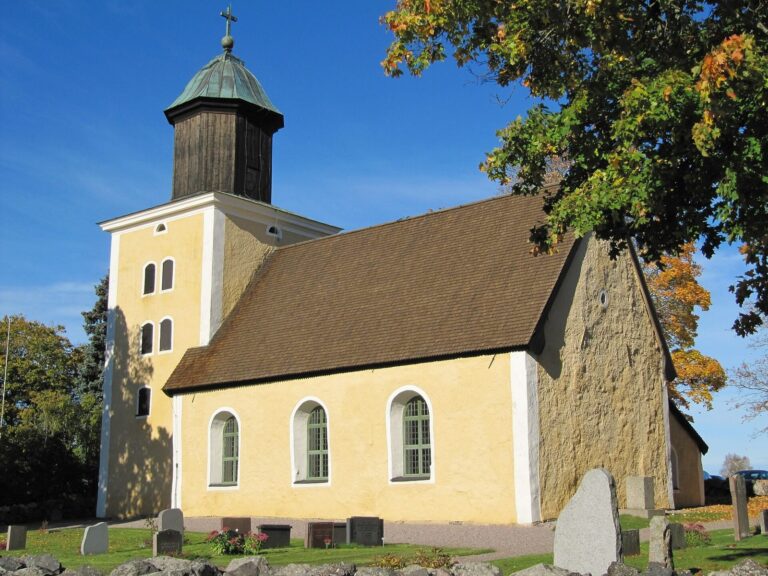
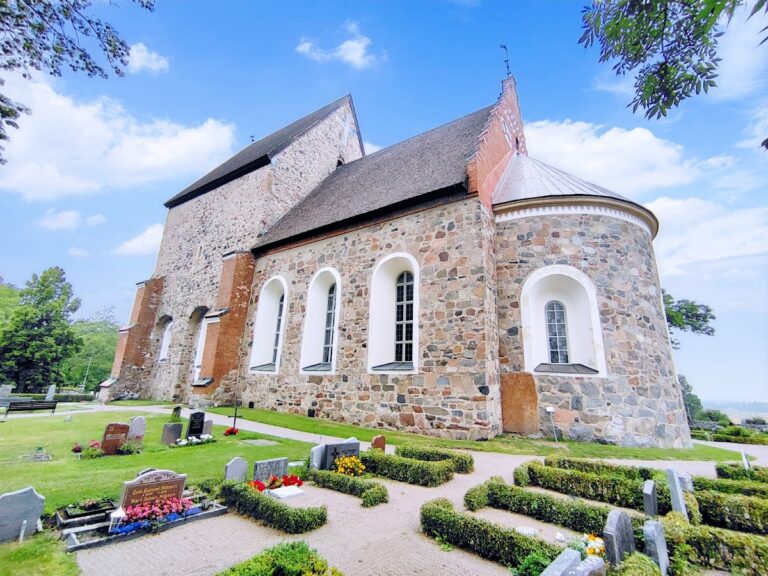
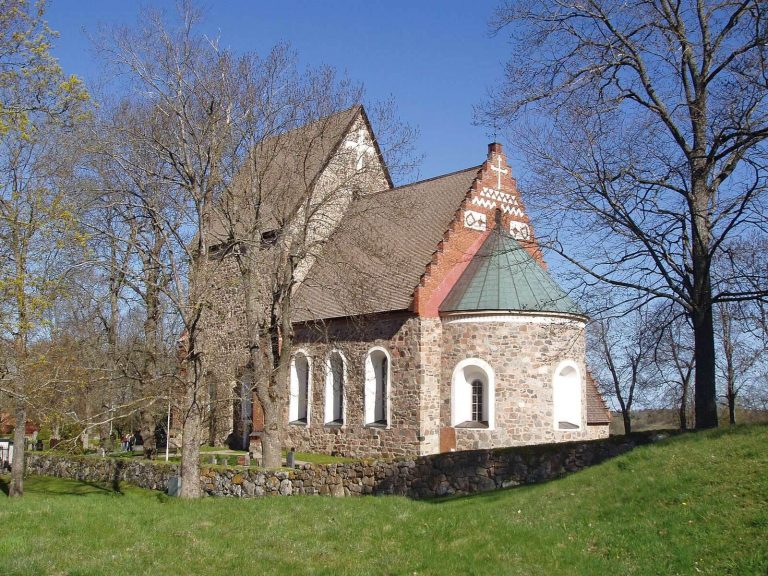
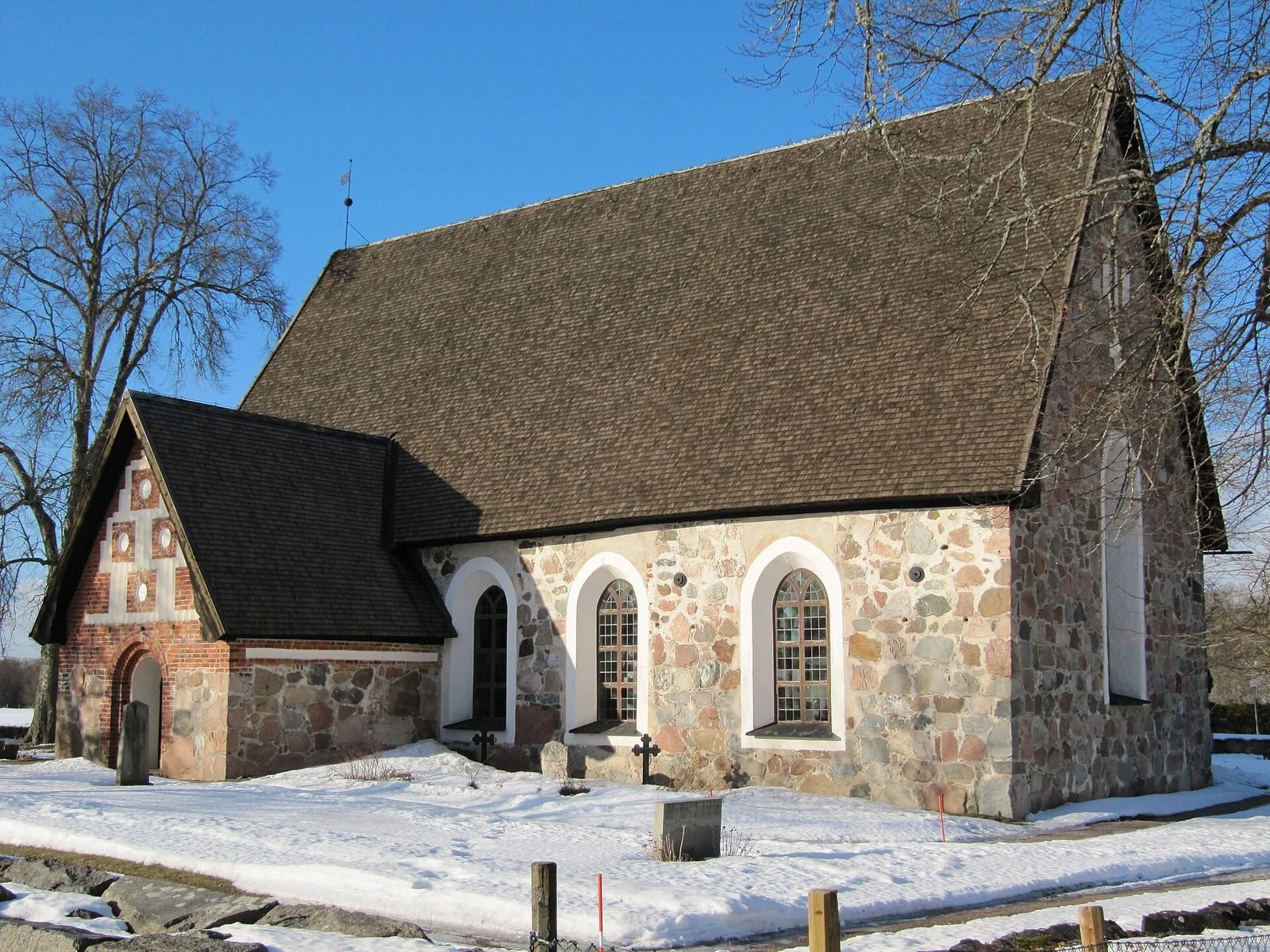
The church stands on the crest of a steep slope descending toward the Jumkil River. Its grey-stone-and-brick building has a rectangular nave divided into three sections and an east choir with a straight end, as wide as the nave. On the northeast side, the brick sacristy contains two rooms, one with a cross vault formed by intersecting arched sections and the other with a barrel vault, a continuous curved ceiling. The sacristy is not bonded into the nave, though bonding stones indicate it was planned from the outset. A grey-stone porch projects from the southwest side; its brick gable has shallow recessed panels that do not open through the wall. Much of the church retains its early-14th-century appearance. A dry-laid stone wall encloses the churchyard, and a wooden bell tower stands outside its southern side.
Choir paintings
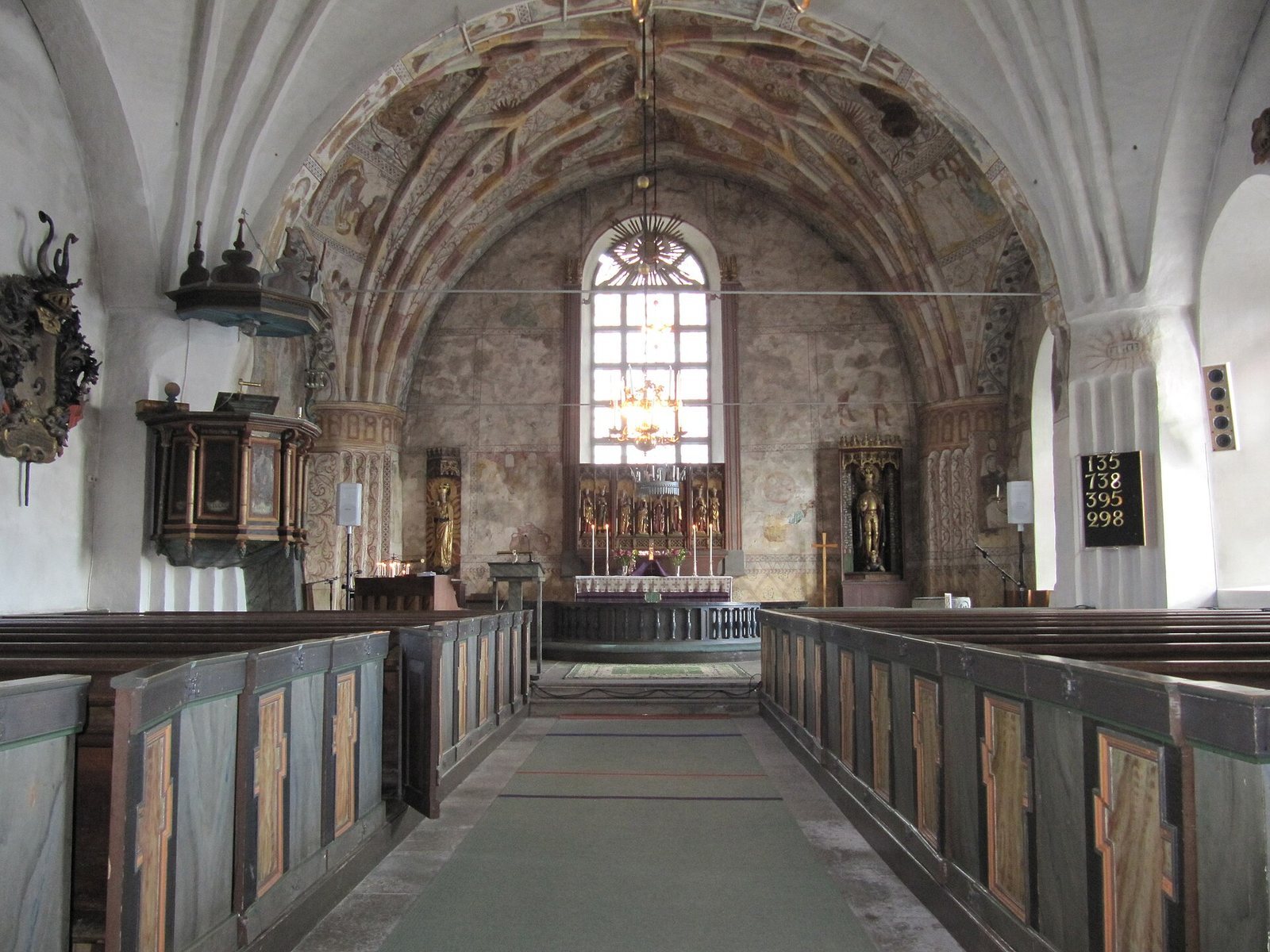
The choir vault bears paintings made around 1500 by an unknown medieval artist. They include the coats of arms of Sweden, Jakob Ulvsson, a Swedish archbishop, and Sten Sture the Elder, a Swedish regent.
Furnishings and memorials
Baptismal font
The choir’s baptismal font is carved from Gotland sandstone and dates to the late 12th century. It is attributed to Master Semi-Byzantios, a conventional name for a medieval stone-carver whose personal name is unknown, and was probably made on Gotland. The bowl depicts scenes from the childhood of Jesus, while four sculpted heads project from its base.
Altarpiece, crucifix, and iron crown
The altar has an altarpiece dating to around 1470, with four images of saints in its central section. A large crucifix made around 1500 hangs on the south wall of the nave. An iron crown in the choir vault probably dates to the 15th century.
Pulpit and pews
The pulpit, made in 1670 in the Renaissance style, carries painted images of the Evangelists. The enclosed pews date to 1761 and were altered in 1831 and 1925.
Funeral memorials
Two funeral hatchments, heraldic panels commemorating the dead, hang in the choir. One commemorates cavalry captain Erik Andersson Rosensabel, who died in 1656; the other remembers lieutenant colonel Peter Hästesko, who died in 1698.
Wooden figures and church silver
The church holds wooden sculptures of saints, including Mary and Saint Olaf, the medieval king of Norway who became a Christian saint. Its silver includes an object from the 14th century and a wine chalice donated by the congregation in 1721 in gratitude for peace with Russia.
Organ
The organ stands on a gallery at the west end of the church. It has mechanical action and slider chests, which regulate the flow of air to the pipes. Its range is listed as 51/27, formerly 51/20. A renovation in 1855 added a stop with an eight-foot pitch; the instrument was enlarged and renovated in 1934–35 and renovated again in 1990.