German Church: A Historic Parish Church in Stockholm
Site at a Glance
- Country
- Sweden
- Primary era
- Early Modern
- Eras represented
- Medieval, Early Modern, Modern
- Civilizations
- Swedish
- Site type
- Religious
- Remains
- Church
On this page30 sections
History
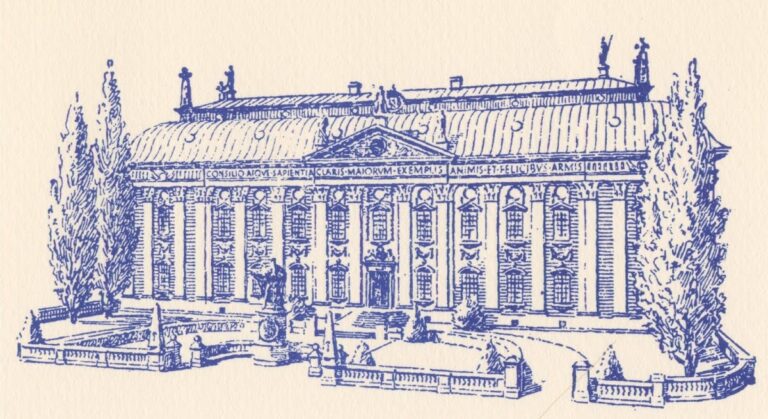
The German Church is a church in Gamla stan, Stockholm, Sweden, formed from the premises of a German merchants’ guild in the 1570s and 1580s with a late-Gothic design. Its origins connect the medieval trading community with a parish that became an important centre of Swedish church music.
The guild and the German parish
The Guild of St. Gertrude was founded in the fourteenth century by German merchants. Swedish trading partners were also welcomed at its activities. The guild house included a hall for feasts, while members worshipped in a chapel at nearby Stockholm Cathedral. In 1448, Charles VIII was elected king of Sweden in the guild building.
After the Reformation, the Crown took the former guild premises as Catholic guilds were dissolved. In 1558, Gustav Vasa allowed Stockholm’s German residents to hold separate services. John III then authorized them, in 1571, to establish their own parish and invite pastors from Germany. It became the earliest parish for German worshippers founded beyond Germany. Its congregants first met at the Greyfriars’ monastery on Riddarholmen, then shared a chapel built for the Finnish parish.
The church is dedicated to Gertrude of Nivelles, a seventh-century Benedictine abbess venerated as a Christian saint. Her cult reached the Nordic countries around the middle of the fourteenth century, including through guilds in towns with German residents. A legend credited her with rescuing sailors in danger, and she became a patron saint of travellers. Before journeys, people customarily drank in her memory.
Conversion and expansion
The guild premises were converted into a church in stages during the 1570s and 1580s. A German school opened in 1580, later moved to Tyska Skolgränd, and remained in operation until 1888. In 1607, Charles IX transferred the former guild site for the German community’s exclusive use.
The chapel was enlarged into a two-aisled church between 1638 and 1642, and the completed building was consecrated in 1642. During the seventeenth century, its school choir participated in royal concerts, and the church developed into an important centre of Swedish church music.
Fires and rebuilding
The tower suffered two fires in 1625 and another in 1829, but both incidents were brought under control. On 7 October 1878, a fire destroyed the seventeenth-century tower. Its spire fell partly onto Tyska Brinken and partly onto the church roof, while the bells crashed onto the vaults, which held. Although the roof caught fire, the vaults kept the flames from reaching the interior. Stockholm’s newly formed fire service confined the blaze to the church.
Restoration ran from 1878 to 1887 and included a replacement tower. The new tower was erected in 1886 and completed the following year. The tower’s copper covering was renewed between 1910 and 1912 and repaired again in 2005 and 2006.
The parish today
By 1800, the German congregation had dwindled to 113 members. The parish continues as a non-territorial parish of the Church of Sweden, meaning it is not limited to a fixed local area. Its approximately 2,000 members live throughout Stockholm, and most services are still held in German. The German Church is one of 43 churches in Stockholm specially protected under Sweden’s Cultural Environment Act.
Remains
Plan and architectural fabric
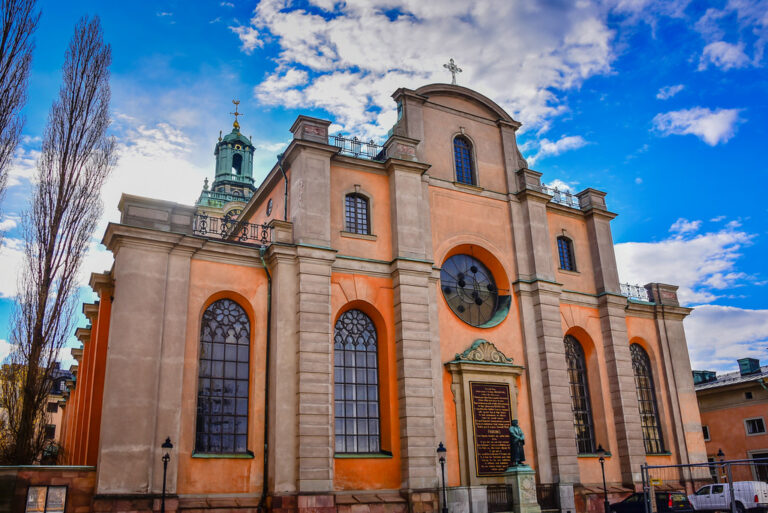
The church occupies the former guild site in Juno block in Gamla stan, Stockholm’s Old Town. Its long axis runs northeast to southwest. The spacious, nearly square building is a two-aisled hall church, with aisles of roughly equal height that create a unified interior. German-Dutch Renaissance features are combined with Gothic forms, while the interior has a Baroque character and the restoration gave it a nineteenth-century revival-style appearance.
Exterior
A limestone base supports dark-red brick walls, divided by buttresses and detailed with grey sandstone and dressed corner stones. The northern wall retains round-arched windows, while tall, pointed Gothic windows mark the southern façade. During restoration after the 1878 fire, machine-made brick was used to face the exterior walls except on the south side. The window frames are cast iron.
Interior
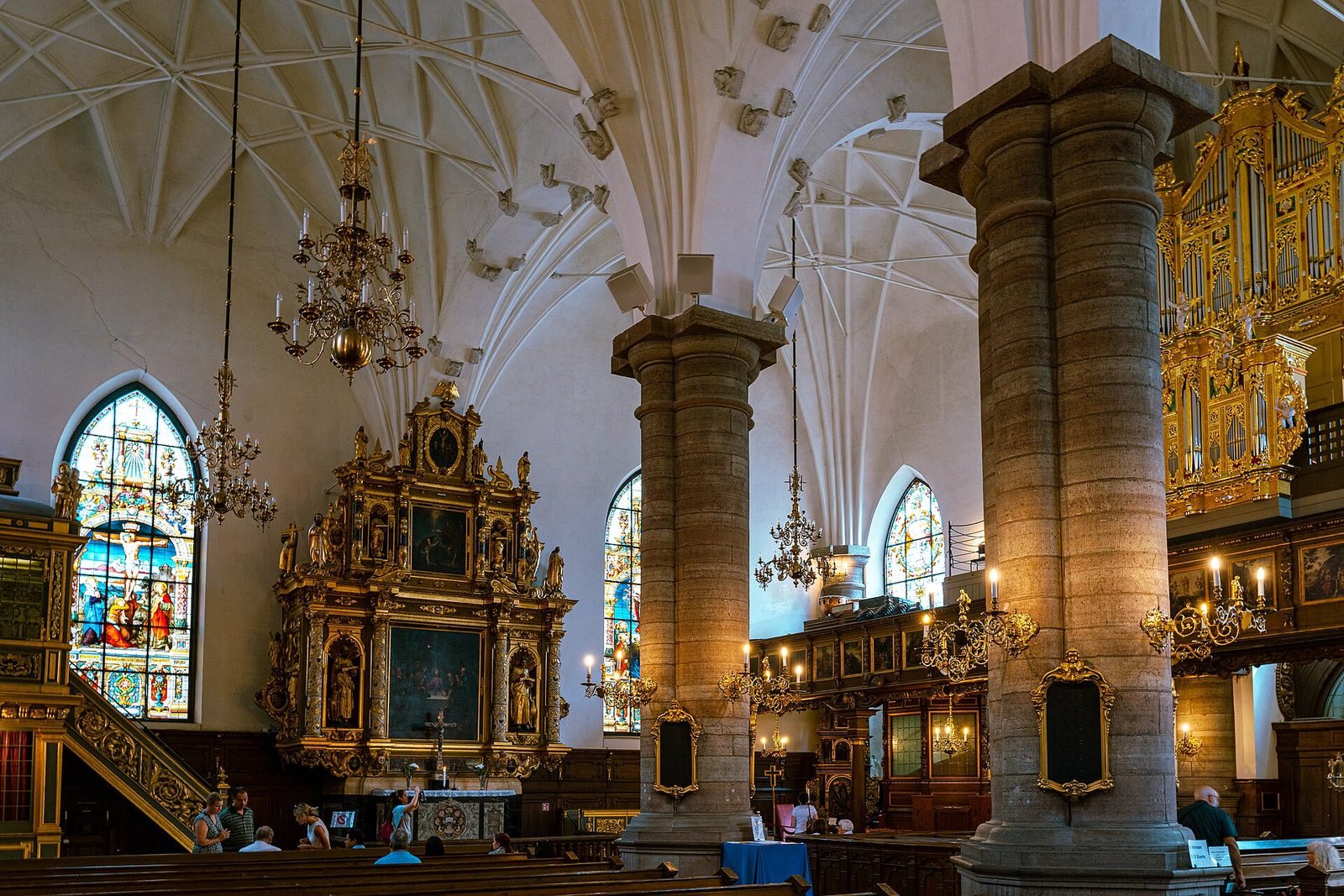
Limestone half-columns support star-patterned rib vaults, while two large sandstone pillars carry the vaults where a central aisle commonly runs toward the altar in Swedish churches. The floor is laid in black, white, and brown marble, and large windows light the space. Angels’ heads decorate the white vaults.
The tower
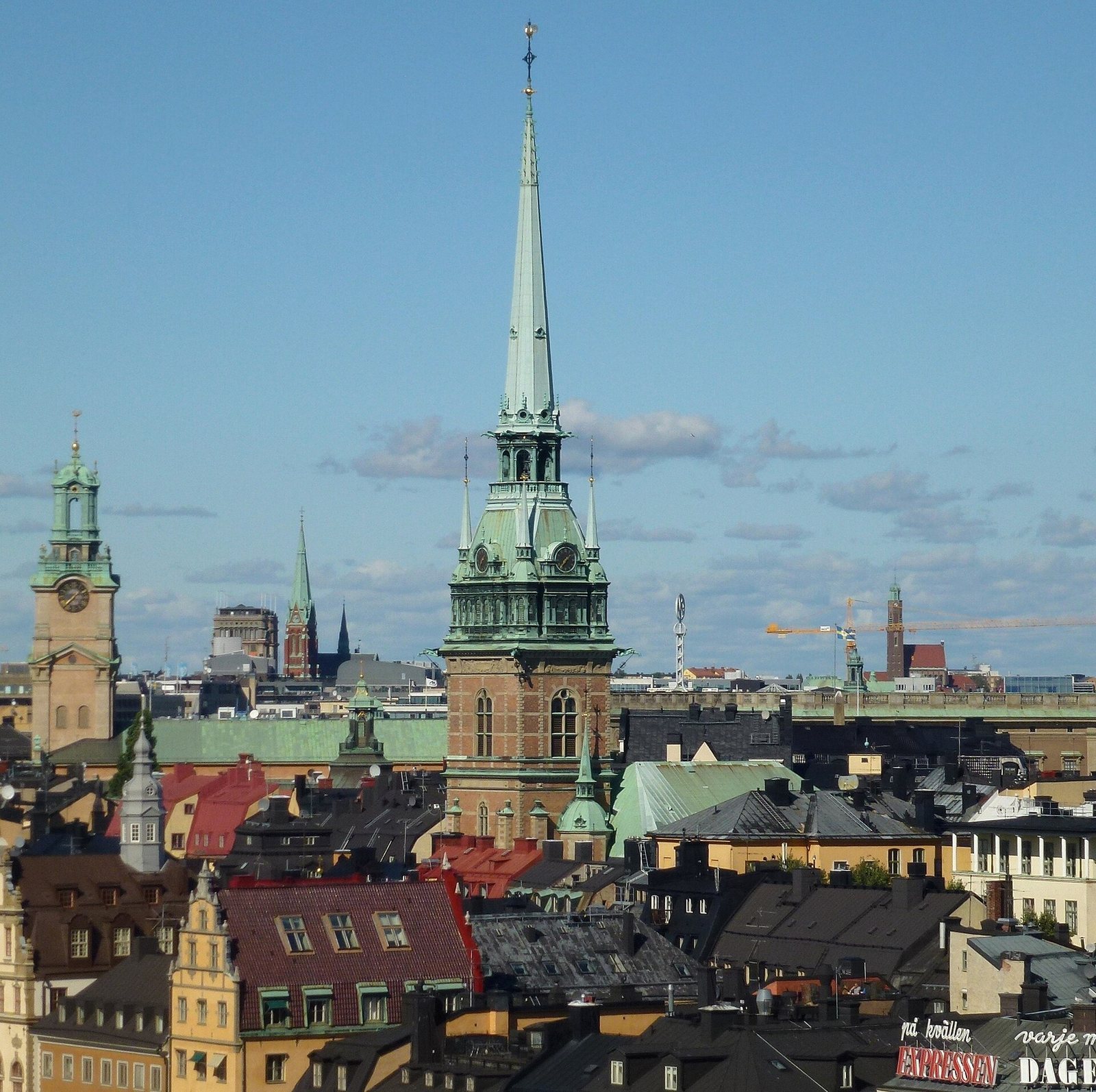
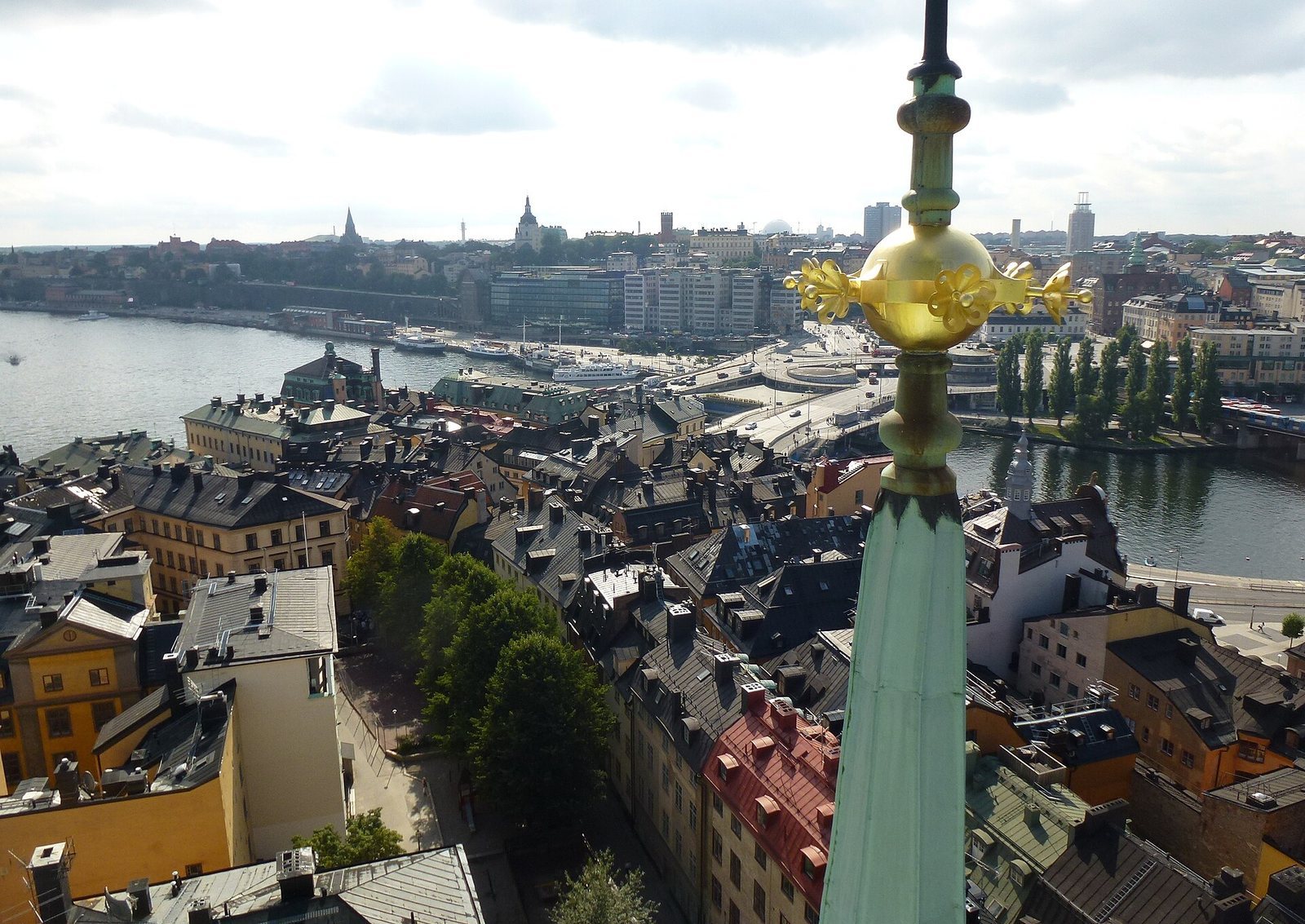
The 96-metre tower, the highest point in Gamla stan, was designed by Julius Carl Raschdorff and completed in 1887. Its steel supporting frame carries a copper-clad spire, flanked by four turrets and topped with a gilded weathercock. Dragon-shaped water spouts project from the tower, and its gargoyles take the form of grotesque animals.
Entrances and gates
Southern portal
The principal portal on the southwest façade is made of sandstone and was carved in the 1640s by Joest Henne, a stonemason from Westphalia. Its restrained Baroque decoration includes images of Jesus and Moses alongside personifications of Faith, Hope, and Love.
Gates
The gate facing Tyska Brinken carries a gilded German inscription urging people to revere God and honour the king, with gilded images of St. Gertrude above it. The eastern gate faces Svartmangatan and bears two tablets with gilded inscriptions.
Altar, pulpit, and galleries
Altar
The nearly ten-metre-high Baroque altar was made by Markus Hebel between 1641 and 1659. Medallions include portraits of the donor Hans Bremer and his wife. Its paintings include The Last Supper, made by Georg Engelhard Schröder in 1743, and The Baptism and The Crucifixion, both from the mid-seventeenth century and by an unidentified artist.
Pulpit
The octagonal pulpit is made of ebony, with contrasting ornament and alabaster figures of Christ and the apostles. An unidentified master created it, and Peter Hanssen and Anna Hansdotter Stecker donated it in 1660. A sun motif incorporates the four-letter divine name commonly rendered in English as YHWH.
King’s gallery
Nicodemus Tessin the Elder designed the king’s gallery in 1672 for Dowager Queen Hedvig Eleonora and Charles XI, who had reached legal majority that year. Its Baroque roof has a double-pitched profile and is crowned by sculpted children bearing the king’s monogram, made by Nicolaes Millich. The glazed lower part now serves as a sacristy, a room for preparing services and storing religious objects. A painting by David Klöcker Ehrenstrahl decorates the upper ceiling. Members of royal families used the gallery when attending sermons.
Other gallery
A separate gallery, originally built on two levels, dates to 1647 to 1649 and was made by Christoffer Wellendorph. Its paintings of biblical subjects were added between 1660 and 1665.
Seating and baptistry
Benches
Christoffer Wellendorph designed the church benches, installed in 1649. After the church fire, the seating arrangement was changed and details from the older benches were reused. Enclosed seating blocks that had mainly faced the pulpit were opened at the sides and directed toward the altar.
Baptistry
The baptistry occupies the southeast corner and contains some of the church’s oldest furnishings. Its baptismal altar and the base of the baptismal bowl were already present in the first church, around 1580. Stockholm silversmith Arvid Falk made the gilded silver bowl in 1670, and Queen Victoria donated the armchairs. An ornate pew associated with a diplomatic mission stands nearby.
Windows and memorials
Painted glass
Painted-glass windows made in Munich around the turn of the twentieth century include southern windows interpreted as showing the benefits of a devout life. A window in the entrance area depicts St. Gertrude holding a chalice and a model of the church.
Fuhrmann memorial
A memorial tablet and an epitaph commemorate Peter Hinrich Fuhrmann, a German-born restaurateur and an important donor to the church. He left his house to the parish and church.
Below the church
Guild-house remains
Vaulted cellar spaces, also described as wine cellars, survive beneath the church, along with part of a wall from the medieval guild house. Further vaulted remains lie below the marble floor.
Parish crypt
Construction of the parish crypt began in 1716. Work was interrupted from 1860 until 1992, and the crypt remains in use by the parish.
Organ and bells
Organ
An 18-stop organ was acquired in 1608, enlarged by eight stops in 1625 and by a further seven in 1647. Mårten Redtmer later decorated the instrument, and Markus Hebel made its façade. The original organ was sold in the late eighteenth century; its main section is now at Övertorneå Church and its rear section at Hietaniemi Church. The present organ, built by Grönlunds Orgelbyggeri and inaugurated in 2004, reconstructs the earlier instrument as it appeared in the mid-1680s. It has 35 stops, an upper section made in Holland, and four bellows of an older, many-folded design.
Bells and carillon
The church has four bells, of which the three largest are used; the smallest has no motor. The great bell, cast by J. G. Grosse of Dresden, weighs about six tonnes without its clapper and measures 2.1 metres across. It is described as Sweden’s second-largest church bell. The original carillon, a group of tuned bells arranged to play melodies, dates to 1666 and had 28 bells made in Amsterdam. After the 1878 fire, a 25-bell replacement and four new church bells were installed. The replacement carillon, associated with gifts from Wilhelmina von Hallwyl and her mother Johanna Kempe, was recast in 1923 because it sounded out of tune. Renovation and expansion in 2008 brought it to 37 bells. It plays chorales including “Nun danket alle Gott” and “Lobe den Herren, den mächtigen König der Ehren.”