Riddarholm Church: Sweden’s Royal Burial Church in Stockholm


Site at a Glance
- Rating
- 4.4
- Popularity
- Medium
- Country
- Sweden
- Primary era
- Medieval
- External website
- Open
- Eras represented
- Medieval, Early Modern, Modern
- Civilizations
- Swedish
- Site type
- Religious
- Remains
- Church
On this page11 sections
History
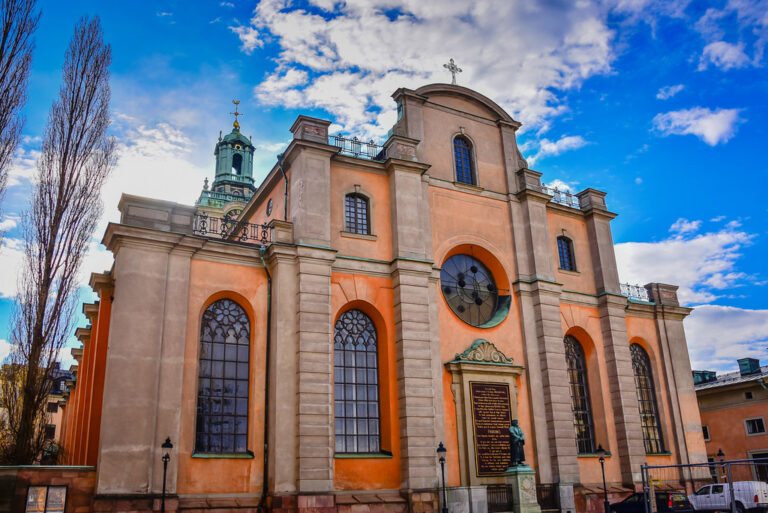
Riddarholm Church in Stockholm, Sweden, is the former church of the Greyfriars, or Franciscan, Monastery founded under King Magnus Ladulås in 1270. The church was built approximately between 1280 and 1300 in the Northern European Gothic tradition. It later became Sweden’s principal royal burial church and remains closely connected with the country’s monarchy and the Royal Order of the Seraphim.
Franciscan foundation and Reformation
The monastery and church stood on Riddarholmen island, near the Royal Palace in central Stockholm. Although the monastery was founded in 1270, the wider complex was completed about fifteen years later, while construction of the church continued into the late thirteenth century. Magnus Ladulås, also known as Magnus III, reigned as king of Sweden from 1275 to 1290 and was later buried in the church.
The Greyfriars remained prosperous until the Protestant Reformation, the sixteenth-century movement through which Sweden broke with Catholic ecclesiastical structures and established Lutheran worship. The monks were forced to leave in 1527, and the church became Lutheran and associated with the Church of Sweden. Its Catholic period therefore lasted from 1270 to 1527, while its Lutheran affiliation continued until 1807.
Royal burial church
The Riddarholmen congregation was dissolved in 1807. After that change, the church served for burial and commemoration rather than ordinary parish worship. It contains the tombs of seventeen reigning Swedish sovereigns, including monarchs from Gustavus Adolphus to Gustaf V, as well as the earlier kings Magnus Ladulås and Charles VIII. The royal family later adopted Haga Royal Cemetery for subsequent burials.
The royal burials include the Bernadotte dynasty’s founder, Jean-Baptiste Bernadotte, who became King Charles XIV John of Sweden and Norway. Queen Christina of Sweden, however, was buried in the papal necropolis of Saint Peter’s Basilica in Rome. Queen Frederica of Baden was buried in the crypt of Saint Michael’s Abbey Church in Pforzheim, Germany. Their burials are exceptions to the royal tradition represented at Riddarholm Church.
Several members of the royal family were later brought to the church from other places. Gustav IV Adolf, originally buried at Saint Gall in Switzerland, and his son Gustaf of Vasa, first buried at Eutin in Germany, were reinterred in the royal burial complex in 1884 at the request of King Oscar II. Louis, another son of Gustaf of Vasa, was reinterred there in the same year.
The Seraphim tradition
Riddarholm Church is associated with the Royal Order of the Seraphim, Sweden’s highest order of chivalry and merit and a royal house order. Until about 1820, deceased Seraphim knights who had died in Stockholm were buried in the church. Their armorial plates, bearing their coats of arms, were placed on the interior walls as memorials.
The traditional Seraphim funeral ceremony continues even though the church is no longer a parish church. The deceased knight’s armorial plate is carried in procession from the Royal Palace to Riddarholm Church and rehung on the walls. The bells ring continuously from 12:00 to 13:00 on the day of burial, serving this ceremonial purpose rather than ordinary parish services.
Fire and later additions
During the reign of King John III, the Flemish sculptor and architect Willem Boy designed a spire for the church’s western tower. Lightning struck it on 28 July 1835, causing a fire, and the damaged spire was subsequently replaced. The Bernadotte Chapel was built between 1858 and 1860 for the dynasty founded by Charles XIV John. Swedish government and royal-court departments now administer the church for its burial and commemorative functions.
Remains
Riddarholm Church is principally a medieval red-brick church whose surviving fabric dates in part from the late thirteenth century. Much of its original arrangement remains, although architectural descriptions differ on whether the interior should be understood as a single-nave or three-aisled church. Later burial chapels give the building an eclectic character, combining medieval Gothic elements with Renaissance and Baroque components.
Western tower and medieval interior
The high western tower carries the present openwork cast-iron spire. This visible framework of iron was installed after Willem Boy’s earlier spire was destroyed by lightning and fire in 1835. Inside, medieval lime paintings survive on the lower zones of the walls. The furnishings consist largely of funerary objects and monuments, including the armorial plates of deceased Seraphim knights fixed to the walls.
Gustavus Adolphus Chapel
The Gustavus Adolphus Chapel contains the coffins and tombs of members of the family of King Gustavus II Adolphus. Gustavus II Adolphus lies in a richly made Italian-marble tomb. The chapel also contains Agnes of Holstein-Gottorp, Gustavus II Adolphus, Queen Maria Eleonora of Brandenburg, a stillborn unnamed daughter born on 24 July 1621, Princess Christina Augusta, and an unnamed son stillborn in May 1625.
Its crypt, a subterranean burial chamber, contains King Adolf Frederick, Queen Louisa Ulrika of Prussia, Prince Frederick Adolf, Princess Sophia Albertina, King Gustavus III, Queen Sophia Magdalena of Denmark, Prince Charles Gustav, King Gustav IV Adolf, Crown Prince Gustaf of Vasa, Prince Louis, Prince Charles Gustav, King Charles XIII, Queen Hedwig Elisabeth Charlotte of Schleswig-Holstein-Gottorp, a stillborn Princess Louise Hedwig, Prince Charles Adolf, and Crown Prince Charles August. The burials range from the eighteenth and nineteenth centuries and include the family members later reinterred there in 1884.
Caroline Chapel
The Caroline Chapel was designed by Nicodemus Tessin the Elder and built from gray sandstone beginning in 1671. Carl Hårleman completed it in 1743. Its three principal tombs use different stones: Charles XII’s is made of black marble, while those of Ulrike Eleonore and Frederick I use green Swedish marble.
The chapel contains King Charles XII, Queen Ulrike Eleonore of Sweden, and King Frederick I. Beneath it, the crypt contains King Charles X Gustav, Queen Hedwig Eleonora of Holstein-Gottorp, King Charles XI, Queen Ulrike Eleonore of Denmark, Princess Hedwig Sophia, Prince Gustav, Prince Ulrik, Prince Frederick, and Prince Charles Gustav.
Bernadotte Chapel
Fredrik Wilhelm Scholander designed the Bernadotte Chapel, which was constructed from 1858 to 1860. Its principal tombs belong to Bernadotte monarchs and their consorts through King Gustaf V. The chapel contains King Charles XIV John, also known as Jean-Baptiste Bernadotte, Queen Désirée Clary, King Oscar I, Queen Joséphine of Leuchtenberg, King Charles XV, Queen Louise of the Netherlands, King Oscar II, Queen Sophia of Nassau, King Gustaf V, and Queen Victoria of Baden.
The chapel crypt contains Prince Gustaf, Duke of Uppland, Princess Eugenie, Prince August, Duke of Dalarna, Princess Therese of Saxe-Altenburg, Duchess of Dalarna, Prince Charles Oscar, Duke of Södermanland, and Prince Erik, Duke of Västmanland. The chapel also holds the porphyry sarcophagus of Charles XIV John, a monument made from a hard, crystal-bearing stone suitable for a durable royal tomb. It was produced near Älvdalen in northern Sweden and taken from the workshop by sled.
Choir and Vasaborg Chapel
The choir contains the tombs of King Magnus III, or Magnus Ladulås, Queen Helwig of Holstein, and King Charles VIII. Their burials represent royal phases that predate the later chapels and connect the present building with the medieval and early modern monarchy.
Gustaf Gustavsson of Vasaborg, first Count of Nystad, is buried in the Vasaborg Chapel. Together with the royal chapels, this burial place contributes to the church’s surviving arrangement of tombs, commemorative monuments, and funerary furnishings.
Nearby sites