Saluting Battery: Valletta’s Military and Ceremonial Artillery Battery
Site at a Glance
- Country
- Malta
- Primary era
- Early Modern
- Eras represented
- Early Modern, Modern
- Civilizations
- British, Knights Hospitaller
- Site type
- Military
- Remains
- Fort
On this page8 sections
History
Construction and the Order of Saint John
The Saluting Battery is an artillery position in Valletta, Malta, built by the Order of Saint John during the 1560s. The Order was a Catholic religious-military body that governed Malta, and the battery served both military and ceremonial purposes. During the Great Siege of Malta in 1565, Ottoman forces on the Sciberras Peninsula bombarded the Order’s position at Fort St. Angelo from a siege battery near the site. After the siege was lifted, Valletta was founded in 1566, and construction of St. Peter & Paul Bastion began that year. The bastion was completed in 1570.
By the late eighteenth century, the battery had sixteen bronze 12-pounder guns, named for the nominal weight of the shot they fired. These guns used spherical stone shot. During the French occupation and the Maltese insurgents’ blockade of Valletta from 1798 to 1800, the armament remained in place, but the guns were raised to reach insurgent positions on Corradino Heights across the harbour.
British rule and changing armament
Soon after the British occupied Malta in 1800, the battery took over three daily gun signals from Saint James Cavalier: at sunrise, noon, and sunset. The shots announced when the city gates opened and closed, and helped ships set their chronometers, or timekeepers. When repairs prevented firing from the battery, the signals came from Fort St. Angelo across the harbour. In 1803, two short-barrelled 24-pounder carronades and additional 24-pounder guns captured from the French were added. They remained until 1825. Meanwhile, the loggia and garden above the battery opened to the public in 1824 as Upper Barrakka Gardens.
The battery had four 12-pounder guns by 1848. By 1852, it carried ten 24-pounders on the main protective wall, four 32-pounders on the right side, three 8-inch howitzers on the left, and two 13-inch mortars behind the wall. Howitzers fire shells on a high trajectory, while mortars fire them steeply. Two 56-pounder carronades stood at the projecting corners. Lascaris Battery was built below the Saluting Battery in 1854, adjoining St. Peter & Paul Bastion.
Another 24-pounder was added during the 1860s, bringing the number of salute guns to eleven. In 1886, guns with rifled barrels, loaded through the muzzle, replaced the howitzers, and the 32-pounders were removed. During the 1890s, eleven muzzle-loading 32-pounders took their place and were used only for salutes. By the early twentieth century, the battery had eight smooth-bore 32-pounder guns loaded through the breech.
War, closure, and restoration
The battery’s gun signals stopped during the First World War to conserve gunpowder. They resumed on Armistice Day, 11 November 1918. In the 1920s, civil authorities sought the battery’s transfer so Upper Barrakka Gardens could be extended. A second entrance connecting the battery and gardens opened in 1924. That year, the armament was reduced to one smooth-bore 32-pounder loaded through the breech and four quick-firing 18-pounder guns. Part of the battery opened to the public, with the guns fenced off.
In 1939, shortly before the Second World War, the guns were removed for coastal defence. A 40 mm Bofors anti-aircraft gun was installed at the battery’s right projecting corner to protect Malta Dockyard, and the Royal Malta Artillery’s 3rd Light Anti-Aircraft Regiment manned the position. Aerial bombardment badly damaged the battery and Upper Barrakka Gardens. During the war, the Lascaris War Rooms were built in tunnels beneath the battery and gardens.
After the war, the battery and gardens were repaired, and four quick-firing 25-pounder guns were installed briefly. They were removed in 1954, when the battery closed and passed to the Royal Navy as part of its Fort Lascaris complex. In 1965, the portion still held by the military was transferred to the civil government and made into a garden. Fondazzjoni Wirt Artna, a Maltese heritage-preservation organization, acquired the battery in 2004 and began restoring it to its late-nineteenth-century arrangement. The restored site opened to the public in the early twenty-first century and continues to fire ceremonial signals using replica guns.
Remains
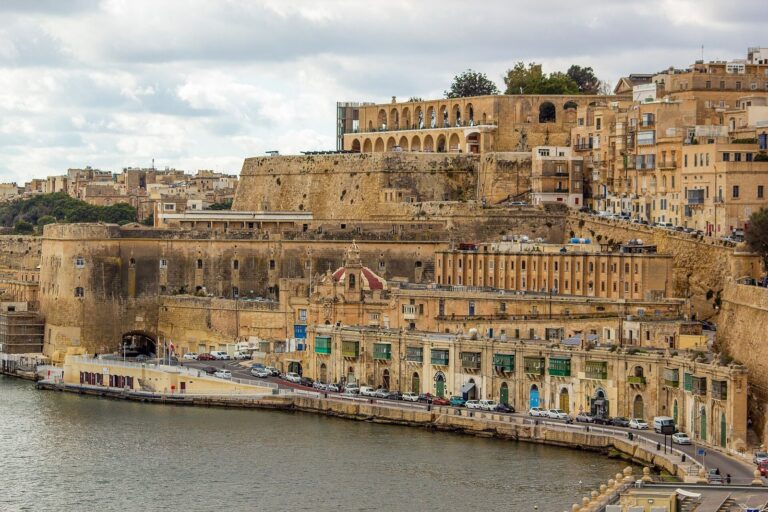
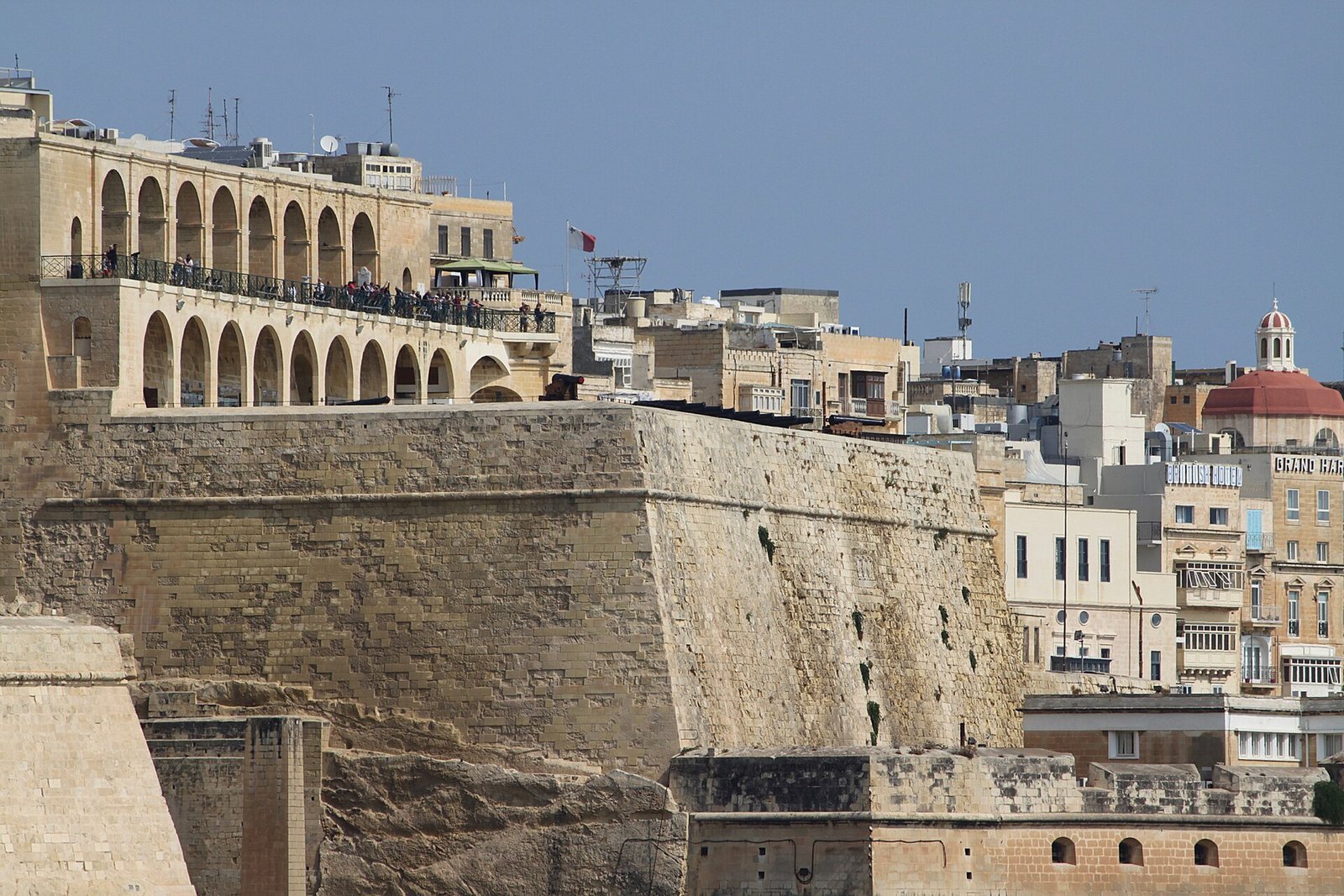
The intact limestone battery forms the lower tier of St. Peter & Paul Bastion, part of Valletta’s Land Front, the line of fortifications facing inland. It lies beneath Upper Barrakka Gardens on high ground overlooking Fort St. Angelo and the Grand Harbour. The bastion’s artillery platform has several levels, allowing guns to be moved higher to cover different parts of the harbour.
Battery and artillery platform
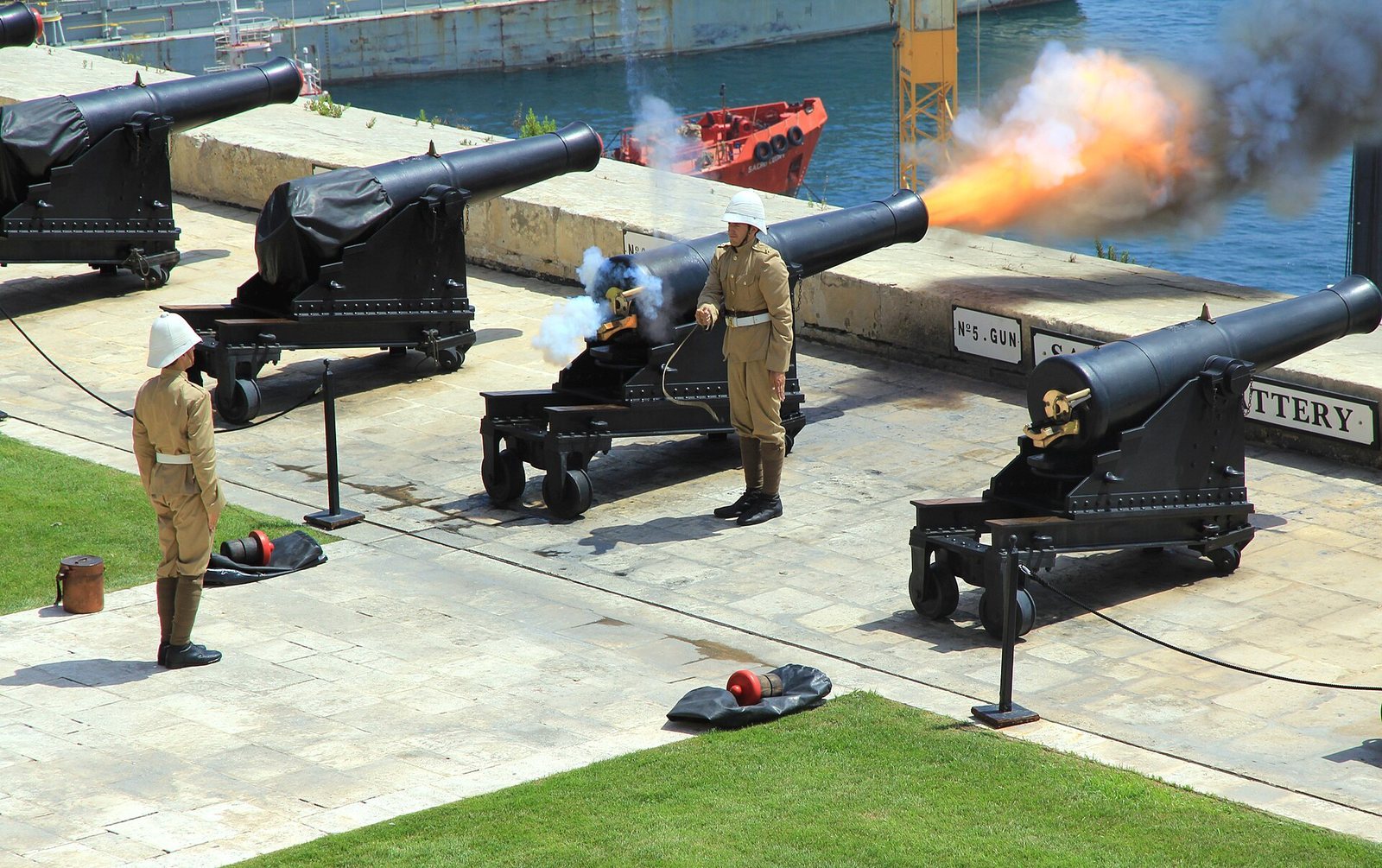
The battery retains its original entrance and a second entrance linking it with the gardens. Its restored spaces include artillery stores, a gunpowder magazine, a collection of historical ordnance, and a small museum. Eight working replicas of smooth-bore 32-pounder guns loaded through the breech are installed at the site. The restoration initially placed eight original 24-pounder Blomefield guns there, made between 1790 and 1810. In 2011, those guns were transferred to a museum and replaced by the working replicas.
Upper garden and adjoining works
A roofed, open-sided gallery, known as a loggia, and a garden occupy the upper part of the artillery platform. The garden is now Upper Barrakka Gardens. Lascaris Battery adjoins the bastion below the Saluting Battery, while the Lascaris War Rooms occupy tunnels beneath the battery and gardens.
Archaeological finds and burial
Restoration work in 2011 uncovered about 100 stone cannonballs and remains of the grave of Henry Anderson Morshead. Morshead, a commander in the Royal Engineers, the British Army’s military-engineering corps, died in 1831.