Santa Teresa, Turin: A Baroque Carmelite Church
Site at a Glance
- Country
- Italy
- Primary era
- Early Modern
- Eras represented
- Early Modern, Modern
- Civilizations
- Duchy of Savoy, Italian, Kingdom of Sardinia
- Site type
- Religious
- Remains
- Church
On this page22 sections
History
Santa Teresa is a Roman Catholic church in Turin, Italy, dedicated to Teresa of Ávila, a Spanish Carmelite mystic and reformer. Built for the Carmelites, a Catholic religious order, it was begun in 1642 at the initiative of Christine Marie of France, regent of Savoy, during the expansion of the city. Its Baroque design took shape over three decades, and the church was completed in 1672.
Construction and Carmelite foundation
The project is traditionally attributed to the Carmelite Andrea Costaguta, who brought the building close to completion. His fellow Carmelite Alessandro Valperga then took charge. Stone from the nearby Porta Marmorea, one of Turin’s four gates dating to the Roman period, may have been reused in the church. The gate was demolished as the city expanded.
Baroque additions and alterations
Work on the chapels and altars continued after the church opened. The Chapels of the Crucifix and Saint John of the Cross were built in 1677 to Valperga’s designs. A chapel erected between 1685 and 1688 was initially dedicated to Saint Joseph; it received its present dedication to the Souls in Purgatory and Our Lady of Mount Carmel in 1826. Purgatory, in Catholic teaching, is a state of purification after death.
The Holy Family altar in the right transept was made between 1715 and 1718 to a design by Filippo Juvarra, an influential Baroque architect. Juvarra also designed the Chapel of Saint Joseph between 1733 and 1735 at the request of King Carlo Emanuele III. The project was linked to a pledge made by the king’s second wife, Polyxena of Hesse-Rotenburg. Juvarra designed the chapel altar, which was made by his nephew Simone Martinez.
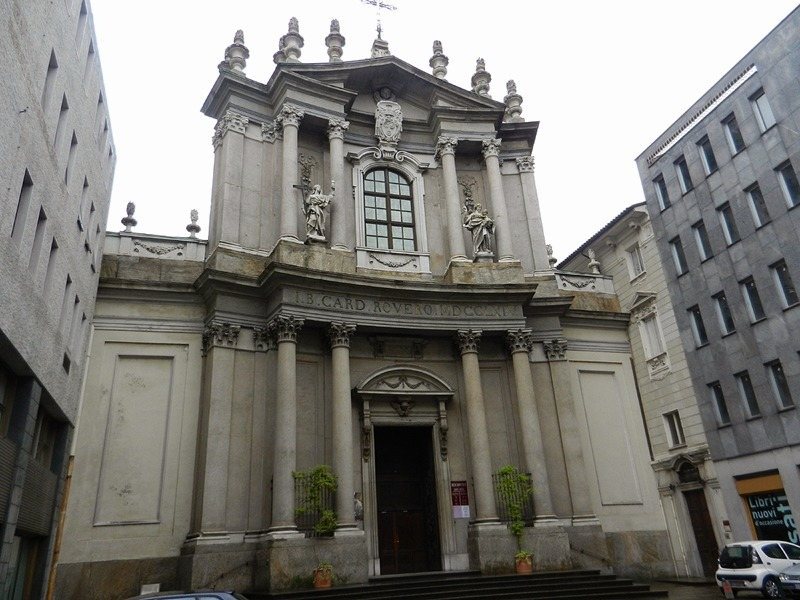
The church’s façade was completed in 1764 to a design by Carlo Filippo Aliberti. Giambattista Roero di Pralormo, Archbishop of Turin and a cardinal, donated it. His coat of arms and a dedication to him appear on the façade, while his funerary monument is inside the church. Other alterations included the remodelling of the Chapel of the Sorrowful Mother in 1767 and the rebuilding of the Chapel of Saint Anne in 1769. The latter chapel was altered again in 1939. The main altar, made in 1681, was remodelled in 1844; that year, statues of Saints Elijah and Teresa were moved from it to the Chapel of Saint John of the Cross.
Memorials and twentieth-century events
A tomb memorial to Christine Marie of France was transferred from the church of Santa Cristina and installed in the Chapel of Saint Erasmus on 1 December 1855. Her ashes are kept there. On 20 August 1907, Giuseppe Bergoglio and Rosa Vassallo, the paternal grandparents of Pope Francis, married at Santa Teresa. Their son, Mario Giuseppe Bergoglio, was baptised in the church on 6 April 1908, four days after his birth.
Bombing in 1943 during the Second World War severely damaged Santa Teresa. The façade nearly detached, part of the roof was destroyed, and the interior was damaged, including one of two inlaid doors made by Pietro Piffetti. Adjacent buildings were also destroyed in the wartime events and rebuilt after the war.
Remains
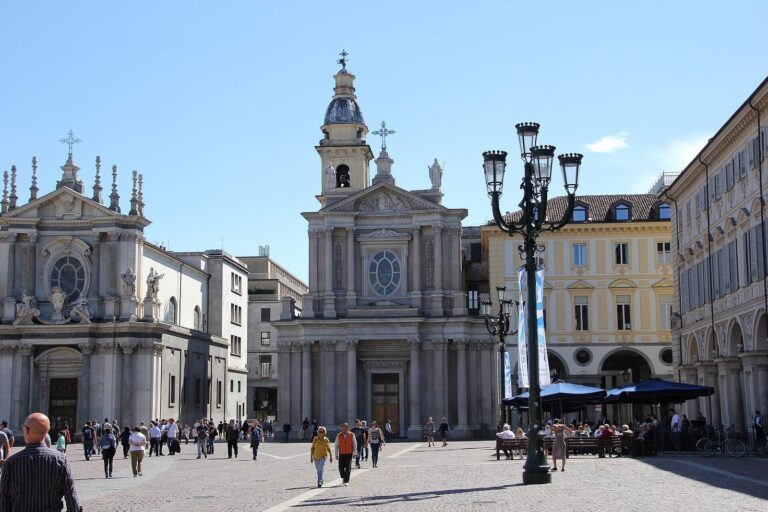
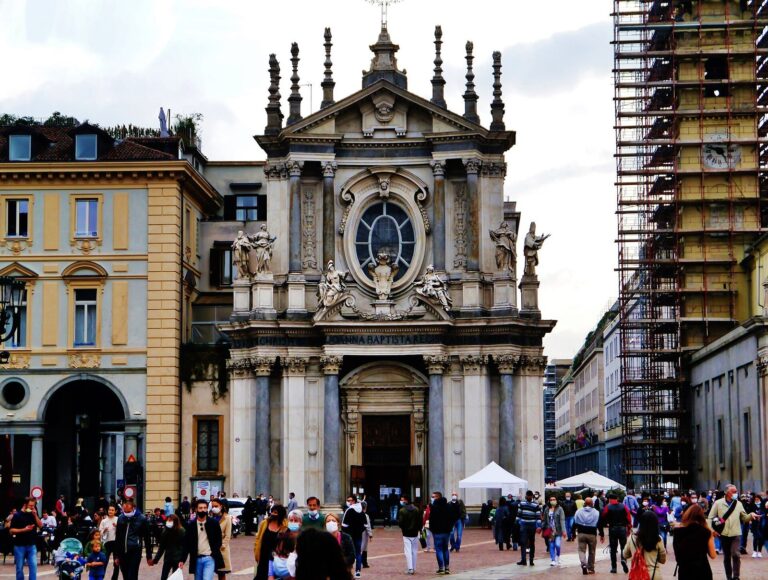
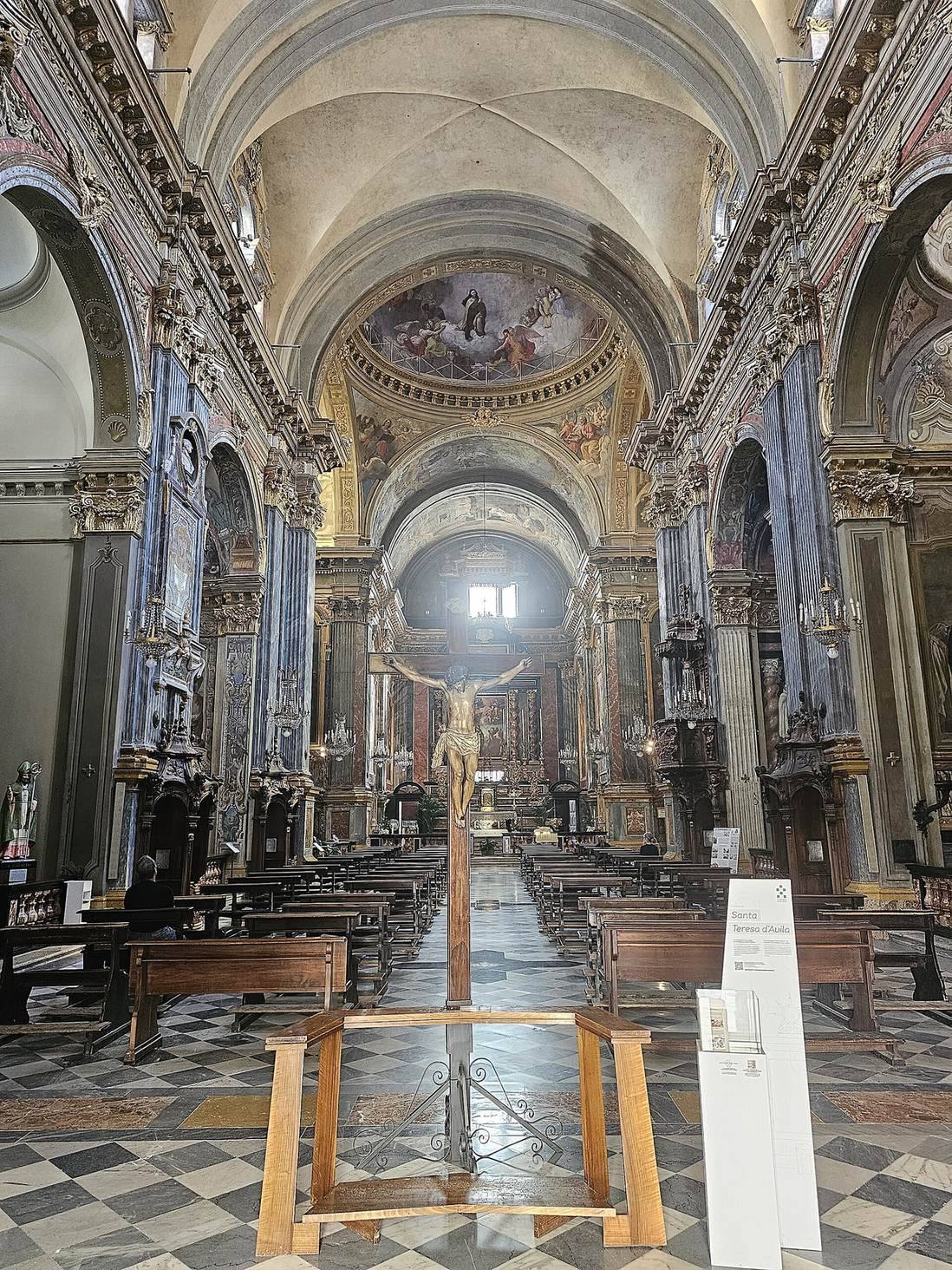
Santa Teresa is a Baroque church arranged around a single main hall, with six side chapels and two chapels in the arms that cross the hall. The church stands on Via Santa Teresa near Piazza San Carlo. A small square in front is enclosed by modern buildings, including the western façade of Torre XX Settembre. Inside, the chapels are linked by doorways and topped by small domes with circular openings. Nearly all have frescoes, paintings made on wet plaster, while the walls around their arches have faux-marble surfaces with applied floral decoration.
Façade and main hall
Façade
The two-level façade has a symmetrical arrangement of pilasters, shallow supports attached to a wall, and columns. On the lower level, four columns with capitals combining Ionic and Corinthian forms frame the entrance. Above it is a curved ornamental top decorated with festoons. The upper level continues the column-and-pilaster arrangement, with statues representing Religion and Charity beside a large window.
Entrance and main hall
Carved wooden confessionals stand against the pilasters between the chapels. A carved wooden pulpit with a canopy is positioned at the rear of the hall on the right. Above the entrance, an organ sits in a late-Baroque carved case with gilded ornament on a white ground.
Crossing, altar, and choir
Dome over the crossing
At the intersection of the main hall and its crossing arms, a dome is supported by curved triangular surfaces called pendentives. Luigi Vacca’s 1820 frescoes depict the Glory of Saint Teresa and Saint John of the Cross; the Evangelists appear in the pendentives.
Main altar
The altar has a stucco frontal showing the Immaculate Conception, the Catholic doctrine that Mary was conceived without original sin, amid interlaced ornament. Between its spiral columns is a painting dated 1640 and attributed to Guglielmo Caccia, known as Il Moncalvo. It represents Teresa of Ávila’s transverberation, a mystical experience depicted as an angel piercing her heart. Caccia also made the original altarpiece, an artwork placed above an altar, which showed Saint Teresa with the Virgin Mary and Saint Joseph.
Choir
The choir’s curved barrel ceiling is divided into two bays. Rodolfo Morgari painted it in 1878 with scenes of the Transverberation and the Death of Saint Teresa. Canvases on the side walls include a mystical vision of Saint John of the Cross, attributed to an unnamed artist and dated to about 1675, and Elijah being taken up in a chariot of fire, painted by Charles Dauphin at about the same time. Giovanni Antonio Mari’s 1716 works depict the Adoration of the Shepherds and the Adoration of the Magi.
Side chapels
Chapel of Saint Anne
A marble altar stands between columns with Ionic-and-Corinthian capitals and beneath a broken, curved ornamental top. An eighteenth-century painting depicts Saints Anne and Joachim with the infant Mary. A marble baptismal font dated 1744 occupies a niche in the left wall.
Chapel of the Souls in Purgatory and Our Lady of Mount Carmel
The marble altar is dated 1688. A gilded wooden statue of Mary and the infant Jesus, made in 1726, is displayed in a case. A seventeenth-century painting of Teresa of Ávila hangs on the right wall.
Chapel of the Crucifix
A seventeenth-century marble altar holds a crucifix attributed to Stefano Maria Clemente. Statues of Mary and Saint John the Baptist stand in niches between twisted columns. Paintings on the side walls show the Flagellation and the Fall of Jesus.
Chapel of Saint John of the Cross
The dome is painted with illusionistic architecture, which creates the appearance of three-dimensional building forms on a flat surface, and childlike decorative figures known as putti. Carlo Busso’s marble altar bears a family coat of arms at the centre of its curved top. The seventeenth-century altarpiece by Giovanni Battista Peruzzini shows Saint Michael supporting the Cross of Saint John. Peruzzini’s wall paintings portray episodes from the saint’s life.
Chapel of Saint Thérèse of Lisieux
This chapel is dedicated to the French Carmelite nun Saint Thérèse of Lisieux, not Teresa of Ávila. Ignazio Nepote painted the altarpiece showing Mary mourning Christ and the figures in the frescoes; Gaetano Perego painted the architectural frames and putti. Nicola Arduino’s painting of the death of Saint Thérèse covers part of Perego’s painted architectural work. The walls have polished stucco by Pietro Piattarelli and Eusebio Albertino. Virgilio Audagna made the relief marble altarpiece, while Albino Bosco made the marble tabernacle and portals.
Chapel of Saint Erasmus
The altar, set between twisted columns, holds Tarquinio Grassi’s painting of the Martyrdom of Saint Erasmus, dating to about 1720. The chapel also contains Carlo Antonio Tantardini’s funerary monument to Ambrogio Fassetto d’Alba. Christine Marie of France’s memorial is a simple white-marble slab.
Transept chapels
Chapel of Saint Joseph
Simone Martinez’s white-marble group, dated 1736, shows Saint Joseph in glory with the infant Jesus. Statues representing Faith and Charity crown the composition, which aligns with the outermost of six columns with Ionic-and-Corinthian capitals. Corrado Giaquinto painted the curved ceiling with the Glory of Saint Joseph and made two side paintings, depicting the Flight into Egypt and the Death of Saint Joseph, dated 1735–39. Beside two large carved and gilded candleholders are doors inlaid in 1745 by Pietro Piffetti with fine woods, ivory, and mother-of-pearl.
Holy Family altar
The altar’s base follows the curved line of the railing. Its altar table incorporates a nineteenth-century bronze urn, flanked by white-marble child figures and sections of red and green marble edged in yellow. Fluted column sections on the marble base support white-marble angels. Marble columns frame Sebastiano Conca’s arched painting of the Holy Family. The unfinished upper structure has a broken triangular top; statues of Faith and Charity by Carlo Antonio Tantardini stand on its sloping sides. Their convex outlines frame the Tana family arms and four child figures. Morgari’s 1878 ceiling painting shows the Apparition of the Angel to Saint Joseph. Side paintings depict the Dispute of Jesus with the Doctors and the Flight into Egypt.