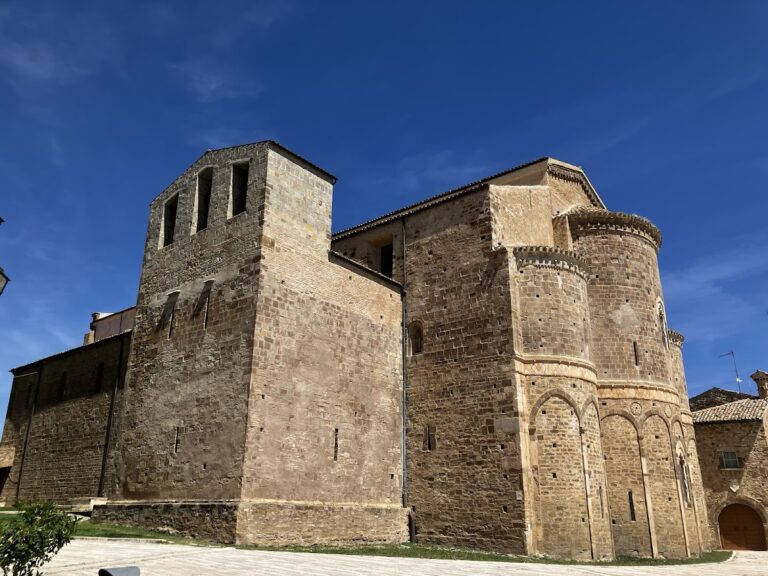
Sant’Agostino Church, Lanciano: An Augustinian Parish and Basilica
Site at a Glance
- Country
- Italy
- Primary era
- Medieval
- Eras represented
- Medieval, Early Modern, Modern
- Civilizations
- Italian, Kingdom of Naples, Kingdom of Sicily
- Site type
- Religious
- Remains
- Church
On this page16 sections
History
Sant’Agostino Church is a Roman Catholic church in Lanciano, Italy, where it served as the principal parish of the Lanciano Vecchio quarter. It belongs to the Diocese of Lanciano-Ortona and received the Catholic Church’s honorific title of minor basilica in 2004. The church developed within an Augustinian convent, a community of a Catholic religious order whose rule is associated with Augustine of Hippo, a Christian theologian and bishop.
Foundation and Gothic building
The convent is dated to 1266 and was the first monastery within Lanciano’s walls, apart from the Basilian monastery of San Legonziano, which then stood outside them. Basilian monks followed traditions associated with the Rule of Saint Basil. Land had been granted to the Augustinians about four decades before the work recorded by an inscription on the convent well in 1313.
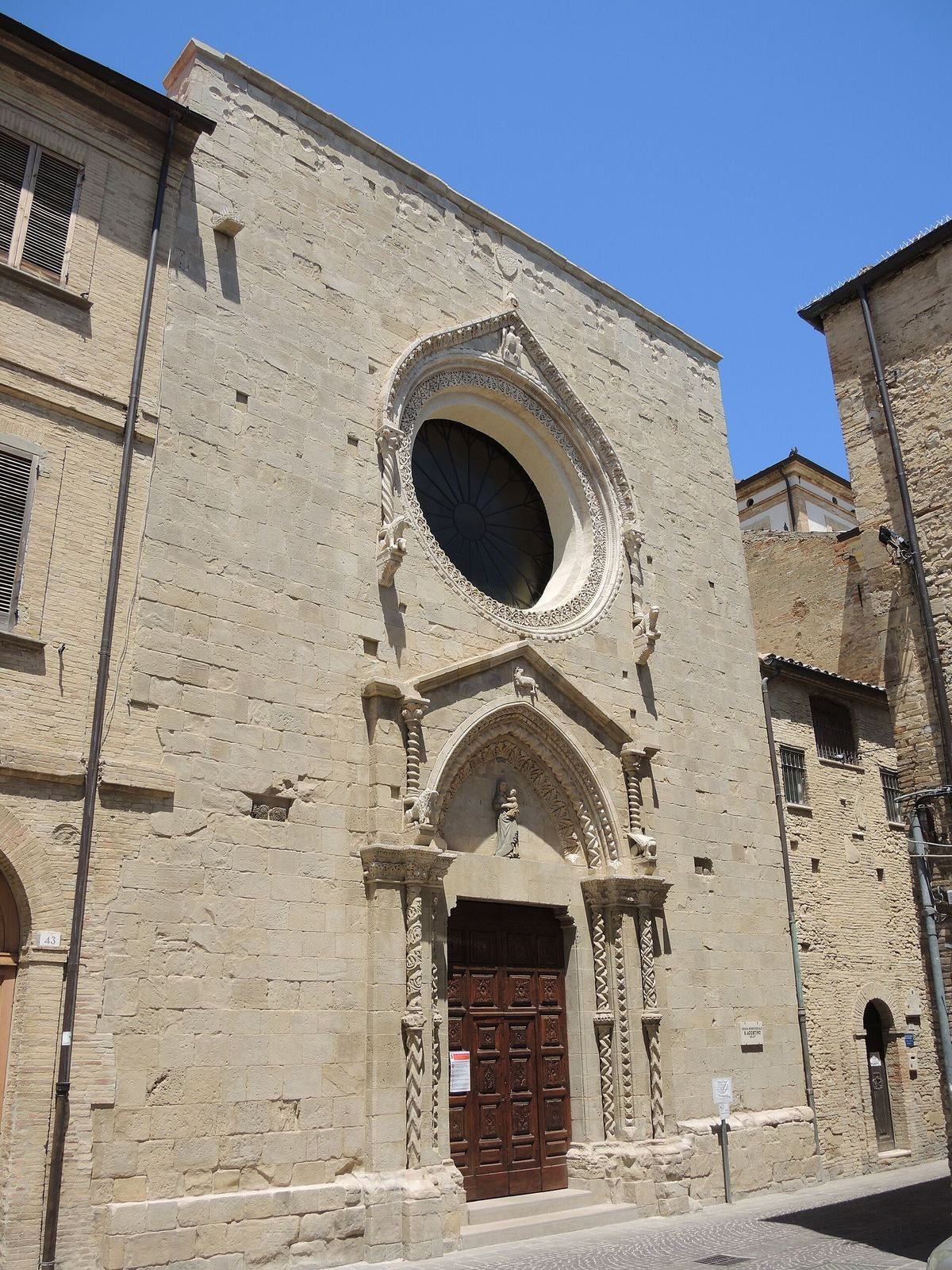
The church’s Gothic façade dates to the early fourteenth century and closely follows the design of nearby Santa Maria Maggiore. Francesco Petrini, also known as Perrini, is associated with the work. The church portal is unsigned but attributed to him and dated to a few years after 1321. An alternative interpretation proposes that the convent was built over an older church dating to the time of Charles of Anjou, the French-born ruler whose dynasty established Angevin rule in southern Italy. This proposal draws on the façade’s fleur-de-lis and eagle, and on the Madonna and Child sculpture above the portal, which is considered older than the Gothic façade.
Devotion and religious traditions
A local miracle tradition called Ricciarella is linked to a stable near the church in 1280. In 1583, Father Agostino de’ Merulis of Offida ordered the stable converted into an oratory. The stable may have belonged to the Gigliani barons.
Tradition also connects the relics of Saints Simon and Jude Thaddeus, apostles of Jesus, with the journey of Friar Jacopo to Venice and their transfer to Lanciano. The story says that Jacopo took the relics without the Doge’s permission. Francesco Foscari, Doge, or elected chief magistrate, of the Republic of Venice from 1423 to 1457, was said to have planned an attack on Lanciano’s port at San Vito, then a village, but instead besieged San Vito dei Normanni in Apulia. A confraternity, a lay religious association organized around shared devotion or charitable commitments, later formed in connection with the relics and their presence in Lanciano.
Before 1426, the Augustinians petitioned Pope Martin V for a new complex because their other site, Santa Maria del Monte, also called Santa Maria de Silva, lay beyond Porta Civitanova and outside the city walls. The church later became the seat of the Confraternity of Santa Maria dei Raccomandati, formerly based in the now-vanished church of San Giovanni, as well as the confraternity associated with Saints Simon and Jude.
Renovation and changing use
The organ and pulpit were restored in 1624. In 1654, Pope Innocent X suppressed the Augustinian order, although some friars remained and the convent continued operating until legislation associated with French rule. The church was restored in 1679, after the suppression.
An earthquake in the eighteenth century prompted renovation of the church in the Baroque style. Stucco artists Girolamo Rizza and Carlo Piazzola carried out the decorative work, funded by Baron Gaetano Gigliani of Vasto, who also commissioned a marble tomb monument inside the church.
The convent was suppressed in 1807. In 1825, King Ferdinand II, a Bourbon monarch of the Kingdom of the Two Sicilies, ordered the chapel of Saints Simon and Jude reopened for worship after its deconsecration under French rule. In 1827, the confraternities and parishes of San Biagio, San Lorenzo, San Giovanni and San Martino were brought together at Sant’Agostino. The confraternity associated with Saints Simon and Jude continued its work in connection with the apostles’ relics.
Legislation enacted by the Piedmontese state and extended after Italian unification led to the final expulsion of the remaining monks in 1866. The convent became a Carabinieri barracks; it continues to house a Carabinieri command, alongside a polyphonic group and a cultural association. The Carabinieri are Italy’s national police force, which has military status. The church remained in religious use.
Restoration and later changes
Restoration work in the 1950s was uneven, and deposits from vehicle exhaust later contributed to deterioration of the façade. A further restoration of the façade began in 2018 and was completed in 2019. In 2002, many monumental works, reliquaries and processional crosses were transferred to Lanciano’s Diocesan Civic Museum. The fifteenth-century statue of Saint Blaise and Domenico Renzetti’s eighteenth-century statue of Saint Isidore were later returned to San Biagio Church when it reopened for worship.
Remains
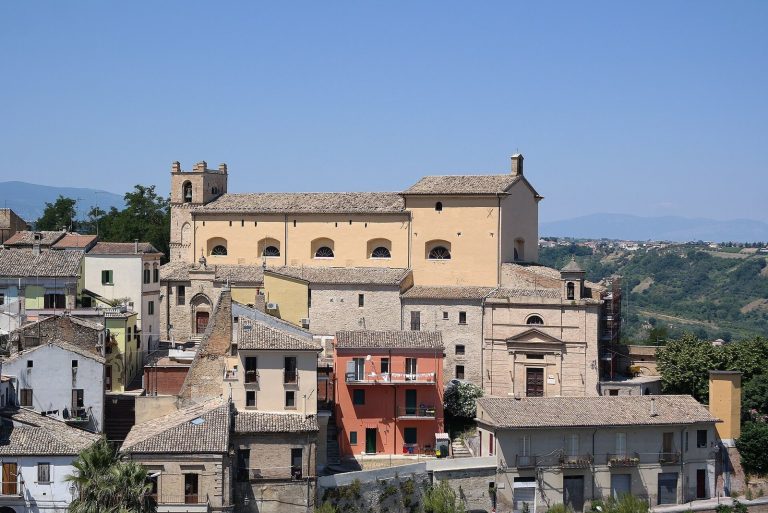
The church and former convent occupy part of Lanciano Vecchio. The complex brings together a squared-stone Gothic façade, a convent cloister with a portico and well, and a church interior arranged around a single nave. The adjoining chapel of Saints Simon and Jude has its own entrance from Via dei Frentani as well as access from inside the church.
Exterior and convent
Façade and portal
The rectangular façade is built of squared stone blocks. Its entrance has a shallow angled opening, with a change in profile between the inner and outer door frames. Paired small columns, each divided into two parts by a central knot, rise from projecting lions. The curved area above the doorway, called a lunette, holds a Madonna and Child sculpture. A fresco once decorated the lunette, and some of its inscriptions remain partly legible. The figures’ drapery, faces and proportions support the sculpture’s attribution to Petrini. The Virgin turns her hip to the right; the Child grasps her hair with one hand and rests the other on her breast.
Above the portal, a circular rose window has a leafy frame related in design to the ornament over the lunette. Its upper section rises to a point, with an eagle spread across the space above the traditional lion supports. A shield-shaped plaque, four lateral crosses made from five glazed ceramic bowls each, a fleur-de-lis and another eagle complete the façade’s recorded decoration.
Bell tower
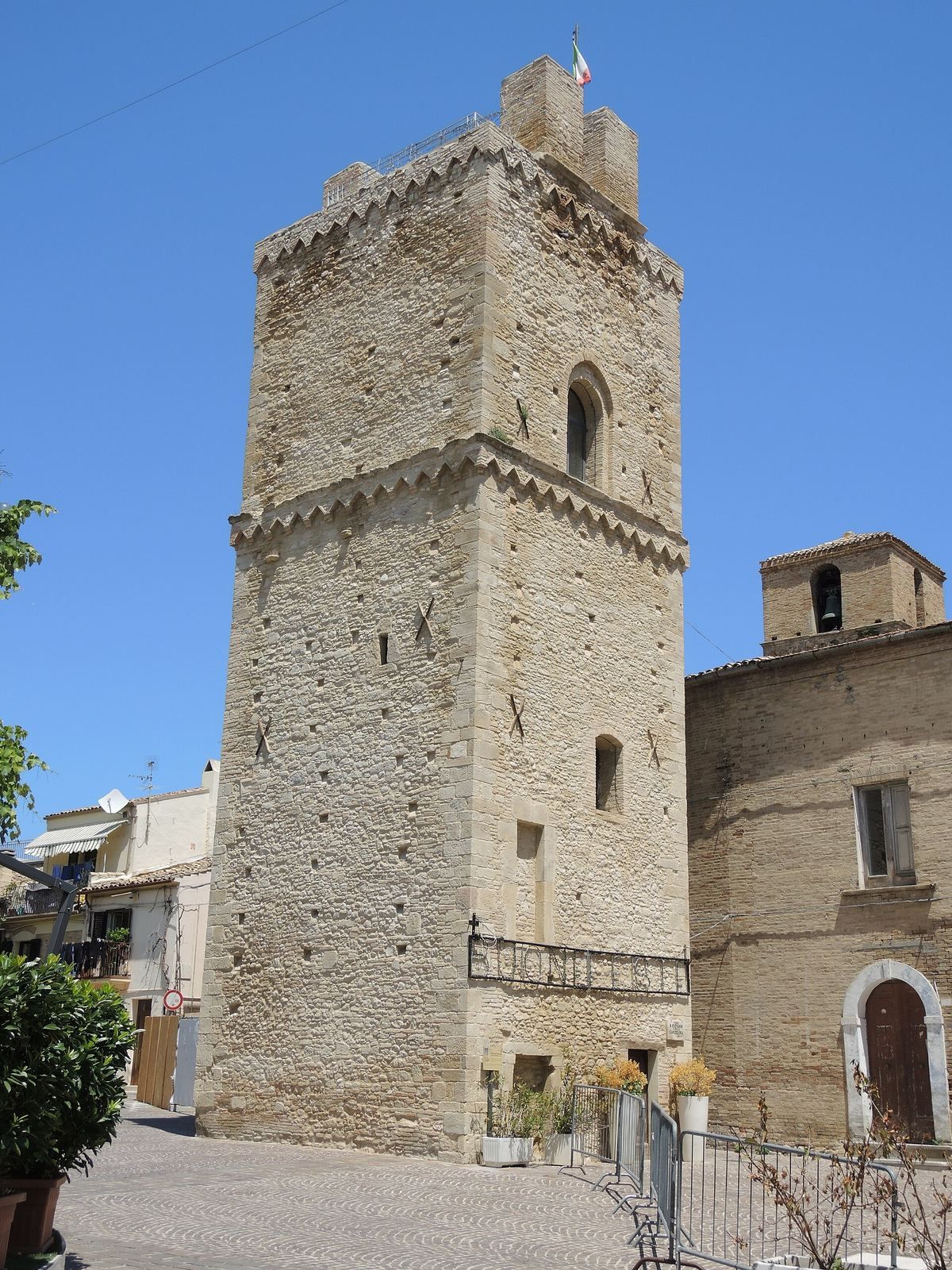
The fifteenth-century bell tower, built in yellow stone, has three levels divided by projecting cornices. On the side facing the cloister, the lower level has paired Gothic windows, while the middle level has pointed single openings. Round-arched windows mark the bell chamber, whose construction is later than the tower’s medieval portions.
Cloister
The former convent retains an internal cloister with a portico and a well. An inscription on the well records construction work in 1313.
Church interior
Nave and side chapels
The medieval interior has been replaced by Baroque forms. A single nave is covered by cross vaults, formed by intersecting vaulted sections, and flanked by three chapels on each side. The central cross vault has decorated bands enclosing frescoes of episodes from the life of Saint Augustine. Eighteenth-century stucco ornament includes geometric designs around the side-chapel cornices and two winged, trumpet-playing child figures beside a chapel arch.
The side chapels contain statues of Saint Gabriel of Our Lady of Sorrows, Saint Anthony of Padua and Saint Rita of Cascia. A statue of Saint Augustine by Domenico Renzetti was replaced by a more modest one; Renzetti’s sculpture is preserved in the diocesan museum.
High altar
Bernardino Altobello gilded the monumental high altar in 1602. Its wooden tabernacle has columns with classical ornament and three compartments for paintings, with a larger opening in the centre. The three-part altarpiece has projecting fluted columns and a crowning cornice. Its central painting shows the Madonna in Glory with angels and Saints Augustine, Michael the Archangel and Apollonia, and may be by Felice Ciccarelli of Atessa. Large paintings of Saint Augustine and Saint Apollonia flank it. Four smaller panels depict saints, including Francis of Assisi, Francis of Paola and Francis Caracciolo.
Chapel of Saints Simon and Jude
Structure and decoration
The adjoining chapel has a four-sided exterior and a circular central interior. Its exterior dome has no vertical supporting drum and ends in a cone; a small bell tower stands beside it. Following a 1955 restoration, stucco and frescoes covered the dome’s interior. The stucco work and the curved triangular surfaces supporting the dome, called pendentives, are attributed to Giovan Battista Gianni.
Relics and devotional works
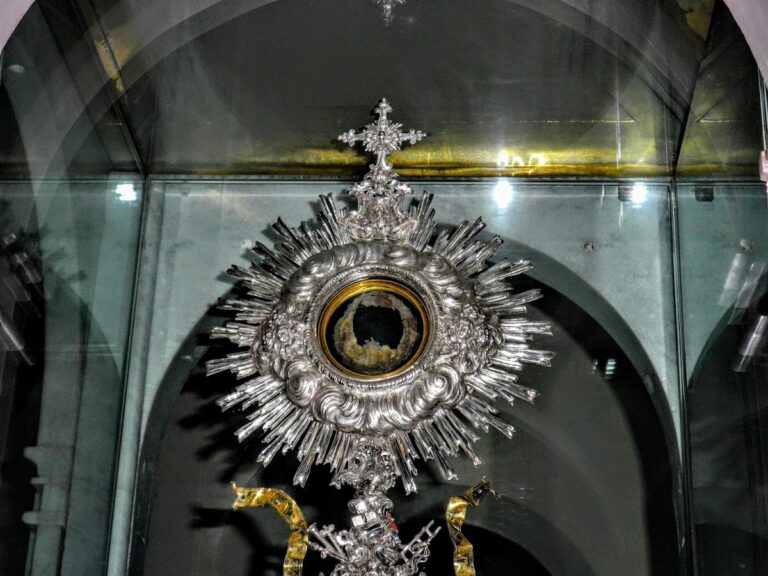
A reliquary made in 1955 holds relics of Saints Simon and Jude Thaddeus, including relics described as a head and an arm. A plaque inside the chapel recalls the relic tradition and the Doge’s later permission for the relics to remain in Lanciano. Another plaque, dating to the sixteenth century, stands to the left of the chapel entrance and records an agreement between Francesco Foscari and Lanciano’s civic community concerning the relics’ placement at the Augustinian monastery.
The chapel also contains Giacomo Colombo’s 1707 statue of the Madonna della Cintura and banners belonging to the local confraternities of the Madonna dei Raccomandati and Saints Simon and Jude. A wooden statue of the Risen Christ, known as the Most Holy Savior, and a statue of Saint John the Evangelist are used in Easter processions. Other features include a worked-bronze wall relief of the Last Supper and a niche above it showing Christ with the crown of thorns, looking toward his Father.