Mont Orgueil: Jersey’s Medieval Fortress
Site at a Glance
- Country
- Jersey
- Primary era
- Medieval
- Eras represented
- Iron Age, Medieval, Early Modern, Modern
- Civilizations
- Celtic, English, German
- Site type
- Military
- Remains
- Castle
On this page22 sections
History
Mont Orgueil is a castle on Jersey, begun after the loss of Normandy in 1204 to strengthen the defence of the Channel Islands. Requested by King John, it was built by Pierre de Préaux and Renaud III de Carteret. Construction is broadly dated to 1204–1450, and the castle was first recorded in 1212. In the medieval period, it became Jersey’s principal fortress and the seat of royal authority.
Origins and royal rule
The Channel Islands became part of the Duchy of Normandy in 933. After the French conquest of mainland Normandy in 1202–1204, the islands remained under the English Crown. The Treaty of Paris in 1259 settled the competing claims: the French king renounced claims to the islands, while the English king gave up claims to mainland Normandy. Jersey was governed by officers including a warden, who represented the English king, and a bailiff, a senior local judicial and administrative officer. The island was never formally incorporated into England.
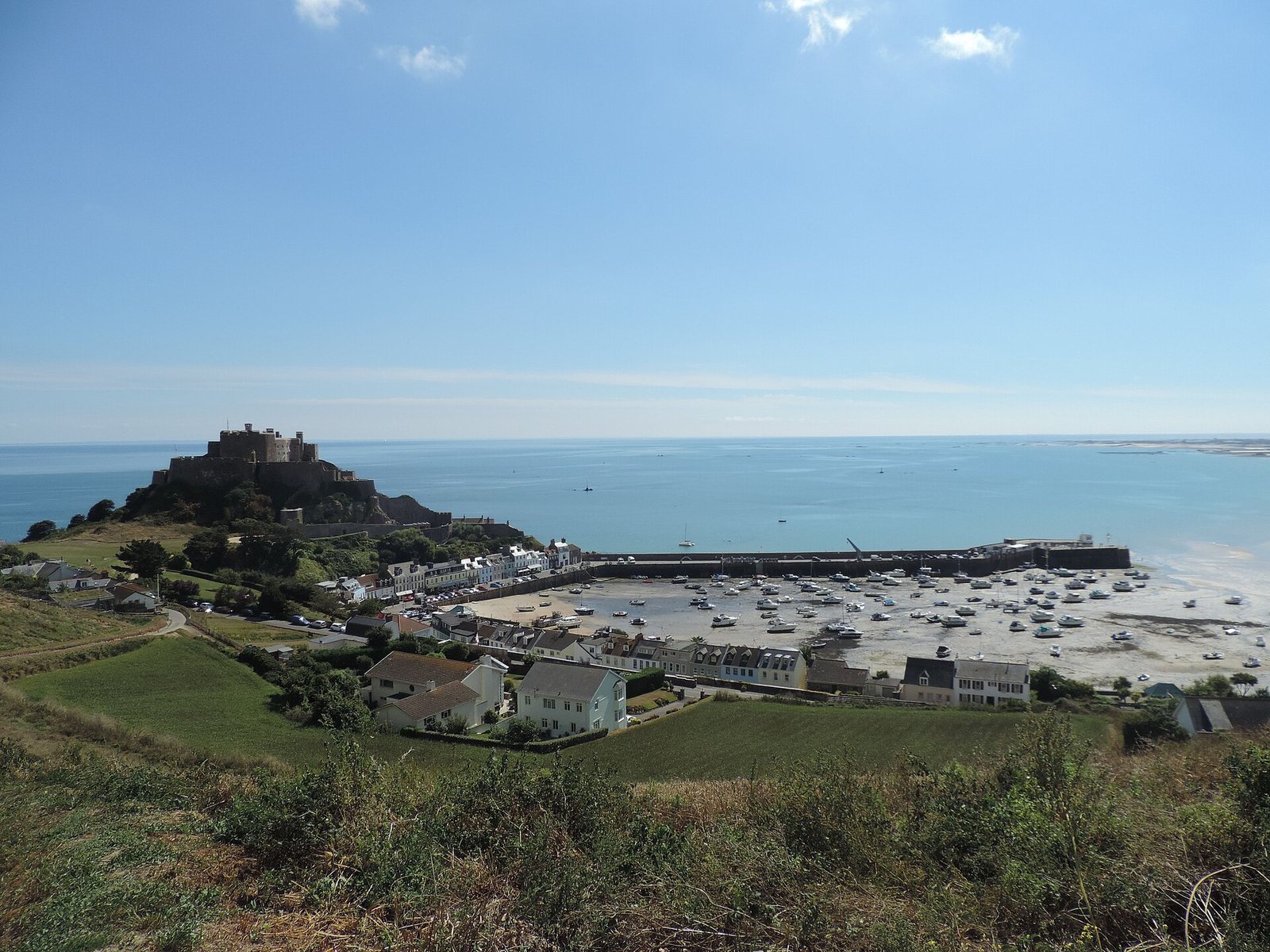
Mont Orgueil guarded Jersey’s eastern coast and Gorey harbour, an important point for landing and communication with the mainland. The harbour had been used in Roman times, although the islands received limited Roman attention. English speakers also called the castle Gorey Castle. The French form Mont Orgueil was recorded in 1462, during French occupation, while speakers of Jèrriais, Jersey’s traditional Norman language, called it the Old Castle. That name also distinguished it from the later Elizabeth Castle.
French assaults and changing control
French forces attacked Jersey in 1338, during the Hundred Years’ War, a series of conflicts between England and France traditionally dated from 1337 to 1453. After ravaging the island, they besieged Mont Orgueil for about six months. Governor Drew de Barentin was killed and replaced by Renaud V de Carteret, but the castle held out. In 1339, another French force, led by Robert Bertrand and Nicolas Hélie, failed to capture it despite a renewed assault. Walter de Weston commanded its defence.
In 1373, the French commander Bertrand du Guesclin brought about 2,000 men against the castle. They broke through the outer walls but could not overcome its inner defences. Further French sieges in 1380, 1403, 1406 and 1454 also failed.
During the Wars of the Roses, the dynastic struggle between the houses of Lancaster and York, French forces led by Pierre de Brézé captured the castle in May 1461, apparently without fighting. The circumstances are uncertain. The capture may have involved treachery within the garrison and political dealings between Margaret of Anjou and Sir John Nanfan, Warden of the Isles. French supporters held the castle and eastern Jersey, while English forces controlled the west.
In 1468, Richard Harliston and Philippe de Carteret led English and Jersey forces in a 19-week siege that recovered the castle. The French garrison could no longer receive supplies by sea, and its occupation had lasted about seven years.
Artillery and the loss of military primacy
The growing effectiveness of artillery led to major changes in the castle’s defences during the sixteenth century. In 1543, Henry Cornish, lieutenant to the Earl of Hertford, sought medium-sized saker cannon to cover the shore between Grovyll and the castle, where French forces had previously landed. He also judged earlier repairs to the main tower, undertaken by Robert Raymont, inadequate against contemporary firearms. Platforms were built in 1548 and 1549, as further defensive work reshaped the stronghold.
Mont Orgueil remained Jersey’s principal fortress until Elizabeth Castle was built at St Helier in 1594. The new fortification better suited larger ships drawing more water and had a harbour that could be used at low tide. Gorey harbour was shallow, accessible to larger vessels only briefly around high tide, and its breakwaters had deteriorated. The castle was also exposed to artillery on the higher ground of nearby Mont St Nicolas, reducing its military value.
In 1600, Jersey’s governor Walter Raleigh rejected a proposal to demolish the castle and reuse its stone for new fortifications. He argued that Mont Orgueil should remain as a second line of defence.
Prison and civil war
During the seventeenth century, Mont Orgueil served as Jersey’s only prison and was used by the English government to isolate political detainees. Jersey law differed from English common law and did not prohibit arbitrary detention in the same way. Among the prisoners were William Prynne, a political and religious writer, and John Lilburne, an activist associated with the Levellers. Prynne arrived from Caernarfon Castle in 1637 and was treated well by Governor Sir Philippe de Carteret. The Long Parliament, convened in 1640, ordered his release that year; Prynne later defended de Carteret in 1645.
In 1640, George Carteret married his cousin Elizabeth de Carteret in the castle chapel. She was the daughter of Philippe II de Carteret, third Seigneur of Sark.
Jersey supported the Royalists during the English Civil War, fought between supporters of the king and Parliament. While Sir Philippe de Carteret held Elizabeth Castle for the king, his wife Anne and their son Philippe occupied Mont Orgueil. In November 1643, Royalists under Sir George Carteret used the castle as a base to recover the island from Parliamentarian forces. The Dean of Jersey, David Bandinel, and his son Jacques were imprisoned for opposing the Royalist cause. In February 1645, they tried to escape through a seaward window on a rope. It failed, and both fell to their deaths on the rocks below.
In December 1651, Colonel James Heane’s New Model Army, Parliament’s reorganized professional force, invaded Jersey. After defeating the island militia at St Ouen’s Bay, the army threatened to besiege Mont Orgueil. The castle surrendered on terms that allowed its occupants to go to Elizabeth Castle.
In 1661, five men who had signed Charles I’s death warrant were transferred to Mont Orgueil: Thomas Waite, Henry Smith, James Temple, Hardress Waller and Gilbert Millington. Waller and Millington had initially been sentenced to death, but their sentences were changed to life imprisonment. Millington died at the castle on 19 September 1666, and Waller also died there in 1666. Smith arrived from the Tower of London in 1664 and is believed to have died at Mont Orgueil in 1668. Temple was later moved to Elizabeth Castle, where he reportedly died in 1680. Waite was buried in St Saviour in 1688.
Decline, reuse and heritage
An assessment in 1691 found the barracks too dilapidated to house a garrison. By 1693 the castle was considered ruinous, and both the garrison and the prison were withdrawn. Repairs began in 1730 and continued through 1734, with further work at intervals later in the eighteenth century.
In 1800, British naval officer Philippe d’Auvergne directed La Correspondance, a spy network intended to destabilise the French Revolutionary government in Brittany and Normandy. One scheme involved importing forged French assignat notes, paper currency issued during the French Revolution, and contributed to hyperinflation in France until 1802. Troop detachments were also housed at Mont Orgueil during the nineteenth century. The castle opened to the public on Easter Monday in that century, a practice that may have continued an older custom of visiting St George’s Chapel on St George’s Day.
On 28 June 1907, the Crown transferred Mont Orgueil to the people of Jersey, and the castle became a museum site in 1929. During the German occupation of the Channel Islands in the Second World War, it was again used for military purposes. German forces expanded their presence from 1941, when the castle’s keeper and his family were displaced. The occupation ended after a period of extensive military use, including the establishment of a battalion headquarters inside the castle in July 1944.
Jersey Heritage Trust took over management in 1994, when Mont Orgueil was declared an island heritage monument. It is also Grade I listed, a top-tier heritage designation.
Remains
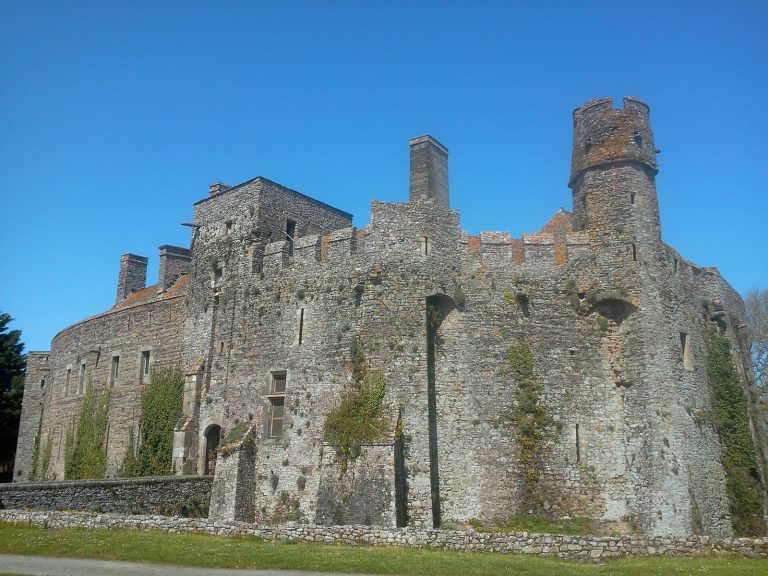
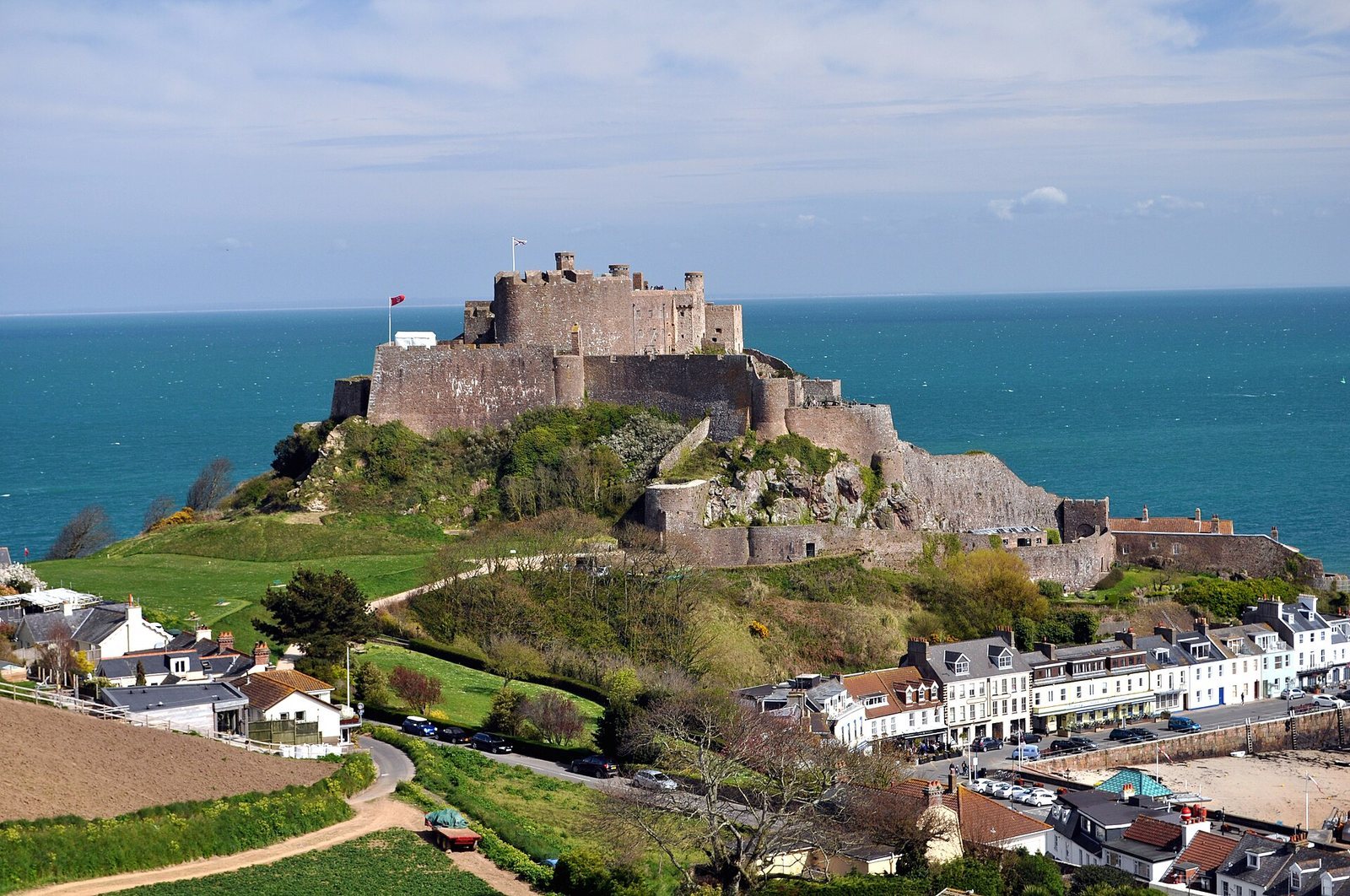
Mont Orgueil occupies a granite rock at the southeast end of St Martin parish, overlooking Gorey harbour and the wide bay of Grouville. High ground and cliffs form part of its natural defences, while the rock supports the castle’s inner walls. Its layout includes a series of enclosures, chapels, towers and later artillery works, built and altered across several centuries.
Prehistoric remains and early chapels
Earthworks and finds
At the top of the rock, excavations revealed an Iron Age raised earthwork used as a defensive barrier. A wall of Iron Age date, identified as Gallic, stands in the intermediate courtyard. Finds from the site include Neolithic pottery and arrowheads dated to 4000–2500 BC. The Neolithic was a later Stone Age period associated with farming and settled communities; the Iron Age was when iron tools and weapons became widespread.
St Mary’s and St George’s Chapels
St Mary’s Chapel and St George’s Chapel predate the twelfth century. Both were retained during the castle’s fourteenth-century rebuilding, linking the earlier religious buildings with the later fortified complex.
Medieval defensive layout
Enclosures and entrance
In the fourteenth century, the main castle stood above an outer enclosure and an intermediate courtyard containing St George’s Chapel. A gatehouse opened onto the intermediate enclosure. The approach ramp was watched by St George’s Tower and a projecting defensive work with openings used to protect the base of the wall. A lower enclosed courtyard stood in front of this group. A large tower was erected at the entrance in 1470 and later became known by Harliston’s name.
Rochefort Tower
Rochefort Tower was built on the northeast side between 1328 and 1330. The inner walls were founded directly on solid granite, tying the defensive structure to the rocky base of the castle.
Artillery defences
The Keep and Grand Battery
The Keep, the castle’s principal fortified tower, was extended in 1551 into a D-shaped projecting defence and strengthened against artillery. Around 1560, a large artillery position called the Grand Battery was added facing west.
Cannon platforms and wall defences
Platforms for cannon were built in 1548 and 1549 under Henry Cornish. Other mid-sixteenth-century changes included lower openings in the parapets through which guns could fire, and wider wall walks for movement along the defences.
Later adaptations
Garrison accommodation
Parts of the castle were adapted for soldiers. In 1770, officers and men occupied rooms in the Keep, while St Mary’s Chapel was fitted out as barracks for 60 soldiers, with bedsteads and other fixtures.
Corbelled Tower
In 1800, the Corbelled Tower was fitted out as Philippe d’Auvergne’s headquarters. Its name refers to masonry built in projecting courses to support the structure above.
German military works
German wartime installations were incorporated into the castle’s existing fabric. Range-finding positions were disguised to resemble medieval features and evade Allied reconnaissance. A makeshift bunker was constructed inside the castle in 1944.
Gorey harbour
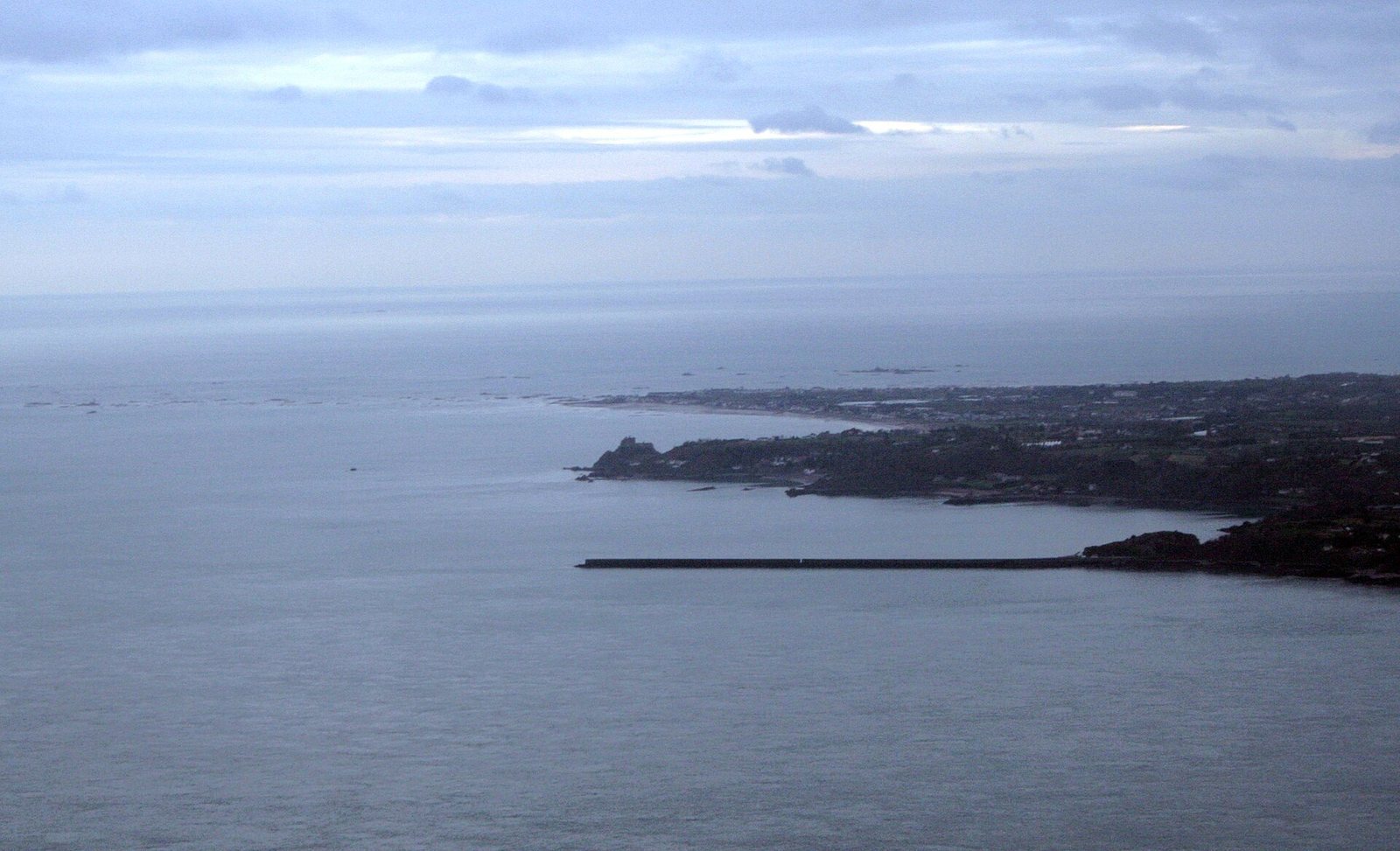
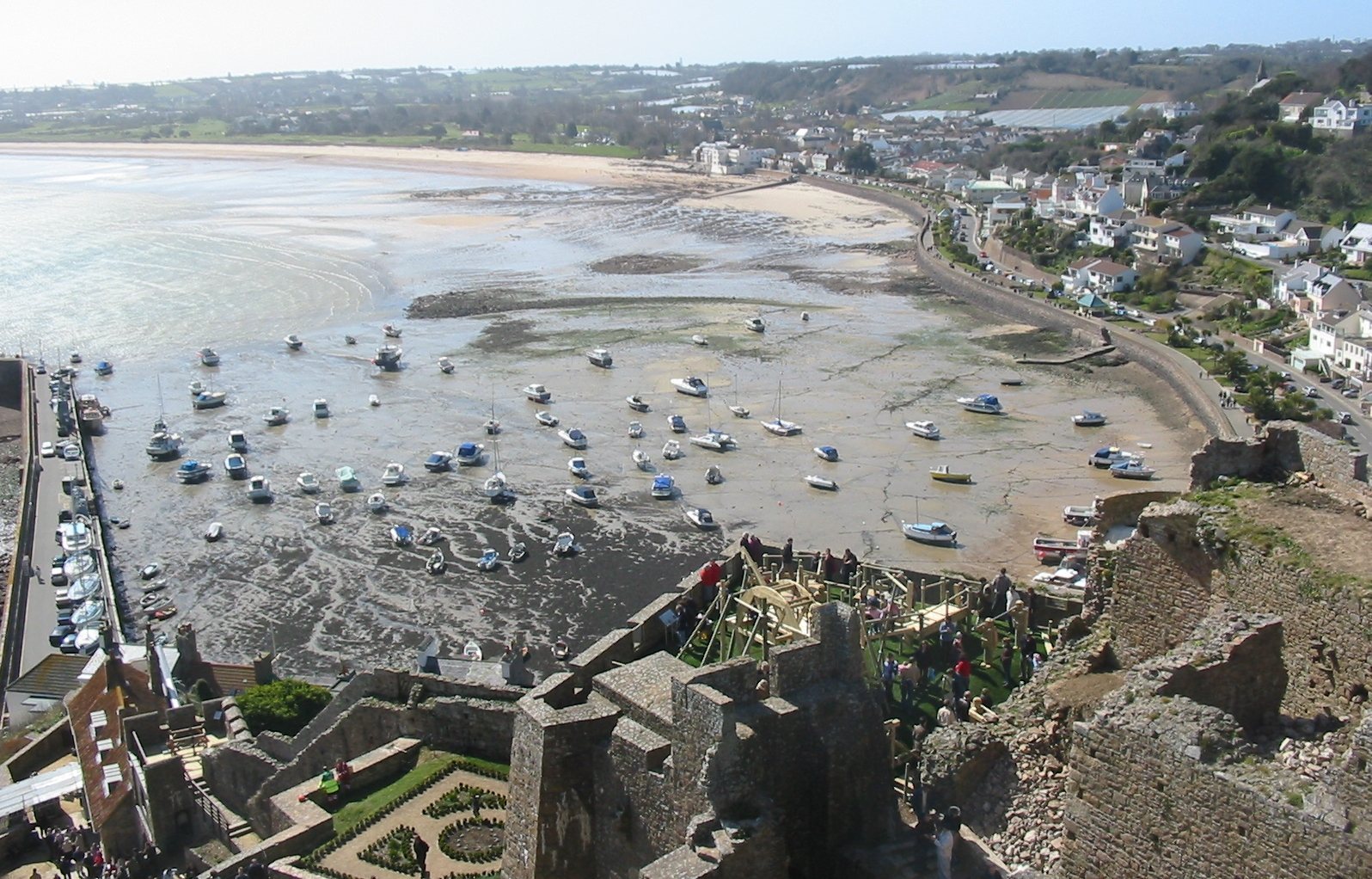
Breakwaters formed the harbour below the castle, and part of the original structures survives. The harbour remains shallow, so at low tide vessels can be left grounded or in shallow water. It is now used by small fishing vessels, motorboats and yachts.
Royal inscriptions and restoration
Inscriptions at the castle commemorate visits by Queen Victoria and Prince Albert in 1846, George V in 1921, and Elizabeth II. Later restoration added weatherproof enclosures to parts of the structure, opened previously inaccessible areas and introduced artistic interventions within the grounds and castle fabric.