St. Paul’s Bay Tower: A Coastal Fortification in Malta
Site at a Glance
- Country
- Malta
- Primary era
- Early Modern
- Eras represented
- Early Modern, Modern
- Civilizations
- British, Knights Hospitaller
- Site type
- Military
- Remains
- Tower
On this page7 sections
History
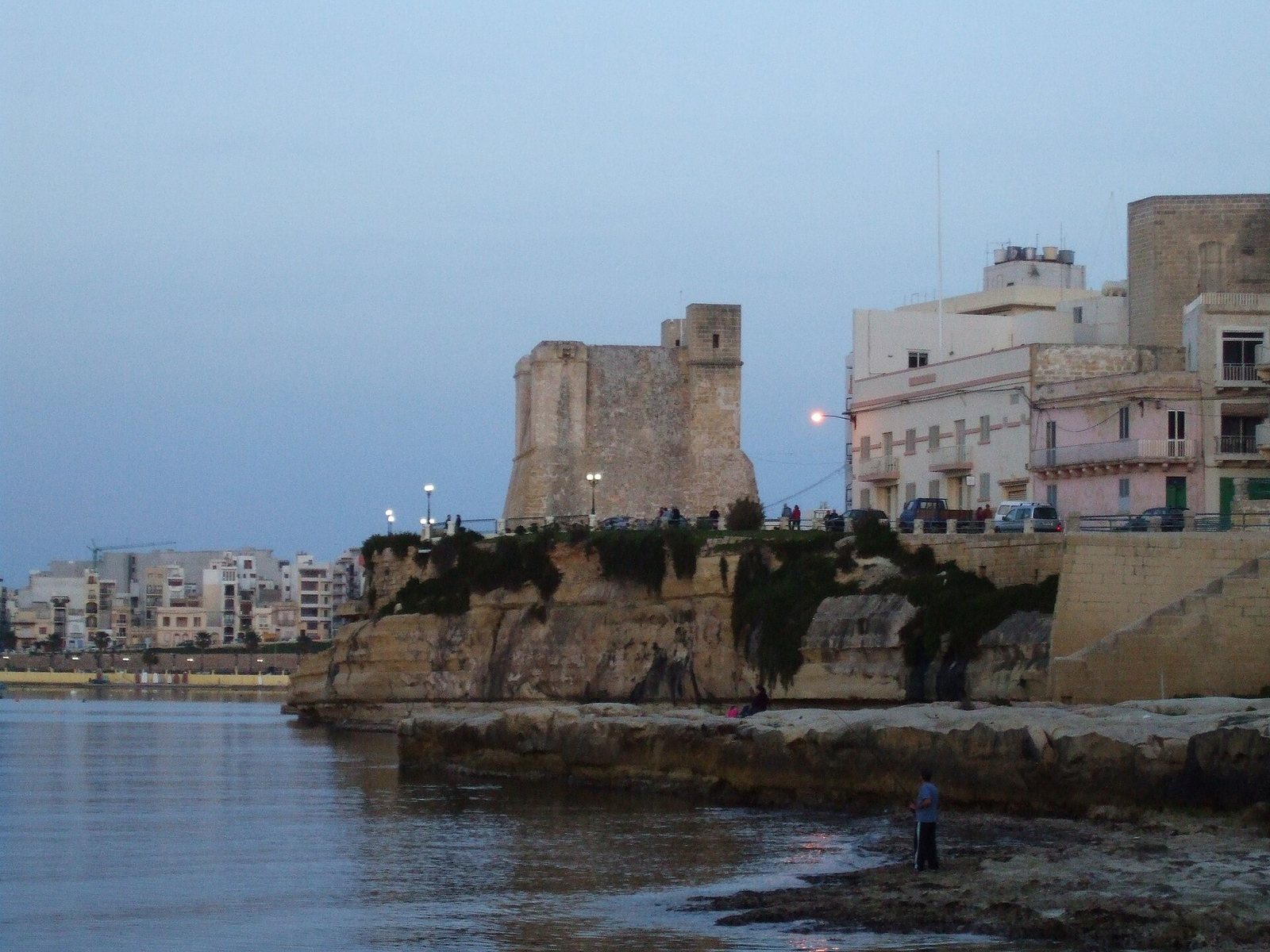
St. Paul’s Bay Tower is a coastal fortification in Malta, built by the Order of Saint John in 1610 to defend the bay. It became the first of six coastal towers initiated by Grand Master Alof de Wignacourt, the order’s senior leader, and remains Malta’s oldest surviving watchtower.
Construction and coastal defense
By the late sixteenth century, Malta’s harbor area had extensive defenses, while much of the rest of the islands remained exposed to attacks by Ottoman forces and Barbary corsairs, maritime raiders operating from the North African coast. Grand Master Martin Garzez had funded Garzes Tower on Gozo; Wignacourt, his successor, personally financed six coastal towers built between 1610 and 1620. St. Paul’s Bay Tower was the second tower built in the Maltese islands, after Garzes Tower, and the first on Malta’s main island. It took over the defensive role of Ta’ Tabibu farmhouse, previously called Dejma Tower.
The Order’s council considered plans and a model on 7 November 1609. Wignacourt attended the ceremony at which the first stone was blessed and laid on 10 February 1610. Construction cost 6,748 scudi, 7 tari and 10 grani, denominations of Malta’s historical currency. The design has been credited to Maltese architect and military engineer Vittorio Cassar, but he died around June 1609, before construction began. An unidentified Maltese master builder was probably responsible. Garzes Tower was demolished in 1848, leaving St. Paul’s Bay Tower the oldest surviving watchtower in Malta.
The tower remained northern Malta’s only major fortification until Saint Agatha’s Tower was built in 1649. Qawra Tower, built in 1638, Buġibba Battery, built in 1715, and Mistra Battery, built in 1761, were within its line of sight.
Later use and preservation
After Malta came under British rule, the tower served as a police station. A postal agency operated there from 1891 to 1921, using a postmark reading “St. Paul’s Bay.” The police station closed in 1931, and the Post and Telephone Department occupied the building from 1937 to 1963.
Din l-Art Ħelwa, a heritage organization, took responsibility for the tower under a government lease in 1970. Restoration took place from 1973 to 1976, followed by further restoration and cleaning in 2015. Since 1998, the tower has housed a museum about the fortifications of the Maltese islands.
Remains
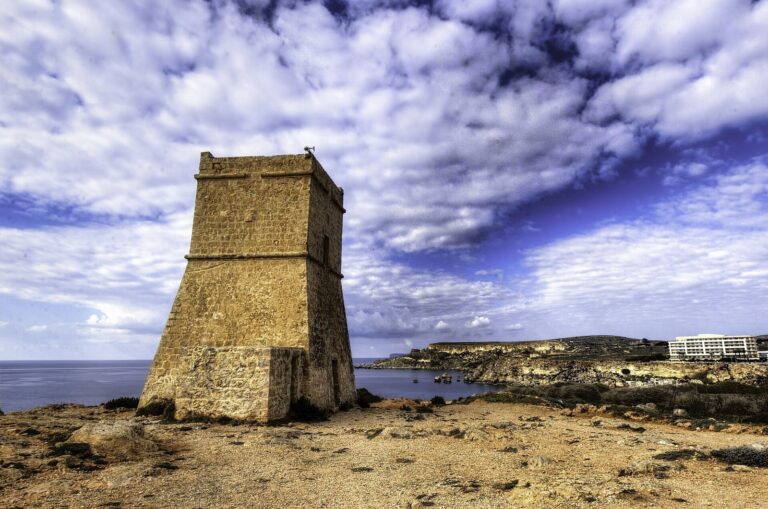
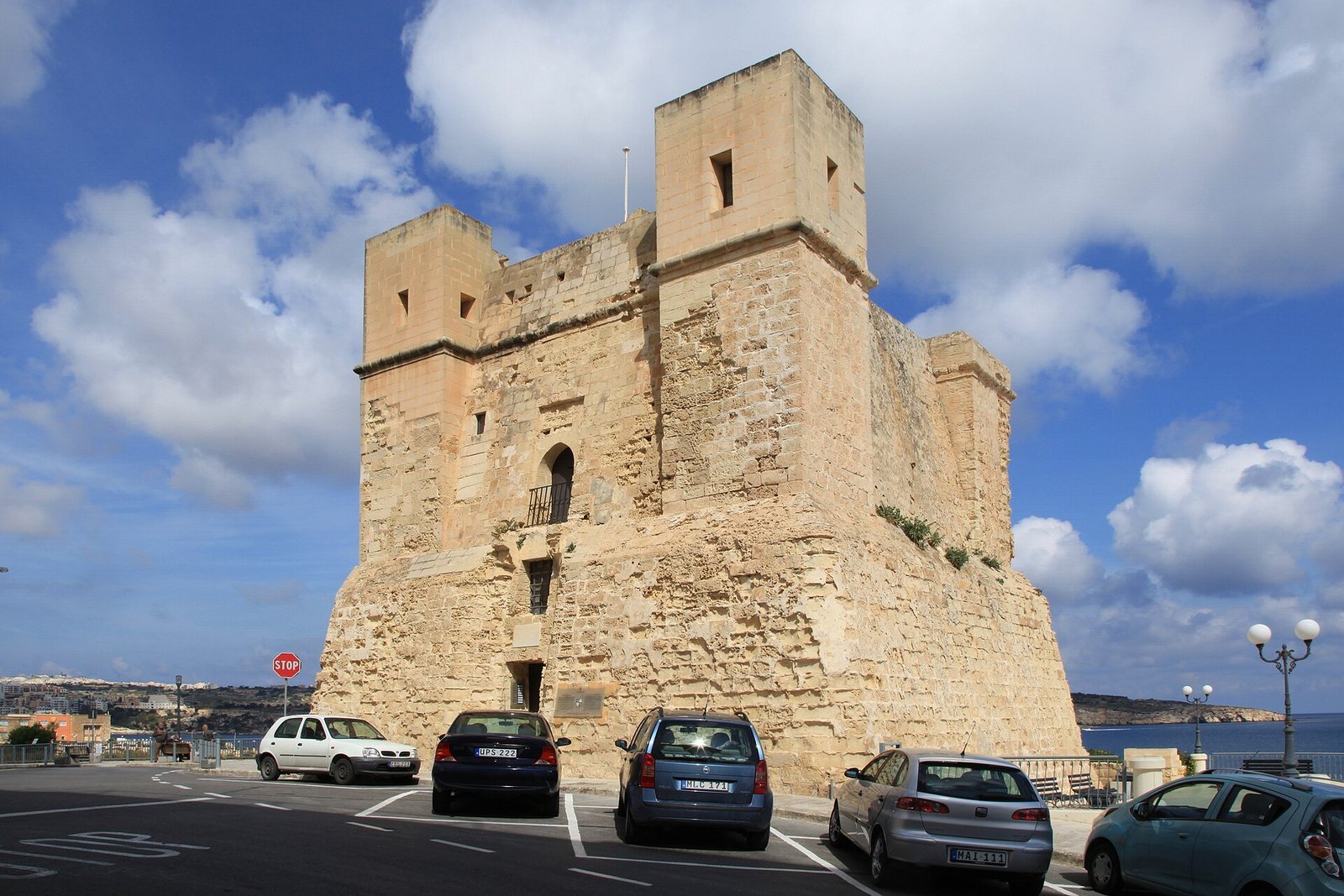
Built of limestone, the intact tower covers 196 square metres and has a square plan, two storeys and a flat roof. Four corner turrets are shaped as false bastions, imitations of bastions (projecting parts of a fortification); their narrow sides and the aligned bases of the walls shape the tower’s outline. Two turrets rise higher and served as observation and guard posts. The design was based on Garzes Tower.
Interior and entrance
Each storey contains barrel-vaulted rooms, which have continuous arched ceilings. The windowless lower floor served as a covered storeroom, while the upper floor, with recessed windows, accommodated the garrison. An internal staircase connects the two levels and leads to the roof, where a low parapet (a protective wall along the edge) borders the area from which cannons formed the tower’s main armament. The original first-floor entrance was reached by stone steps and a drawbridge. The steps were removed in the 1950s when the road in front of the tower was widened, and an entrance was added at ground level. The drawbridge wheel, main entrance door and its key survive.
Artillery and restored features
A coastal artillery battery, a position for guns, was added in 1715 and designed to hold two 18-pounder guns, each named for the weight of its shot. Around 1761, buttresses, supports built against walls, were added to reinforce the tower’s lower half. The corner turrets were rebuilt during the 1973–76 restoration. Above the ground-floor entrance, a marble plaque credits Wignacourt with building the tower in 1610 and Din l-Art Ħelwa with its restoration in 1975, marking European Architectural Heritage Year.
Museum displays
The museum presents models of fortifications across the Maltese islands, reproductions of objects used by the tower’s occupants in the seventeenth and eighteenth centuries, old photographs and a restored cannon.