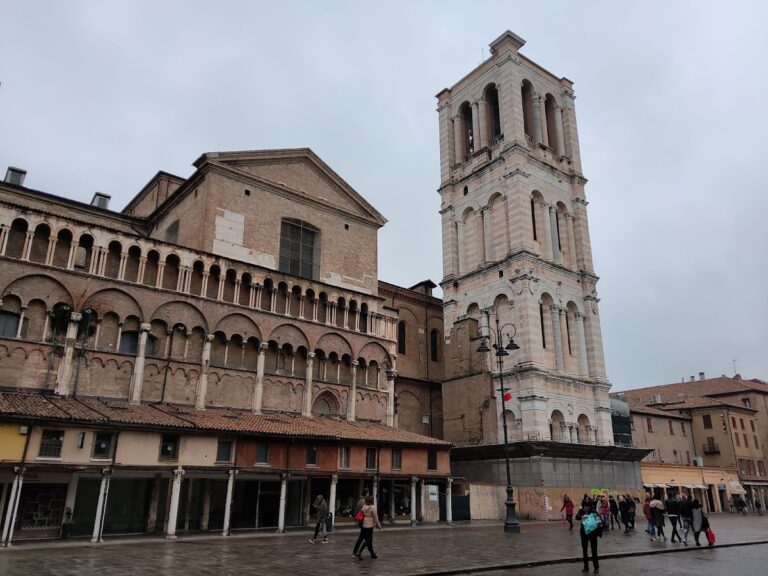
San Francesco: A Franciscan Basilica in Ferrara
Site at a Glance
- Country
- Italy
- Primary era
- Medieval
- Eras represented
- Medieval, Early Modern
- Civilizations
- Duchy of Ferrara, Papal States
- Site type
- Religious
- Remains
- Church
On this page15 sections
History
San Francesco in Ferrara, Italy, is a Roman Catholic church of the Franciscan order, the religious movement formed by followers of St Francis of Assisi. Its present Gothic layout dates to 1341-1344, and it underwent a Renaissance reconstruction in 1494. The church also served as a burial place for members of the ruling House of Este.
Franciscan foundation and Este burials
A small Franciscan church and monastery had been established by 1232, before work began on a larger church. The complex served as an Este family mausoleum until the early 15th century, when Niccolò III d’Este chose to build the church of Santa Maria degli Angeli. Este burials nevertheless continued at San Francesco. Those buried there included Ferrara’s rulers Obizzo II and Obizzo III, Ugo II, and Parisina Malatesta, Niccolò III’s second wife.
The Este tomb known as the Arca Rossa held rulers from Marchese Azzo IX through Alberto III and their wives. Costanza, the wife of Malatesta, was buried there in 1392. The last burial was Niccolò di Leonello, known as Véla, who was beheaded in 1476 after invading the duchy during Ercole I d’Este’s rule.
Renaissance rebuilding and earthquake damage
In 1494, Ercole I d’Este sponsored a Renaissance reconstruction as part of the Erculean Addition, Ferrara’s urban expansion under his rule. This rebuilding transformed the existing church rather than establishing a new foundation.
An earthquake in 1570 destroyed the roof and brought down part of the façade. The damaged façade was subsequently rebuilt.
Memorials, art, and later history
A cenotaph, a memorial that does not necessarily contain the person’s remains, commemorates the Ferrarese commander Ghiron Francesco Villa. He led Venetian forces in the unsuccessful defense of Candia against Ottoman armies in 1668; his memorial dates to 1671.
A city guide from 1773 described the church’s artworks before religious houses were suppressed during the Napoleonic era. By 1835, the best paintings had been transferred to Ferrara’s municipal picture gallery, and a guide reported that the church’s foundations were in poor condition. Two paintings by Benvenuto Tisi, known as Garofalo, were moved to the civic museum in 1864. During the 20th century, much of the church’s art was transferred to the Ferrara Picture Gallery and replaced with copies.
Pope Pius XII granted the church the title of minor basilica in December 1956. It forms part of Ferrara’s World Heritage Site, inscribed in 1995. The 2012 Emilia earthquake left most of the interior unusable for an extended period, and restoration work followed.
Remains
Plan and exterior
Church plan and façade
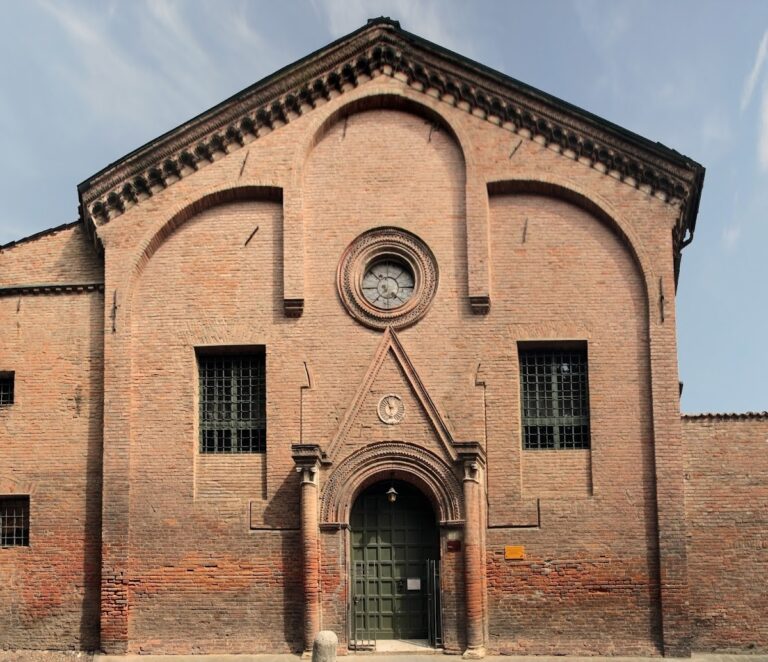
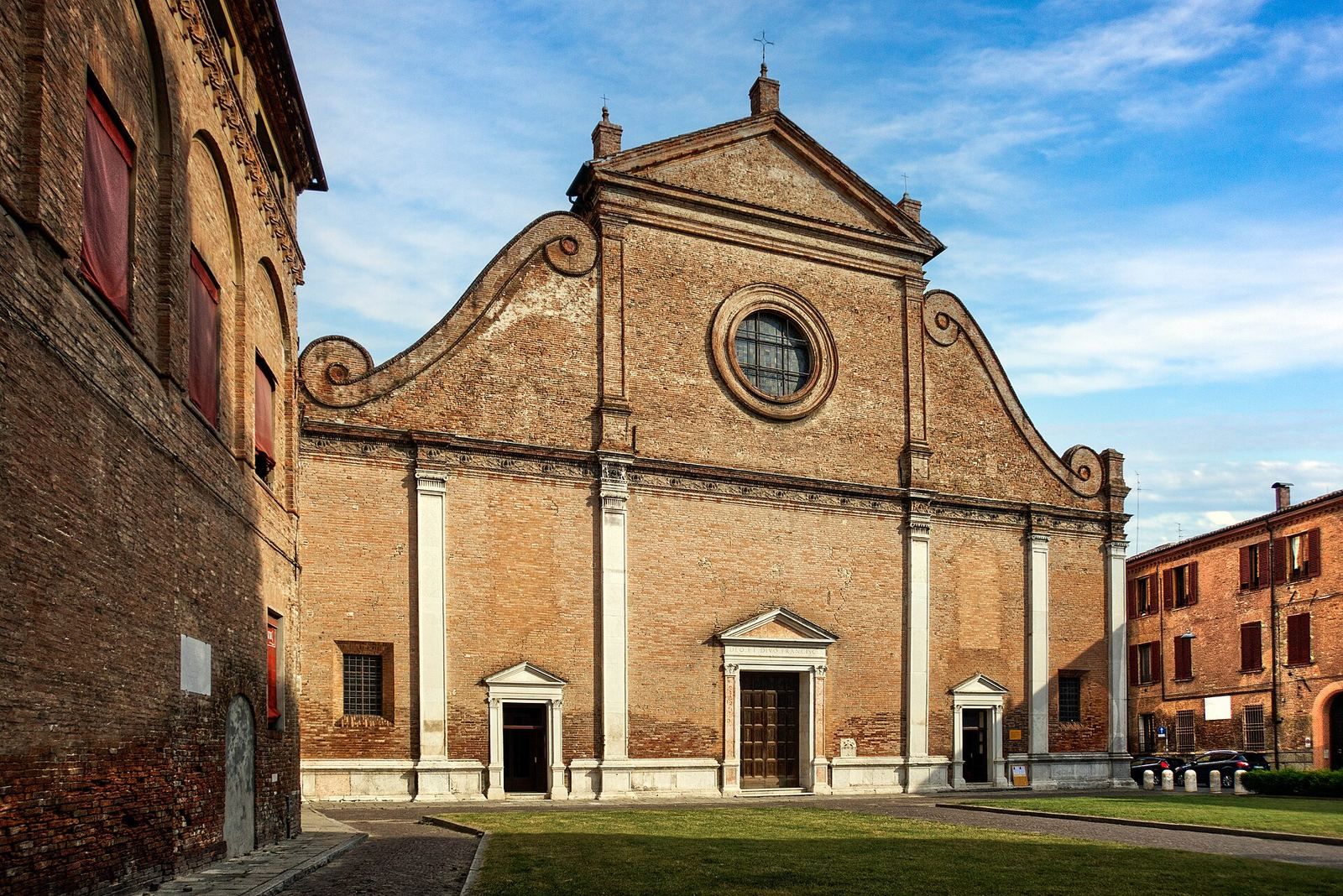
The church has a three-aisled interior arranged in a Latin-cross plan, shaped like a cross, with eight chapels along each side. Brick forms the façade and main body. The Renaissance façade combines marble pilasters with curved, scroll-shaped ornaments inspired by the work of Leon Battista Alberti. Niches in the front hold statues of St Francis and St Anthony by Antonio Magni. Giuseppe Filippi painted frescoes in the nave and on the inner face of the entrance façade.
Convent chamber
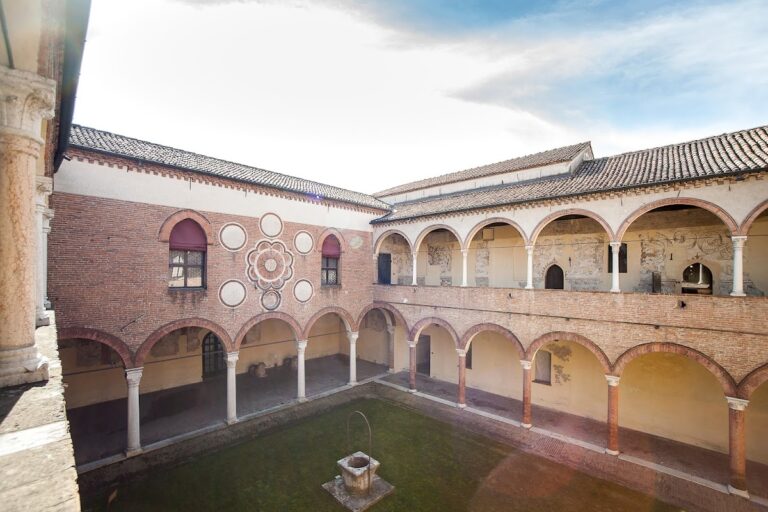
A windowless room in the adjacent convent, near the street, was reputed to have housed St Anthony of Padua and St Bernardino of Siena. The room was also used to imprison Este family members who rebelled. Bernardino preached in Ferrara against vanity and excessively long dress trains before leaving after his appointment as bishop of Ferrara.
Chapels, cross arms, and memorials
First chapel on the left
This chapel contains Garofalo’s 1524 fresco of the Capture of Christ, accompanied by two monochrome prophets. A terracotta altarpiece depicts Christ in Gethsemane and is attributed to Cristoforo Borgognoni and Battista Rizzi. Garofalo also painted portraits of the patrons, Francesco Massa da Argenta and his wife.
Left cross arm
A fifth-century stone coffin, or sarcophagus, of Ravenna origin stands in the left cross arm. The Ariosti family later reused it, and their heraldic devices appear at its base. On the front, Christ blesses with an open book, while six apostles stand in shell-shaped niches separated by columns.
Red-marble tomb
The Arca Rossa is a red-marble tomb associated with Este burials. Its physical form preserves the connection between the church and the family’s burial history.
Right cross arm
Villa’s Baroque memorial shows him kneeling in prayer, with carved reliefs representing his military deeds and a statue of him by Emanuel Tesauro. Two paintings from the convent refectory are also in this part of the church: Moses Brings Water from the Rock of Mount Horeb and The Marriage at Cana, attributed to Jan van Beyghem, also called Giovanni Vangembes.
Eighth chapel on the right
Dedicated to St Anthony of Padua, this chapel contains a copy of a fresco from the Basilica of Padua and two paintings of the saint’s miracles by Carlo Bononi. Another painting is by a Flemish artist; Jan van Beyghem’s Miracle of the Mule is among the works associated with the church.
Choir and main altar
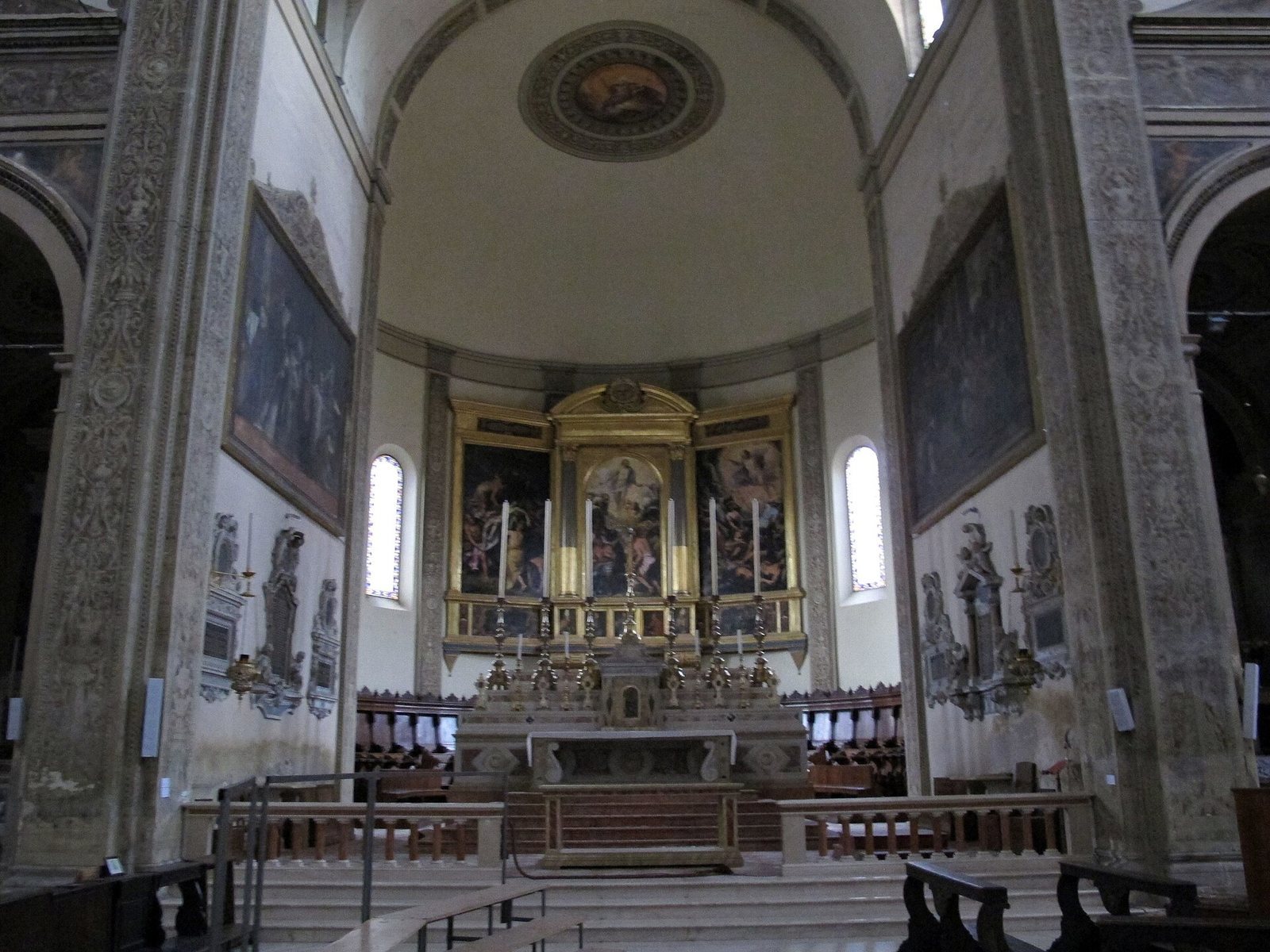
Behind the main altar is a three-panel altarpiece by Domenico Mona, dated 1580-1583, depicting the Resurrection, Ascension, and Deposition. Francesco Ferrari painted the choir ceiling, while Niccolò Roselli added half-length figures of saints beneath the principal canvases. Two paintings beside the altar show the Virgin in the Temple and Christ among the Doctors, and are attributed to Antonio Bonfanti or his brother. The main altar is made of polychrome marble and includes a figure of the Virgin formed from precious stones and bronze, donated by Cardinal Bonifazio Bevilacqua.