Palazzo Beneventano del Bosco: A Baroque and Rococo Palace in Syracuse
Site at a Glance
- Country
- Italy
- Primary era
- Early Modern
- Eras represented
- Medieval, Early Modern
- Civilizations
- Crown of Aragon, Kingdom of Sicily
- Site type
- Domestic
- Remains
- Elite Residence
On this page12 sections
History
Palazzo Beneventano del Bosco is a palace on Ortigia in Syracuse, Italy, first built around 1400 for the Arezzo family and rebuilt in the late eighteenth century as a private residence in Baroque and Rococo styles. Baroque design is richly ornamented, while Rococo is an elaborate but lighter style associated with the eighteenth century. Before its reconstruction, the palace served civic and religious institutions; its later history includes stays by Horatio Nelson and Ferdinand III of Sicily.
The Arezzo palace and religious orders
The Arezzo family’s palace housed Syracuse’s Royal Chamber, a royal judicial and administrative institution, as well as the city Senate. It also accommodated a commandery, the local administrative unit of a religious-military order, associated with the Knights of the Holy Sepulchre, a Catholic order of knighthood linked to Jerusalem.
In 1500, the palace hosted members of the Knights of the Holy Sepulchre during their stay in Syracuse. Afterward, it became the Syracusan seat of a commandery of the Knights of Malta, a Catholic religious order with charitable and military roles. The nobleman Pietro Borgia founded that commandery in the first half of the seventeenth century.
Rebuilding for the Beneventano family
The 1693 earthquake damaged the palace. Baron Guglielmo Beneventano later acquired it and commissioned architect Luciano Alì to rebuild it in the late eighteenth century. The redesign changed the building from a seat of local government into a private residence.
The Beneventanos were an old noble family connected with Syracuse, Modica, and Lentini. Family members held prominent positions and numerous fiefs, lands held in return for obligations of service or allegiance. Their name “del Bosco” came from a large fief between Syracuse and Floridia, where Mediterranean scrubland was once dense.
Naval and royal visitors
British admiral Horatio Nelson stayed at the palace when his fleet called at Syracuse, both before and after defeating the ships of Napoleon Bonaparte, a French military and political leader, off Abukir. Abukir is a coastal area in Egypt near Alexandria.
In 1806, Ferdinand III of Sicily stayed at the palace during a visit to Syracuse. A Bourbon monarch who also ruled Naples as Ferdinand IV, he watched a comedy performed by Syracusans from a balcony.
Remains
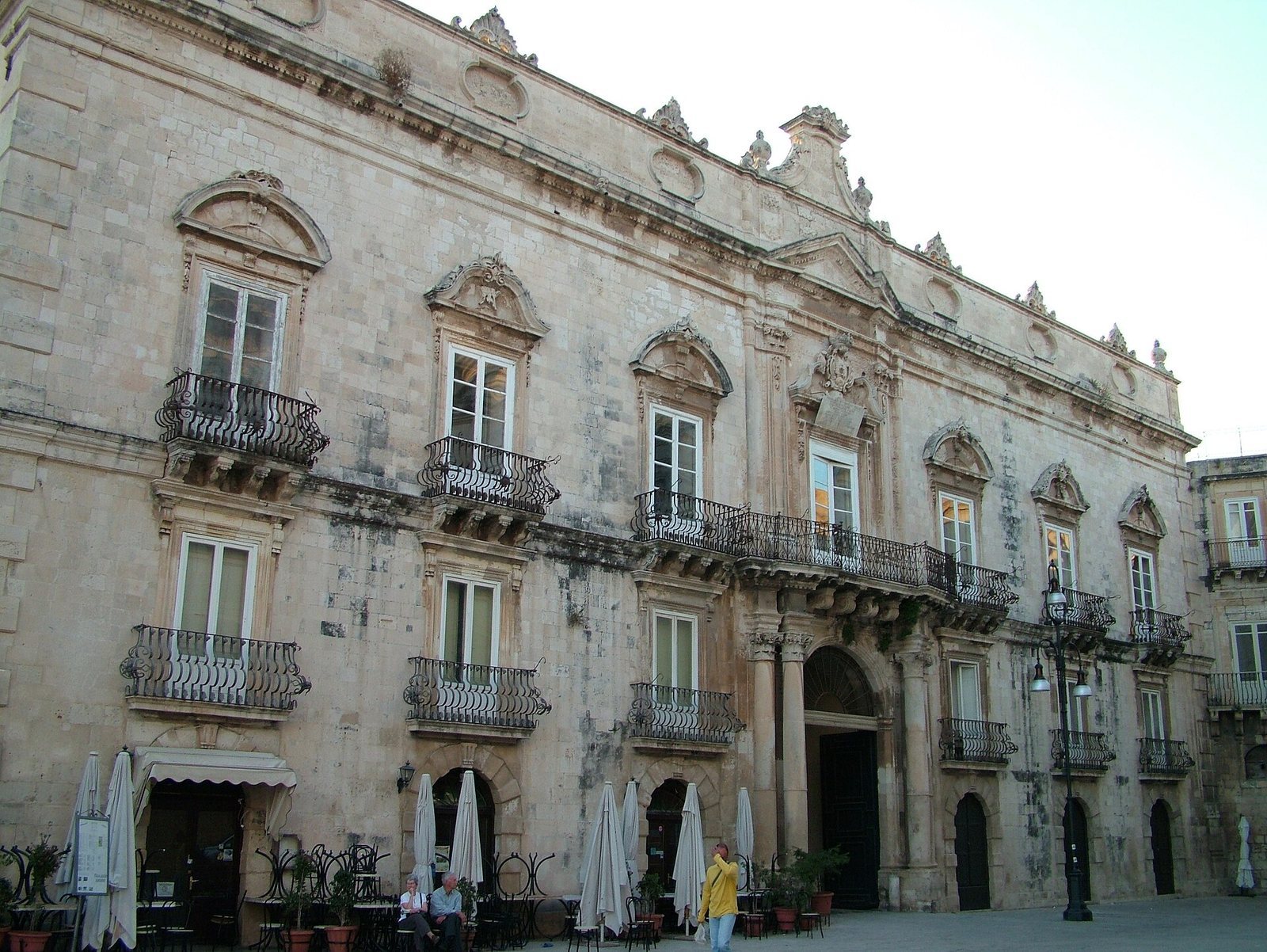
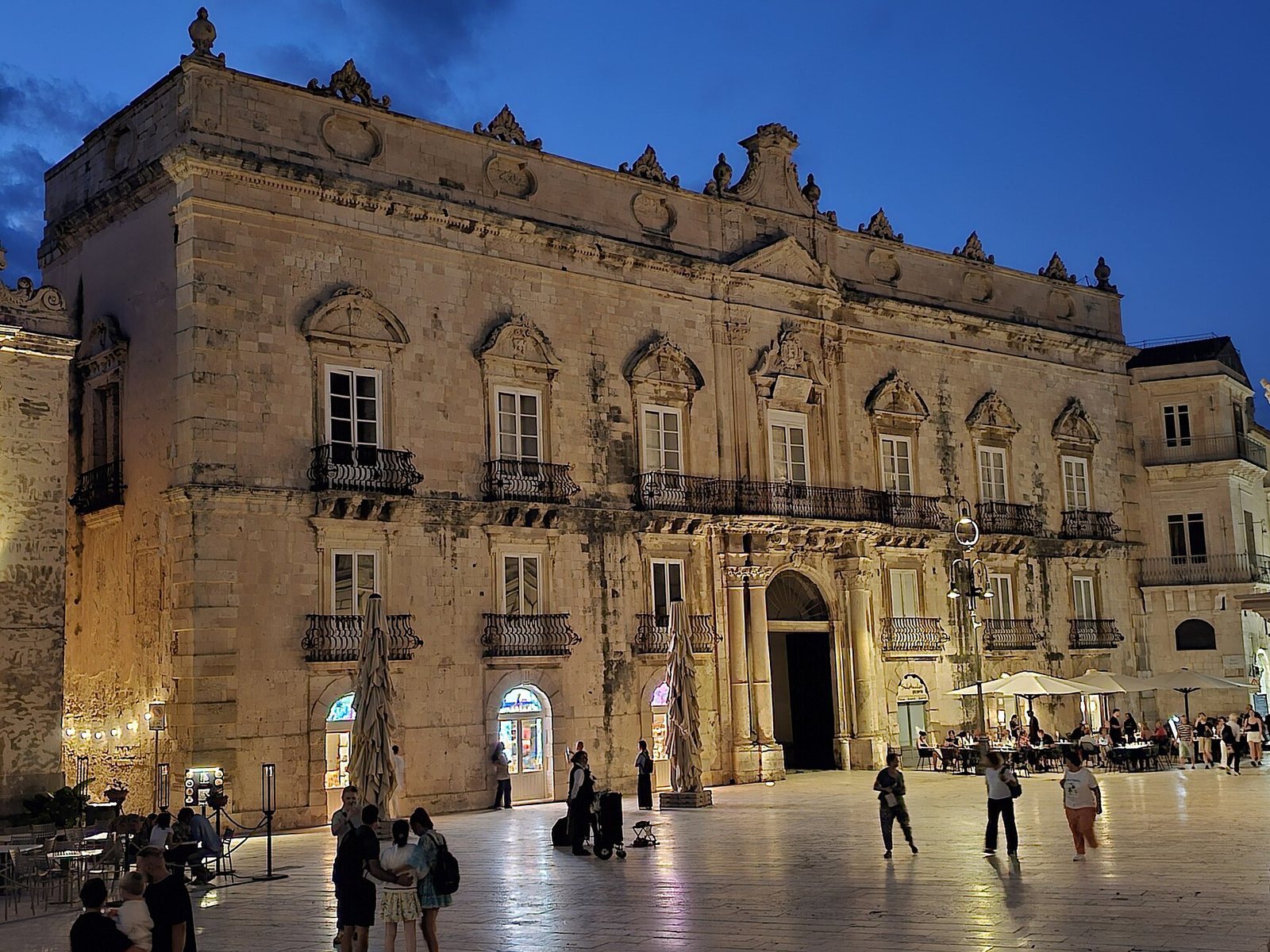
The palace stands on Piazza del Duomo on Ortigia, diagonally opposite Syracuse Cathedral and across the square from the present city hall. It is arranged around an enclosed courtyard, with Baroque and Rococo ornament on its three-level facade, in its courtyards, and throughout its interior.
Facade
Stepped pilasters, shallow vertical strips shaped like columns, mark the sides of the facade. Four ornate Corinthian columns, two on each side, frame the arched main entrance and support a richly decorated central balcony. Six smaller arched doorways, three to either side, each have a balcony with curved wrought-iron railings; the central balcony has a larger curved parapet. The side openings have semicircular crowns. Above them, a battlement-like band carries a shaped triangular feature at its center. On the third level, polygonal panels frame balconies beneath floral reliefs. A central triangular crown finishes the facade, accompanied by spherical ornaments.
A single-block stone plaque on the central balcony bears the Beneventano arms and a Latin commemorative inscription dated 28 April 1806. The shield shows three green mountains on a gold field, with a red lion and bear facing each other above them and a baron’s crown above the animals. The inscription commemorates the royal visit as an act of gratitude and remembrance.
Courtyards
Principal courtyard
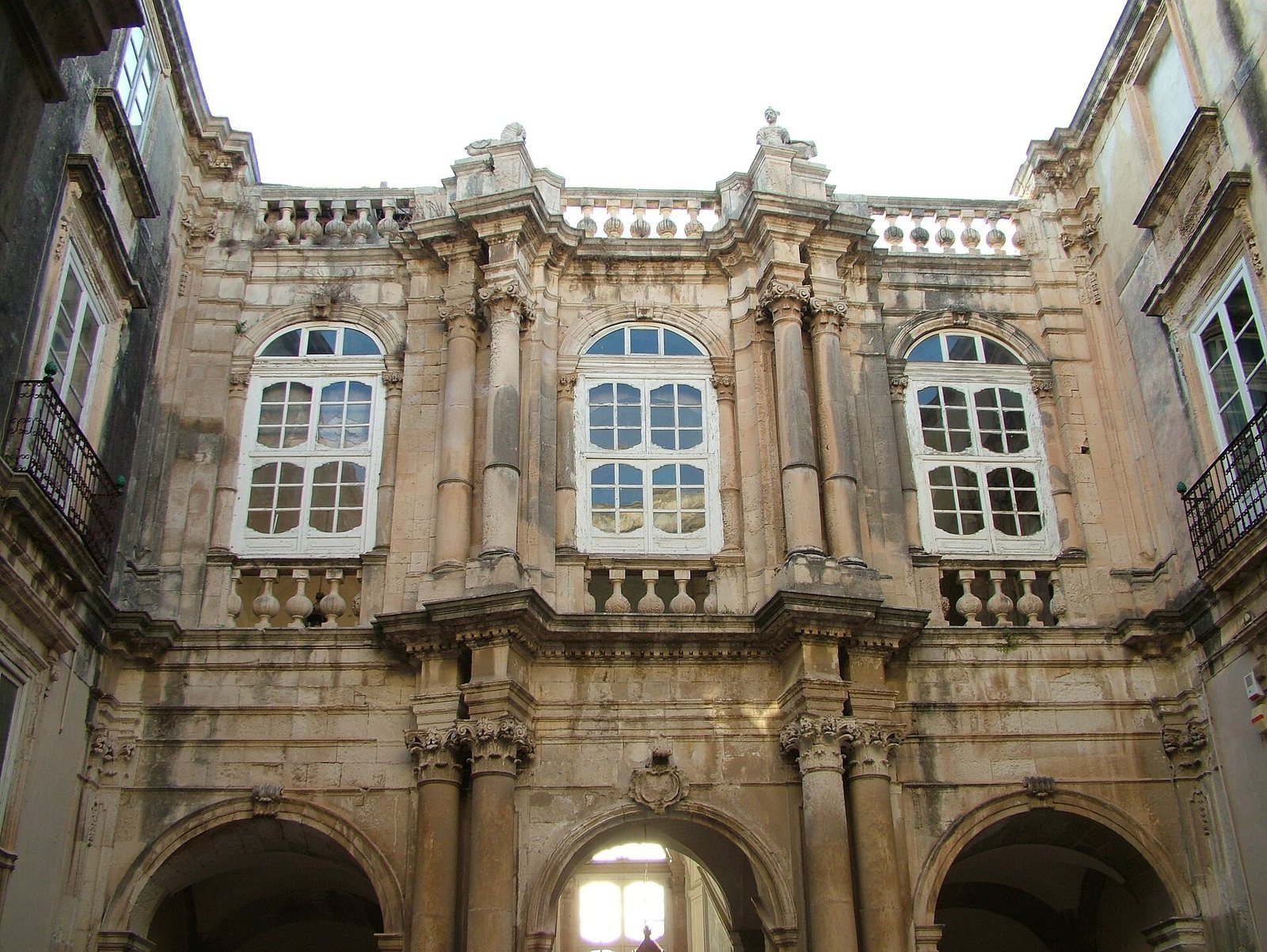
The main courtyard combines stucco, or decorative plasterwork, with wrought iron and patterned paving. Its entry hall has a decorated vaulted ceiling and opens toward two portals into the palace. Straight ahead, an iron gate topped by the Beneventano arms stands before glazed windows and a covered gallery with three arches. Statues on the terrace are viewed from below, while the eighteenth-century black-and-white cobbled pavement has a design resembling a carpet.
Smaller courtyard
Two side doorways lead to a smaller court with a suspended fountain decorated with masks and a floral openwork terrace railing. Its angled facades feature paired columns, child figures, and statues, creating richly varied surfaces through contrasts of light and shade.
Interiors and collections
Rooms and chapel
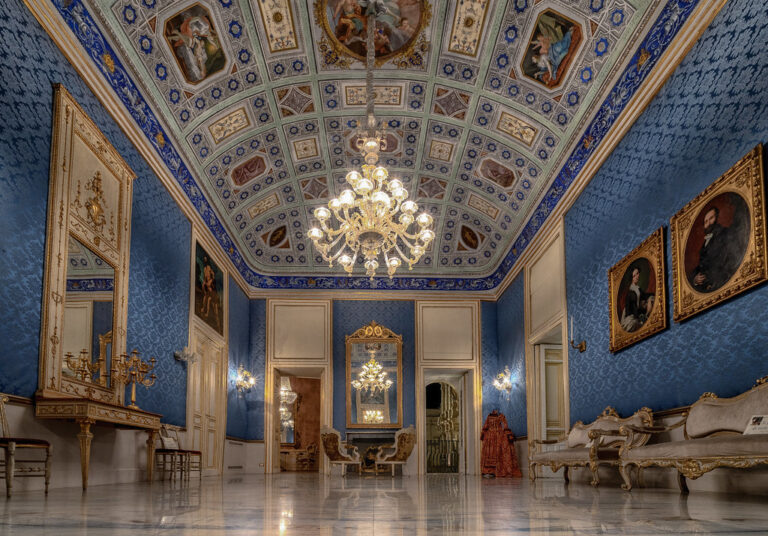
The rooms contain multicolored wall paintings and decorative plasterwork attributed to the Palermitan artists Ermenegildo Martorana and Gregorio Lombardo; Lombardo is also credited with sculptural work. The palace’s marble came from Catania. Its chapel contains a large wooden crucifix, and the interiors include period furniture and decorative crystal brought from Malta and Venice. Large crystal chandeliers came from Murano.
Sculpture and prints
A sculpture above the courtyard entry hall, called Belisarius, depicts a beggar asking for alms. Belisarius was a sixth-century Byzantine general later linked in legend with the figure of a blind beggar. The palace also displays old Beneventano prints, including period maps of Syracuse, Sicily, and Italy.