Habo Church: A Timber Parish Church in Sweden
Site at a Glance
- Country
- Sweden
- Primary era
- Early Modern
- Eras represented
- Medieval, Early Modern, Modern
- Civilizations
- Swedish
- Site type
- Religious
- Remains
- Church
On this page18 sections
History
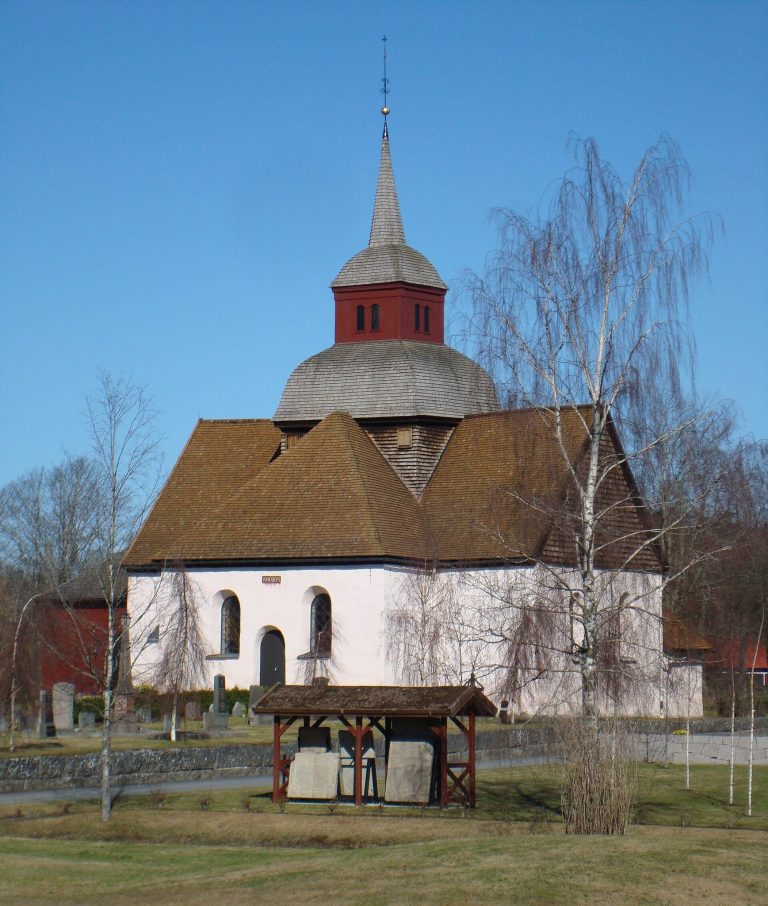
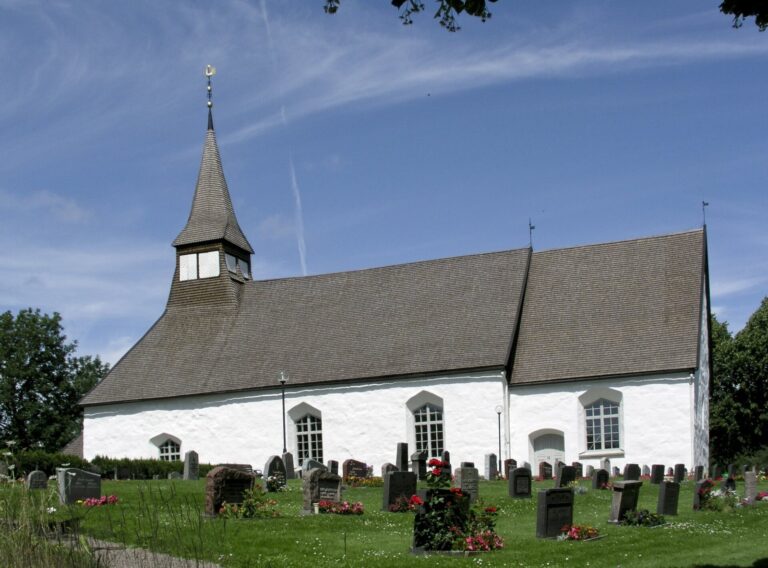
Habo Church is a timber parish church in Habo kyrkby, Sweden, whose present form dates to a major rebuilding in 1723. It belongs to Habo Parish in the Diocese of Skara, a territorial jurisdiction of the Lutheran Church of Sweden.
Medieval origins
Christian missionaries reached the region in the 11th century, and a first church at Habo was probably built in the 12th century. By the late 13th century, a church stood here. During alterations in 1716, workers found a reliquary, a container for sacred relics, inside the medieval altar. A parchment within it stated that Bishop Sigge had consecrated the altar in the middle of the 14th century.
Expansion and rebuilding
Additions to an earlier long church had created a cruciform building by the early 17th century. A seal dated 1622 depicts it with a large tower and two smaller towers at its sides. The church was extended and widened in 1680, then consecrated that year and again in 1723.
Martinus Seth became the church’s pastor in 1704 and advocated another major rebuilding, probably preparing plans himself. Parishioners objected to the expense, but the project proceeded under master builder Sven Nilsson Swan. The 1723 work gave the church its present form and produced a building sized for a parish of about 2,000 people. The pulpit and altarpiece were carved by Jonas Ullberg, a sculptor from Härja.
Painted church and later changes
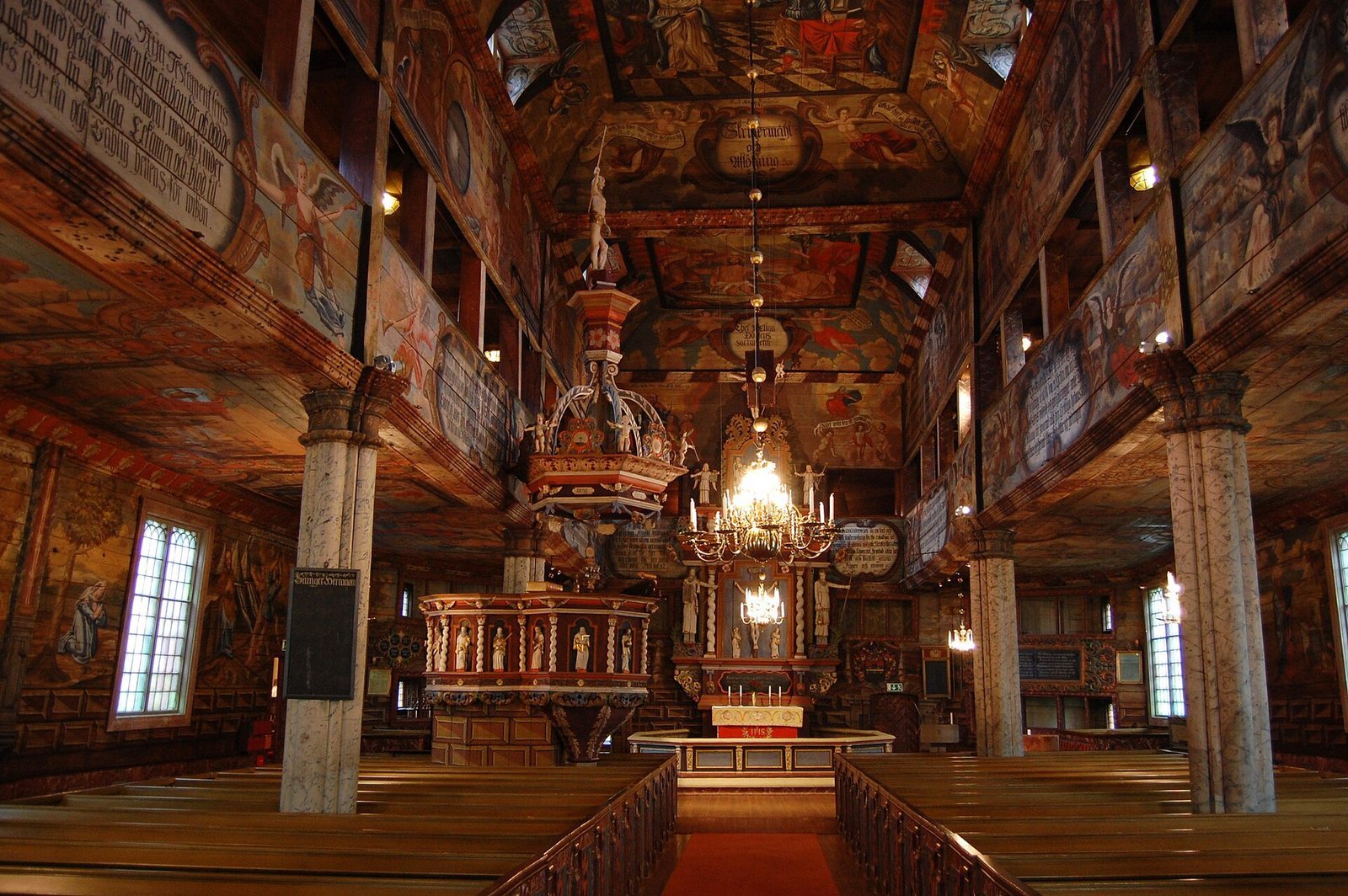
Between 1741 and 1743, Johan Kinnerus and Johan Christian Peterson covered much of the interior with paintings. They were instructed to prepare their own pigments. The images helped worshippers learn and remember Luther’s catechism, a concise guide to Christian teaching used for instruction. A local legend tells that the devil confronted a painter working on an image of “deliver us from evil,” objected to the depiction, and knocked the painter from a ladder, injuring his face. A detached bell tower was built in 1760. By 1776, damage to the paintings had been reported, and heating stoves later caused further harm, especially to images of the third and fourth commandments.
Restoration work took place in 1872 and 1908, and the paintings were restored in 1912. Railway rails were used to reinforce the walls in 1945. In 1952, the paintings were repaired, cleaned, and secured; they have not been overpainted. The main organ was replaced in 1920 and again in 1962, and a choir organ was installed in 1981.
Remains
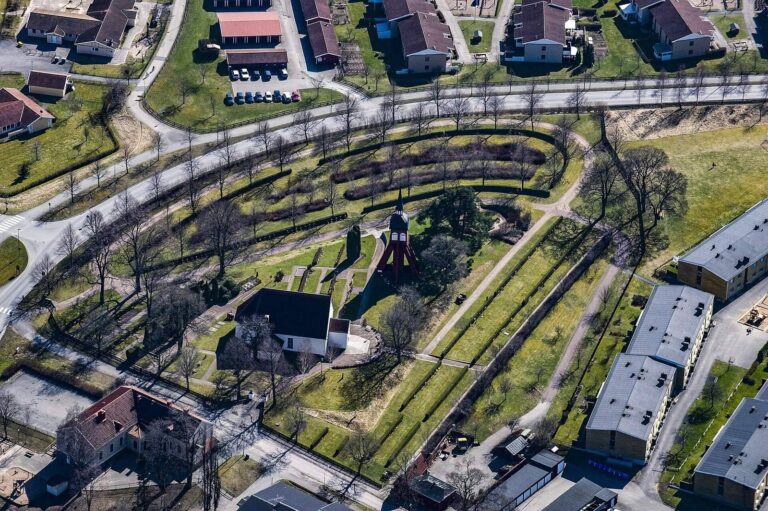
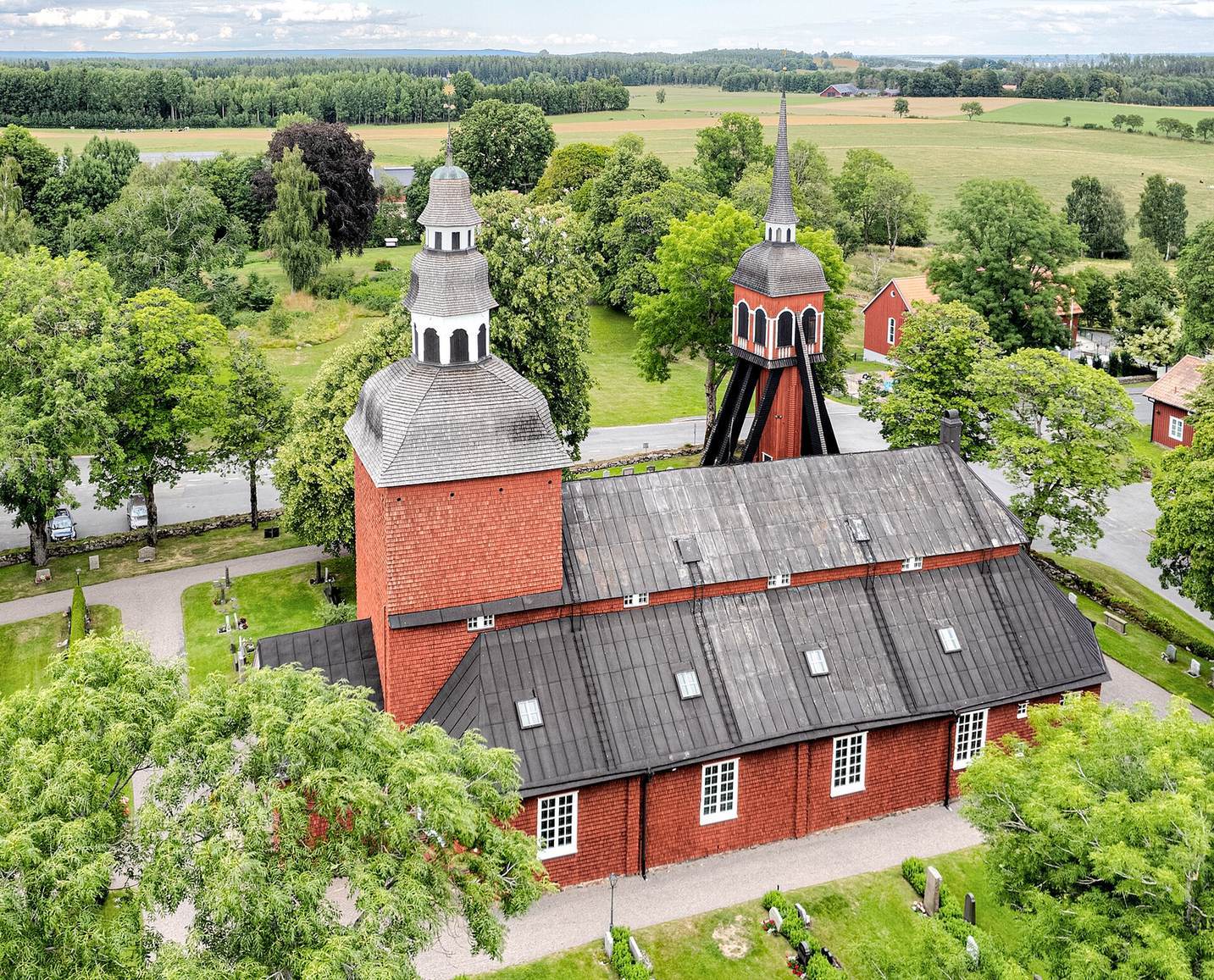
The church stands about five kilometres southwest of Habo. Its timber frame is made from smoothly hewn horizontal logs. A high central nave rises above two lower side aisles, forming a basilica plan and giving the building the appearance of a wooden cathedral. The church seats about 600 people.
Building and layout
Main church
The long nave ends in a choir as wide as the nave, with a three-sided eastern end. A decorative tower rises at the west end; it contains no bells. One porch stands west of the tower, and another is attached to the north side of the nave. An eastern porch built during the 1723 rebuilding was converted into a sacristy in 1928.
Exterior alterations
In 1872, shingles were fitted to the roof and walls, then covered with tar and paint. Windows were added to the lower roof slopes to light the side galleries. The north and south porches were demolished and their entrances sealed, while an extra roof was put over the tower to protect the organ from dripping water. Iron sheeting replaced the shingles on the nave and choir roofs in 1897. A porch was added at the north entrance in 1908, and old pew doors were reused as paneling on the side walls.
Medieval stone sacristy
The medieval sacristy is the oldest surviving part of the church and its only stone-built component. Its iron door and interior furnishings include ten wooden figures of saints.
Interior furnishings
Medieval furnishings
A large wooden sculpture of John the Baptist, the preacher associated with baptizing Jesus, shows him holding a lamb and dates to the 13th century. Smaller figures from the 15th century came from a former altarpiece. The sandstone altar dates to the 14th century. The sandstone baptismal font, the basin used for baptism, was made in the latter part of the 13th century and retains traces of red paint on its inner surface. After a new font was acquired in 1908, the medieval one was put aside and later used as a mortar for mixing red paint. It returned to baptismal use by the early 1950s.
Pulpit and altarpiece
A clock is built into the pulpit, which is surrounded by figures of Jesus’s twelve closest followers, with Jesus at the centre. A figure of Death holding a scythe stands below the figure of Jesus on the altarpiece. The altarpiece depicts the crucifixion, burial, and resurrection of Jesus. Above it, the risen Jesus holds a victory banner. Moses and Aaron, brothers in the biblical Exodus story, flank the scene: Moses holds the tablets, while Aaron carries a budding staff. A clock made in Jönköping in 1750 was later incorporated into the altarpiece. It has one hour hand, and at each hour a boy figure above it strikes two half-spheres with a hammer.
Paintings and commemorative plaques
Painted teaching program
Paintings cover the walls, gallery fronts, and ceilings. The Ten Commandments appear on the side walls, with even-numbered commandments to the left and odd-numbered ones to the right. The Lord’s Prayer is painted above the galleries, beginning to the left of the altar. The Creed appears on the gallery ceilings, with an apostle in each scene. Large ceiling paintings depict baptism, confession and absolution, the Eucharist, and the blessing. Female figures, perhaps including Queen Ulrika Eleonora, appear near the organ gallery with various musical instruments. The painters made pigments from metal oxides, plants, and earth.
Commemorative plaques
Memorial plaques to Martinus Seth and Sven Nilsson Swan stand on the left and right of the choir, respectively. Beneath the image of the fifth commandment is a plaque commemorating Sweden’s 1700 victory over Russia at Narva, a major battle in the Great Northern War. An epitaph to sculptor Magnus Ullberg-Johansson is on the right beneath the third commandment. On the left, another plaque carries an exhortation from King Frederick I and Queen Ulrika Eleonora to celebrate the Augsburg Confession, a foundational statement of Lutheran belief presented in 1530.
Bells and organs
Bells
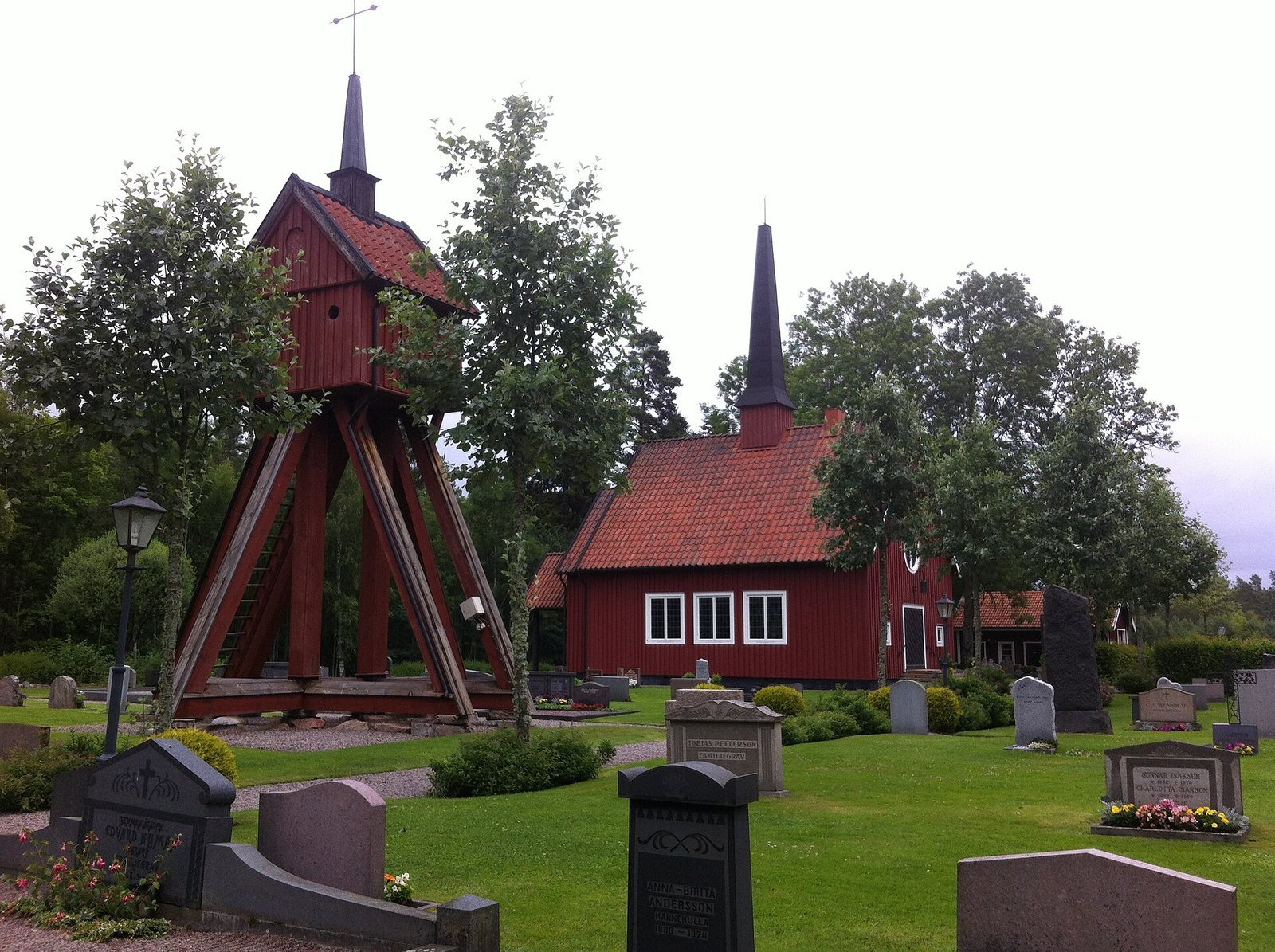
Three bells hang in the separate bell tower northeast of the church. The two larger bells were recast versions of bells dating to the 16th century. The large bell was cast in 1756, and the middle bell in 1757; the middle bell was recast again in 1877. The smaller bell was cast in Jönköping in 1760.
Organs
The original organ, built by Johan Niclas Cahman, had eight stops, controls that select sets of pipes. Its facade, decorated by Magnus Ullberg-Johansson, survives, as do restored pipes from Cahman’s instrument. The main replacement organ, built by Hammarberg’s organ workshop, has 16 stops, two manuals (keyboards), and a foot-operated pedal, and follows the Baroque style. The choir organ has five stops.