Brännkyrka Church: A Medieval Parish Church in Älvsjö, Sweden
Site at a Glance
- Country
- Sweden
- Primary era
- Medieval
- Eras represented
- Medieval, Modern
- Civilizations
- Swedish
- Site type
- Religious
- Remains
- Church
On this page13 sections
History
Brännkyrka Church is a Church of Sweden church in Älvsjö, Sweden, consecrated in the 12th century and probably first built late in that century. The Church of Sweden is an Evangelical Lutheran church. Brännkyrka is one of two churches serving its parish in the Diocese of Stockholm, a regional church jurisdiction.
Medieval origins and the name Brännkyrka
The church and parish were once known as Vantör. Fires in the 15th century gave rise to the name Brännkyrka: a fire associated with the change took place before 1425, the earliest known use of the present name. The church’s west tower was added before the middle of the 13th century. A sacristy followed on the north side in the 14th century, and vaults were built over the nave and choir during the 15th century. A porch was added on the south side later.
A fire in 1723 destroyed the church’s entire interior. A handwritten note in a copy of the Charles XII Bible calls it the church’s fourth fire. Charles XII was king of Sweden from 1697 to 1718.
Rebuilding and later changes
In 1802-1803, the eastern end of the nave was extended, and the original choir was replaced by a new choir area and sacristy. A rebuilding plaque above the tower entrance commemorates this work. In 1851, a new sacristy was added at the eastern gable, the choir was altered, and an organ gallery was installed at the west end. The tower was remodelled in 1890. In 1912, an arched opening connected its lower level with the nave, and the gallery was altered.
A renovation in 1975 replaced the 1851 sacristy with a new choir area and a sacristy on the north side, and included work on the exterior. An interior renovation followed in 2004. The altar, pulpit, pews, and baptismal font date from after the 1975 work. In 2011, a new altarpiece took the place of a painting installed in 1979; the painting was moved to Solomon Hall in the parish hall.
Churchyard and parish grounds
The churchyard has medieval origins. Märta Helena Reenstierna, the Swedish diarist known as Årstafrun, was buried there. In the late 19th century, a new burial ground was established about 700 metres north as an extension of the churchyard. It is now called Västberga Burial Ground. A parish hall was built northeast of the church in 1959.
Remains
Church building
Plan and fabric
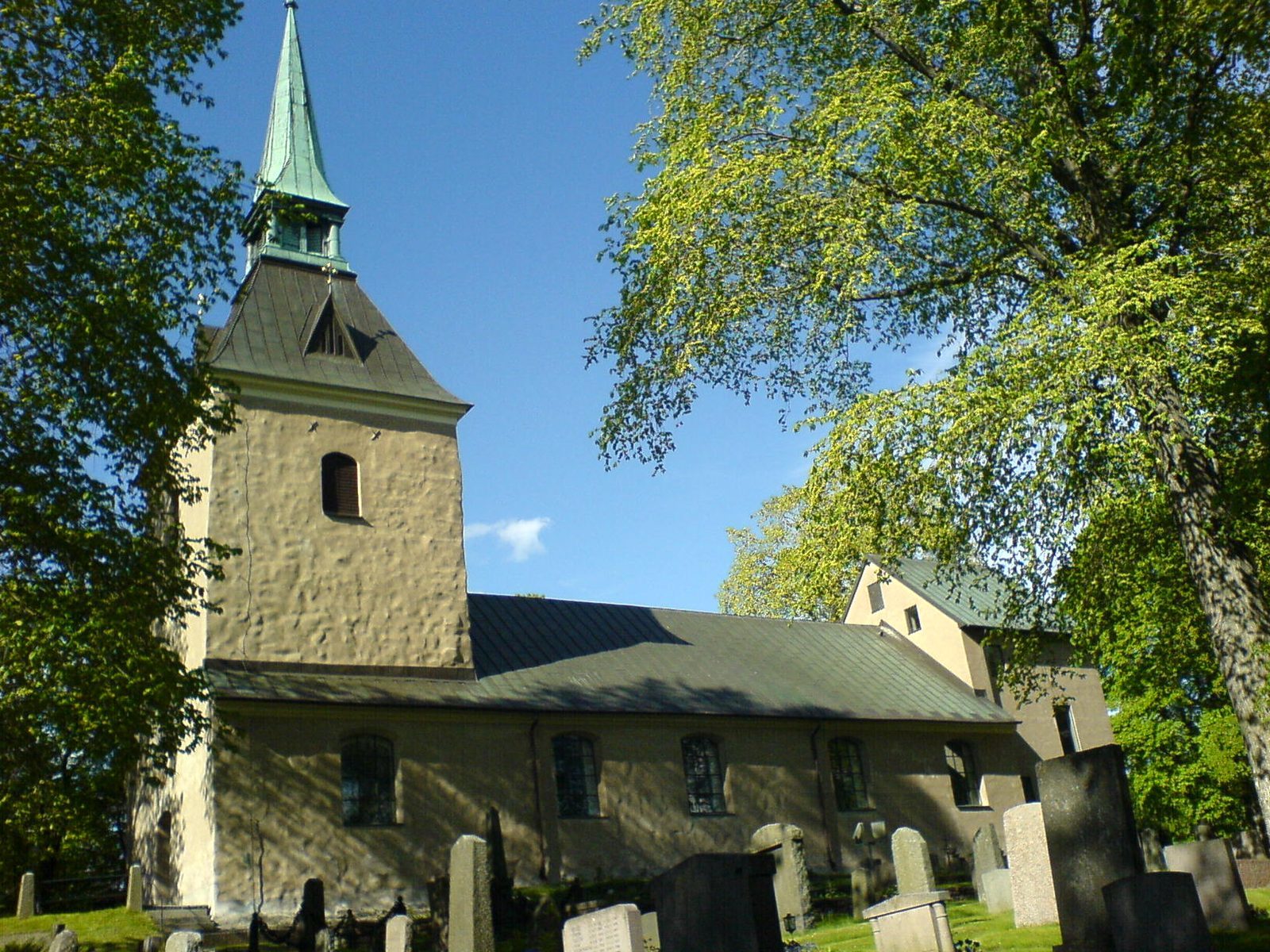
The church runs east to west and has a single nave beneath a three-part ceiling. Its original plan had an almost square nave and a narrower choir to the east, and much of the original nave survives. The medieval fabric is mainly grey stone with some brick; brick also forms the eastern part of the nave. The exterior is finished in light-brown plaster, and the roof is covered with sheet metal.
Tower, choir, and sacristy
The west tower contains the main entrance and ends in a spire clad in sheet metal. Its unusual roof arrangement has hipped sections, with the nave roof continuing partway along the tower. In the Diocese of Stockholm, Västerhaninge Church is the only other church with this form, which is common on Gotland. At the east end, the choir has a straight wall and a roof ridge higher than that of the nave. The north-side sacristy includes a vestment room and an accessible entrance; rooms below ground level include utility rooms, a meeting room, and a bridal chamber. The 14th-century north sacristy had a brick vault, while vaults were also built over the nave and choir.
Sculpture and altarpieces
A piscina, a basin with a drain for water used in worship, is set into the choir’s south wall. Sculptor Sven Lundqvist decorated it with reliefs of the Samaritan woman meeting Jesus at the well of Sychar, an episode in the fourth chapter of the Gospel of John.
The circular altarpiece by Bertil Vallien is made of glass and wood at Orrefors Kosta Boda and draws on the design of medieval rose windows. It presents God’s embrace as encompassing the heavens and the underworld. At the centre of the cross, Christ holds a boat; rays rising above him represent the Holy Spirit, and sixteen glass blocks in the cross’s angles carry biblical motifs. Three related pendants hang on the north wall.
The earlier altarpiece, painted by Einar Forseth, is now in Solomon Hall. It depicts Christ within a mandorla, an almond-shaped frame around a sacred figure, with children and burdened people beside him. The scene illustrates the invitation in Matthew 11:28.
Organs
The church has had several organs. In 1835, Pehr Zacharias Strand of Stockholm built an eight-stop instrument with one manual, or keyboard, and an attached pedalboard played with the feet. Åkerman & Lund of Stockholm supplied a twelve-stop organ with two manuals and a pedal in 1900. A. Mårtenssons Orgelfabrik AB of Lund built a 25-stop, two-manual organ with a pedal in 1941. In 1978, Walter Thür Orgelbyggen AB of Torshälla made a 20-stop organ with mechanical key action, electric controls for selecting stops, and a case built for the instrument. The present organ, made by Åkerman & Lund Orgelbyggeri, was inaugurated on 2 September 2012.
Churchyard and parish grounds
Churchyard and funerary chapels
The churchyard extends mainly south and west of the church, covers 1.5 hectares, and contains just under 2,000 graves. A ring of trees planted by Reenstierna remains around it. A funeral chapel stands in the northern part, and a memorial grove lies north of the main burial ground. The graves include those of Reenstierna, Hildebrand Hildebrandsson, Otto Torell, and John Adolf Leyonmarck.
Three freestanding funerary chapels stand in the churchyard. Northwest of the church, the Lagerbielke chapel has a roughcast exterior and a pyramidal roof. The Odelberg chapel on the south side is Neo-Gothic, built of brick with cement trim. Southeast of the church, the chapel for churchwarden L. E. Andersson has white plaster and a round-arched entrance.
Parish hall and surrounding landscape
The parish hall northeast of the church is a low building with white plaster walls and a slate roof. Wrought-iron work on its entrance railing, by Folke Heybroek, depicts a fish, a dove, and a lamb, Christian symbols. A small park between the hall and church contains an outdoor altar and baptismal font. The church stands beside the old Göta Road, now Götalandsvägen, and is largely surrounded by 20th-century housing. South toward Älvsjö, the lake once called Brännkyrkasjön or Kyrksjön has been drained; the area is now known as Sjöängen.