Izushi Castle: Administrative Center of the Izushi Domain
Site at a Glance
- Country
- Japan
- Primary era
- Early Modern
- Eras represented
- Early Modern, Modern
- Civilizations
- Japanese, Tokugawa
- Site type
- Military
- Remains
- Castle
On this page14 sections
History
Izushi Castle is a Japanese fortress in the former province of Tajima, now northern Hyogo Prefecture. Koide Yoshihide established it in 1604 at the foot of Mount Ariko. The castle reused the former residence of Ariko’s lords, while the mountain-top fortification was abandoned. A town grew beside the new castle, forming the basis of Izushi’s present townscape. During the Edo period, the era of Tokugawa rule from 1603 to 1868, the castle served as the administrative center of the Izushi Domain, a territory governed by a lord under the shogunate.
Yamana rule and Ariko Castle
The Yamana family ruled Tajima from the fourteenth-century Nanboku period, when rival imperial courts competed for power, and maintained its base at Konosumi Castle. Traditions name different Yamana family members as builders of Konosumi, whose foundation date remains uncertain. In 1569, forces acting under Oda Nobunaga’s orders captured it, including troops led by Kinoshita Tokichiro, later known as Toyotomi Hideyoshi. Yamana Suketoyo escaped to Sakai, a major port and commercial city near present-day Osaka. With the merchant and tea master Imai Sōkyū acting as mediator, Suketoyo made peace with Nobunaga. A tradition places his return to Tajima that winter.
Around 1574, Suketoyo built Ariko Castle on Mount Ariko, about 3.5 kilometres south of Konosumi, and transferred his base there. The mountain rises 321.5 metres, and a lord’s residence and town developed at its foot. In 1580, an invasion led by Toyotomi Hidenaga, Hideyoshi’s younger brother, captured Ariko and brought Yamana rule in Tajima to an end. Hidenaga and Aoki held the castle before Maeno Nagayasu became its lord in 1585. Koide Yoshimasa followed in 1595.
Koide, Matsudaira, and Sengoku government
At the 1600 Battle of Sekigahara, Yoshimasa supported the Western Army while his younger brother Koide Hideie fought with the Eastern Army. The Koide family retained its holdings. In 1615, the One Castle per Province Edict, a Tokugawa policy limiting each province to one castle, made Izushi the sole castle in Tajima.
When the last Koide heir died without an heir in 1696, the family’s holdings were confiscated. Matsudaira Tadachika took control of the domain the following year. In 1702, he moved the lord’s residence from the main enclosure to the Sannomaru, where it became an audience hall. Tadachika was transferred in 1706, and Sengoku Masaaki arrived from Ueda. The Sengoku family governed Izushi until the domain system was abolished. A local tradition credits workers brought from Shinano, a historical province in central Japan, with helping develop Izushi soba by combining their methods with local practices.
A power struggle within the domain, known as the Sengoku Disturbance, reduced its assessed yield in 1835 from 58,000 to 30,000 koku, a measure of agricultural output.
Dismantling and later recognition
With the new government’s permission, the domain dismantled the castle buildings in 1868, before a nationwide order to abandon castles followed in 1873. Toyooka City designated the remains a historic site in 1968. In 2017, Izushi Castle and Ariko Castle were selected together as site 162 in the Continued Top 100 Castles of Japan.
Remains
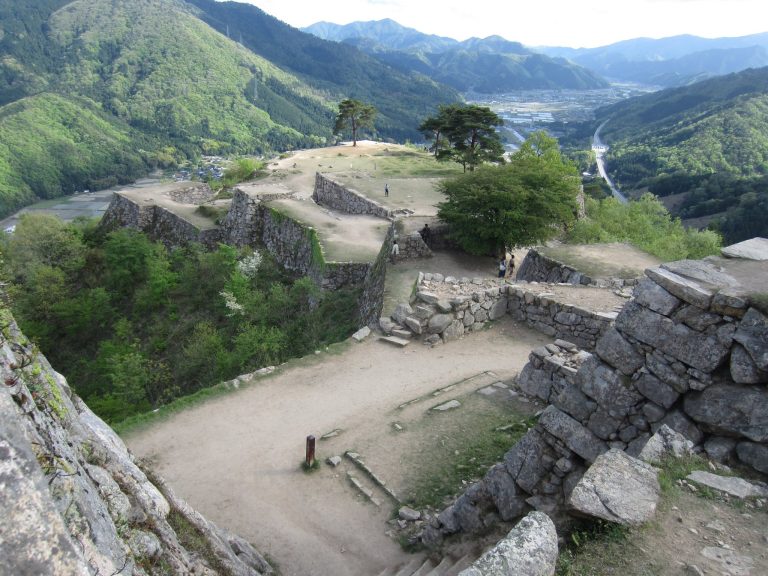
Izushi was a hill-and-plain castle, a fortress extending from a slope onto nearby level ground. Its grounds covered about 400 metres east to west and 350 metres north to south, with defended sections arranged along the northern foot and slope of Mount Ariko. The uppermost section was the Inari enclosure, with the main and second enclosures below it. The Sannomaru occupied the flatter ground to the north.
Enclosures and defenses
Sloping enclosures and stone walls
The castle’s sloping grounds included the Inari, main, second, lower, and western enclosures, as well as the Yamasato enclosure to the east. Sections of rough, undressed stone walls survive at the lower, second, main, and Inari enclosures. Together with the inner moat, these walls preserve parts of the castle’s defensive layout.
Gates and moats
Angled gates with concealed entrances controlled the routes between the Sannomaru and lower enclosure, and between the lower and second enclosures. A passage linked the main and second enclosures. Raised earth defenses and moats protected the castle’s two principal parts, while walls strengthened the approaches around the gates. Ditches without water extended the defenses along the mountain side.
Sannomaru and castle town
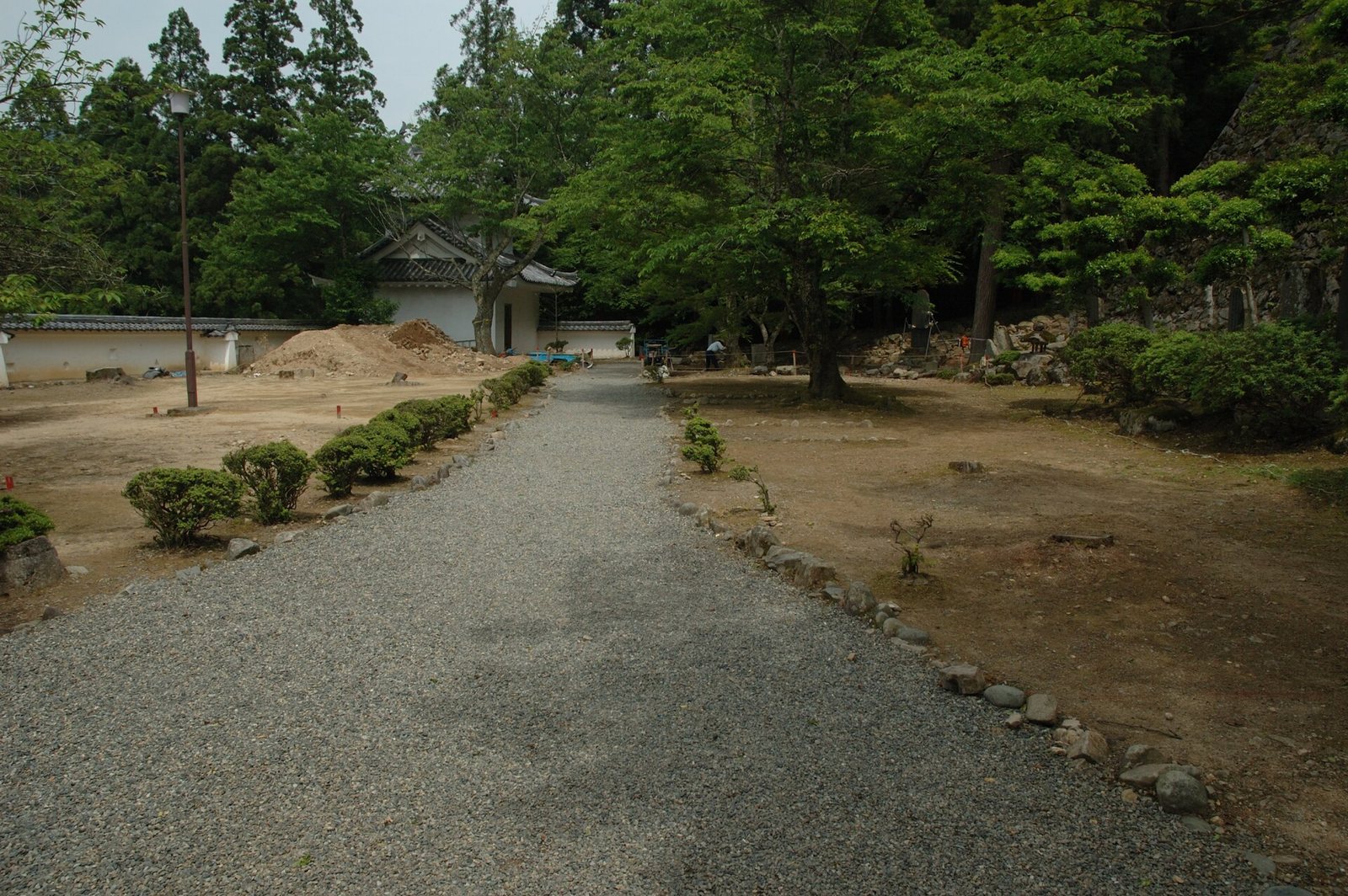
The Sannomaru, or third enclosure, was also called Uchimachi, meaning Inner Town. It held the chief retainer’s residence and formed part of the northern approach to the castle. Its east and west gates opened onto a road running east to west, while another road led north to the main gate. An inner moat separated the Sannomaru from the adjoining town, which included residences for high-ranking samurai, merchant houses, and a county office. Izushi retains an Edo-period street grid laid out for military purposes, along with old samurai residences and shops.
Rebuilt structures and shrine approach
Main-enclosure towers
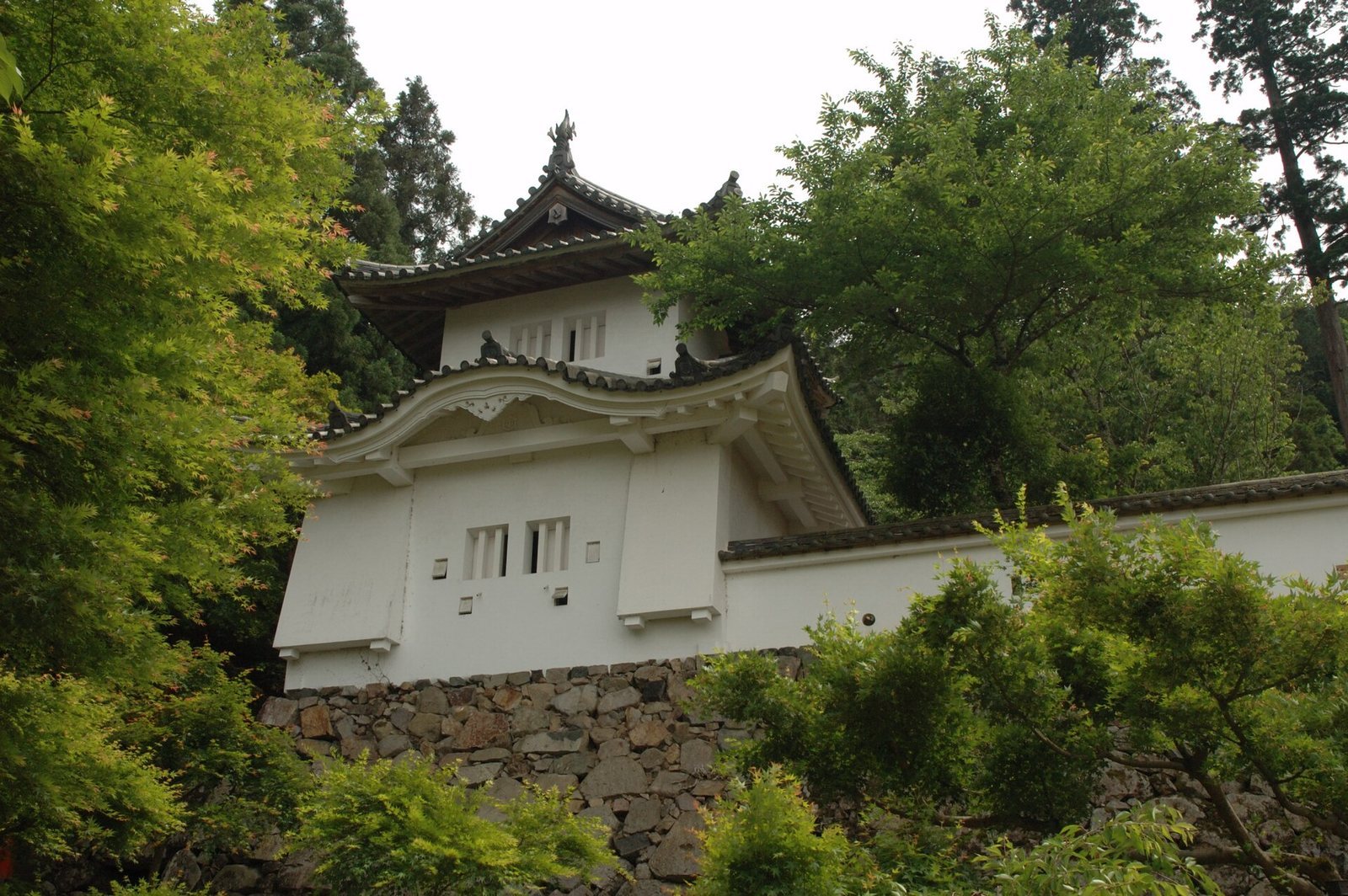
Two rebuilt towers stand at the eastern and western corners of the main enclosure. Both have staggered and curved gables. The western tower combines the two forms, while the eastern tower presents them in the opposite arrangement.
Castle-entry gate and bridge
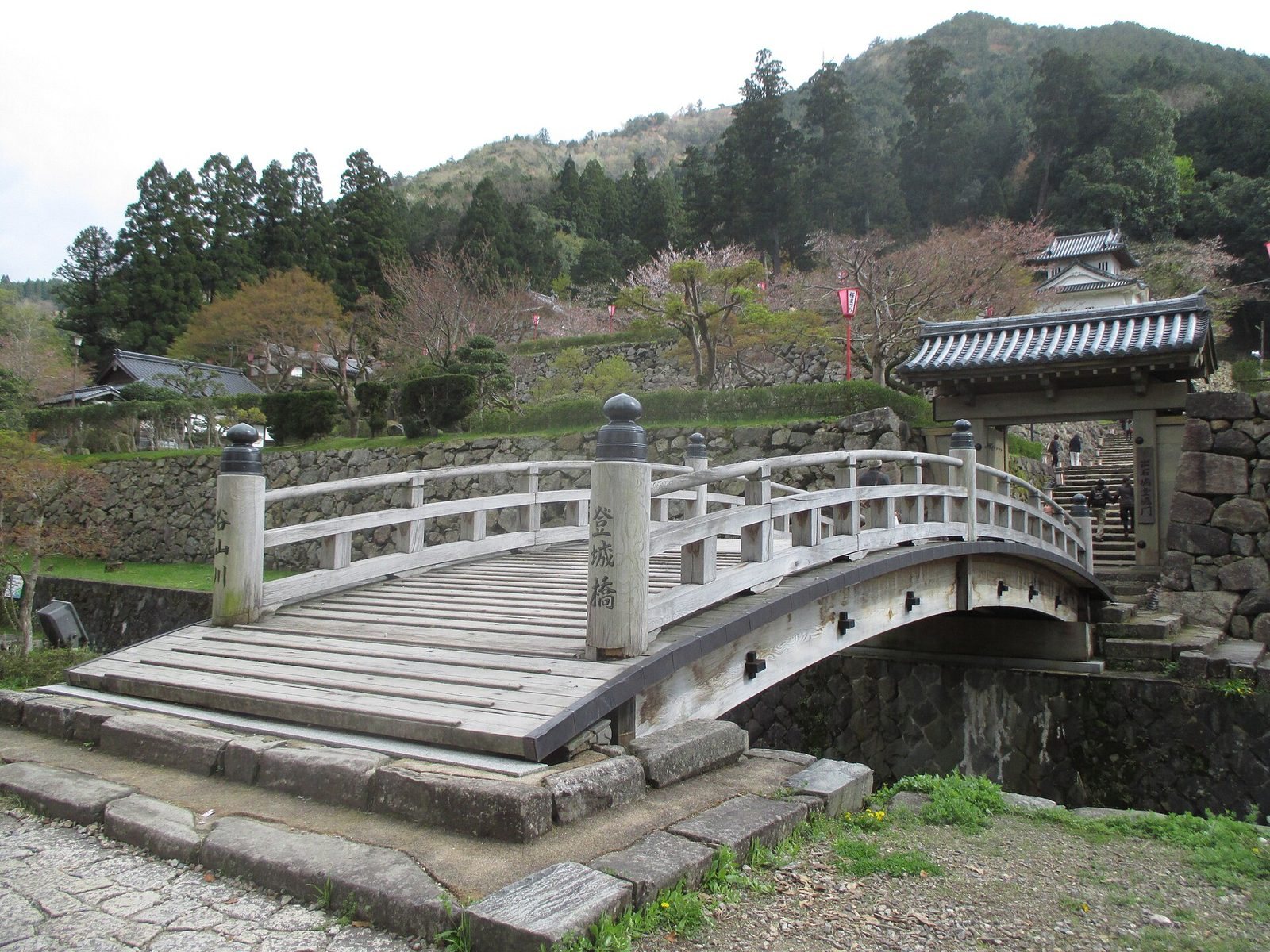
The rebuilt entrance gate stands with a bridge over the moat. Both were reconstructed in 1994.
Shinkoro clock tower
Shinkoro is a wooden clock tower built in 1871 on the turret platform beside the former main gate of the Sannomaru. A clock was installed there in 1881.
Inari shrine
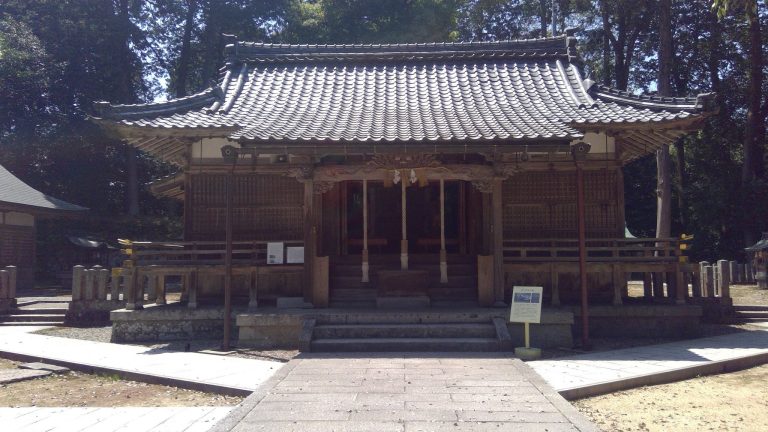
A small shrine dedicated to Inari, a Shinto deity associated with rice and agricultural prosperity, stands above the Inari enclosure. Its approach includes 37 torii, gateways marking the way to a Shinto shrine, and 157 stone steps.