Fort Moultrie: A Coastal Fort Defending Charleston Harbor
Site at a Glance
- Country
- United States
- Primary era
- Modern
- Eras represented
- Early Modern, Modern
- Civilizations
- Unclassified
- Site type
- Military
- Remains
- Fort
On this page18 sections
History
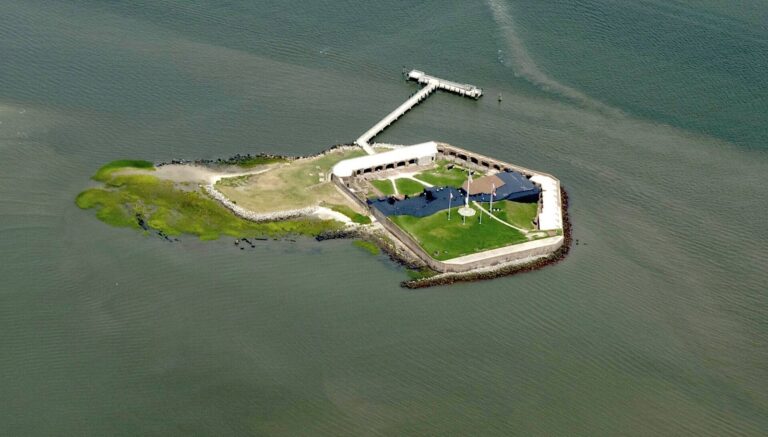
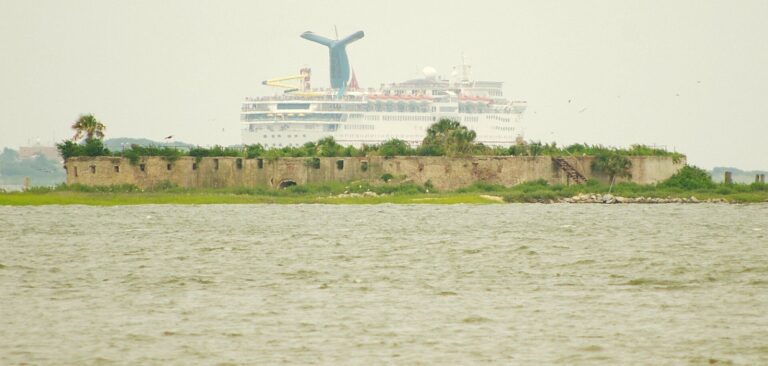
Fort Moultrie is a coastal fort on Sullivan’s Island in the United States, begun by South Carolina patriots in 1776 to defend Charleston Harbor. First called Fort Sullivan, it became known by its later name after its defenders repelled a British naval attack during the war for American independence.
Revolutionary defense and British occupation
William Moultrie took command on March 2, 1776. The garrison included 413 infantrymen from the 2nd South Carolina Regiment and 22 artillerymen from the 4th South Carolina Regiment. Military engineer William Gerard de Brahm supervised construction. Continental Army general Charles Lee considered the unfinished position dangerously exposed and recommended abandoning it, but South Carolina president John Rutledge ordered Moultrie to hold the fort.
On June 28, a British squadron of nine warships under Admiral Sir Peter Parker attacked. Moultrie’s defenders resisted throughout the day, damaging the ships and forcing them to withdraw. The fort was later renamed in Moultrie’s honor. During the battle, a blue flag with a crescent and the word Liberty was knocked down, then raised again by Sergeant William Jasper. Known afterward as the Moultrie or Liberty flag, it became a symbol of the Revolution in the South. South Carolina marks the victory each year on June 28 as Carolina Day.
Charleston came under siege in 1780, when British forces led by General Sir Henry Clinton began surrounding the city on April 1. On April 9, Vice Admiral Mariot Arbuthnot’s 12 ships passed the island’s defenses into the harbor, using fog and the tide despite fire from Fort Moultrie. Two ships exchanged fire with the fort. The British transport HMS Aeolus ran aground and was burned, and the British suffered 27 killed or wounded.
By then, the fort had lost much of its strategic value. Colonel Charles Cotesworth Pinckney shifted his command to a defensive earthwork at Haddrill’s Point, while General Benjamin Lincoln ordered six 18-pound guns moved from Moultrie to another position at Lampriere’s Point. The Haddrill’s Point garrison returned on April 26 as British infantry approached. The next day, 500 British sailors and marines landed at Mount Pleasant and found a patriot battery abandoned.
On the night of May 4, 150 sailors and marines under Captain Charles Hudson landed at the northeastern end of Sullivan’s Island and seized a defensive position. Another 100 men arrived under Captain John Orde. Hudson demanded the fort’s surrender, and Lieutenant Colonel William Scott agreed on May 6 on the condition that his men could leave with their weapons. The garrison marched out the next morning and laid down its arms. Most American troops had already been evacuated; the British took 217 prisoners along with artillery and military supplies. They renamed the fort Fort Arbuthnot and valued it as protection for their harbor fleet. The loss also weakened patriot morale in Charleston.
After British forces withdrew in 1782, the fort again took the name Moultrie, but it was not maintained for combat and fell into disrepair. When President George Washington visited in 1791, he found ruins.
Federal rebuilding and the antebellum years
Renewed conflict in Europe led the United States to develop the First System, an early federal program for building coastal forts. Congress assigned construction and maintenance to the Corps of Artillerists and Engineers, established in 1794. A new fort was completed at Moultrie in 1798, and an artillery company took up station there in 1802. After a hurricane severely damaged the structure in 1804, the Army rebuilt it in 1808–09 under the Second System, the next federal coastal-fortification program. Its armament numbered 40 guns in 1811. The design changed little over the following decades, although its protective earthworks and weapons were altered. As Fort Sumter became central to Charleston’s defenses, Moultrie’s strategic value declined.
The Army began taking weather observations at the fort around 1820 and also used it to hold Native American prisoners. Seminole leader Osceola, who resisted U.S. efforts to remove Seminoles from their homeland, was brought there with other Seminoles in 1837. He died at the fort in January 1838.
In 1858, Companies A and E of the 4th U.S. Artillery arrived from Fort Capron and joined Company H. Yellow fever killed 28 artillerymen that August. Colonel John L. Gardner moved his headquarters outside the fort with presidential permission, then spent the following year in North Carolina; Captain Abner Doubleday commanded in his absence. As secession approached, Gardner asked Secretary of War John B. Floyd for reinforcements. Floyd sent 70 men for repair work, but they placed added pressure on the fort’s limited food supply rather than strengthening its garrison.
South Carolina’s General Assembly called for secession on November 10, 1860, and the state left the Union on December 20. The next day, U.S. Army officer Fitz John Porter inspected the federal forts in Charleston and found Moultrie’s garrison in satisfactory condition. He also found it exposed to attack from land, while much of its ammunition was stored in Charleston, where moving it risked provoking local opposition. Major Robert Anderson was ordered to replace Gardner. When Anderson tried to obtain ammunition, Governor William Gist strengthened the guard at the city arsenal.
Secession and the Civil War
On December 26, 1860, Anderson moved the federal garrison from Fort Moultrie to the stronger Fort Sumter. Some soldiers and officers remained temporarily, disabling the guns and burning the powder magazine before departing. Confederate forces then occupied Moultrie, raised South Carolina’s flag, and repaired or replaced its guns. On January 9, 1861, cadets from South Carolina’s military college fired on the unarmed merchant ship Star of the West as it tried to bring supplies to Fort Sumter.
Confederate guns at Moultrie joined the bombardment of Fort Sumter on April 12, 1861. Federal return fire struck Moultrie’s flag three times. The fort later exchanged fire with federal ironclad warships on April 7, 1863, and helped repel a federal landing attempt at Sumter on September 8. In the bombardment that followed, Union forces battered Fort Sumter into rubble and reduced Fort Moultrie beneath a protective sand hill. Confederate forces abandoned Charleston Harbor’s defenses on February 18, 1865. The following morning, USS Canonicus fired several shots at Moultrie and received no return fire.
Modern coastal defenses and preservation
The Army strengthened Moultrie in the 1870s with concrete bunkers and new artillery. Beginning in 1897, the Endicott Program brought a large-scale modernization of U.S. harbor defenses using reinforced-concrete batteries. Eight such batteries were completed on Sullivan’s Island by 1906, and some earlier earthworks were removed to make room for new works. Forts Moultrie and Sumter formed the Charleston Coast Artillery District, renamed the Coast Defenses of Charleston in 1913.
Two 12-inch guns installed at Fort Sumter in 1899 also strengthened Charleston’s defenses. During the Second World War in Europe, the United States again upgraded its coastal defenses. The Regular Army’s 13th Coast Artillery Regiment and the South Carolina National Guard’s 263rd Coast Artillery Regiment served in Charleston’s harbor defenses. New positions on Sullivan’s Island and the construction of a long-range gun battery made many of the area’s older gun works obsolete.
The Army lowered Fort Moultrie’s flag for the last time on August 15, 1947, ending 171 years of military service. Submarines and nuclear weapons had made the country’s coastal-defense system obsolete. In 1960, the Department of Defense transferred the fort to the National Park Service, which manages it as part of Fort Sumter and Fort Moultrie National Historical Park. The park presents the fort’s history in reverse, moving from its Second World War defenses back to the original palmetto-log works.
In 1999, the National Park Service, preservation groups, and local residents acquired and removed a private house beside the fort. The 38-foot house had blocked the sightline to Fort Sumter; the acquired parcel measured 0.23 acres. In 2007, the 5.3-acre Fort Moultrie Quartermaster and Support Facilities Historic District was added to the National Register of Historic Places, the federal list of places recognized for their historical importance.
Remains
The fort’s physical record reflects successive changes in construction, from timber and sand works to brick defenses and reinforced-concrete gun batteries. The earliest works stood at the southern end of Sullivan’s Island, while later batteries occupied different parts of the island and its harbor defenses.
Early fortifications and associated remains
The original Fort Sullivan
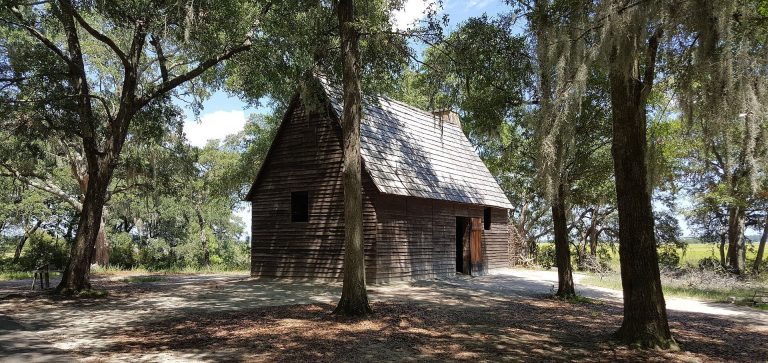
The first fort was planned as a square with bastions, projecting corner parts of a fortification. Its walls used two parallel rows of horizontal palmetto logs, a palm native to the southeastern United States. Each wall stood about 10 feet high, with logs about 20 feet long; sand filled the 16-foot space between the rows. By June 28, 1776, the southwest and southeast sides and their corner defenses were complete, while the rear walls to the north reached only about 7 feet. Raised gun positions strengthened the rear. Thirty-one guns, ranging from 9- to 25-pounders, faced the channel into Charleston Harbor. Their platforms used 2-inch planks secured with wooden pegs. A thick-plank barrier shielded the powder magazine and unfinished northern side from fire from the rear.
The later forts
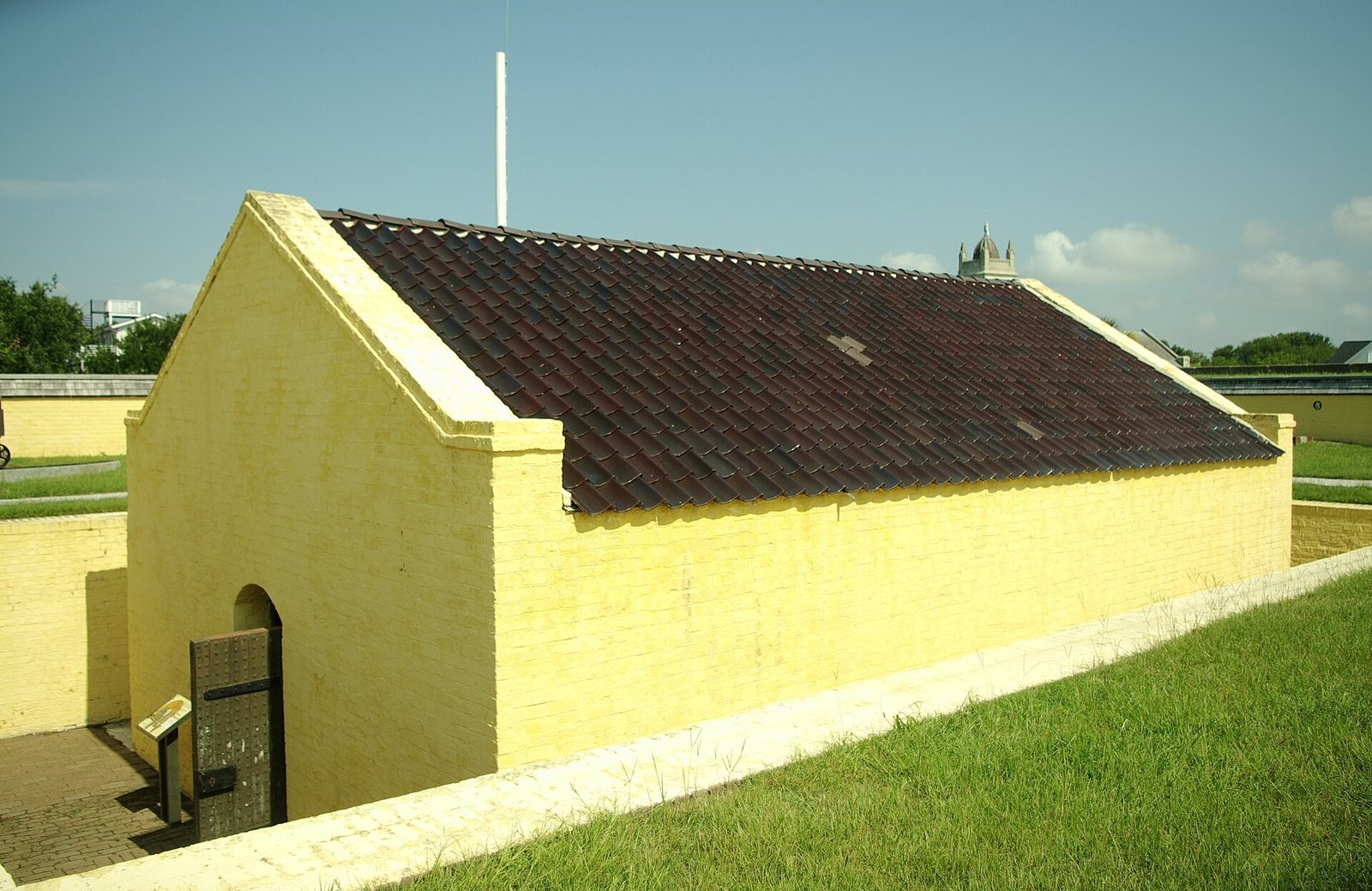
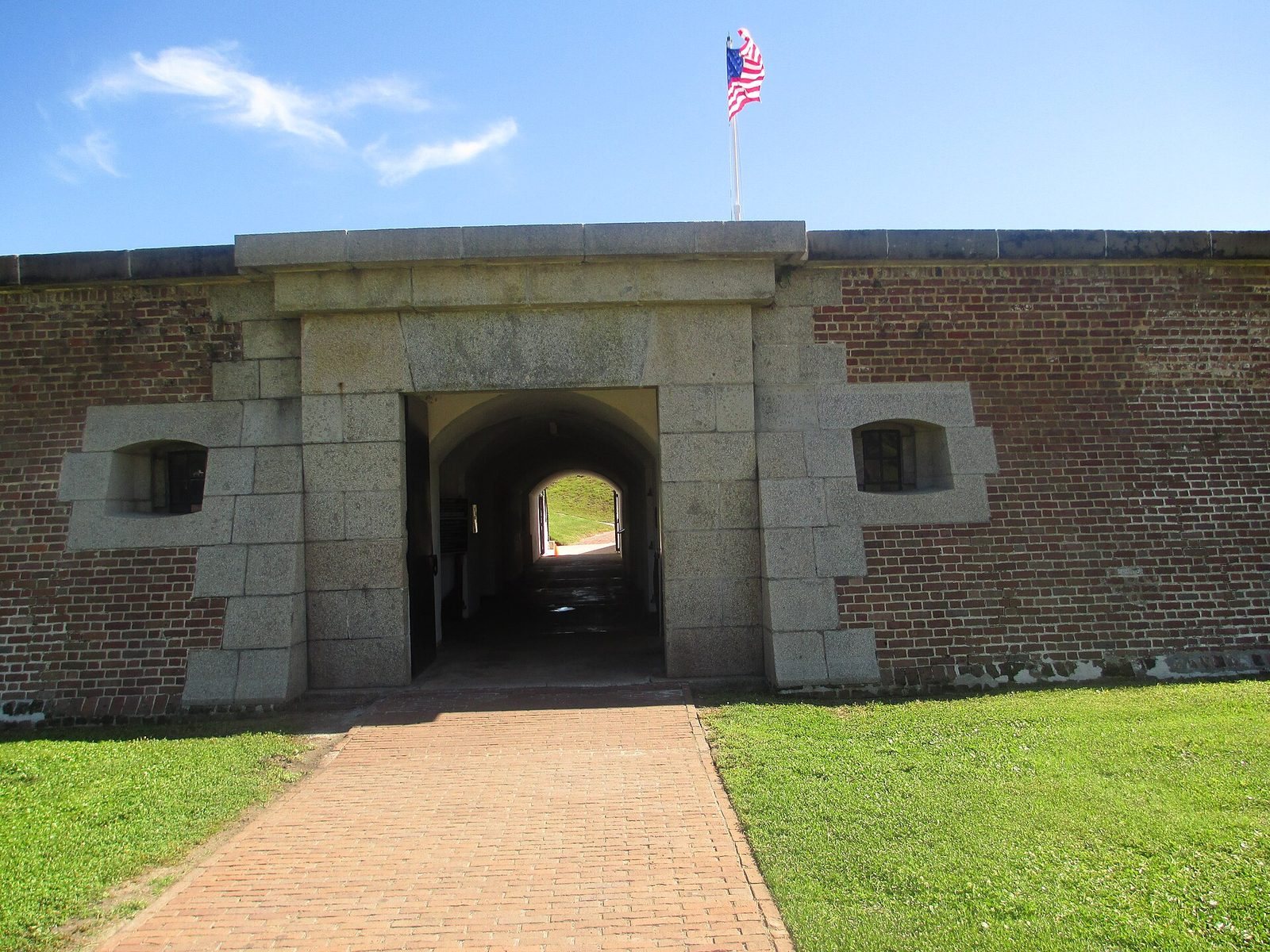
The 1798 replacement was a five-sided timber-and-earth fort, with walls about 5 metres high, built over the decayed first fort. The structure rebuilt in 1808–09 was made of brick. In 1811, its irregular plan had three sides facing the sea and two rear corner bastions. Earth banks and barriers protected its brick walls. Army improvements in the 1870s added concrete bunkers and 15-inch and 10-inch smoothbore Rodman guns, large American cannons with unrifled barrels. The fort also received 8-inch cannons with grooved barrels, adapted from 10-inch Rodman guns.
Osceola’s grave
The Army buried Osceola at the fort’s front gate in 1838 and maintained his grave there.
Endicott batteries
Capron and Butler
The reinforced-concrete Battery Capron began with 16 12-inch mortars. In 1906 it was divided into Batteries Capron and Butler, each assigned eight mortars. In 1920, eight mortars were removed and the eight remaining weapons were replaced with M1890 mortars on M1896 carriages. The change reduced crowding in the mortar positions and improved the rate of fire.
Jasper and Thomson
Batteries Jasper and Thomson together held six 10-inch disappearing guns. These weapons could be lowered behind a protective wall after firing. Two of Jasper’s four guns were removed in 1918, possibly for conversion into railway guns; guns from Fort Washington replaced them in 1919. Battery Thomson retained two 10-inch guns after most of Moultrie’s older armament was scrapped in 1942.
Logan and Bingham
Added during the Spanish-American War, the conflict between the United States and Spain, Batteries Logan and Bingham were equipped mainly with guns purchased from Britain. Logan’s 6-inch Armstrong gun was removed in 1904, probably for transfer to Fort Adams. Bingham stood on the island’s southeastern face. Its two 4.7-inch Armstrong guns were removed in 1919–20.
McCorkle, Lord, and Gadsden
Batteries McCorkle and Lord occupied the southern face. McCorkle was added in 1901 with three 3-inch guns to defend the minefield; Lord followed in 1905 with two 3-inch guns. Lord retained those two guns after the 1942 scrapping of most older weapons. Gadsden, added in 1906, held four 6-inch rapid-fire disappearing guns. They were removed in 1917 for use on field carriages on the Western Front in France and never returned. The guns reached France, but no artillery units equipped with 6-inch guns completed their training before the armistice. The batteries were named for military figures, including Allyn K. Capron, Pierce M. Butler, William Jasper, William Thomson, Christopher Gadsden, William Logan, Horatio Bingham, Henry McCorkle, and George Edwin Lord.
Second World War defenses and surviving structures
Wartime gun positions
The Marshall Military Reservation occupied the northeastern part of Sullivan’s Island. In 1941, a battery of four towed 155 mm guns was installed on concrete platforms known as Panama mounts. The long-range Battery Construction Number 520, or BCN 520, was armed with 12-inch guns removed from Battery Kimble at Fort Travis in Texas. Two fixed anti-motor-torpedo-boat positions, called AMTB 2A, were built on the former Battery Jasper. A Harbor Entrance Control Post coordinated Army and Navy defenses against threats approaching through the harbor.
Buildings and later uses
The Harbor Entrance Control Post survives as an exhibit, while BCN 520 is now a private residence. A former naval-mine storage building serves as park office space. The Fort Moultrie Quartermaster and Support Facilities Historic District lies along Middle Street and Thompson Avenue, between Stations 14 and 16.5 on Sullivan’s Island.