Château Borély: An Eighteenth-Century Country Residence in Marseille
Site at a Glance
- Country
- France
- Primary era
- Early Modern
- Eras represented
- Early Modern, Modern
- Civilizations
- French
- Site type
- Domestic
- Remains
- Elite Residence
On this page13 sections
History
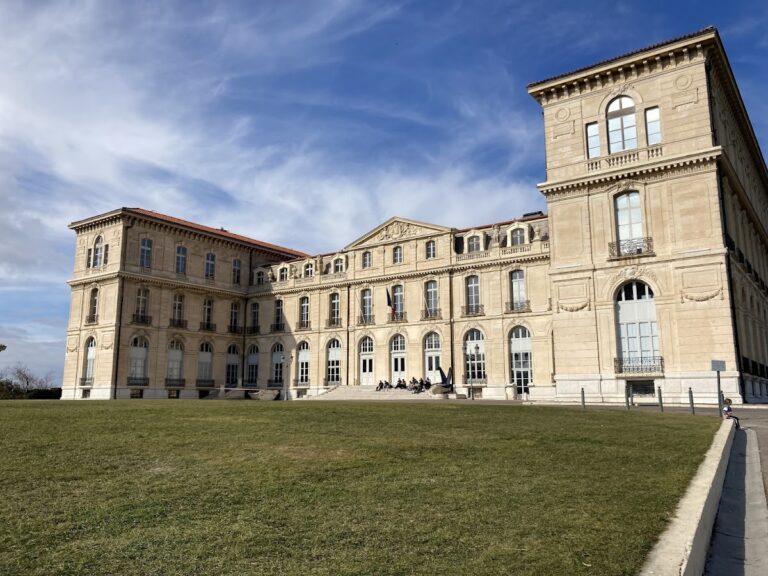
Château Borély is an eighteenth-century neoclassical residence in Marseille, France, built as a Provençal bastide, or country house within an estate. Commissioned by the Borély family, it became a public property and later a museum.
The Borély estate and construction
Joseph Borély, a member of a wealthy Marseille family involved in maritime trade, acquired a rural estate at Bonneveine on 26 June 1684. It included vineyards, meadows, gardens, trees and farm buildings. His sons Nicolas and Louis traded from Alexandria, bringing wheat, rice, silk and oil to Marseille; oil was used in soapmaking. The family gained standing in the city. François Borély became Marseille’s senior alderman, its leading municipal officer, in 1685, and Nicolas held the office in 1747 before Louis XV, king of France, ennobled him in 1753.
After returning to Marseille in 1755, Louis Borély expanded the estate through further land purchases, including La Tirane, La Michèle, La Dumone and La Valbelle in 1764. He commissioned the château as a country residence. A façade design submitted on 1 September 1767 was simplified at Louis’s request, apparently because he considered the first proposal too elaborate. Several architects are associated with the project, though their individual contributions are uncertain. Construction began in 1767 and was completed in 1778. Louis’s son and heir, Louis Joseph Denis Borély, finished the work, commissioned rich decoration by painter Louis Chaix and furnished the house. He died without children on 6 April 1784.
Inheritance and public ownership
Louis Joseph Denis’s brother Honoré inherited the estate. An honorary member of Marseille’s Academy of Painting and Sculpture, he cared for the château and expanded its library. He left during the French Revolution but later regained the property nearly intact, and died on 26 July 1804. His daughter Louise-Jeanne-Marie Borély inherited the estate. She had married Pierre Léandre de Mark-Tripoli, Count of Panisse-Passis, in 1800; her husband preserved the château and its collections and added artworks. Their son, Gaston de Panisse, later became owner.
In 1856, Gaston exchanged the château with the city of Marseille for compensation and a plot in the Chartreux area. Industrialist Paulin Talabot negotiated the agreement, which the municipal council approved. The deal came amid plans to expand the railway and port southward, but those plans were redirected and Talabot lost interest in the château. The city acquired it in 1860 and opened the grounds to the public. The estate had covered 54 hectares; its central area was developed as a 15-hectare racecourse and golf course, inaugurated on 4 November 1860, and a 17-hectare public park. Work on the park continued from 1860 to 1880, and it was inaugurated in 1864.
Museums and preservation
The château housed Marseille’s archaeological museum from 1856 until 1989, when its collections moved to the Museum of Mediterranean Archaeology at the Vieille Charité. After extensive restoration from 2009 to 2013, the building became home to the Museum of Decorative Arts, Faience and Fashion. It opened there on 15 June 2013 as part of Marseille-Provence 2013, the city’s European Capital of Culture program. The museum had previously been housed at Château Pastré. Château Borély has been protected as a French historic monument since 1936. In 2024, the remainder of the Borély estate, excluding the already protected château, was also registered for protection.
Remains
Building and estate setting
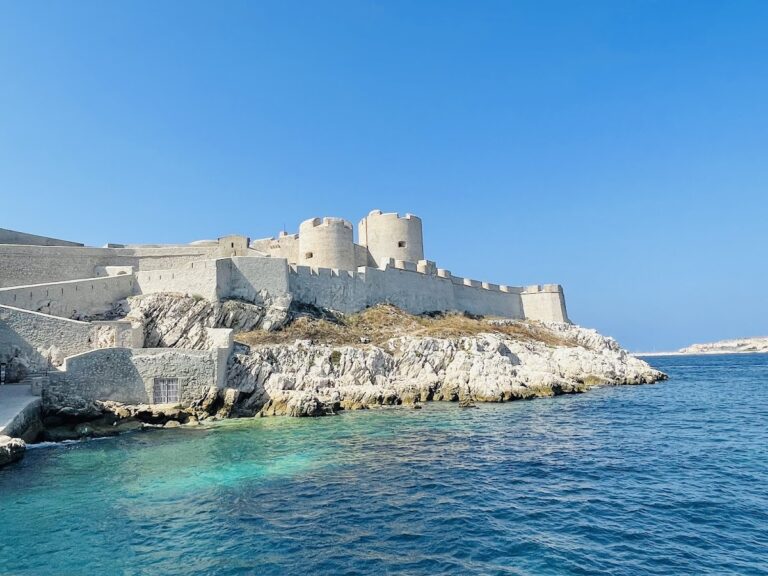
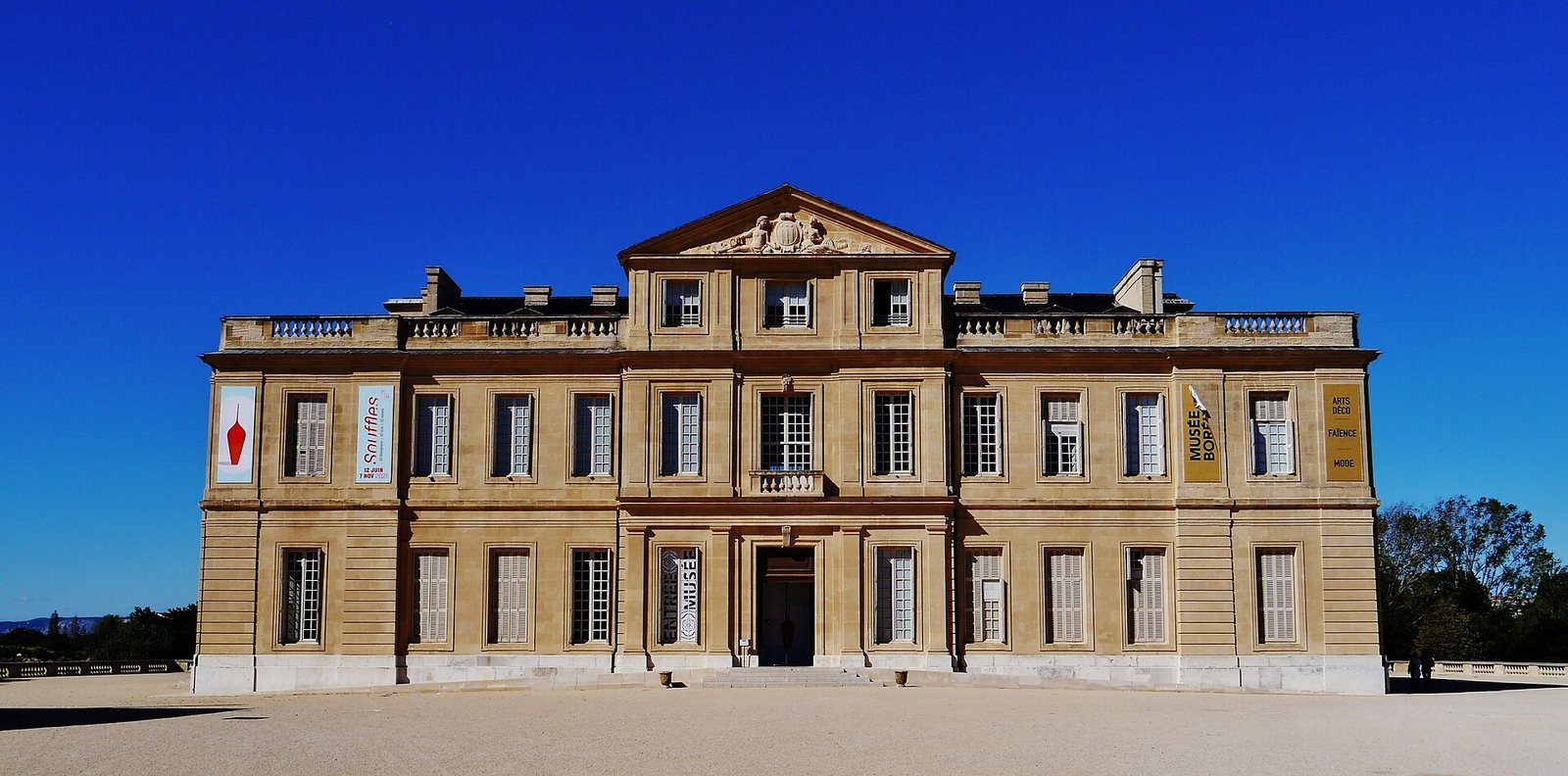
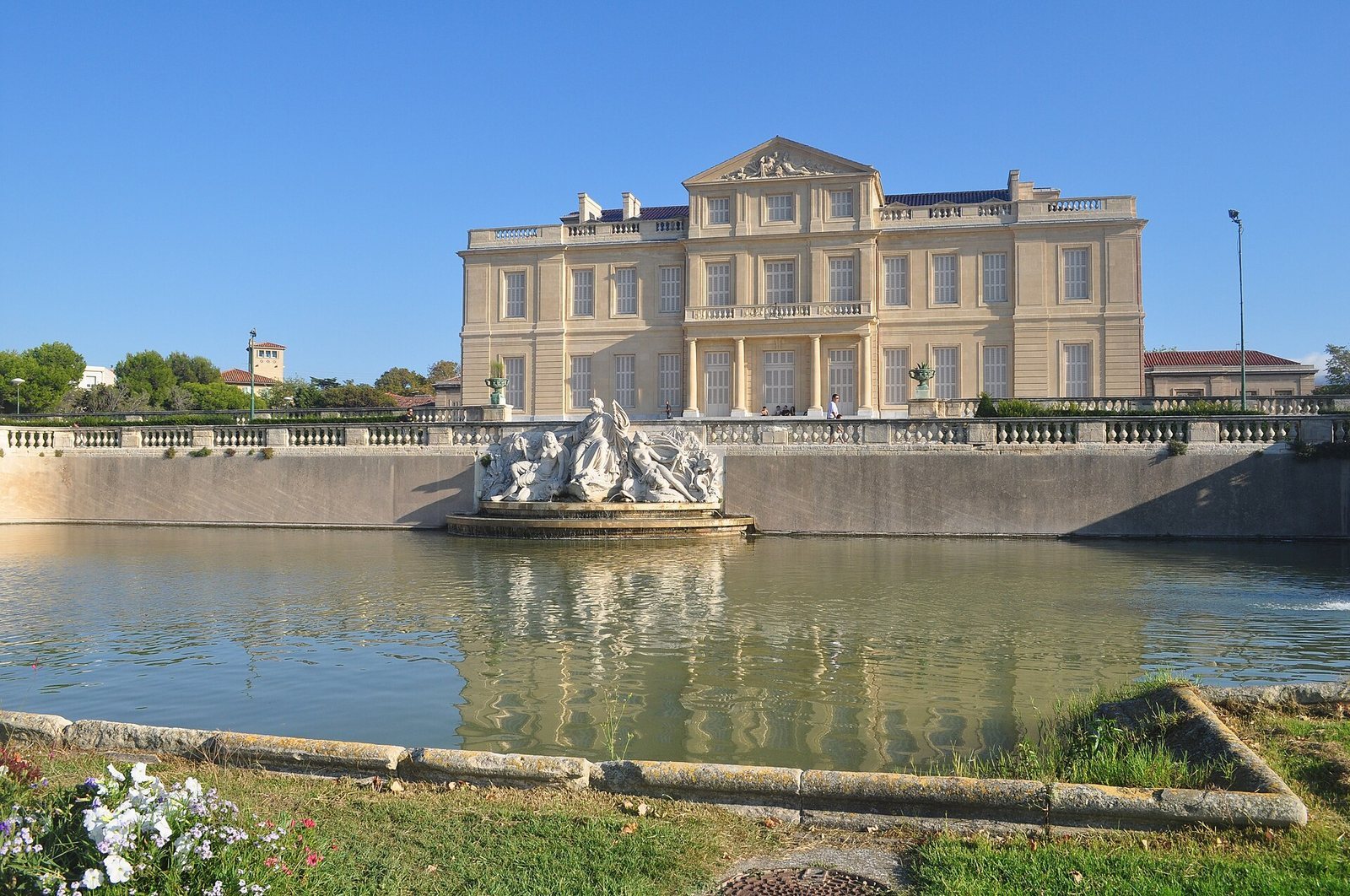
The three-storey château has a restrained neoclassical façade with a central projection. Two pavilions flank the building beside a large courtyard, while a portal stands at the rear. It lies within Parc Borély and is associated with the Marseille Borély racecourse and golf course. The original estate stood on Marseille’s coastal route, with views toward the Mediterranean, the Frioul Islands and Château d’If.
Interior decoration and collections
Decorated rooms
The interiors include the Golden Salon, a library, a bedroom and a grand staircase. Stucco, gilded wall ornament and painted decoration enrich the rooms. Mythological ceiling paintings by Louis Chaix draw inspiration from works by Guido Reni and are considered Chaix’s principal work at the château. He also made grisaille, paintings in shades of grey or another single colour. Much of the original interior decoration is displayed in the restored building.
Private chapel
The château’s oval private chapel is dedicated to Saint Louis and decorated with marble.
Ceramic displays
Marseille ceramics make up the main part of the museum’s tin-glazed earthenware collection. These works are displayed in the dining room and other rooms of the château.
Garden features
Garden basin
A basin survives as part of the French formal garden associated with the château.
Bird-catching enclosure
A planted area with rows of bushes and nets also survives in the park. It was formerly used to trap small birds, a pastime often practiced by women on large estates.